
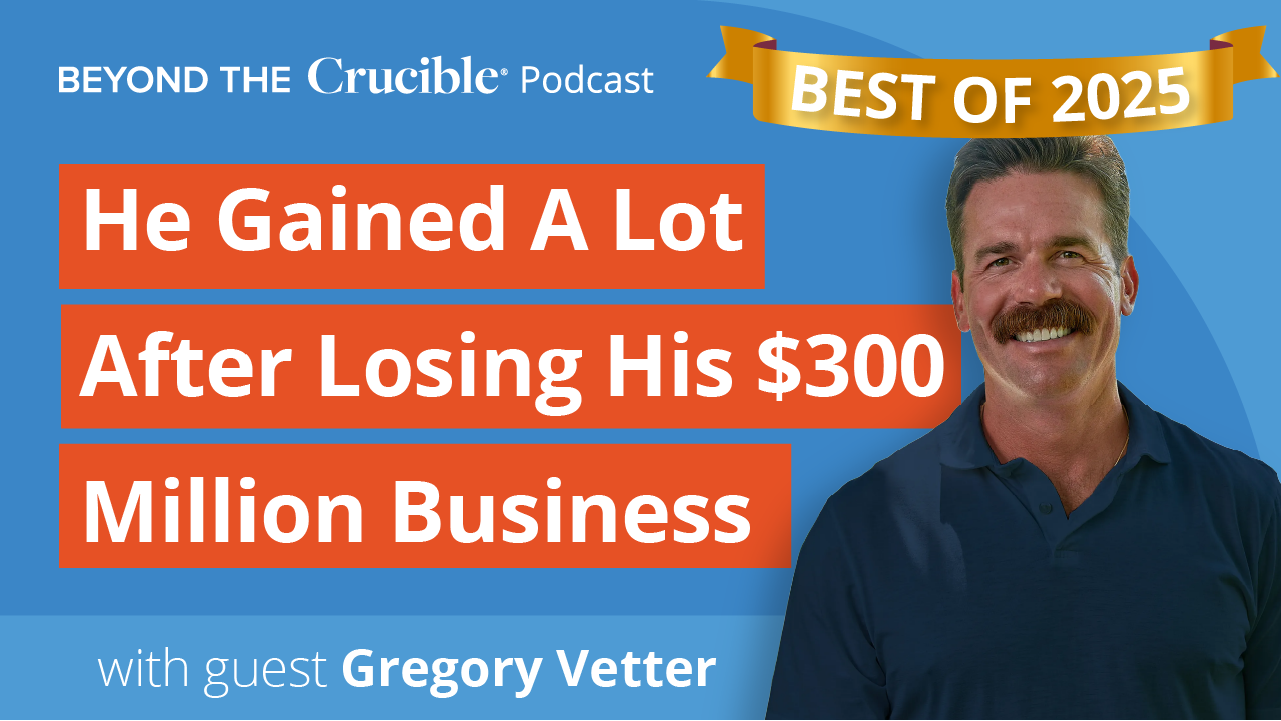
BEST OF 2025: Gregory Vetter Gained Much After Losing His $300 Million Business
BEST OF 2025:
Gregory Vetter Gained Much After Losing His $300 Million Business
Gregory Vetter describes the shock and loss he felt over losing the $300 million dollar salad dressing business he and his brothers built using their mother’s recipe.
They were forced to file for bankruptcy, he says, because of a legal battle with greedy and unscrupulous investors. He may have lost millions of dollars, but not his entrepreneurial spirit — going on to launch new businesses and help other entrepreneurs with a big idea do the same.
You’ll want to pay special attention when he tells us the lesson his crucible taught him about the four things money can’t buy.
—

Don’t forget to subscribe for more leadership and personal growth insights: https://www.youtube.com/@beyondthecrucible
Follow Beyond the Crucible on Facebook: https://www.facebook.com/beyondthecrucible
Follow Warwick on LinkedIn: https://www.linkedin.com/in/warwickfairfax/
Follow Beyond the Crucible on Instagram: https://www.instagram.com/beyondthecrucible
Take the free Trials-to-Triumphs Self-Assessment to discover where you are on your journey of moving beyond your crucible and how to chart your personal course to a life of significance: https://beyondthecrucible.com/assessment/




Transcript
Warwick Fairfax:
Welcome to Beyond the Crucible. I'm Warwick Fairfax, the founder of Beyond the Crucible.

Gregory Vetter:
It tested my belief system. It tested my faith in humanity, honestly. It made me very, very bitter for a while. It started to harden my heart.

Gary Schneeberger:
That's our guest this week, Gregory Vetter, describing how he felt in the immediate aftermath of losing the $300 million salad dressing company he and his brothers built using their mother's recipe. They were forced to file for bankruptcy, he says, because of a legal battle with greedy and unscrupulous investors. He may have lost millions of dollars, but not his entrepreneurial spirit, going on to launch new businesses and help other dreamers with a big idea do the same. You will want to pay special attention when he tells us the lesson his crucible taught him about the four things that money can't buy.

Warwick Fairfax:
Well, Greg, it's wonderful to have you here. Greg is Greg Vetter, and just to give folks a little bit of idea of his background, Greg is a trailblazing entrepreneur. He turned a family recipe into Tessemae's. Is that close?

Gregory Vetter:
Yep, close enough.

Warwick Fairfax:
Okay. Into the number one organic salad dressing brand in the U.S., and pioneered clean food manufacturing. He's gone on to found Alta Fresh Foods, revolutionizing the salad industry with innovative processes, as well as Quenchers Vodka Drinks and Tushees Portable Toilets, showcasing his diverse entrepreneurial spirit. And he's also launched homegrown brand Accelerated to help others build the next great American brands. He is committed to mentoring young leaders and entrepreneurs, empowering them to dream big and execute with purpose. Where I thought we'd get started is this whole salad dressing became this enormous business, but the way you started it I found absolutely fascinating. You have just this pure go for broke, there is no fear, or if there is fear, I'm plowing right through it kind of spirit. So just talk about where that whole recipe came from and how you got started in that first natural food store. I love the gumption you have instead of not build it and they will come. It's like sell it and then let's build it later, kind of thing.

Gregory Vetter:
That's actually the entire philosophy. Yeah, I was selling insurance and sitting in a cubicle over top of a bodega with our scenery being a graveyard, and I'm not making that up. And I actually ended up being good at cold calling all day. I was kind of very disciplined. I could sit there and just grind through the pain. And so I went to the owner and I said, "Hey, man, I brought in three of the top five largest customers. I want to be a partner." And before I got the word partner out, he was like, "No, you make enough money. You're young. You're never going to be a partner in this. And that's that." And in that moment I realized I was not in control over my destiny, I guess you could say. And I wanted to be.

And so every day at lunch, I would go home in my little townhouse and I'd stand on my head with a journal next to me waiting for an epiphany. And they didn't come. But afterwards I'd walk downstairs, I'd make myself a big salad with protein on it, and my mom would make me this one salad dressing in a two liter bottle. It would last about a month. And I would put dressing on it and I'd go back to work and I'd cold call all day. And so one day I walked downstairs and this two liter bottle of salad dressing's missing. And you do not misplace a two liter bottle of salad dressing. And so I'm looking all over, I'm opening every cabinet, every drawer is open, and then I'm like, "Oh, man, I got to call my wife. I cannot find this." And so I call my wife, I'm like, "Hey, did you take the salad dressing to work?" She goes, "No, I didn't take a two liter bottle of salad dressing to work."

And I'm like, "I cannot find it anywhere." And she's like, "Well, maybe someone came into our house and took it." I'm like, "No one broke into our home and stole the salad dress." And she goes, "Well, I don't know what to tell you, Greg." So she hangs up. So I call some people and I get to a guy that doesn't have a full-time job, and I said, "Hey, man, random question. Have you seen my salad dressing?" Everybody prior to this point had said no and hung up. And he goes, "Yep, woke up this morning, was Jonesing for it, knew the code to your house, hopped on my scooter, came over, took it. Now I'm crushing a salad."

And I sat there in the kitchen of my little townhouse and I thought to myself, what kind of man steals another man's salad dressing? And then I thought, what kind of salad dressing is so good that someone would break into my house and steal it? And so I told him to bring it back. And then I called my wife back and I'm like, "Hey, so you were right. So-and-so broke in and stole the dressing." And so then I sat there for a minute and I'm like, "I'm going to start a salad dressing company." And so I said that as a pressure test to my wife to see her reaction, I'm going to quit my job and I'm going to start a salad dressing company. Dead silence. And she goes, "That's the best idea I've ever heard. I have a weird feeling that it's going to work." And so I go, "Okay."

So I took the only business skill I had, which was cold calling, and I started cold calling grocery stores and I was just going to see if I could get a meeting. And I was just focused on, I'm going to get an educated yes or no. I don't know what it's going to be, but I'm just going to call until I get an educated yes or no. And so for about two weeks, all I got were nos. But being a quote-unquote expert at cold calling, you know when it's an educated yes or it's an educated no. And so everybody just kind of picked up and they're like, "Yeah, we're not interested." And I'm like, "They didn't even ask any questions. I'm going to keep going until I get an educated no." And this one guy goes, "Bring it in today," which was a Friday in February, "and let me try it."

So I call my mom and I go, "Hey, I need you to make the greatest batch of salad dressing ever made." And she's like, "Why?" I go, "I got a meeting at this grocery store." And she goes, "For what?" And I'm like, "I'm going to bring it in there. I'm going to start a salad dressing, I'm going to take your recipe. We're going to go into business together." She goes, "You're not a company. There's no name, there's no bottle. You have nothing." I'm like, "I didn't ask you for any of this. I just need you to make the dressing. I'll take care of the rest." So she makes the dressing, I stop by her house. She goes, what are you going to put it in? And I'm like, "Give me a Tupperware container." So I take some crunchy romaine lettuce, I put it in a little Tupperware container with a red lid, and I marched myself into this grocery store and I ask for this guy and he comes up and he looks like a former professional boxer. He does not look like a guy that's buying organic salad dressing.

And he's like, "Show me your stuff." And I'm like, "Ooh." So I hold this little Tupperware container up. I'm like, "I brought you a salad. It's lunchtime." So he takes this piece of wet lettuce out of this little Tupperware container, licks the dressing off and goes, "That's the greatest salad dressing I've ever had. You need to call the regional office." And I go, "Well, why don't you call the regional office and I'll show up to the meeting." So they ended up giving me 200 pages of food manufacturing paperwork, and they said, "Fill this out and you can be in for the grand opening of this new store in Annapolis, May 5th, 2009."

And so I take the papers home and I look at the first page and it's a different language. I have no idea what they're asking me. So I start Googling, "What is a HACCP plan? What is a HACCP plan for salad dressing?" And so I'm literally just printing these documents off the internet, this is before AI could just do it in two seconds, and I'm sending this grocery store these documents. And so we ended up overcoming a million hurdles to be a food manufacturer. And we get in for the grand opening of this grocery store, and I got an apron that's embroidered, and I got my little table and samples and recipe cards. And the doors open and people are running into this grocery store. I've never seen people so excited for a new grocery store before in my life.

And the next thing I know, the four cases that they ordered were sold. So I go to the director of the East Coast and I go, "Hey man, all that dressing's gone." He goes, "There's more in the back." I'm like, "No, I sold it." And he goes, "You sold four cases of dressing in 30 minutes?" And I'm like, "Yeah." And he goes, "Well, go get more." I'm like, "I got to go make more. You said this was a month." And so I run outside, I call my mom, I'm like, "We got to make more salad dressing!" And she's like, "I'm in Pilates." I'm like, "No one cares about Pilates." And she hung up on me.

So then I called my wife. I'm like, "We sold all four cases. It's unbelievable." And so next day, same thing happened. We ended up making six cases that night. I stayed up till 3:00 o'clock in the morning making salad dressing. And sold the next six cases in 45 minutes. And in that five-day period, we set a national sales record for that grocery store, and we ended up selling 650 bottles of one dressing in one store in five days. And so that was really my pressure test of people like this, I bet I could build this to something bigger. I'm not sure how big, but I'm willing to bet everything on the journey. And so that is when the journey began, which was May 5th, 2009.

Warwick Fairfax:
I mean, it's just so amazing how, I guess it's maybe not resilience yet, but it's courage and gumption. I mean, you were like, "Where are we going to make this?" And you found a couple of different places initially, the back of a barbecue place, and then middle of the night at a bakery. I mean, and eventually you got a warehouse near Baltimore. But it's like friends, your brothers, friends or friends, anybody you could find. I mean, that was just, and even when people said no, some of these folks that had locations, we had to make stuff, it was like, you thought to yourself, it may be no now, but I can get you the yes. And they said yes. I mean, the courage it took in those early days. Well, the whole journey is ... I know it's easy to look back at some of the bad side, which we'll get to, but if you look back and said, "I had a lot of courage, a lot of guts that not everybody has." I mean, are you able to give yourself your fair due of some of the courage and gumption that you had?

Gregory Vetter:
Yeah, I mean, I think I honestly had to brainwash myself, right? Because you have to ignore every social norm that you've been taught up to that point to build something from nothing. Because everybody says no. Nobody wants to be bothered with your problems. No one cares about your problems. And so you're just nonstop trying to find a way to appeal to their humanity so that they will stop what they're doing and take a chance on you. And so that was really the theme in the beginning, which was we almost didn't get our manufacturing license because a shelf was a half inch too low and the guy was going to deny our manufacturing license. And I grabbed him, I'm like, "Listen, man, everything is on the line. I need you to do this for me." And he was just like, "Whoa, dude. I've never seen someone who's this crazy about salad."

Sure. Because my day, I don't care whether or not you pass or fail, but you really care. And so there was a lot of that in the beginning, and that kind of ended up running out. I think maybe we used up all of our miracles for that journey. By the end, everybody was kind of like, "Dude, we've given you all the miracles we can give." And so yeah, it was a lot of breaking social norms and really just burning the ships. I mean, we're either going to win this battle or we're not going home. And that was really the view we took. And I think when you take that view, generally speaking, the universe conspires in your favor.

Warwick Fairfax:
Yeah, it's almost like, I forget the exact quote, but the Teddy Roosevelt quote that talks about the man in the arena that's willing to try and go for it. And very much that philosophy. And you grew tremendously with nationwide chains and one in California. And there were problems, but you just overcame them. We need to seal these salad dressing bottles. Well, how do we do that? Well, let's use wax from Maker's Mark liquor and stuff. And incredibly, they have a patent on that wax and they said, "Sure. You're not a competitor, obviously. You can use our wax." Which is like ... There's so many ... So talk a bit about before we get to the challenging years, you grew tremendously. It's almost like the biggest challenge you had was how can we keep up with manufacturing, with personnel, with financing? It's almost like you didn't have a problem that nobody wanted it. The problem you had is everybody wanted it. I mean, that growth must've been heady days and just one chain after another, it's like, "Are you kidding me? How many stores is this?" It's like, wow, it must've been quite a trip, if you will.

Gregory Vetter:
It was very wild. And we were also, I think a big part of the issue was we were three years ahead of the organic clean food movement. We really spearheaded that entire movement. We were just banging down doors to get people to bring stuff in. Whereas years later, all you had to say was, "Oh, yeah, it's organic and it's clean," and everybody's bringing it in and in mass truckloads. But in the beginning, nobody believed that organic salad dressing was going to be able to be a thing. And I kept thinking about rap music in the eighties and early nineties where everyone just kept going, "Well, it's just a trend. It's going to go away." And organic foods, you're like, "It tastes good and it's better for you. Why would anybody go back to something that doesn't taste as good and isn't good for you?" And those were the conversations we're having with people. But yeah, I mean, it was a Herculean effort in the beginning to match manufacturing capacity with sales demand. And it was always a tightrope where we were getting these national retailers on board and then we had to figure out how to deliver it with zero time to plan.

Warwick Fairfax:
So let's get to maybe some of the more challenging years. It seems like that growth in manufacturing required financing. Just talk about how the financing felt like it was so difficult to, A, find, and then find people that you didn't have a queasy feeling in your stomach.

Gregory Vetter:
Yeah, I mean, I think the interesting part is people are willing to bet on you if they can basically take over everything. And so we were always trying to find this balance of protecting our original shareholders that believed in us with bringing in the right capital to then take the brand to where it could be. And I think because we were so early in the organic clean food movement, when people started finally saying yes, we were just so excited that someone finally saw what we had been screaming from the rooftops for for years. And so it was less about us being selective and it was more us just being grateful that somebody finally kind of believed what we had been saying and saw the data and saw the future and wanted to participate. So we really were not as selective as we should have been. For example, let's use AIs as an example. I'm sure you go in, you've got some situation and a patent and you've got this and that and this and that, and you can look at the top tier people and you have them competing against each other and you put yourself in the best situation possible. We were always being told this isn't going to work. This doesn't scale. There's never been a lifestyle brand for salad dressing. Who cares about salad dressing? And so not until after we would close these massive deals, would we then take the data points back to these people and say, "Well, look, we just got another 2,600 doors. We got another 3,500 doors. We got this and we got that."

And in not being as selective as we should have been, you start letting in people that have ulterior motives to what they originally said. And you fast-forward a couple years and the next thing you know you're paying professional negotiators to come to an agreement because everybody just wanted to take the entire thing. And so that part obviously was very tough to process because there was so much value there for everybody. And all that needed to happen was just everybody come to an agreement on the path forward and let's get it done and everybody rides off into the sunset. And that's not always how it goes, specifically for us. And so a lot of insane lessons learned, enough to write a book about, enough to be giving keynotes and lecturing to business departments across the country on the lessons learned. So a lot of wild stories there for sure.

Warwick Fairfax:
So talk about how things kind of ended up at the end, because it feels like you had these two billionaires and there's a whole host of characters in the book even before that, of just the LA young guns and there's Ryan, somebody, there's all these people with colorful names, but it just seems like at the end, it wasn't about common sense, even wasn't about what was in their best interest, it was about winning to a degree, maybe crushing you, crushing the other guy. It's a lesson in that sometimes people, not only are they not just cutthroat, but they don't always act in their own interests. It just, it's win at all costs, greed at all costs. If we have to pay the lawyers hundreds of thousands a month, who cares? It's all about winning. It's not about money. I mean, that was powerful lessons, I'm sure, right?

Gregory Vetter:
Well, and it went against rational thought, because you're sitting there at the end and you're like, "We can all come to an agreement. We can all do this. Everybody's willing to play ball." And we would spend six weeks ironing out some type of deal where it worked for everybody and the board would get on the phone, they go, "We got it. It's good. I know this is going to suck for you, Greg, but it's not as good for them too, but we're all going to move forward together. And here it is moving forward." And the lawyers would send over the documents and it was nothing that was discussed or negotiated. And so then you really start thinking about, okay, well, what are the motives? To understand a person, you need to understand their motives. And it really just came down to unbelievable greed, almost like an addiction, ego to the point of addiction, but then also the need for complete destruction of their opponent. And that was the part that went against what I thought their motives were, which were kind of greed and ego, because then you layered in the destruction part and you're like, but you're going to get the greed side, that'll be satisfied, your ego component will be satisfied, but destroying me and my family, we're going to part ways and part of us will be destroyed, but it wasn't the complete destruction they were looking for. And that was the part where it gave me a completely different insight into human behavior that I didn't know at the time.

Warwick Fairfax:
I mean, the fact that their desire to destroy was greater than their desire for greed?

Gregory Vetter:
Right.

Warwick Fairfax:
I mean, the story you tell, there's a lot of stories, but the one in the parking lot when I guess as you put it, [inaudible 00:24:04] has this document, he makes you sign this template, say, "Look, it doesn't really mean a whole lot. We just need something."

Gregory Vetter:
A start.

Warwick Fairfax:
Right. And then later on, so that's not a starting point, that's the finish. So they lied. I mean, obviously that happens a lot. So obviously you're in a position where you don't have a whole lot of choices, the salad dressing market isn't what it is now, and organic, but dealing with people that you can't trust, I mean that felt like that was almost the apex of, "Are you kidding me?" moments in the book. I mean, it's one thing to play hard. I mean, you and your brothers played lacrosse, which is massive in Maryland, certainly in Annapolis. You play hard, you want to win, but it's like you play by a set of rules and you know what they are: play hard but play fair. Really? But here it's like it's all about winning. If you have to lie, cheat, steal, hey, whatever it takes. I mean, that must've been sobering to say the least, those kind of moments.

Gregory Vetter:
Again, it tested my belief system. It tested my faith in humanity, honestly. It made me very, very bitter for a while. It started to harden my heart because I had always tried to do what was right for the entire shareholder base, which included all the employees because we gave them all stock. And so when you're dealing with people that don't care about any of that and they don't care about the repercussions from a karma perspective, you're dealing with a different animal. And again, I thought people had some level of decency, right? Like, okay, I can get the greed side. My ego's fulfilled. I don't need to destroy this dude and his family. I know him. I've invited him to my Christmas parties. But no. Again, it was something I've never experienced before. And leaving that and reflecting on that, that took me a long time to really process because it really just made me question humanity for the most part.

Warwick Fairfax:
So let's talk about how you got over that. Because in the book, you start in a very haunting way. Obviously you talk how there was a $300 million business that was valued and sold bankruptcy for 4.5 million, which seemed like a fair amount of money, but relative to 300 million, it's not much. It's a small, small percentage. And you talk about having in your farm in western Maryland, stacking wooden pallets and having a bonfire almost back to the Viking ship thing with the ritual. It's horrendous, it's sad, but we're going to have some kind of ritual to kind of mark this time to even say Tessemae's all-natural would go out like a Viking. You actually say that. "I decide on a funeral pyre fit for a battle-scarred warrior." So how did you come back from being, I mean, it's one thing to be battle-scarred, which obviously you are, I get that and I can certainly relate in many ways, but how did you find a way not to be bitter and angry? You could have been angry at God, who's ever up there, at not just these billionaires, but there were stacks of people after them. There was the investment bank that gave you the B team, I think you wrote, and let's do the financing road show in the summer, which is the worst time to do it because everybody's ... having done one of those myself, I get it. So there's a list of people you could feel like let you down. So how did you deal with the sense of bitterness at both at other people, the world, God, gosh, if we'd been five or 10 years later, we would've killed it. I mean, how do you process all that so it didn't just sit there forever?

Gregory Vetter:
A couple things. I started writing the book. I hired a performance coach. He said something really funny one time. He goes, "Are these stories real?" And I'm like, "Yeah." And he goes, "Listen man, I spend 99% of my time convincing my clients to not write books because they have nothing interesting to say and it's purely an ego play. I think you need to write a book." And I said, "No, I don't want to write a book about the greatest failure of my life and how stupid I was for 15 years." But he planted a seed in my brain and my leadership philosophy kind of boils down to leave things better than when you found them and lead by example. And so at a minimum, I wanted to document the journey for my kids. I have four kids, they range in age right now from a freshman in high school down to a nine-year-old, and I just wanted them to know how hard it was and what I was willing to do to fight for my dream, because I think every parent wants their kids to fight for a dream no matter what the dream is. And so I went to this kind of men's group on Friday mornings, and these guys were talking about forgiving your enemies. And I was really just not on board with that. But then I kept going every Friday and I started thinking about it, and it really helped me to ... there's a difference that these guys were talking about, which is forgiveness, which is in your heart, and reconciliation, which is with another person. So it requires another person to forgive you as well as you forgive them. So I got to the point where I go, "Yeah, you know what? I'm willing to forgive these people in my heart." Because having that much bitterness and that much anger is not going to help anybody or anything moving forward.

Gary Schneeberger:
And that's one of the things that we talk about a lot at Beyond the Crucible is that forgiveness is key, because Warwick said it, if he said it once, he said it a hundred times on this show, if you don't forgive, it's like just drinking poison, right? I mean, it's going to affect you more than it affects the other person. They're not really going to care necessarily. They may not even know that you've forgiven them, but that frees you up from the cell, that unforgiveness, from the cell that bitterness can create in you.

Gregory Vetter:
I can forgive somebody in my heart, but it doesn't require the reconciliation with another person because it really comes down to an alignment with me and God. And that took probably a year to get to. If you ever talk to the guys from that group, they joke all the time of me talking about like, yeah, man, I'm cool with all this stuff you guys are talking about except for forgiving your enemies. I am not okay with that. I eventually got there.

Warwick Fairfax:
Yeah, just as you've been talking, even though, as Gary would say, the products, the numbers, the countries are different, I can relate. And our personalities couldn't be more different. I'm not an entrepreneur at all. I could never do what you did. I don't have that kind of gumption in that area. I've got a fair amount of perseverance, but not that kind of gumption. But yeah, I mean, just like you, I wrote my book Crucible Leadership, I guess '22 it came out, took years to do it. Like you, it was incredibly painful because I was writing about some of the toughest times of my life and some of the stupidest mistakes I made. And one of the things that we say a lot on Beyond the Crucible is forgiveness doesn't mean condoning. Forgiving those two billionaires along with a whole host of others doesn't mean that you approve how they do business. You abhor and condemn how they do business, putting words in your mouth, not something that you would model or want your kid's doing. Put it that way.

Gregory Vetter:
Yeah.

Gary Schneeberger:
Let me jump in. I've hosted this show with you, Warwick, for 270-something, 280 episodes. This is the first time we've had a guest who has something approximating your story. And I'm just wondering, Greg, I imagine you don't run into a lot of people who have a story like yours and the way it's like yours down to the point that you were 25 and he was 26. I mean, how helpful is that? And I think about that across anybody who has a crucible. How helpful is it just to hear someone who's got your experience someplace? Warwick has talked before about he felt in the aftermath of the failed takeover, he felt like he was a party of one. You must have felt like that a little bit too. Is it helpful to hear somebody else who's been through some of the same beats of a story like yours?

Gregory Vetter:
Yeah, I mean, it's always helpful because I think I've always felt alone and all of the alleged consultants and advisors and experts at every phase and at every stage, I remember I went to this one performance coach in the middle of it, and he's former Army Ranger and PhD and worked with all these pro athletes, and he's so elite. He's not my current performance coach, but I went to him and I tell him the whole story and I have to pay ahead of time to get into his room. And at the end he just goes, "Oh my God. It's like you're fighting three different wars at the same time with three different weapons simultaneously. I wish you nothing but the best." And then that was it. And I'm like, "Any advice, man? Because I feel like I'm drowning." And he's like, "Good luck. Good luck to you. I don't really have any insights on that one at all."

So that is the theme. The theme is everybody talks a big game, but the amount of people that can actually sit there and empathize and provide credible insight and understanding and actually listen, to provide meaningful counsel, it is so rare I cannot begin to describe it to you. And I get all these thank you notes for my book, and it's all these entrepreneurs, they go, "Man, thank you so much for writing this because I felt alone. Because when you go on LinkedIn or you go on YouTube or you go on Instagram and you hear all these business experts, it's pay for my program and these four things will make you a billionaire and these systems will skyrocket your business, and this will do that, and this will do that. And I just feel like I'm an idiot all the time."

And so it is a very kind of rare select group of people that have endured the complete destruction of their belief system and then found a way at the end of it to pick themselves up, move forward, make the best out of it, and then even have the wherewithal to come back and try and help others. Because I can tell you, I was doing an interview with this venture capitalist and she said, "Thank you so much for your honesty because I have people on here all the time that I know have failed, and they will answer my questions and blatantly lie to my face knowing that I know because they don't want to be associated with any of the weak components of their life."

And I just don't really know what that gets you. I don't get it. I don't understand it. It's not how I parent my kids. Because life's tough and nobody bats a thousand. And these stories are important for the simple fact that someone's going to listen to it and they're going to go, "Man, I'm going through something similar. One, I'm not alone. I'm going to do some more research into these guys. Maybe their stories can provide me that one little kernel of hope or insight or advice to allow me to move forward one step the next day." Because it doesn't end. We're dealing with something similar right now with one of our businesses, not investor-related, but employee-related. And Gary, I told you when we were chatting, it was like rock bottom has a basement.

Warwick Fairfax:
Right. And that has a sub-basement, right?

Gregory Vetter:
And you're like, wow, this is as low as it gets. And then the next day you're like, whoa, it's getting lower. I thought I was there. And then the next day, you're a little bit lower and you're like, "Man, okay, well, I thought I already experienced all of this." And it's like, no, you haven't. You've only experienced one component of it.

Warwick Fairfax:
"Hey, we're going to give five minute talk to a bunch of people talking about resilience and what they've learned in business." And I said, "Well, you know my story?" And yeah, sure, and people said, "Warwick, we never knew. I was going through some of the stresses during business school because my dad dying and the expectations that we never knew, I'm so sorry." And there was empathy. I was like, but of course the lies in my head was like, oh, they're going to laugh. The dumbest Harvard MBA graduate in history, Warwick Fairfax, because if you Google me, it's actually there. And Wikipedia. So talk about how you did not let your worst day define you. You found a way to bounce back and help people.

Gregory Vetter:
Well, I think the four things money can't buy: your soul, your health, your time, and your children's love. When all of your transactional friends leave you and when all of your material possessions have no more meaning to you, you're left with the things that really matter. And every time I've ever gone through something horrible, I basically have stripped more and more and more away to get down to this core me. The St. John of the Cross has a book The Dark Night of the Soul, and there's a two-part purification process. And I have gone through it. And what you find is that really actually in the most fundamental sense of reality, there is nothing more than your capacity to be loved by your kids and love them and lead by example, to be in control over your time and your health. But then the soul component is something that that's the one that takes a lot of daily work because a lot creeps in day in and day out where you think about getting back at the people that have destroyed you, or can you still maintain the forgiveness of your enemies, or are you still leading by example? Are you still a person that is in pursuit of living this life that you're proud of? And so the shame component is real, but it's personal.

The thing that I realize is when all of your fears are realized, you understand there's nothing to lose and you actually understand what you're made of. All of my fears were exposed. They were all written in newspaper articles and everybody knows that we lost the business and there was no exit. And so it really, again, in that refinement process of the four things that money can't buy, it made me understand what I was willing to sacrifice and what I wasn't willing to sacrifice in this life for the pursuit of alleged ambition or the grand cosmic plans that God has for me or doesn't have for me. So there is a lot of continued soul-searching on a daily basis to make sure that I'm hearing the voice of God and that I am doing what I'm supposed to be doing, even though sometimes I feel like I'm on hold. "Hey, are you there, man? I need some answers, brother." So, yeah.

Warwick Fairfax:
You've learned some powerful lessons that you can be with your kids. So just talk about what that means to you because like you, you probably have your bad days and read an article and, "Oh, yeah, I could have been ... look at what I could have done and what an idiot I was."

Gregory Vetter:
I was talking to somebody and they're like, yeah, I sold my business for this, and I'm like, "I was right there."

Warwick Fairfax:
I have that house.

Gregory Vetter:
"I was right there."

Warwick Fairfax:
I have that house in the Caribbean, man, that huge boat. We just love going in the Mediterranean. It's just such a fun thing with the family and friends.

Gregory Vetter:
Exactly. South of France. No biggie. I'm like, okay. Yeah. But I think I realized once we won Inc. Magazine's Entrepreneur of the Year, I don't know what year that was, it was kind of like in the early days, I thought that was going to be a defining moment for the trajectory of our business and me specifically, and nothing happened from it. Nothing. I think we got more cold calls for copiers and everybody trying to sell something under the sun, but no one was like, "Hey, man, you're awesome and we want you on this board. You took salad dressing and ..." And nothing happened. And we went to the party in New York and it was a soulless event without any positive real connection or energy. It was kind of like a bunch of people walking around trying to figure out who's who and how can they benefit me or not me.

And I think that was the first time where I'm like, I really need to make sure that I'm not getting sucked up in this nonsense. Now, I was not that wise at that point so it's still much more bad decisions came after that. But as I look back on it, that was my first real taste of, yeah, we won the things, we were at the parties. It means nothing. It really means nothing. And the only thing that actually matters is how much my kids want to be around me and love me and tell me their secrets and want my opinion on things and want me to coach their teams and want me to take them to wherever. And I've seen a lot of people sacrifice that, the children's love side of it, justify not being around for this other stuff that doesn't mean anything. It will never mean anything.

Warwick Fairfax:
So just as we begin to close, talk about what you do now, because it must be very fulfilling as you're speaking, talking to young entrepreneurs, giving your hard-earned wisdom. There's that oft-used phrase, pain for a purpose. But I've certainly found when I've spoken, podcasting and other things, when I feel like somehow what I went through can help other people, it doesn't make all the pain go away, but it helps a bit.

Gregory Vetter:
It does.

Warwick Fairfax:
Not that that's necessarily the reason you do it, but talk about how fulfilling it is to use your hard-earned wisdom to help young entrepreneurs and other folks and just talk about what that feels like and what your mission is now, would you say?

Gregory Vetter:
Well, one, it feels great to help people. And it doesn't matter how you're helping them, whether or not you're coaching kids, which I do a lot of that because it brings me unbelievable amounts of joy, or speaking to entrepreneurial kind of incubators, regardless of the age, business departments, talking to them about risk and scale and risking it all and age. Real quick, I had somebody call and they're like, "Hey, I'm planning and I'm really worried about where I'm going to be at 25." And I go, "Hey, bud, you should be really ... like you're 20 now. I would say, where am I going to be at 45 or 50? What does that look like? Not where are you going to be at 25, because that means nothing." But trying to bring that youthful perspective to that group of people, it's super rewarding because, again, I have an unbelievable, relatable story. I'm not a genius. I didn't invent anything. I took my mom's recipe, everybody has a mom with a recipe, and I decided to risk it all, came from no money, credit cards and 401(k)s and crazy loans, and I just was willing to do it.

And so I think a lot of people can relate to that, and it gives me a lot of ... it's a new-found sense of purpose where people need to make things. People need to take risk, people need to be okay with ... I don't want people to fail. I didn't want to fail, but I learned an unbelievable amount about myself in the failure process. I figured out who I was, I figured out what mattered, I figured out what I was capable of, and I figured out what I wanted to do moving forward because I didn't have to keep up a facade to people that didn't really matter. So I just think that giving back is magnificent for me personally. And then what I'm doing now is I have a brand accelerator where we help people launch and scale companies, I do a lot of consulting work that ranges where CEO performance coach type stuff to product consulting to just helping people in turnaround situations, because I've been through a lot of wild stuff. And I really do enjoy that because I give them the insights I needed people to give me that they wouldn't give me. I was searching for answers and everybody's like, you're talking to your lawyers and they're just like, "Yeah, well, it's whatever you want to do." I'm like, "No, I need the answer here. It's not what I want to do. I need to know the right answer." Well, I've never been in this situation before, and you're just like, "Help me, please." So I love that part of it.

And then I also love exposing my kids to it all. I bring them to a lot of my speaking engagements. I bring them to a lot of the events and the book tour stuff. And so anything I can do where I'm bringing them, I bring them. And so that's been really rewarding for them to be able to be a part of it because they're at an age where they can really understand it.

Gary Schneeberger:
This is a good time for me to jump in, Greg, since you've just talked about all the things that you're doing now and the benefits that you're bringing to other people, for you to tell our listeners and viewers how they can find you on the internet and perhaps engage with you.

Gregory Vetter:
Yep. Gregoryvetter.com is my website. And then I'm on social media. I'm on Instagram, I'm on TikTok, I'm on LinkedIn. Just look for the aggressive loud guy with a mustache and that's me. So I have a team that responds to everybody or I respond. So if somebody wants to get to me, they will.

Gary Schneeberger:
Awesome. Warwick, as always, the last question or questions are yours.

Warwick Fairfax:
So really a couple come to mind. One is, there may be somebody today that maybe today is their worst day. And, of course, as you would say, "Never know. Tomorrow could be worse."

Gary Schneeberger:
Rock bottom has a basement, my friend.

Warwick Fairfax:
Exactly. Yeah. So let's say they think today's their worst day. What would a word of hope be? I guess that's one question, and maybe a different question would be, what's the biggest lesson that you've learned throughout your whole painful experience? So there are really two questions. One is, what is your worst day? What's a word of hope? And then the second is the biggest lesson you've learned.

Gregory Vetter:
Worst day for hope is I always ground myself in things that matter. So read something of substance that gives you perspective. That could be the Bible, that could be a biography of great people that have done great things. Read a passage of that for perspective. I did a lot of that. You read about Teddy Roosevelt, Ulysses, S. Grant, Abraham Linc- ... all these people, and you're like, "Man, my salad dressing problems really aren't that difficult." So I did a lot of that. Go on a walk. I do a lot of walking. Do something that brings you actual joy. So watch a sunset, eat dinner with your family and actually be present. Watch a funny movie. If you want to eat ice cream or something, let's not overeat and do that, but do something that brings you actual joy, and then go to bed early because tomorrow is a completely new day and your perspective on how bad yesterday was is going to be totally different.

So I really focus on that type of stuff. Where things get real bad, I'm like, for me, I just go to my kids. I'm like, I'm going to go, I got to coach their team tonight, I got to drive to this, we're going to go out to dinner. It's going to be great. Everything's going to be fine. So there's that piece. And then the one thing that I really learned from all of it is trust your gut and also have unwavering faith in your journey. Because I think so often on our worst day, we think that is the end of the game. And what I realized, lacrosse has four quarters, the kind of destruction of that first business was just the end of the first quarter, and I had three more quarters to go. And so understanding where you are on your journey I think is really important. And then just also, again, going back, unwavering faith in the journey. It will eventually work itself out for you and you just have to have faith in that. And that's really hard. It's easy to say, but it's very hard to do.

Gary Schneeberger:
Friends, I've been in the communications business long enough to know when the last words have been spoken on a subject, and our guest, Greg Vetter, just spoke it. Warwick, we just got off an interview with, from my perspective, the most fascinating guest we've ever had on the show because his story is very similar to yours, and we've not been able to say that in terms of the details of his story, more similar to yours than perhaps any other guest, not perhaps, than any other guest we've had. We talk all the time. Details can differ, emotions can be the same. Here you've got details that are closer than usual and the emotions are certainly the same. So my question to you is, as it always is after an interview, what's the big takeaway that you want listeners and viewers to take from our conversation with Greg Vetter?

Warwick Fairfax:
You know, what's amazing about Greg's story is that he and I, we couldn't be more different. I mean, he grew up in Maryland, in Annapolis, where I actually now live, which is kind of crazy because a lot of the place names, I kind of know what he's talking about, but he didn't grow up with a whole lot of money. He's sort of this entrepreneur person that goes into the local health food store and tries to sell his mom's dressing. He has no manufacturing, no nothing, and it's like, "Hey, take a sample." So he has gumption in that area that I certainly don't have. Mine was sort of this family newspaper business in Australia. His was this organic salad dressing business that he grew and lost. I mean, it was massive. It was like a $300 million business that eventually had to file for bankruptcy. So there's a lot of differences, but yet there are similarities. As you say, sort of the emotions are in a similar, but one of the biggest challenges he had to face was a sense of shame, a failure. I had to face that. I mean, I'm a Harvard MBA, launched my $2.25 billion takeover within months of graduating at age 26. It was just the sense of letting down my father, who'd died earlier in 1987 when I did the takeover, letting down John Fairfax, my great-great-grandfather who founded the business. Yeah, there was that sense of shame. Just the number of things that went wrong, of just advisors in his case, bankers, actually more than bankers, but just people, potential investors that you expect people to have ego and greed, but it was like it about destroying him. That was more important to them than the ego and the greed. It's just the desire to crush one's enemy. Just some perverse satisfaction out of doing that. So I'm not quite sure whether I faced ... I faced certainly people with the greed and ego. I'm not sure about people who loved crushing people just for fun.

But yes, the sense of failure, dealing with people that maybe you wished you had other advisors. In my case, I've often said ignoring the good advisors and listening to the financial advisors that maybe weren't as good. So a lot of the emotions. Just how painful it was for him. He talked about how hard it was to forgive when he was with a group that was, I think, faith-based group, and they talked about the importance of forgiveness, and him saying, "Yeah, no, I can't do that one. What they did to me basically, in not so many words, no." It took him a year and he learned that forgiveness doesn't always mean reconciliation. You're not always going to have people say, "Oh, I'm so sorry I hurt you." People that are disreputable as he dealt with, the odds of them having a sense of self-knowledge that they're going to say, "Yeah, but I'm so sorry, Greg. We were awful to you." It's like one in a trillion or one in a billion. It typically doesn't happen. And you just have to realize most people don't tend to say they're sorry for things like this. So, yeah, I mean, while the businesses were different, the countries were different, the sense of failure and the shame in it and the sense of, gosh, maybe what I'll do now, maybe I won't have a $300 million business again. For me, maybe I won't have the same kind of impact that I could have had in the nation of Australia. And you got to tell yourself, it's not a comparison game. It's like, am I doing what in my view God's calling me to? That's what's important.

He talks about the four things that money can't buy: your soul, your health, your time, and your children's love. He played lacrosse growing up in Annapolis and he coaches his kids in sports and spends time with them. He works on his soul to make sure he doesn't go astray. He's a healthy person. He gives back by helping other young entrepreneurs and just speaks and gives advice. He's leading definitely a life of significance, a life on purpose dedicated to serving others. There's no question. So his lessons are hard-won, but really money and success into themselves are meaningless. Success is not wrong. But if your whole soul and identity is wrapped up in success, it's not really going to make you happy. It's not fulfilling. When you're focused on others and you have some higher purpose, you value your family, that gives far more satisfaction and is far more lasting than just building some empire.

He shared how he won Inc. Magazine's Entrepreneur of the Year Award. He went to this big deal, I think probably in New York, and it just felt empty. It didn't generate him any more business. It's like, so what? I'm sure he was proud of getting it, but in of itself, he didn't seem to lead to some next level of business, still less did it lead to some next level of happiness or joy in of itself. He can be proud of it, but in of itself, you don't want to worship the fact, "Hey, I was the entrepreneur of the year." That's great. But in of itself, does that achievement make you happy or fulfilled? I'm not sure that it does. So yeah, this is a powerful discussion, a lot of common emotions, and a lot of powerful lessons about what really matters in life.

Gary Schneeberger:
So until the next time we're together, please remember this truth. We know your crucible experiences are difficult. Warwick and Greg talked about similar crucible experiences, which were similarly difficult for them. But here's the good news. Your crucibles are not the end of your story. In fact, if you learn the lessons from them and apply those lessons moving forward, they can take you to a destination that will be the greatest, most rewarding destination you'll ever find. And that is, too, a life of significance. Welcome to a journey of transformation with the Beyond the Crucible Assessment. Unlike any other, this tool is designed to guide you from adversity to achievement. As you answer a few insightful questions, you won't just find a label like The Helper or The Individualist. Instead, you'll uncover your unique position in the journey of resilience. This assessment reveals where you stand today, the direction you should aim for, and, crucially, the steps to get there. It's more than an assessment. It's a roadmap to a life of significance. Ready? Visit Beyondthecrucible.com. Take the free assessment and start charting your course to a life of significance today.