
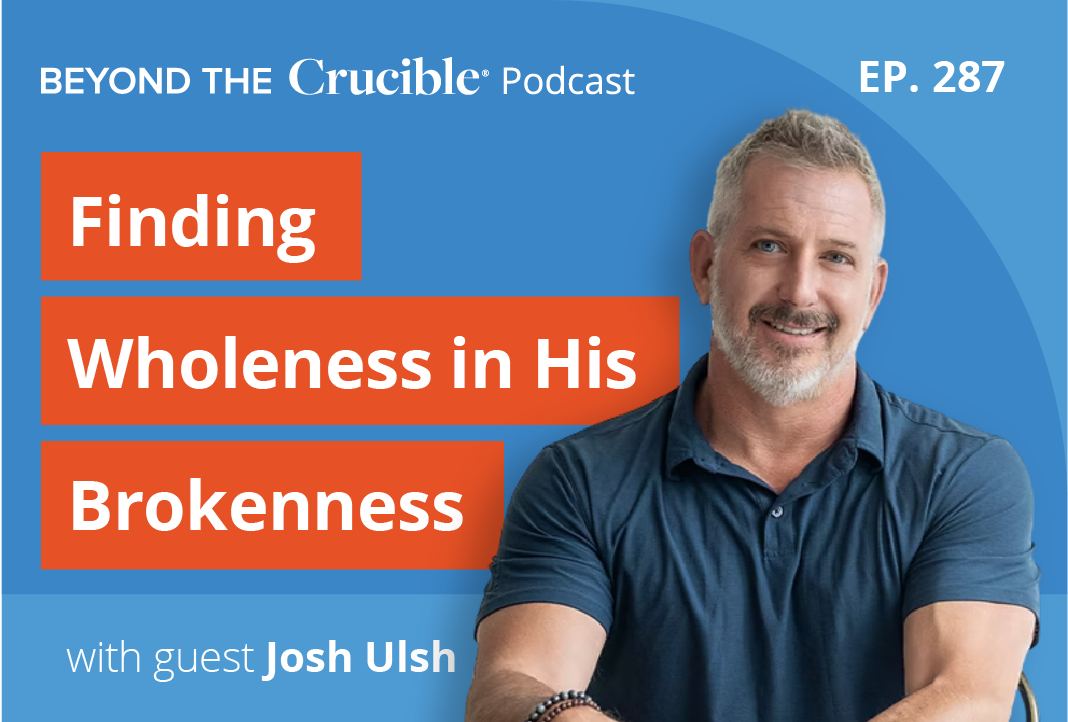
Finding Wholeness in His Brokenness: John Ulsh
Finding Wholeness in His Brokenness: John Ulsh
Our guest this week, John Ulsh, spent 18 days in a coma after he and his family were in a high-speed head-on car crash. And that was just the beginning of the ordeal he endured.
Given just a 3 percent chance to live, enduring more than 45 surgeries to piece his broken body back together, he has not let the pain keep him from discovering his purpose: helping others overcome adversity and finding strength in their struggles.
To explore Beyond the Crucible resources, including our free Trials-to-Triumphs Self-Assessment, visit beyondthecrucible.com.
Enjoy the show? Leave a review on your favorite podcast app and leave a comment at our YouTube channel and be sure subscribe and tell your friends and family about us.
Have a question or comment? Drop us a line at info@beyondthecrucible.com
—

Don’t forget to subscribe for more leadership and personal growth insights: https://www.youtube.com/@beyondthecrucible
Follow Beyond the Crucible on Facebook: https://www.facebook.com/beyondthecrucible
Follow Warwick on LinkedIn: https://www.linkedin.com/in/warwickfairfax/
Follow Beyond the Crucible on Instagram: https://www.instagram.com/beyondthecrucible
Take the free Trials-to-Triumphs Self-Assessment to discover where you are on your journey of moving beyond your crucible and how to chart your personal course to a life of significance: https://beyondthecrucible.com/assessment/



Transcript
Warwick Fairfax:
Welcome to Beyond the Crucible. I'm Warwick Fairfax, the founder of Beyond the Crucible.

John Ulsh :
I spent 18 days in coma, so by the time I was out of my coma, my family was all home. So I knew they were alive, I knew they were. I mean, once I could start the process. So I didn't have the same experience the rest of my family had because I went through the hardest parts that my kids and my wife were suffering through in a coma.

Gary Schneeberger :
Those 18 days were just the beginning of the ordeal our guest this week, John Ulsh, endured after he and his family were in a high-speed head-on car crash. Given just a 3% chance to live enduring more than 45 surgeries to piece his broken body back together, he has not let the pain keep him from discovering his purpose, helping others overcome adversity and find strength in their struggles.

Warwick Fairfax:
Well, John, it's so good to have you here. Very much enjoyed reading your book, The Upside of Down. Love that title. What a profound title. So we'll get into that here in a bit, but I want to get to your story. But let's just start with who you are. So I'll just read a brief bio. So John Ulsh is a dynamic speaker, coach, and accomplished athlete whose life exemplifies resilience and transformation. After surviving a devastating car accident with his entire family, a tragedy that led to over 45 surgeries and numerous additional setbacks, John discovered his purpose, helping others overcome adversity and finding strength in their struggles. John has been featured in People Magazine, Men's Fitness, on Good Morning America. John blends his personal comeback journey with professional success, including 425 million in real estate sales.
From a devastating accident to tackling Spartan Races, which we'll touch on, that's pretty fascinating. John now empowers others to turn setbacks into comebacks. So I loved reading your book. Let's just talk a bit about your story. So what was life like before The Crucible, which was life-changing? What was life like for you, John, your family, the rhythms of life? What was the before for John Ulsh?

John Ulsh :
So I was 36, had been married since 22. Two children, an eight-year-old and four-year-old that we'll talk about later, successful business. And I would often tell people we were probably living that American Family Dream, making good money, not great, fantastic out of this world money, but more than enough to live a very nice lifestyle. Putting our kids in private school. We were doing the American Dream. Healthy, I was a marathon runner. We had an old pair who helped us manage our kids because both my wife and I worked. So yeah, I would say, if there was this stereotypical mid-30s family dream, that's probably where we were.

Warwick Fairfax:
Yeah, life was good. So tell us what happened that day. I think you were out with your family and what was that day like? I think I remember reading somewhere, you actually ran a whole stack of miles that morning. Just tell us about that day.

John Ulsh :
Yeah, so it was December 1st of 2007. In central Pennsylvania, December 1st can be 60 degrees and it can be snowing. That particular day, it snowed. That year, Thanksgiving was very late, so this was the Saturday immediately after Thanksgiving. So we were still in that Thanksgiving weekend, Black Friday was the day before, which was a big day in my wife's retail world. Yeah, so that morning, like I said earlier, I was a marathon runner, and so that morning in a dusted snow cold morning at 6:00 AM, I knocked out 12 miles, which was my normal routine when I was just trying to stay marathon-ready, but not necessarily training for one. And so we left and drove about an hour south of where we live for our eight-year-old daughter Katie's swim meet. It was the first swim meet of the season, indoor obviously. And we were going down to a high school, close to the Maryland border.
And so that was an early meet. And so our son James, who was four at the time, we persuaded him to come along, behave himself. And if he was well behaved, which a four-year-old in an indoor swim meet for four hours could be challenging, that we were going to go cut down a Christmas tree after we were done. And so that was our carrot and stick. And so we got through the swim meet. It was a great swim meet for our daughter. She was six to eight as an age group for swimming and she was eight and that day swam four events, won for all four events, swam an IM, which is four laps. So the pool for an eight-year-old is a pretty big, big deal. So we were leaving the swim meet a little bit after lunchtime, noon in a pretty good mindset.
Again, we're going to go get a Christmas tree now. Our daughter had a great swim meet. Our son was relatively well behaved, and so we pulled out of this high school where the swim meet was. And instead of turning left and going home exactly the same way that we had just come down, we decided to turn right. This area is called Mercersburg, and there's a boarding prep school there called Mercersburg Academy. And so we thought, well, they'll have holiday decorations up. It's just right down the road, why don't we drive through campus and then just go home up onto Route 81, which is a major highway that runs up and down Pennsylvania to go home. So we were just going to jump two exits farther down to come back. We drove through the campus, we're driving on this 55 mile undivided country road, very rural area, a lot of farming in that area.
And off to the right is a ski hill called Whitetail Mountain. And I remember my wife saying to our kids, "Oh look, they're blowing snow. We'll probably be able to go skiing really soon." That's the last memory I have. A car coming the other direction through a straightaway across the center line at the very last second, there were no skid marks on the road and the police estimated our impact speed to be 125 miles an hour. They estimated we were traveling 55, he was traveling 70, two objects traveling in opposite directions. It's their combined speed that creates the impact speed. So if you hit a telephone pole at 55, you hit a telephone pole at 55 because he was traveling and there were no skid marks. They take that combined speed. So it was a devastating impact. Speed. We went driver to driver. He was a single driver. He died instantly. And honestly, he was not wearing his seatbelt either on top of all this. So his probability of life was even more deterred by the fact he didn't have a seatbelt on. He and I went driver to driver.
And so my wife was sitting in the front seat, unconscious, broken hand, broken foot, broken ribs, laceration from the lap belt, severed her skin, broken collarbone, all the types of injuries that the seatbelt itself would cause. My daughter was in the back passenger seat. She was cut by the seatbelt, broken collarbone, but she was conscious. She was the only one who stayed conscious. My son James, was in a booster seat being four. He was directly behind me. My seat came back, broke his leg in two places, and then we later learned that the lap belt actually severed his small intestine but didn't cut his skin. So he was already in the hospital legs set before they even realized he was going septic and that his small intestine had been clear severed from the seatbelt, but no cut in his skin.
I took the blunt of it. I was given less than a 3% chance to survive. My internal injuries were what's killing me. My spleen ruptured, my diaphragm ruptured, my left lung completely collapsed. My right lung partially collapsed. And those were the internal bleeding issues that were killing me. On top of that, my left foot was shattered when the engine block collapsed onto my foot, the energy traveled up, my left leg shattered my pelvis, four and a half inches in the front and then snapped the back of my pelvis. Split my tailbone long ways, and then fractured L1 through L4 of my lower vertebrae. So the four lowest vertebrae were all fractured just from the impact. My son and I were flown. So Penn State's Medical Center is located in Hershey, Pennsylvania. It isn't in state college where the university is.
Technically the closest non-trauma hospital was University of Maryland and Baltimore where we were. But Penn State has these emergency helicopters, they call Life Lion because Penn State is the Nittany Lion. So they use the called the Life Lion. They actually keep one in my hometown. So they keep one at the hospital and they keep one in my hometown for the sole purpose of reaching into this very rural part of the state. That helicopter saved my life. It was able to get there. The first responders, the first person on the scene was somebody who came minutes after the accident. It was not a very busy road, so it wasn't like there were cars all over the place. He found our daughter, Katie, crawling between the front seat crying, "Daddy don't die." We know this because he would later send a letter to my wife because he didn't think I survived, just stating what he saw, what happened, giving his story to my family.
Obviously, I had survived and had this opportunity to read his description of it, but my son and I were flown to Hershey and my wife and my daughter were taken to Hagerstown, Maryland, which was the closest non-trauma hospital. And then would later have to be transported by ambulance later that day to Hershey because I was going to die. So my son was in for 15 days, mostly related from his bowel. My wife spent five days in the hospital when my daughter was transported up to Hershey. She was never admitted back in. She refused to go into the children's wing of the hospital, and so they didn't sign her in. My father took custody of her and then slept in my wife's room with my daughter, so she could be by her mom through this.
But I spent 18 days in coma. So by the time I was out of my coma, my family was all home, so I knew they were alive, I knew they were. I mean, once I could start the process. So I didn't have the same experience the rest of my family had because I went through the hardest parts that my kids and my wife were suffering through in a coma. So the other challenging part for me is because my back and pelvis were shattered, I was non-weight bearing for 10 weeks. So when I came out of the coma and within a week they transferred me out of the hospital and I got moved into a nursing home where I would have to spend eight more weeks laying flat on my back, not being able to be raised more than 15 degrees. So I would argue that the darkest angriest parts of that period of my time were in the nursing home.
If you've ever spent any time in a hospital overnight, you're consciously aware of the fact that you'll never get any rest. Somebody is coming in to check some vitals, there's all kinds of noise out in the hallway. All night long, somebody is coming in to check on you. In the nursing home, the third shift would come in at 11:00, I would see my nurse aide and my nurse, and then I wouldn't see somebody again until 6:00 AM unless I needed them, unless I hit a button and called for them. They were going to leave me alone. Well, I was in excruciating pain. I couldn't move my legs at all. And so, I would lay in that bed at nighttime, not able to sleep in pain and spend a lot of time, one, wishing that I hadn't survived.

Warwick Fairfax:
So as we talk about the way back, you've talked about it quite a bit in the book. You mentioned you've had 45 surgeries and I think maybe you mentioned to Gary this year might be the first year in forever basically when you haven't had a surgery, at least in living memory, so to speak.

John Ulsh :
Absolutely. Yeah. As of now in 17 years, this would be the first year where I didn't have at least one.

Warwick Fairfax:
So just talk about, I mean, it is just one of the things where I think your abdominal muscles weren't connected, which how can you sit up without that? And your back was in a body cast, just the number of surgeries, the narcotics that had to fill you with just to make the pain bearable, which seemed like if it ever really made the pain bearable. But those first few weeks, months, it just seemed like every day was excruciating pain in one surgery after another and you had an issue with the blood clot in your leg. It's just the number of issues which just it's mind-numbing to read about. Just talk a bit about those days just to give people an idea of how bad it was.

John Ulsh :
So they opened me from sternum to pelvis when I arrived at the hospital, all because of all these ruptured organs and internal bleeding. And so, they left me that way for three days while they tried to stop the bleeding. My medical records show that I took 36 units of blood in the first 12 hours. And so men hold about eight units of blood. So that's how often I was just bleeding out. I'm also O+, which is a very, I can only take O+. So I was wiping out a blood bank in a major university hospital with the amount of blood I was taking. And so after two days, they just decided that the risk of infection was too high. So they went to close me and they couldn't pull my abdominal muscles back because I was so swollen between the blood plasmas and all the trauma and the shock that they couldn't pull my abdominal muscles shut.
So they just pulled my fascia layer, the top layer of my skin shut, stitched me up with big blue sutures because, well, a plastic surgeon wasn't brought in to reattach my skin because they knew that if I survived, they would have to cut me back open So it wasn't put together. So to this day, I have big tick marks like you would see in somebody who 30, 40 years ago had major open heart surgery where they didn't tape it shut and make it nice, clean straight line. But because of that, you're right, I couldn't sit up. And so when they would eventually decide that they were going to be able to fix it, which was nine months afterwards, they realized, because I spent all that time laying on my back, my bowel had grown adhered to the scar. And now because I had no abdominal muscles, it was stuck and it wouldn't unstick itself.
And so when I finally went into have that surgery, they determined that I had a hole in my heart that nobody knew about. Now I had already 19, 20 surgeries, I had had a stethoscope obviously stuck on me by every type of doctor in the world. So I'm going to an anesthesiology appointment as a pre-op to my surgery coming up the next week. So I just have a nurse, and she puts a stethoscope and she says, you have a heart murmur. Now my wife is with me, because I can't drive a car. She's like, "He doesn't have a heart murmur." Next thing, the doctor comes in and he puts a stethoscope and he's like, "Oh, you 100% have a heart murmur." So I get a call from my doctor, you got to go see a cardiologist before we do this surgery.
And of course, I get to the cardiologist and he's like, those doctors don't know how to use a stethoscope. Every cardiologist thinks that everybody else doesn't know how to properly listen to a heart. So he puts this stethoscope, he hears it immediately, and he's like, "Okay, well." And he starts with a, "If we had a time machine," which I would tell you any conversation that ever talks with, if we had a time machine, generally isn't a good way to start, right?

Warwick Fairfax:
No.

John Ulsh :
But the determination was that at some point over time, the heart tissue died out in the last, somewhere between month four and month seven after the car accident. And that nobody else has this because nobody else should have survived what you went through. You should have died of five other things. So at the time, they determined I was the only person left in the United States and possibly the world who had what would be called a traumatic VSD, a hole between the right and left ventricle. And solely because of the fact that anybody else before this hole would've opened up, would've died from all the other complications.
And it made a huge deal because nobody knew what would happen when they tried to reattach my abdominal muscles and they put all this extra stress on my heart, would the hole get bigger? So when I ended up having the surgery, I had a general surgeon in there to separate my bowel, a plastic surgeon who was going to try to recreate what they could of my abdominal muscles and a cardiologist sitting on the sideline just in case my heart started having issues. 12 hours, and I ended up back on a ventilator just because my organs, my liver shut down when we pushed all this because that was all living out in like a woman in her third trimester just because I had no abdominal muscles. And when they put all the organs back, they all were not acclimated to being back inside my chest cavity. And so they had struggled. So I spent 15 more days just from that surgery in the hospital.

Gary Schneeberger :
I'm going to jump in just for a second, Warwick, because you've mentioned a couple times, John, just how unlikely the fact that you were still living was. You were told you had a 3% chance of living. I did some research this morning and I just typed in 3% chance of. And I did a news search for what else is a 3% chance of, here's what I found. There is right now a 3% chance of a city killer asteroid hitting earth in 2032. That'll tell you just how rare your surviving this is. That's remarkable that you're here to tell this story. So I just thought I'd toss that in there so we can see the perspective.

John Ulsh :
Gary, with your permission, I'm going to borrow that in my next keynote because I have never had somebody actually dive into what is a 3% chance. So I always say I could have won the lottery. That would've been better than, you know.

Gary Schneeberger :
I'll give you a bonus one. The other one I came, which is a little bit funnier, is as of right now, our recording of this episode, the Dallas Cowboys have a 3% chance of winning their division in the NFL. And they're not having a good season. So there's another 3% chance right there.

John Ulsh :
Well, I'm a big Philadelphia Eagles fan, so that doesn't hurt me in any way.

Gary Schneeberger :
Good, good, good.

Warwick Fairfax:
Yeah, 3% is low. So one of the remarkable things is back in 2008, 2009, as you write in your book, obviously you had to have a lot of opioids, narcotics, just to try to numb the pain, which didn't seem like it helped all the way, obviously, but you were determined. I think you're right. There was one part of my new normal, I refused to accept being trapped by narcotics. You would not want to be defined by that. So even before it became mainstream to be worried about it, you were on it and you sought alternative therapies, massage, meditation, biofeedback, which I've not heard of.
So talk about that because you talk about you wanted to reclaim your life, you wanted to be in control. So there's the whole mental aspect that, and you're right with the whole narcotics, there were times in which you knew all you had to do is press a little button, instant relief. The willpower not to press that button when you're excruciating pain, that's Olympic level mind control. So talk a bit about that. Because that was one of those keys to your coming back. You couldn't control a lot of things, but this is one thing you were determined to control. I'm not going to be governed by narcotics for you and for your family. So just talk about that because that seems pivotal in your journey.

John Ulsh :
Yeah, as you mentioned, this is pre-narcotic epidemic. So my pain management doctors were not interested in having me not take them. I had numerous doctors going through all these surgeries saying, "You need these, these are what they're here for. Don't mess around with them." But I had reached the point within two years that I was taking 90 milligrams of morphine twice a day, significant amount. I would have nurses say, "Well, if we gave 90 milligrams to a cow, their heart would explode." But that's how tolerance, that's sort of obviously why you can understand how the addiction happens. Because what happens is you take 30 and three months later, 30 doesn't mask the pain anymore. So the doctor says, "Okay, well, now we're going to give you 60." And you go through another three, six months of taking 60 milligrams and your body builds up tolerance and it doesn't work anymore. Then they give you 90.
So at some point you start to say, well, if 90 doesn't do it, I'll just give myself 120. You just start dosing yourself. And when you had unlimited access before it was so controlled as it is today, you just get a two months of prescription filled instead of your 30 days. One of the things that I benefited from because I was in such bad shape, my wife would put my pills together for a week at a time, an AM and a PM. And so, I never controlled my own narcotics. I didn't even know where they were. And so if I took an extra pill, I then had to go ask for a pill. So it wasn't like I was in control of my own medication, which now in hindsight was huge. But when I decided to go off of it, it was mostly because the big aha for me is I attended a wedding of a friend in that summer two years after, and I have no memory of the wedding.
I started writing this book at that point as a memoir to my kids because I was starting to forget the stories. As you know in the beginning of the book, there's a lot of out-of-body/drug-induced hallucinations of different rooms. I was forgetting that part of my... I would go to speak to nurse aides. One of the things that's real unique about my story is I lived in a nursing home for 10 weeks. I was 36, I got better. Most people don't enter as a patient in a nursing home and proceed to become better. So I had a very unique insight that I could give men and women who were going to become nurse aides, what it was like to be in a nursing home, what kind the care that's not taught in a textbook that benefited me or made me feel better.
And so, I would start to forget. I would be there and the same instructor would be there, a whole new class. And the instructor would say, "Tell this story." And I'd be like, "I don't remember that story." And so, I could see me losing my mind from the narcotics. The question was, as you said, nobody could say I didn't need it, that I could function with all these shattered bones still in place and still put together with titanium. I still, at that point, could hardly use my left leg at all. My left leg feels like it's asleep all the time. It's just that pins and needles from the nerve damage. I only walk today because I can feel my big toe on my left foot. I can't feel the rest of my foot.
But if you've ever heard stories of people with frostbite or diabetics who are having to lose toes, they try to save the big toe because that is your balance, and that ultimately allows you to walk. So you can lose your four other toes, but you need your big toe to walk. And by a miracle, that's the one part of my left leg and my foot I can feel, which allowed me to learn to walk.

Warwick Fairfax:
So what's interesting to me is, and we'll shift here in a second to the eight pillars. But the resilience and creativity you used was amazing. Because you were a marathon runner and you realized, okay, that's what part of life is over. But you did the 2007 Turkey trot, and then I think it's what? Somebody at the YMCA, they started mentioning about the whole Spartan Races just going over obstacles and climbing some huge mountain. That's just remarkable. And one of the things I'm fascinated in, you write that the old John Ulsh wouldn't have been able to do that, because you didn't have the upper body strength what was needed. So you shifted to something that you couldn't do before, but you could do now. Talk about reframing. Talk about that because that probably is part of how you felt like you were reclaiming your life, your sense of self. Because that was huge in your recovery, those Spartan Races and all that part of the journey.

John Ulsh :
Yeah. So the trigger for me, there was two years after I was still going to three days a week of outpatient rehab. I could use a cane around my house, I could use a walker. If I had to be moved like 150, 200 yards into a stadium or doing it, I got to be put in a wheelchair. I couldn't travel that far with just even a walker. And so I'm sitting in my office at home and my daughter, who's now eight, is out front juggling a soccer ball, loves soccer, but I'd be out there all the time when she wasn't on practice. And I look up and she's not there, and she comes in the door and she's crying. And I ask her what's wrong. And I just assumed she hurt herself. And ultimately she said, "I miss my old daddy, the one who would come outside and train with me."
And honestly, after everything I'd been through at that point of 28, 30 surgeries taking all these narcotics, I just realized that if I believed I lived so my kids would have a dad, I was honestly not living up to her expectation of what that looked like. And so literally the next day I go to rehab, I quit. I basically told him, "Look, I was a college athlete. I was a marathon runner. I know I can push myself harder than you're willing to." And my therapist was a younger man, it was probably my third therapist there by that point. And he's like, "I get it. We are mostly healing people that have just had knee replacements, and hip replacements, and shoulders, and orthopedic stuff related to old age." And I was not your typical patient. I left, drove down the street to my local YMCA, just happened to roll in at 10:00 AM at exactly the same time that United Cerebral Palsy had a program for teens with Down syndrome.
And so I started working out that day with 17- to 19-year-old special needs adults, young adults with Down syndrome. And for the next year, that became my motivation. But what drove me was this concept that after the first day, I woke up in the middle of the night, sore, shoulders hurting. And for the first time in over two years, something other than my back pain, my leg pain, my pelvis woke me up. And it became a battle between pain I could control and pain I couldn't control. And so, it became a control issue more than anything. So if I went to the gym and pushed myself hard enough to be sore, and the next morning my legs are sore, my arms are sore. I could be okay with that because I was like, that's because I literally tore muscle, pushed, and now my body's healing.
And I did this to myself of my own. And by the way, it was positive because now I'm building strength to counteract shattered back missing abdominal muscles, and it became this what I could control and what I couldn't control. And so if you talk to marathon runners, you talk to elite athletes, they all have that high, if you will, that comes from pushing your body beyond its normal limits. It became my replacement for narcotics. And then, obviously, the biofeedback was introduced. So as I was working through getting off narcotics, I was finding alternative things that I could supplement. And like you said, the running was never going to... I kept telling everybody when it first happened, I'm going to get my life back. At some point I had to let go of the fact that my life was never going to come back to what it was. Could be, its a great goal, but I had to come to terms with what my life was going to be. And that I could reinvent it on any level I want to, but I wasn't going to get back what it before.
And maybe in hindsight it wasn't as great as it looked. Obviously, reflecting back on our lives, you can always say, well, that was the golden years, or that was the best times. Was it when you were living it? Probably not. And so, the working out made me stronger, and bigger, and stronger, and that led to finding alternative challenges that I could put myself through that were going to be not running marathons anymore because I was never going to run a marathon again. Spartan Races is great because you have to have strength, and it's not... The best guys are fast too, but I was there just to challenge myself.

Warwick Fairfax:
It seems like working out in the Spartan Races were a step along the journey to reclaiming your life and finding you purpose. You obviously didn't realize where it would lead. It was just as you write later, what's the next step? Well, this next step is getting fitter and the rehab place won't give me what I need. So that's a remarkable part of the journey that this fitness regimen and Spartan Races led to some national opportunities with Good Morning America and Men's Fitness. That's an amazing journey.

John Ulsh :
It was very organic at that time, and it was really just, I think really when I started to work out with these young adults with special needs is the first time that people really took interest and just wanted to ask questions. Or a lot of people, including ones that related to Spartan, would be like, well, if you can do this and I know your story, this kind of goes back to what off-air when Gary said about his tooth. People come with me all the time and I really have no excuse not to get into the gym or to take better care of my health. Because if you're doing it and you got this litany of issues, then I kind of don't have the right to complain about a sore knee.

Warwick Fairfax:
I want to shift to these eight pillars because one of the things I've found in my own life and with most, if not all, of the guests, is when you go through great challenge and pain, you are the great wisdom. And we say this all the time, believe it or not, when you go through a crucible, you have a choice. You can proverbially hide under the covers and be angry at God, angry at yourself, angry at others, and be in just a doom loop of anger, rage, and depression. And that's understandable. You can say, this wasn't fair. I don't like what happened, but how can I move forward? And clearly, you made a choice, a very difficult choice to move forward. But by doing that, the wisdom you have in these eight pillars is I feel like we could spend a lot of time on each one of these. This is, at least, from my opinion, profound stuff that you have here.
And this is obviously hard-won wisdom. This is wisdom that you never wanted to learn, at least not that way. Can I read a book? I mean, not this way, but sadly, to learn profound wisdom, you need profound challenge and pain. So let's just go through some of these. That first pillar you have is commitment, and it's the foundation of which all transformation begins to talk about. Why is that the first pillar? Commitment to overcome a challenge.

John Ulsh :
Again, I'll speak for my experiences. There's plenty of times where I kind of knew what I should be doing or what the next steps are, but I wasn't in the right space, so I didn't spend enough time evaluating where I was. In many cases, I didn't have the right tools, whether they were physical tools or whether they were the right people in my life. And ultimately, this ability to yield and accept that this is not a linear journey can be overwhelming. So I often say, I was not a patient person before the car accident. I would say patience was shoved down my throat when you get paralyzed and get stuck into a bed. And so, I learned to be patient. But out of that experience, I also learned that I could still go hard when I was ready. So you talk about health-related issues, you talk about work, relationship-related issues, you can hear it from every person and you can know that it's not doing the right thing. But until you're ready, until you're truly prepared to take on this thing, you won't succeed.
And so, I've had plenty of times where I just had to give myself enough grace to say, I'm just going to sit because I know I need to tackle this again because I had another setback. But I'm either still mad that I took the setback that I had, the other surgery that I had to deal with something that something in my life has gone sideways again, whether that was relationship, or job, or health. And so I'm not going to do it, but I'll be ready. I think that's the biggest challenge for me is always been, I know I can do it again because I've done it before, but I'm not committed to it right now. You can argue about smoking. We all know smoking is bad. We still know probably some people who smoke. They're not ready to give it up. And so to me, the very first step is this idea of commitment because you've got to be ready to do something before you can take the first step.

Warwick Fairfax:
That's profound. And that really feeds into this next step, understanding the source of your problems. And one of the things, again, I'm not trying to be nice for the sake of nice, but you have so many profound things in here and you really do. One of the things you say here is under this step is my mindset, my fears, and my self-doubt were just as big of obstacles as my broken body. That's not obvious to people. But talk about that because part of understanding the source of your problems, you could say, well, the source of John Ulsh's problem is pretty obvious, his body is broken, and every bone that exists in his body. It's pretty obvious that's the source of these problems, but yet it's not that simple, right?

John Ulsh :
And honestly, very seldom is. And again, in my experience even coaching and working with other people, I often say, what do you think are your challenges? What are your problems? And they might rattle off four, or five, or six. And one of my favorite exercises that's in that book is ask yourself why five times. So when someone says, I don't exercise, my question is why. I don't have enough time in my day. Why? My work is overwhelming all the time. Why? Because I have challenges getting everything done in a day. Why? I don't block enough time in my day to do it. Your problem isn't exercise your problem's time blocking. You could do this. My kids would be like, I do this to them all the time when they were teenagers. But that's the truth.
And the other part of it is if there's generally when you have five or six things on that list, I would bet almost every time we can get it down to one. That if you tackled that one thing first, so in my case, it was the mental fear. It was the fear of having to start this, and hurting, and not being as good as I was as an athlete or as my ability to get myself stronger. It wasn't a question of whether it would be good for me to build stronger muscle to put myself through it. It was this fear that I was no longer myself.

Warwick Fairfax:
Yeah, just some of the other pillars, you've got a step to create an effective plan. You've got the whole mental stuff of mistakes, mindset, method. Execution is huge. Mistakes, momentum, motivation, sustaining forward movement. The key to execution isn't perfection, it's persistence. That is excellent, excellent stuff. Keeping score, the wrong way and the right way to measure progress. Tracking the wrong way, tracking of the outcome, not the effort. Getting caught up in external comparison. I've certainly done that compared to what I could have been, been there. Tracking consistency is the right way. Measuring small improvements to get quantitative growth. Step seven, that was very profound, falling in love with the process. You would know this as well, if not better than I do, was elite athletes always do this.
Growing up in Australia, Australians love tennis. I'm a big fan of what used to be the big three, Roger Federer, Novak Djokovic, and Rafa Nadal. They love training. They live for training. Novak Djokovic is one of the most fittest athletes on the planet. He spends hours stretching every day, hours. We're not even talking about weightlifting and running. He's manic about nutrition, about what goes in his body. The fact that he is, I don't know, he's almost 40. He may not win another major, but he is probably the fittest 40-year-old tennis player in history by light years. It's just staggering. That's probably one of the most elite athletes on the planet, but he loves all that stuff, which you kind of have to. So yeah, just talk about any of those things because, look, we could spend a long time in each of these. These are profound things. But that whole loving the process when you're going through the spot and stuff, and the training, and its agony, but yet you must have loved the process somehow, right?

John Ulsh :
Yeah. Honestly, when I have 15 minutes to do a TED talk or 15 minutes at an event, that's the one I focus on because at the end of the day, that is your win. If you love the process, you want the finish line to keep moving, you want the goalpost to go farther away. You want to get back to doing what you just did this morning, the soon as you can get back to it. And you're right, you'll never find an elite athlete who doesn't love the process. I've been fortunate to speak to a lot of athletic departments of Division 3 schools. Division 1 being the high level, this is two levels lower. These young men and women, at the very least, if they're seniors, have competed eight years, four years of high school, four years of college. If they're golfers or tennis players, they might've started at four or five to do that.
So they would've committed at that point, 18, 17 years of their lives to something they're never going to be pro at. And the only way they have that ability to commit is because they literally love practice. They love the locker room, they love the camaraderie of teammates. That's what they love. And if you can't reach that point in any goal, whether it's business, relationships, health, and you will almost always return back to the common norm because take weight loss, you can lose all that weight because you force yourself to go to the gym and you force yourself to watch what you eat, but you hate it the entire time. And we see it all the time. Three years later, they're back to where they were after they hit their goal. Because they just never found joy in the process. And so, I constantly talk to everybody from kids to adults saying, find joy in what you're doing and it'll never be a job.
Find joy in what you're doing and you'll want to get up and do it. If you're doing it for all the wrong reasons, it won't become a habit. It won't become a shift in your life. It'll become just another taxing thing on you that you have to get done. And if anything, you're at least determined to do it every day, but you don't like it. So we all know successful people in business or we perceive them as successful, but they don't like their job, but they're the kind of people who fill obligation. So therefore they show up, but they don't love it. And they're not going to become the CEO, and they're not going to go out on their own and start a new company. They're going to do the minimal process, but they don't love it. And if they ever found something that they loved, I can guarantee you with that work ethic, they would be successful.

Warwick Fairfax:
Yeah, so well said. The last lines of the book that I thought was so profound was actually in the acknowledgments. It's rare that... The acknowledgments, usually all the people have helped you and you're very grateful. You don't often find something incredibly profound in the acknowledgments, but you have written such a thing, John. And the last lines of this, and when you're acknowledging you're being grateful, this is in the context of being thankful. And finally to the setbacks, you were brutal, relentless, and at times completely unfair. But you were also my greatest teacher who taught me resilience, perspective, and how to build a life I never could have imagined before everything fell apart. Who thanks their setbacks? So talk about that because that's reframing at Olympic levels. I don't think I've ever heard anybody or read anybody in acknowledgements write what you wrote.

John Ulsh :
Again, it was, if we talked a little bit earlier, I look at this experience as something that's open doors. It's 110% rebuilt my perspective on value of things. Writing this book alone, having to relive through this over and over again through each edit on top of having to write it the first time, having to relive it over and over again allowed me to see a lot of my shortfalls, a lot of things that I was okay just ignoring at the same time without the challenges. And I think, or you could say the same, but without the challenges, you aren't who you are today. And if you like who you're becoming and you feel like you're on the right path, then you've got to give credit to what shifted you off of the path you were on. In my case, it was immediate. It was, everything's fine, then everything's upside down. For some people, it's over a period of time of things falling apart.
It doesn't matter. But either way, the journey, the path you're walking on now gets shifted. And I want to believe that where I am today is where I should be. I want to believe that I've taken as much from the setbacks that I can get from them constantly trying to... One of the reasons I love being on podcasts now versus being keynotes is because of both you and Gary have asked me questions I didn't really think about. Gary giving me this 3% statistic that I will now, I'll do my own research. What it does is it answers a question really fast. It's like looking at a photo of my car as you see the pictures. If I put a picture of my car, I don't have to explain 125 mile impact speed. You could see it in the physical visual of it. And so, I kind of look at this as, yeah, these things that were out of my control, the path that I've now been shifted on. It wouldn't have happened without these setbacks. I by no means think, I'm also... I'm learning constantly.

Warwick Fairfax:
Just one last question before we wrap is we talk a lot at Beyond the Crucible, that your crucible didn't happen to you, it happened for you. I have a feeling you probably have a similar perspective. So talk about... I'm sure there's not just cost physically, there's probably been cost in your family, in your life. There's been all sorts of costs. But talk about how, if it's true, do you identify with that? It didn't happen to me, for me. What's your perspective in your story in that whole paradigm and gratitude and all?

John Ulsh :
I look at it as something that has come into my life. I didn't invite it. It certainly came into my life. And then we're back to what does it serve? It is common phrase to say, everything happens for a reason. And I think that's, I've had literal discussions with people that I don't necessarily think... I mean, I always say sometimes the reason is that person's just an idiot. But I do believe that what we are handed, there is a silver lining in everything. You have to be willing to look for it. People ask me, would I turn left instead of turn right out of the school parking lot? My answer's always yes, I would turn left so that my children wouldn't have gone through what they have gone through. Not for me.
This journey has built me in so many different ways, positive and negative, but I am one of those people who also identify a lot of their self-worth in giving to others, good or bad, I know that about myself. And so, I look at this as an opportunity to give and give. I would argue that one of the reasons I was able to get out of a bed and out of a wheelchair is because I didn't want to disappoint my family. And so, I use that instead of as a negative, as a positive. And instead of framing it in a way that you're just constantly worried about taking care of other people to being, yes, I'm just constantly worried about taking care of other people, particularly my family. And that's okay.

Gary Schneeberger :
John, you just mentioned taking care of other people. That's important to you. One of the ways to do that is people contact you on your website and you're a coach. You do keynote speeches, you do podcasts. How can people find you on the web so they can maybe find opportunities for you to help them?

John Ulsh :
So the easiest place is just johnulsh.com, so J-O-H-N-U-L-S-H .com. So if you go there, you'll see everything from my speaking to links to all my social medias, to all those types of places. We work a lot on Instagram right now just because it's a great place to put little segments of stuff that I've done to give a lot of people. But we're on LinkedIn and we're on TikTok. When I say we, I have people who help me make sure that I'm at the spots where the people that need to hear it. But yeah, johnulsh.com is the easiest place, you can message me there. I love answering stuff. So again, if your listeners say, "Hey, jump on my Instagram and send me a direct message," I'm going to respond to it. I don't always have the answers. Sometimes people just want... I mean, after I speak, I like to hang around.
Sometimes people just want to tell me their own journey, which is great because then I'm learning from their journey. And I would love to walk away from any event. And again, that's why I love podcasting because we're now having a conversation and I'm learning and I'm growing. Instead of me standing in front of an audience and just presenting. And Gary and I, we talked about this a little yesterday. To me, the most valuable thing is your listeners go out today and they talk about what we talked about. Because if we read my book and you don't share it, or you listen to this podcast and you don't share it with someone else, then we're not exponentially growing at the level that we should and we're not giving to others, right?
It's great that somebody can take something to this. But the most valuable thing that will happen today is probably the conversations that the three of us had and helping ourselves grow as people. And so if I can leave here today, go see somebody that I'm about to have a meeting with, and just talk about what we just talked about and tell your story. Now, not only am I spreading it, but by the way, it is proven the best way to learn is teach, right?

Gary Schneeberger :
Yeah. Warwick, as always, the last question is yours. So take it.

Warwick Fairfax:
So John, again, thank you for being here. There may be a person who today might be their worst day. They might feel there's no hope. They're angry. It could be themselves, God, other people. What would a word of hope be for somebody who they might feel like today is their worst day?

John Ulsh :
So here's my constant answer to that. Give yourself grace. The biggest thing I ever learned was when I wasn't having my best or I wasn't in the right headspace, to be okay with that. If you're a driven person, which I'm a driven person, I would guess that you guys are. You don't do what you do if you're not. Some days it's just not there, and that's okay. It doesn't mean it's not there tomorrow. And so there was a lot of times where I could have benefited from just giving myself the grace to be okay with the fact that I'm not hitting it out of the park today. I'm not on my game. I'm not feeling my best, and that's okay. I constantly felt like if I wasn't going forward all the time, I wasn't progressing.
And it's one of those things, Rick, when you look at the mile high view of the year, it's going to look like a chart that goes from left to right, completely up. But if you look at it on day to day or week to week basis, it looks like an EKG. It's just all over the place, right? That's just our reality. And we get so tied in like I do into yesterday wasn't as great as it should have been. Now I feel bad. You got to let that go. Give yourself the grace to know that if you look at it from a perspective of what you've accomplished over the last month, then you probably are on the right trajectory.

Gary Schneeberger :
Friends, I've been in the communications business long enough to know when the last word's been spoken on a subject. And our guest today, John Ulsh, has just spoken it. So Warwick, we've just had a fascinating, I always say that, a fascinating episode, because they are fascinating episodes with our guest, John Ulsh. Talk about what the big takeaway of this episode was for you that our listeners and viewers should know about.

Warwick Fairfax:
It was an incredible discussion with John Ulsh. He's gone through so many surgeries. I think it was 45 from his accident back, was it 18 years ago? It was a while ago, and the accident itself was horrific. He lives in Central Pennsylvania. He was at a swim meet with his wife, and son, and daughter. And somehow they were just on this small country road and a guy driving on the other side of the road, he wasn't drinking or anything. He just, I think, was on his phone, and he just veered just over the median at the last moment. And it was a horrific accident. All his family were injured, but the one who was injured the most was John. He was given a 3% chance of living. It was that bad. Umpteen surgeries, his abdominal muscles were detached. He had to have a back brace. It was just the pain was so bad, they had to give him so much narcotics that it was very difficult to get off of that because that just really controlled his life. It was just a horrific accident and years and years of recovery.
But what's amazing, not just his journey back, but his resilience. He wrote this book The Upside of Down, which is a profound title. How could down have any upside? It's really, we talk about this obviously at Beyond the Crucible. How can there be any benefit from a crucible? Well, as we say all the time, we feel in the lessons often. There can be things that help us grow and become a better version of ourselves, a different version. Nobody wishes to go through a crucible, but as John puts that there can be a silver lining. And just the commitment that John made just to accept that one of the things he talks about is yielding to the fact that he will never be the same. He was an athlete, he was a marathon runner, he ran 12 miles the day of the accident.
It was a snowy early December in Pennsylvania, and so we can't do that anymore. But now he does these Spartan Races, which have obstacles, and you're going over logs, and climbing, crawling under barbed wire. And he says he couldn't have done that before because he didn't have the upper body strength. But there are things that he does now that maybe he couldn't before. And he was featured in Men's Fitness magazine and Good Morning America, and now he speaks really about resilience and just talks about having commitment, loving the process, even when the process can be very painful. One of the interesting vignettes he mentioned is he was in constant pain through those first few months, maybe first few years. But when he started working out to train for this Spartan Race, he would be in pain because of the exercise. That was good pain, because that was pain that he inflicted on himself he could control.
In some strange way, it helped him deal with the bad pain that was pretty difficult to control. So the lessons he has learned, talk about hard-won lessons. Who wants to learn those kind of lessons? I don't think anybody does, but it's just the amount of wisdom he had. And certainly the things that he said that were similar to what we say in different language. But yet his commitment, and one of the single most profound things he said was at the very end. And we often ask guests, somebody might be listening today, and perhaps today is their worst day, what would a word of hope be for that person who today was their worst day? He said something I don't think I've ever heard anybody say. And we're probably, I think we're going to reach 300 episodes in February. So we've had a few guests and a few episodes.

Gary Schneeberger :
Few guests.

Warwick Fairfax:
The thing that John said that was so profound is he said to that person who today might be their worst day, he said, you got to give yourself grace. Maybe today wasn't a good day. You'll get back at it tomorrow or maybe the next day. But it's okay to give yourself grace and say, "Okay, today I'm not going to try that again. I'm just going to give myself a break." That is such profound advice. We all have days in which life isn't going well. We're not at our best, and it's like, okay, it's okay to push the pause button and say, "Okay, I'm going to give myself grace today. I'll get back at it tomorrow, but today I'm going to give myself a break." That was profound advice, and now I'm going to remember that. Give yourself grace. Certainly something I need to think and reflect about, because I don't always do that to myself. I'm pretty tough on myself, so give yourself grace, profound advice.

Gary Schneeberger :
So until The next time we're together, please remember this. We know your crucible experiences are tough. Goodness, we heard how tough John's was. You know how tough Warwick was. You know how tough mine has been that I've talked about. But here's the good news on the other side of that, it's not the end of your story. In fact, if you learn the lessons from your crucible and you apply those lessons moving forward, the destination it can lead you to is the best destination you'll ever reach in your life, and that is a life of significance.
Welcome to a journey of transformation with Beyond the Crucible assessment, unlike any other, this tool is designed to guide you from adversity to achievement. As you answer a few insightful questions, you won't just find a label like the Helper or the Individualist. Instead, you'll uncover your unique position in the journey of resilience. This assessment reveals where you stand today, the direction you should aim for, and crucially the steps to get there. It's more than an assessment. It's a roadmap to a life of significance. Ready? Visit Beyondthecrucible.com, take the free assessment, and start charting your course to a life of significance today.