
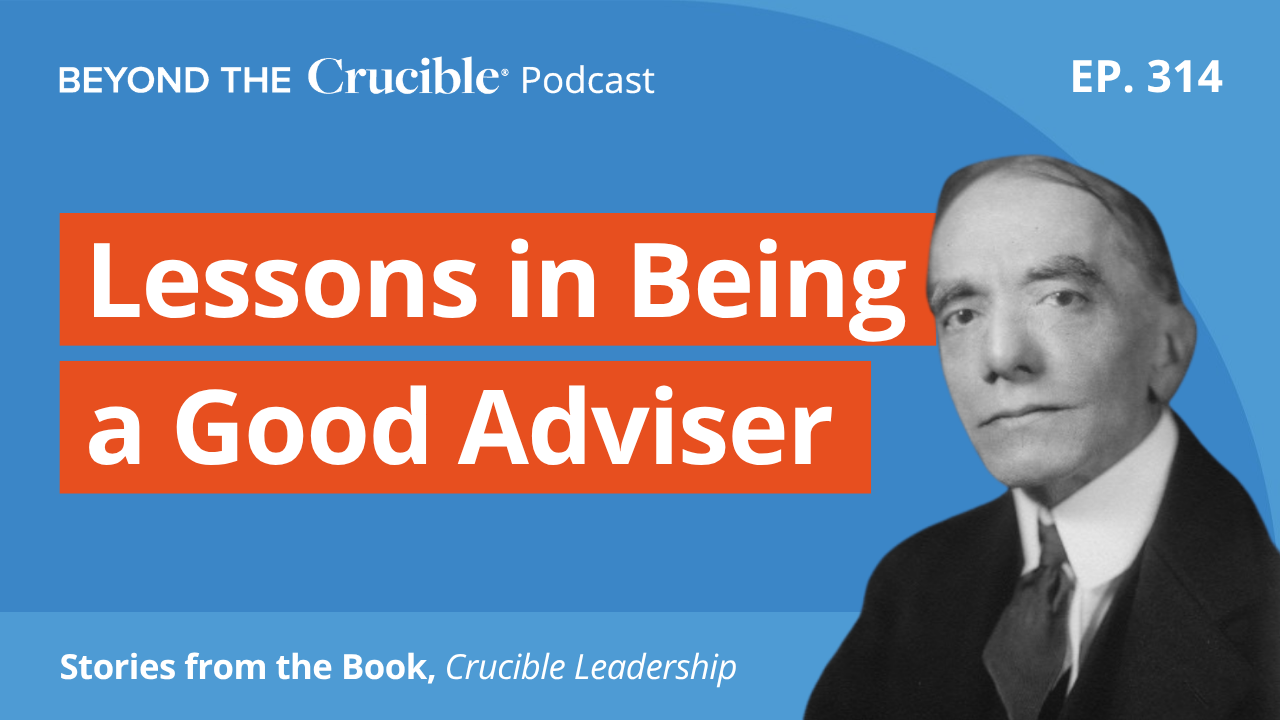
Lessons in Being a Good Adviser: Louis Howe
The most powerful advisers aren’t the ones who flatter — they’re the ones who refuse to let you quit. In this episode, we explore the remarkable story of Louis Howe, the man most historians credit as essential to Franklin Roosevelt becoming president of the United States.
Part of our ongoing series, More Stories From the Book Crucible Leadership, this episode unpacks not just who Howe was and how he shaped FDR’s trajectory, but what his example teaches us all about being a truly great adviser. From holding those we serve accountable when crucibles hit to speaking hard truths that prevent future ones, Howe’s legacy offers timeless lessons in loyalty, courage, and purpose-driven counsel.
Have a question or comment? Drop us a line at info@beyondthecrucible.com
—
👉 Don’t forget to subscribe for more leadership and personal growth insights: https://www.youtube.com/@beyondthecrucible
👉 Follow Beyond the Crucible on Facebook: https://www.facebook.com/beyondthecrucible
👉 Follow Warwick on LinkedIn: https://www.linkedin.com/in/warwickfairfax/
👉 Follow Beyond the Crucible on Instagram: https://www.instagram.com/beyondthecrucible
👉 Take the free Trials-to-Triumphs Self-Assessment to discover where you are on your journey of moving beyond your crucible and how to chart your personal course to a life of significance: https://beyondthecrucible.com/assessment/



Transcript
Warwick Fairfax:
Welcome to Beyond the Crucible. I'm Warwick Fairfax, the founder of Beyond the Crucible. I think it may well be true that without Louis Howe, most of us would never have heard of Franklin Roosevelt. That's how important Louis Howe was to Franklin Roosevelt after arguably the defining moment in his life getting polio.
Gary Schneeberger:
Talk about not just a life-changing impact, that's a world-changing impact. And we discuss it all this week in our latest episode of the series within the show, more stories from the book Crucible Leadership. You'll learn not just who Louie Howe was and how he changed the trajectory of Franklin Roosevelt's life, but also the lessons he can teach us all about how to be a good advisor. From refusing to allow those we're advising to give up when crucibles hit to speaking truth to power to help them avoid future crucibles, these are just some of the actions Howe took that earned him the praise of history as the man who made Roosevelt.
Welcome friends to this episode of Beyond the Crucible. You've joined us at, again, an interesting time because we are doing another episode of what we call our series within the show and that is this year it's called More Stories From the Book Crucible Leadership. You can all applaud us for being creative because last year we did one called Stories From the Book Crucible Leadership. So this year there are More Stories From the Book Crucible Leadership. And Crucible Leadership is the book that Warwick wrote in 2022 that truly not making this up, not inflating it, if it weren't for Crucible Leadership beyond the Crucible would not exist. It's the book that birthed the brand. Each month, although with our summer series coming up starting in July, we're going to take a pause until September after this. But each month in what we're calling the series within the show, as I said at the top of the show, we'll feature one story from Warwick's book spotlighting one key learning that helped the subject of that story overcome a crucible and can help you do the same when you apply the lessons of it.
And we've edited an interesting twist this year at Warwick's suggestion because there were some stories that were in the final published book in 2022, Crucible Leadership. Some stories as it went through the editing process got excised, the cutting room floor as they say. So we're alternating back and forth between stories that were in the book and stories that were not in the book. And this is one of the stories that was indeed in the book. Although we did swipe a couple of things that didn't make the book. There's like a couple of call-outs that aren't in the book, but it's mostly a story that's in the book. So today we are going to talk about a man who made the cut and that is we'll be discussing Louie Howe. Louie Howe on being a good advisor. So Warwick, every episode I begin, I ask you this, both why is Louie Howe in the book and secondly, who was Louie Howe? Help people understand what we're about to talk about here.
Warwick Fairfax:
So not everybody's heard of Louie Howe, but the man that he spent his life helping, I'd say pretty much everybody's heard of this guy, certainly everybody in the United States. So the man that Louie Howe spent his life helping is President Franklin Roosevelt. And he was his closest advisor for many years leading up to the presidency during the Great Depression and the early '30s. Louis Howe was critical to Roosevelt's rise of the presidency and was particularly critical to Franklin Roosevelt as well as his wife Eleanor after Franklin Roosevelt got polio in 1921. I think it may well be true that Roosevelt may not have had a political career after being stricken with polio. As we get into more, polio was considered a political death sentence back then. It's hard to believe, but back in the day in the '20s and gosh, '30s, '40s, if you had polio, you were meant to just stay at home, be an invalid. Somehow it was shameful. It's just hard to understand, but that was the prevailing culture, certainly at the time when Roosevelt got polio in 1921. I think it may well be true that without Louis Howe, most of us would never have heard of Franklin Roosevelt. That's how important Louis Howe was to Franklin Roosevelt after arguably the defining moment in his life getting polio.
At that point, as I mentioned, Polio was almost like this political death sentence. You're meant to stay at home and be an invalid and Roosevelt may well have done that. He may well have hid under the covers, felt sorry for himself if it wasn't for Louis Howe encouraging him. So that's how important that Louis Howe was to Franklin Roosevelt. And in that sense, if you look at the impact that Roosevelt had on the nation of the United States and the Depression and in the Second World War, that's how important Louis Howe was to Roosevelt and to the United States and arguably the world, given the US's prominence in helping defeat Nazi Germany and Imperial Japan in the war. So not everybody has heard about him, but he had a massive impact.
So who was Louis Howe? Louis Howe grew up in a prosperous Indianapolis family that ran into hard times. The family moved to upstate New York to Saratoga Springs and Howe started working at a young age for his father newspaper, the Saratoga Son. Now, Louis Howe first met Roosevelt in 1911. So at this point, Roosevelt is a young man and Roosevelt is in a senatorial fight against Tammany Hall for the New York State Senate. Tammany Hall was the political machine at the Democratic Party back then. And Roosevelt's persistence and eventual victory in this state senatorial fight really impressed Howe. And the first impression of Howe had of Roosevelt is quite striking. He said he was so impressed with Roosevelt, his seriousness, his earnestness, his dedication to the cause. And he said, "From that moment, we became friends." And Howe said these very telling and prophetic words. He said, "And almost at that very first meeting, I made up my mind that he was presidential timber and that nothing but an accident could keep him from becoming President of the United States." Well, Howe was almost true, nothing but an accident. You could say getting polio was almost like an accident, but even an accident didn't prevent him from becoming President of the United States in large part because of Louis Howe.
So as we mentioned, Howe first met Roosevelt in 1911 as a member of the New York State Senator as Roosevelt was and really from the beginning, Howe felt that Roosevelt, he had what it took to become president, he had the enthusiasm, the charisma, he had just this X factor that those who know who are in that political game, they see somebody and say, "This guy has what it takes. This person has what it takes." So Howe helped guide Roosevelt in 1913 when Roosevelt became assistant secretary of the Navy in President Wilson's administration and later on, Howe worked as Roosevelt's campaign manager during the 1920 presidential campaign. And Roosevelt was on the Democratic ticket and Roosevelt was candidate for Vice President of the United States alongside the presidential candidate, James Cox. Now, Cox lost a landslide to Republican Warren Harding, but in 1920, Roosevelt, it just seemed like the sky's said limit. He was a young guy and here he is, he was a former state senator in New York assistant secretary of the Navy under Wilson. And here he is vice presidential candidate for the United States. So it seemed like sky's the limit. This guy's stars on the rise.
Gary Schneeberger:
So why then did you use in your book Louis Howe as an example, as an illustration of being a good advisor? Because there's a lot of directions I think Louis Howe could have gone too, but he dedicated his career really to helping Franklin Roosevelt build his career. So why Louis Howe as a good advisor?
Warwick Fairfax:
So it's interesting. We haven't talked a lot about advisors and good advisors on Beyond the Crucible. What we do talk about quite a bit is the importance of having a team of fellow travelers. And what we mean by that is some fellow travelers, they can encourage us when we're down. Let's say we feel like it's our worst day, we're in the pit of despair and they say, "This day feels terrible, but tomorrow it might be a bit better. They encourage us, they're with us when we're down." That's one type of fellow traveler, those who encourage us. And the other are people who have skills that are different than ours. So maybe we work in a nonprofit or for profit company, maybe we're more of a visionary founder and others may be more marketing, public relations, marketing, manufacturing, operations might have skills that we don't have. A wise matter woman surrounds themselves with people who have different skills than they do? So that's really critical to have fellow travelers and not go it alone and say, "I've got it." Rarely do we just have it. There'll be days when we don't have it and we need help. That's why fellow travelers are important.
But there's a particular type of fellow traveler that really going to focus on today and that's absolutely critical to make our vision become a reality and it's certainly critical to folks who are leaders. And we feel that leadership, it can be of a small company, a large company, it could be just an initiative in your local neighborhood park. In that sense, I think we can all be leaders. We all have things that we're passionate about and we want to bring to reality. So having a good advisor is critical. So what is a good advisor? A good advisor comes alongside us and speaks truth to power. What it doesn't mean is just telling us what we want to hear. Now maybe that's the easy path, but that's not the good path. True leaders, true people that really want to get something done, get out of the pit of despair and get beyond their crucible, live a life of significance, a life on purpose dedicated to serving others. They're absolutely committed to bring that vision to reality. Those kind of people want good advisors that will speak truth to power and be straight with them.
And good advisors, they'll offer wisdom directly or indirectly. Sometimes the most powerful advice comes from penetrating questions to cut to the core of our soul. You know it's a good question when you say, "I haven't thought about that. I need a minute because I'm not sure." Well, that's really just cut me to the core. That's a good question. And good advisors, they're fearless. They can't be intimidated. They will do whatever it takes to help the organization and help that person, even if that means getting fired or even if they're not a paid advisor, maybe it risks losing the relationship. A good advisor will risk losing the relationship, not in some burn the ships, a crusader mentality, but more they so believe in the person, they so believe in the vision that they will run the risk of getting fired or not being in that person's circle again because it's the right thing to do. They will do the right thing no matter what. That's what a good advisor will do. They have no hidden agenda. It's not about what they want to achieve. It's about helping the leader achieve their vision, helping the organization achieve their vision. That's what a good advisor is.
And when we look at that criteria, I have to believe that Louis Howe would be in the Hall of Fame for being good advisors. He may well be arguably the GOAT, the greatest difficult time of advisors. Certainly when you look at the challenges that Roosevelt faced getting literally out of bed, which was not easy when you've got polio and he had to walk with these heavy metal braces strapped to his legs. It was so difficult to walk. He had two sons who were athletic and well-built. They had to be because they helped their dad walk as he shuffled along, trying to make it look easy as he lent on his two sons. It was not easy for him to get out of bed. But Louie Howe was beside him in his darkest days and was there encouraging him that would speak truth to power. And really Louie Howe from 1911 on, when he met Franklin Roosevelt, he dedicated his entire political life, his entire working life to helping Roosevelt in his political career. That was his sole focus, no other agenda other than helping a man he deeply believed in further his career and hopefully become president.
Gary Schneeberger:
So I've got two follow-up questions. This has never happened before where I'm like, I have two follow-up questions over what you've just said. I'm trying to figure out which one I'm going to go to first. I'll go to the one I think will be a shorter answer first. It's important to note, you mentioned the importance of a good advisor speaking truth to power. It's also important to note though that if we want to have good advisors around us, we have to be people who are willing to let someone speak truth to "Power to us." Because that doesn't work. If you are not open to hearing unvarnished truth spoken to you to help you, it's going to be tough to have good advisors. That's fair, right?
Warwick Fairfax:
It's such a good and profound question. You can be the best advisor in the world, but you will not be able to do any good if the person you're advising, the leader you're advising is not open to input. Few people are because you need to be a very strong man or woman, a very strong leader to say, "I don't know everything. And sometimes not only can I be wrong, I can be very wrong." How many leaders in politics or business will say, "Hey, there are sometimes I'm really, really wrong. Sometimes I just completely miss it and I need people to help me and I need people around me, a team of certainly good advisors that will speak truth and I need the humility to be able to listen to them." It doesn't mean their advice is always right. We're all human, we're fallible, but I will listen to them. My default might be their advice may well be right until proven otherwise rather than the other way. I'm sure they're idiots until proven otherwise. Maybe one time in a million, they'll offer some good thought, the rest to the time they're idiots. Well, you've got to have a real sense of humility. Great leaders are humble.
I'm reminded of that book Good to Great by Jim Collins in which he analyzes some of the greatest business leaders as marked by returns on the stock market over a 15-year period long term success in the market. And what he finds in the data is the great leaders, the most successful, yes, they're driven, but they're humble. A humble leader takes advice. A humble leader takes input. So if you're not that kind of person, your chance of being successful will be a lot less. So it's such a good point that Louis Howe is a great advisor, but he needed somebody like Franklin Roosevelt that would listen to him and he trusted Louie Howe. He knew he was on his team. He knew his agenda was only for Franklin Roosevelt. So yet you got to be able to listen, otherwise good advice will go nowhere.
Gary Schneeberger:
Right. So that was my first question. The second one actually it works out great because the second one speaks more to the qualities of the advisor. And you said at the very outset of our discussion here that most people who are listening and watching probably have never heard of Louis Howe. It seems to me that being somewhat unknown, flying beneath the radar, that's in the job description really of being a truly effective advisor, isn't it?
Warwick Fairfax:
It's so true. If your agenda is to get your name in lights, "Hey, I'm Louie Howe." And obviously no TV back then, but there was radio, there were movies. He could have gone to, I don't know what Hollywood or all of the big functions on the radio saying, "I'm the secret behind Franklin Roosevelt. He'd be nothing without me. He'd still be in the bed with polio." So it's really "Every smart thing that comes out of Roosevelt's mouth, it's all me. It's all Louis Howe." Now whether some of that might be true, not all of it, no, that's not a good advisor. A good advisor only has your interest at heart and their not looking for the limelight. They're looking for you to be the one that the world sees as successful, as really bringing their vision to reality is hopefully helping the world in some way, which certainly Franklin Roosevelt did. So yes. A good advisor will tend to be not as well known and people I think at the time knew how important he was, but he wasn't seeking adulation. He was just trying to help Franklin Roosevelt so it's a very good point.
Gary Schneeberger:
All right. Now we'll go back to our regularly scheduled program here of the things that we've already prepared for. And that is this pivotal truth. In a very real sense, Roosevelt may never have become president if it weren't for Louis Howe, right? Why was Howe so instrumental in Roosevelt's ascendance to the White House?
Warwick Fairfax:
So let's go back to 1921. Franklin Roosevelt was stricken with polio. He actually visited a boy scout camp shortly before this when people now believe that's where he contracted polio. He had a vacation placed in Campobello Island, which is in New Brunswick, Canada, not too far from the border with Maine in the US and Roosevelt was out swimming in the water. He came back felt chilled. I think one side of his body felt stiff and paralyzed and by the next day he was completely paralyzed from the waist down. He couldn't move his legs. Now at the time, as we've mentioned in 1921, having polio was considered a death sentence. It was mainly a disease that would affect kids. When they would get polio they would be told to stay inside. Parents would tell their kids, just don't go to the local public pool because I think it was thought that just being around kids there, they might contract it.
There was huge fear at the time of polio because there was no vaccine at the time, no cure, nothing could do. And so as I mentioned, it was considered like this political death sense, this career death sentence. You're meant to stay inside, be an invalid. During this time, Louie Howe sought to boost the spirits of both Franklin Roosevelt and his wife, Eleanor. And Howe would not give up on Franklin Roosevelt. Now I imagine when this first happened, Roosevelt might have been saying, "Well, my life's over. My career's over." As we often say, he might have thought he was in, I'm sure, the pit of despair. There's no way out, no vision I can bring to reality. My political career's done. Nobody's ever going to hear Franklin Roosevelt again. I wouldn't blame him if that's what he's thinking. But Louis Howe was dedicated to preserving the memory and enhancing it of Franklin Roosevelt.
So he encouraged Roosevelt to write statements on public issues and get them out so that people could read about them and write magazine articles and encouraged him to appear at the 1924 Democratic Convention. One of the things he also did was that he encouraged Eleanor Roosevelt to speak throughout New York State, to keep Franklin Roosevelt's name in the state of New York. And you have to remember that Eleanor Roosevelt back then, she was a shy reserved person. She was not used to public speaking. We think of the Eleanor Roosevelt later who, if memory serves me, I think she actually gave a speech after Franklin Roosevelt died to the United Nations. So it's hard to remember an Eleanor Roosevelt back in the early '20s in 1921. This is probably the last thing she wanted to do, but she was a very strong woman. And when Louis Howe said, "You've got to help Franklin, you've got to help keep his name in the public eye, you need to speak." And I'm sure that Howe coached her on how to speak and some thoughts she might want to consider saying, and so she did.
And this campaign was successful. In 1928, Governor Alfred Smith of New York got the Democratic nomination for presidency and Governor Smith urged Roosevelt to run for governor of New York and Roosevelt did win and became the governor of New York in 1928. Now, Republican Herbert Hoover beat Alfred Smith in the '28 election, but Roosevelt was back and this culminated in Howe's advisory role with Franklin Roosevelt when he became president in 1932. In those early years, Howe was appointed secretary to the president, which is really what we call the White House chief of staff, which is a critical position in the modern presidency. Howe did an amazing job, but how he got him out of bed literally and back in the public eye is remarkable. Because one of the other things that's important to note that Franklin Roosevelt's mother, Sarah, she subscribed to the traditional view. She urged Franklin to give up any hopes of further political office. She wanted him to stay in bed, be an invalid, and she would help care for him.
Now, Eleanor didn't have the same opinion that Sarah did, but her opinion was greatly helped by Louie Howe. So there were two voices. Sarah saying to Franklin, "Stay in bed, be an invalid, I'll care for you." And Eleanor, I think knowing that if that happened, she'd lose the husband she married, the person that really wanted to make a difference. And so with Louis Howe's help, Franklin Roosevelt didn't listen to his mother and came back from this devastating crucible of polio. One of the things we say is it didn't happen to you, it happened for you. Are you going to be defined by your worst day? Well, in this case, Franklin Roosevelt was not defined by his worst day.
And one of the things I've often thought of ... And this is really more about Franklin Roosevelt, is he was the son of, I guess you'd say, an aristocratic New York family, very old money New York family. And in his younger days, he was this charismatic, happy-go-lucky life at the party kind of guy. And yes, he may have been intelligent and charismatic, but can you imagine somebody like that in 1932 in the height of the depression, "Hey, I'm Franklin Roosevelt. I'm a wealthy guy. I go to parties, but I can help you. I can relate to you people in America who were struggling, who don't have jobs, who just trying to get food on the table, vote for me." I think he wouldn't have had a prayer. If they'd vote for that guy, there's no way.
But then when you see this guy, even though They shielded how bad what he went through was, people could see him with the braces struggling to get up. They would never show him in a wheelchair because that was considered political death and he was pretty much never shown in a wheelchair. In fact, the press, hard to believe back then they collaborated with him to avoid showing in a wheelchair. Can you imagine the press would never do that now. But back then they admired him. So it's just remarkable that without polio, I think he could make a good case, he never would've become president. Without Louie Howe, he would've just stayed in bed.
Gary Schneeberger:
And then unfortunately, as much as Howe was helpful to him, Howe's own life was cut short by his own illness and death, and that had an effect on Roosevelt, right? Even if people didn't know who Louie Howe was, the Roosevelt who went on after Louie Howe died, there was some personal political upshot to that, right? So how did that play out once Louie Howe was removed from the scene of Roosevelt's life?
Warwick Fairfax:
Unfortunately, Louis Howe's health declined and he died at 1936. Now, just to give an indication of Louie Howe's impact on Roosevelt, look at what was said about him in the press at the time. He was known as the man who put Franklin D. Roosevelt in the White House. That's how the press described him. Other people may not have known much about Louis Howe, the press did. They knew exactly how much impact that Louis Howe had. And for the first time in his political life, in some sense, Roosevelt was now alone. Yes, he had Eleanor, but he'd lost his key political advisor who had a really close pulse on the political environment, on the country. He was an invaluable source of advice and intelligence and somebody that Roosevelt would listen to. So Roosevelt was so devastated by losing Howe he actually had the White House flags flown at half-mast. This wasn't a Senator. This wasn't a former president. This was his advisor. I wonder if there's been any subsequent White House chief of staffs who when they've died and had the White House flag flown at half-mast. I'd be surprised if they were, but that just goes to show you how much Roosevelt admired and respected Louis Howe.
Roosevelt canceled all these appointments and activities for at least the next few days, was in seclusion. And some historians have said that the political mistakes that Roosevelt made in the years after Howe's death were due to the absence of Howe's incessant criticism and accurate assessment of public opinion. Howe's devotion and loyalty to Roosevelt was remarkable. He'd be able to say, "Hear what you're saying, Mr. President, but don't think the public's going to go for it. I don't think that's a hill we want to die on." That's the kind of advice I don't think he got elsewhere.
Gary Schneeberger:
Yeah. And you said as you began what you were just talking about, that Howe was known as the man who put Franklin Roosevelt in the White House. So there was absolutely insiders had information of the impact of another insider in Louis Howe, but how generally did history view Howe's importance to Roosevelt while he was in the White House and in fact going back to how he got into the White House?
Warwick Fairfax:
One of the greatest tributes to Louis Howe was given by Franklin Roosevelt's son, Elliot Roosevelt. And Elliot Roosevelt said this, "The person who was most responsible for the development of my mother's personality was Louis Howe as he was of my father. He was a man that gave my father the iron will and the ability to move ahead politically, which I don't think he would've ever done on his own. Louie Howe was probably the greatest influence on both my father and my mother's lives." Those are strong, strong words. Time Magazine after Howe's death, he wrote this, and these words are so well written. "Admirers he Roosevelt had by the millions, acquaintances by the thousands, advisors by the hundreds, friends by the score, but intimates such as Louie Howe, he had only one." That shows you what Time Magazine thought of Louie Howe. They deeply respected his impact. Howe's influence on Roosevelt? It was profound. Even after Roosevelt became president, Howe continued to speak to Franklin Roosevelt bluntly and frankly. He refused to let the aura of the presidency prevent him from offering honest advice. He was known by some as the man behind Roosevelt and the New York Times described him, Louis Howe as the president's other I. That's a dramatic statement.
Gary Schneeberger:
And not eye that you see out of, but other I capitalize, right?
Warwick Fairfax:
Absolutely. Incredible. And this is what the New York Herald Tribune said of Howe. And these words are profoundly true. Speaking of Louie Howe, they said this, "His loyalty is not to himself or to an abstract ideal of government, but solely to Franklin D. Roosevelt." Now that's some advisor. And the New York Herald Tribune, they got to write. Louie Howe's loyalty was only to Franklin D. Roosevelt. Now that's an advisor. He wants to do whatever he can to help Franklin Roosevelt be successful and was willing to say whatever it took. He would speak truth to power. Now, did Franklin Roosevelt listen all the time? Probably not. But Roosevelt had such confidence in Louis Howe I better believe that he listened to him more often than not.
Gary Schneeberger:
Yeah.
Warwick Fairfax:
Why wouldn't you?
Gary Schneeberger:
Yeah. This is the part of these episodes where we're pulling stuff from your book that are really interesting to me because this is something that you did not write in your book, but personally in your own journey, your own professional and personal journey, being a good advisor is important to you. You've had good and bad advisors, you've been an advisor yourself. Why do you think the role of advisor is so important and what does it take to be a good one? Because that's something that Crucible Leadership didn't talk about. So talk about it here.
Warwick Fairfax:
I have quite a few things I'm very passionate about. I have very strong convictions. I don't always talk about everything that I believe in and strong convictions of just because I probably get tedious for people. But one of the things I have very strong convictions about is what it takes to be a good advisor. And there are reasons for that. I've had both good advisors and not so good advisors so it's no wonder I have strong opinions. So just a bit of the backstory. During my takeover of my family's 150-year-old media business in Australia, I had a number of advisors. Some were well-meaning, but arguably their advice wasn't as good as it should be. And some were not so well-meaning. They might've had ulterior motives. But both in a sense, were they well-meaning or not so well-meaning their advice from my perspective looking back was not that helpful. I had some, again, well-meaning. They said they'd been praying for God to raise up somebody in the heart of the media in Australia for years. In the sense they said that I was an answer to prayer. Well, that's a huge load to put on somebody that's 26 years old. You're an answer to prayer for the nation of Australia, for the media.
Gary Schneeberger:
Yeah. Not just to people, but like a country.
Warwick Fairfax:
Well, right. Like God's anointed you or something. My gosh. And so that was well-meaning, but this only helped fuel my desire further to bring the vision of the company back in line with my great-great-grandfather, John Fairfax, back in line with his vision and see the company was well run. And their hearts may have been in the right place, but what they and others didn't do is ask me a series of penetrating questions.
I've thought about that a lot. What would I have done? If I was somebody else going back in time knowing me the way I do, what questions would I have asked me? And here are some of the questions. I would've asked "So, Warwick, is this something that you want to do or are you just doing it because of your great-great-grandfather? I know your dad, Sir Warwick Fairfax." He had the same name as me other than he was knighted. He died in his 80s and early 1987, the same year that I did the takeover. "I know you're obviously devastated by your dad's death. Are you doing it because of his legacy? Are you doing it because some other family members threw your dad out as chairman 11 years before in 1976? Is it some kind of revenge thing?" Which wasn't consciously. Subconsciously who knew? That would've been an interesting question.
"Why are you doing this? You've told me, Warwick, that your dad didn't really agree with the direction of the company, had issues with management. Is that why you're doing it? Do you have the skills to do this? Do you want to be a chief executive or publisher of John Fairfax Limited? Is that really what you want to do in life? Are you doing it for you? Are you doing it because you want to make your dad and your great-great-grandfather proud in some sense? Why are you doing it? Is this really the right thing to do? Have you heard God's still small voice saying, 'You need to do this.'?" There's so many questions a good advisor would have said. Would I have liked that? I don't know. Would I have listened? I don't know that either. I'd like to think I would. I can't swear that I would, but I would have liked to been given the chance and I wasn't given the chance in that sense.
And I've mentioned, I had other advisors that I'm uncertain as to their motives. After the takeover was launched, these advisors, there were things they could have said because the company ended up with too much debt. Even before the October 1987 stock market crash, one of the things that really put us in trouble was that other family members sold out. They didn't want to be trapped in a company controlled by a 26-year-old. Who would? That added enormously to our debt. So when I said, "Okay, we're going to do this takeover, help me come up with the plan to make it work." Did they say, "Okay, so Warwick, your key assumption here is other family members aren't going to sell out." And I'd say, "Yeah, I don't think they will." A good advisor would have said, "That's crazy. You know your family but no rational person is going to stay in a company control by a 26-year-old. It won't happen. I'm telling you that is an assumption that's flat out wrong. It won't happen. If this takeover is predicated on that, don't do it because it won't work. That's just stupid.
I'm telling you, if the family sell out, the numbers won't add up. It'll go from challenging to it'll be a miracle if the company survives. That would have been speaking truth to power. I'd like to think that would have crossed my attention because this company had thousands of employees. Obviously, I didn't want to put that in jeopardy. So I would have had me thinking, but it didn't happen. They didn't say, This is nuts. They might have asked a question, but I would have liked people to speak truth to power. So yes, I have strong opinions about what a good advisor is. And ironically, subsequent to the failed takeover, I moved to the US in late 1990. My wife's American. I've lived here in the US ever since. And I've actually been an advisor. I've been on the other side and I've tried to be the kind of advisor that I didn't get. That's why I have such strong opinion. That's why it's so personal. I've been an elder at my church for many years, which is a non-denominational evangelical church. I was on the school board of a private Christian school for a number of years and there's some faith-based organizations I advise to this day.
And when I'm an advisor, I'm fearless. It's funny, I'm somebody that's fearful about a number of things, but when I'm in an advisor mode, whether it's on a board, being an elder, advising a number of organizations, I am fearless in that particular context. And why? Well, I feel like from almost a biblical perspective that I try to work hard as unto the Lord. And so I try to speak truth to power. I try to do it diplomatically, but I can be direct if I need to if that's what's required. And sometimes that might be the people who are good friends of mine on these organizations and I try to act in their best interest and the best interest of the organization. Now, I'm a certified international coach federation executive coach. So sometimes I offer my advice through questions and often that is the better way to offer advice. But whatever it takes, whether it's asking questions or giving direct advice, I don't hold back. For the most part, I would say that advice has been well received. That's not necessary, but obviously that's a blessing. I feel like, "Okay, I am making a difference when I offer my advice." And so yeah, that's one of the things I do as an advisor and it's a role I think it's so important because very few people have people that will be willing to speak truths to them no matter what.
I try to do it nicely and kindly, but one way or the other, I make sure that they hear what I'm saying and I let go of the consequences because it's not my life and move on for the most part pretty good about that because I'm not the person making the decisions. I'm just the advisor. So I really try to not hold it too tightly because it's their life, not mine, and I respect that, but I want to be the kind of advisor that gives them advice that I didn't get.
Gary Schneeberger:
I'm going to get personal here for a minute and talk about I've always thought of good advisors, the people to surround yourself with are those who not just people who will commiserate with you, not just people who will celebrate with you, but people who will elevate you. That has been my experience. Because you mentioned here about how that Time Magazine said that he was an intimate of whom Roosevelt only had one. So it was described by Time Magazine as an intimate. I just want to give a shout-out to a friend of mine who started out as just a professional advisor, worked for me, but then we developed, right, he became an intimate in his name. Shout out to you, Rajeev Shaw. "What's up, bro? You're on the podcast But my friend Rajeev fits exactly what you're talking about. There was a time eight, nine years ago when personally I was pondering a decision that he knew about and he had to pray through it. He had to summon the courage to do it and he had to confront me about what was not in his estimation, the right move for me to make. And what it is immaterial. What is material for this discussion is that he put our friendship, a decade long friendship on the line by confronting me with something that in his estimation and his counsel was not something that I should do.
We still talk about that and we're closer now than ever, but if it wasn't for that concern, that counsel, that being an advisor, I could have trundled off into some bad territory in my professional and my personal life. So it's true that people who are good advisors like Howe to Roosevelt can become intimates who can speak life into some pretty dying situations in our lives. That's a pretty fair assessment, isn't it?
Warwick Fairfax:
That's such a great point and great example. Rajeev Shaw was willing to speak truth to a friend. He didn't know how it would be received. He'd say, "Rajeev, you're nuts. What are you talking about?" That he risked the relationship because he cared about you. That's a true friend that's got to be willing to risk it all for your benefit. And I think as you're implying, you listened to him, you listened to his advice. Now what does that do now as you think of Rajeev and what do you do? What does that do for your friendship when he's willing to risk it all for you? What does it make you feel now about Rajeev?
Gary Schneeberger:
Yeah. He elevated me. We commiserated plenty of times. We celebrated many times and we still do both to be honest with you, but he elevated me and he still does that too. So those are the best relationships in my experience to have where you can have someone who is willing to put it on the line to elevate your character, to elevate your outlook, to elevate your actions. That's the kind of thing that he did for me and that it's made a huge difference in my life.
Warwick Fairfax:
Yeah. And really, as you look back on Rajeev, I'm sure you were good friends before. You probably became even better friends afterwards.
Gary Schneeberger:
Oh, for sure.
Warwick Fairfax:
You admired him before, but it's like, when I needed you, Rajeev, you had my back. So it's like it wasn't that you lack confidence before, but that kind of thing, it takes a friendship and respect to a whole other level. Is that fair?
Gary Schneeberger:
Oh, that's fair. Absolutely fair. Now so that if he does listen to this, he doesn't think I'm getting too mushy. I'm just going to have to say my special nickname for him, which is, all right, calm down chuckle butter. Everything's fine. Okay. And we'll move on with the show, Warwick. Our wrap up here is what are the big takeaways from Louie Howe's service to Roosevelt that we discussed today that can help our listeners and viewers become better advisors and fellow travelers?
Warwick Fairfax:
Louis Howe's sole motivation was to help further the career of Franklin Roosevelt. That was it. He wanted to help his friend, the person he admires so much, Franklin Roosevelt. Now when Roosevelt was a young man, clearly Howe saw something in him in Roosevelt that was different. He saw that this young guy, he had the makings of a successful politician, somebody who would even be president one day. Roosevelt was charismatic, he was personable, high energy and Louis Howe was an astute person. He knew politics and this guy has what it takes. He could go all the way. It wasn't just professional. Louie Howe was willing to do whatever it took to help Franklin Roosevelt the man. And the way Howe came alongside Franklin Roosevelt in 1921 when Roosevelt got polio, it is just amazing.
Again, as we've said, having polio, it was a political if not career death sentence. But even when Roosevelt may have been feeling bad about himself, which would be completely understandable, here he was a year before in 1920, the candidate for Vice President of the United States, just one year before. The sky's the limit. Most people would be feeling like, "This is so unfair. I've got my whole life ahead of me. I could become president potentially. What is the deal? This is so unfair." But yet Louis Howe wouldn't give up on Roosevelt. Not only was he saying, "Look, tomorrow will be better." He had a plan. He had a plan for how Roosevelt's going to get out of the bit of despair. Okay. Franklin, I know this is tough, but you can write articles. It'll be published in various publications and circulars. Okay, Eleanor, I know you're not used to public speaking and you're not used to being the limelight. Franklin needs you. You need to go speak throughout the state of New York. Keep Franklin's name up there. 1924 Democratic Convention. Franklin, I think you need to find a way to be there to be prominent. 1928 election comes by and Franklin Roosevelt becomes the candidate and then the governor of the state of New York.
This was all Louis Howe pushing Roosevelt, not in a place he didn't want to go. It wasn't like Louis Howe was trying to force Roosevelt to go into direction he didn't want to. Roosevelt had all the skills and abilities to be a successful politician. He was a smart man, charismatic, knew how to get on with folks, but Howe gave Roosevelt the strength to do that which he wanted to do. He helped Franklin Roosevelt listen to Eleanor and ignore his mother, Sarah. His mother, Sarah, like many of the times to just stay in bed, Franklin, be an invalid. They were from a prominent New York state aristocratic family. They had money. They had the ability to just live in a nice house and be cared for. But Louis Howe knew that this would have killed Franklin Roosevelt. He would have been a shadow of his former self. He would have been thinking what might have been. I could have made a difference, what might have been. And that would be death by a different name, death of what might have been. You don't want to be that person. And Louie Howe wouldn't let that happen.
He had a very willing partner, if you will, in Eleanor, but he strengthened Eleanor. He gave Franklin Roosevelt's strength to come back from what he came back so that he wouldn't be defined by his worst day. And it's worth remembering again these telling words of Franklin Roosevelt's son, Elliot. We've mentioned them before. It's worth remembering as we sum up Louie has impact on Franklin Roosevelt. Again, Elliot Roosevelt's words. The person who was the most responsible for the development of my father's personality was Louis Howe as he was of my father. He was the man that gave my father the iron will and the ability to move ahead politically, which I don't think he ever would have done on his own. Louie Howe is probably the greatest influence on both my father and my mother's lives. We would all be fortunate to have somebody like a Louie Howe in our lives who would speak truth to power, who speak truth to us and his only motive, the soul motive was in our best interest and the best interest of the organization. We would all be so blessed to have somebody like Louis Howe in our lives.
Gary Schneeberger:
Folks, that'll wrap up this sixth episode of our series within the show, More Stories From the Book Crucible Leadership. We'll turn the page in September. That's the next time we're going to turn the page in September after our summer movie series to another story to help you turn the page and move beyond your crucible to a life of significance. We will see you then.
Welcome to a journey of transformation with the Beyond the Crucible Assessment. Unlike any other, this tool is designed to guide you from adversity to achievement. As you answer a few insightful questions, you won't just find a label like the helper or the individualist. Instead, you'll uncover your unique position in the journey of resilience. This assessment reveals where you stand today, the direction you should aim for, and crucially the steps to get there. It's more than an assessment. It's a roadmap to a life of significance. Ready? Visit beyondthecrucible.com. Take the free assessment and start charting your course to a life of significance today.