3 Lessons from 3 Years of Discussing How Movies Help Us Move Beyond Crucibles
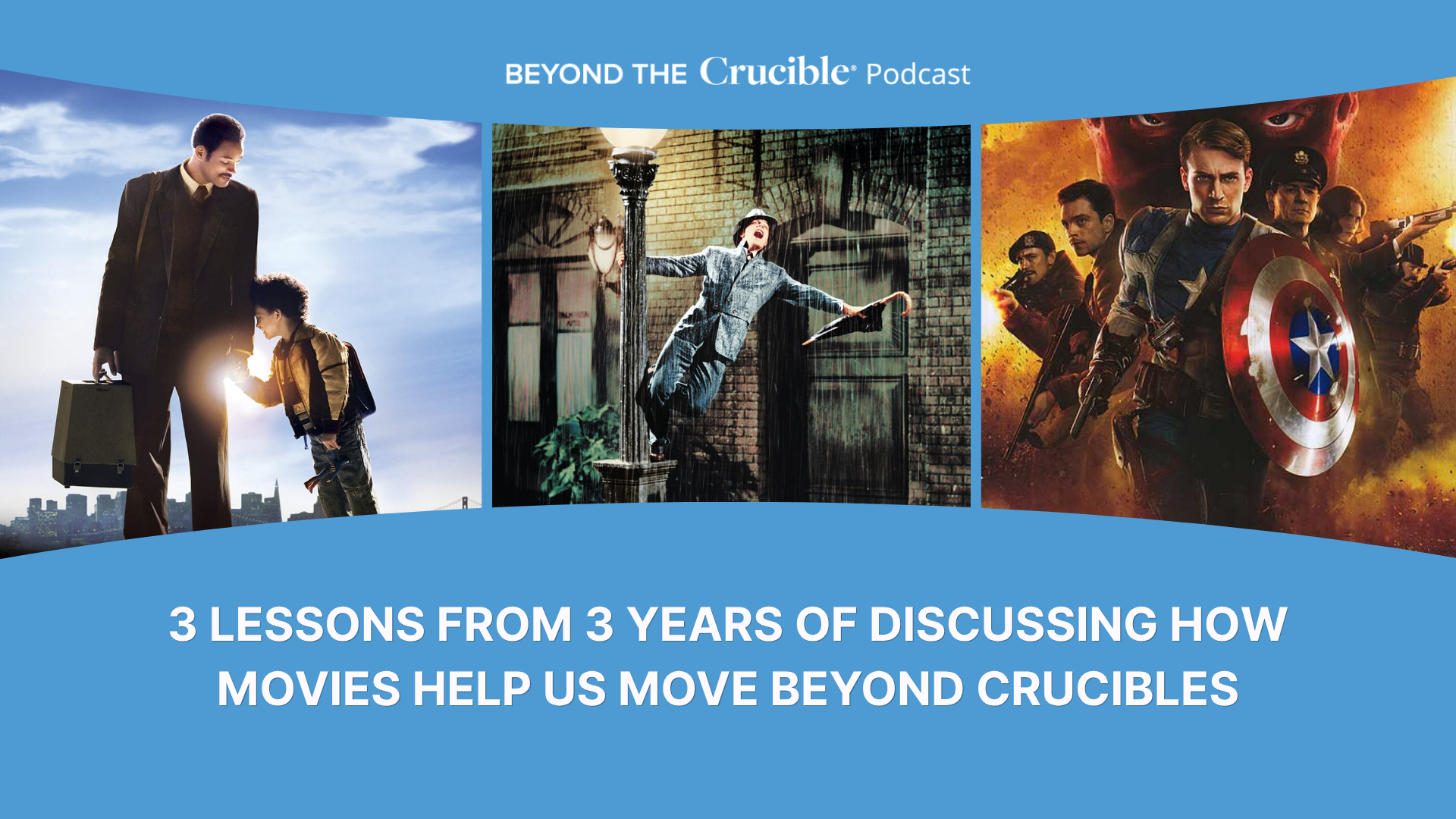
What do a homeless salesman, a singing movie star and a skinny, sickly kid from Brooklyn have in common?
You know the answer if you’ve listened to or watched our summer podcast series in 2022, 2024 and 2025, which focused on the lessons movies can teach us about overcoming crucibles and leading lives of significance after them.
As we prepare to launch our fourth such series throughout this July and August – focused this year on the crucibles of sci-fi cinema – we thought it would be fun, and informative, to revisit a few of the things we learned from our earlier efforts.
So, we pulled one key insight, from one film, from the previous three series to whet your appetite for what’s to come.
We chose The Pursuit of Happyness (2025), Singin’ in the Rain (2024), and Captain America: The First Avenger (2022), movies that may seem to share little beyond their status as beloved motion pictures. One is a gritty true story about survival. Another is a joyful Hollywood musical. The third is a superhero origin story.
But beneath the surface, all three tell the same deeper story: setbacks and failure do not have to define us. In fact, crucibles often become the fertile soil from which we are able to grow lives of meaning and significance.
Across these conversations on Beyond the Crucible, one lesson emerged again and again: People who move beyond their darkest days refuse to let adversity determine their identity.
Instead, they choose perseverance, authenticity and purpose. And that choice changes everything.
Lesson 1: Protect the Dream
In The Pursuit of Happyness, Chris Gardner faces what feels like an endless avalanche of setbacks. He loses money. His wife leaves him. He becomes homeless. He sleeps in shelters and subway bathrooms with his young son beside him. Life seems determined to break him.
Yet Gardner keeps moving forward.
One of the film’s most powerful moments comes when he tells his son: “Don’t ever let somebody tell you you can’t do something. Not even me. You got a dream, you got to protect it.”
That line captures a profound truth about overcoming crucibles: many failures become permanent only because we surrender our vision after setbacks.
Gardner refuses to do that.
Even when he paints “Dear Chris, you suck” on the wall of his apartment in a moment of despair, he does not stay there emotionally. He keeps pursuing the possibility that life can become something more. That how he’s living is not all there is.
That perseverance eventually transforms his life.
But here’s the important nuance: his dream was never just about becoming wealthy. His deeper purpose was to create a better life for his son and become the father he himself never had.
That’s why he kept going.
The lesson is clear: perseverance without purpose eventually burns out. But perseverance connected to meaning becomes remarkably resilient.
Lesson 2: Choose Joy in the Storm
At first glance, Singin’ in the Rain may seem like the outlier among these films. There are no life-or-death stakes. No homelessness. No world-saving missions.
But its central message may be the most practical of all.
As Warwick observed in our podcast discussion, the film embodies “having a positive attitude on almost seeing our trials and crucibles as gifts rather than something to weigh us down.”
That idea matters because crucibles do not only test our endurance. They test our perspective.
Don Lockwood, the film’s hero, experiences career upheaval during Hollywood’s transition from silent films to “talkies.” The world around him changes dramatically. Yet instead of becoming bitter or cynical, he adapts creatively and optimistically.
That famous scene — singing joyfully in a downpour — has endured for generations because it represents something deeply aspirational: the ability to maintain hope even when circumstances are difficult.
This doesn’t mean denying pain or pretending hardship doesn’t exist. It means refusing to let hardship have the final word.
Too many people spend their lives waiting for ideal conditions before they allow themselves hope, joy or forward movement. But resilient people understand something crucial:
You don’t wait for the storm to end before choosing your attitude. You choose your attitude within the storm to help you weather it and move beyond it.
Lesson 3: Character Matters More Than Strength
In Captain America: The First Avenger, Steve Rogers begins as physically weak, repeatedly rejected by the military and underestimated by nearly everyone around him. He wants to join the fight against the Nazis, but his physical condition repeatedly holds him back.
How unfit for duty in the military’s mind is he?
He is also only 5’7″ and 110 pounds. He has asthma, scarlet fever, rheumatic fever, sinusitis, high blood pressure, palpitations or pounding in his heart. He also suffers from easy fatigability, heart trouble, nervous trouble and has had household contact with a tuberculosis patient.
But Dr. Erskine sees something not in any of his medical records that others miss. He recognizes that Steve’s true strength isn’t physical. It’s moral.
As Erskine explains when Steve is given a chance to take part in a top-secret program to create a super soldier: “This is why you were chosen. Because the strong man who has known power all his life, may lose respect for that power, but a weak man knows the value of strength, and knows… compassion.”
Steve is selected over more “qualified” candidates because the doctor sees in the Brooklyn kid kindness and humility and a never-say-die attitude. Often bullied, he tells his attackers as they’re pummeling, “I could do this all day” – and that’s exactly the kind of perseverance he will need after receiving the serum and becoming Captain America.
Perhaps even more than his chemically enhanced strength and agility, Steve’s spirit to keep meeting challenges head-on – in or out of costume – is what makes him a hero. As we encounter our own crucibles, adopting that mindset of “I could do this all day” as we move beyond them is a key element to achieving a life of significance.
No one may ever make a movie based on the crucibles you’ve faced. But don’t miss the lessons movies can teach us about how to turn our trials into triumphs. The inspiration they offer will be with you long after the closing credits have ended.
Reflection
- Have you had to protect a dream of the life you want beyond your crucible? How did you do it?
- When have you had to choose joy in the storm? What was the effect of you doing so?
- How can you build up your character in the same way you build up your strength?
To explore Beyond the Crucible resources, including our free Trials-to-Triumphs Self-Assessment, visit beyondthecrucible.com.
Enjoy the show? Leave a review on your favorite podcast app and leave a comment at our YouTube channel and be sure subscribe and tell your friends and family about us.
Have a question or comment? Drop us a line at info@beyondthecrucible.com
—

Don’t forget to subscribe for more leadership and personal growth insights: https://www.youtube.com/@beyondthecrucible
Follow Beyond the Crucible on Facebook: https://www.facebook.com/beyondthecrucible
Follow Warwick on LinkedIn: https://www.linkedin.com/in/warwickfairfax/
Follow Beyond the Crucible on Instagram: https://www.instagram.com/beyondthecrucible
Take the free Trials-to-Triumphs Self-Assessment to discover where you are on your journey of moving beyond your crucible and how to chart your personal course to a life of significance: https://beyondthecrucible.com/assessment/