
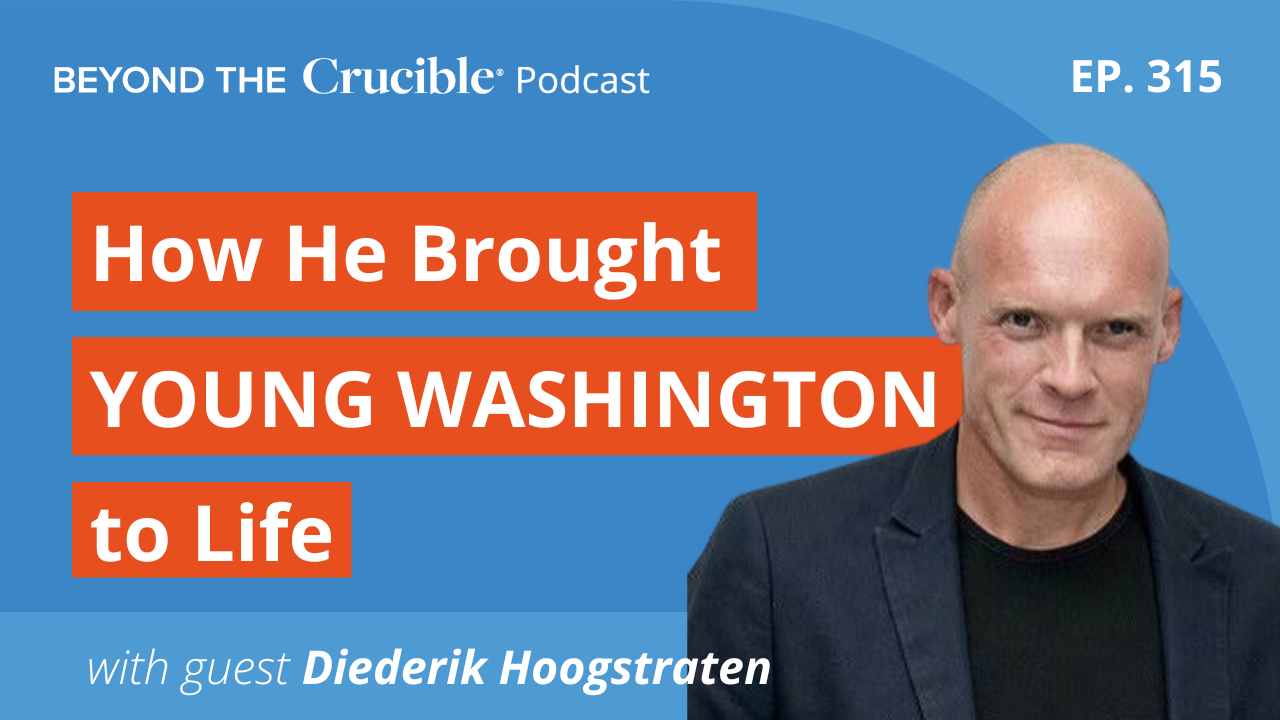
How He Brought YOUNG WASHINGTON to Life: Diederik Hoogstraten
What does it take to bring George Washington to life on screen — not as a monument, but as a man?
In this episode, screenwriter Diederik Hoogstraten joins us to share the vision behind Young Washington, the upcoming film hitting theaters July 3 that explores the formative years of America’s most celebrated Founding Father. Long before he led the Continental Army to victory in the Revolutionary War or became the first President of the United States, Washington was forged by crucibles — and Hoogstraten built the script around exactly those moments.
Hoogstraten opens up about how he and his co-writers shaped the story around the experiences that built Washington’s resilience, integrity, and commitment to service. He also reflects on the crucibles of his own life that he drew upon to bring the “father of the country” authentically to life.
Have a question or comment? Drop us a line at info@beyondthecrucible.com
—
👉 Don’t forget to subscribe for more leadership and personal growth insights: https://www.youtube.com/@beyondthecrucible
👉 Follow Beyond the Crucible on Facebook: https://www.facebook.com/beyondthecrucible
👉 Follow Warwick on LinkedIn: https://www.linkedin.com/in/warwickfairfax/
👉 Follow Beyond the Crucible on Instagram: https://www.instagram.com/beyondthecrucible
👉 Take the free Trials-to-Triumphs Self-Assessment to discover where you are on your journey of moving beyond your crucible and how to chart your personal course to a life of significance: https://beyondthecrucible.com/assessment/



Transcript
Warwick Fairfax:
Welcome to Beyond the Crucible. I'm Warwick Fairfax, the founder of Beyond the Crucible.
Diederik Hoogstraten:
To me, writing the movie, it was essential to get those very early formative years write because he faced a number of Crucibles to come up with that term again that really, really shaped him.
Gary Schneeberger:
That's our guest this week, Diederik Hoogstraten, discussing his mindset as he was co-writing the upcoming film Young Washington. The movie hitting theaters July 3rd looks at the early days of the man who would lead the American colonies to victory in the revolutionary war and become the first President of the United States. Hoogstraten explains why he fashioned the script around the moments in which Washington built his resilience, integrity, and commitment to service. And shares the crucibles of his own life that he drew a pawn in bringing the story of the father of our country to life.
Warwick Fairfax:
Diederik, it's so wonderful to have you, Diederik Hoogstraten. He is a screenwriter, producer, and author. He grew up in the Netherlands. He has spent a lot of his adult life, New York, Los Angeles, and now Texas. He is married to Kelly Merryman Hoogstraten, who was the CEO of Wonder Project, I found out. And so Diederik has done a lot of work on a number of screenplays and is the co-writer of a movie we're going to talk quite a lot about in this podcast, Young Washington, incredible movie. I very much enjoyed it. And Diederik is a graduate of the Columbia University's journalism school where he got his masters. And I understand that you write and run wherever you go and you're called the Running Dutchman, which what a title, which is a lot of fun. So before we get into the movie of Young Washington, tell me a bit about the backstory.
You grew up in the Netherlands and you've been a journalist and now a screenwriter. Were there any kind of parts of your background that just said you just loved writing stories? Or how did you get to the point where you would co-write a screenplay, Young Washington?
Diederik Hoogstraten:
That's a great question. First of all, thanks for being here. Love the show you do and it's a privilege to talk to you too. I like that question because when you frame it like that, it makes me wonder, how did I get here really? Growing up in a college town in Holland, Netherlands, as you said, long before the internet age, obviously we read the newspaper at breakfast. I gravitated to the sports section always as long as I can remember. There were good stories there. Fun fact is that the papers that we read at home, two newspapers the morning, the evening. I ended up writing for them both when I lived in New York. So that was a real badge of honor for me. But I grew up in a relatively small college town in the eastern part of Holland, middle class. I think what got me going was my dad lived for stories.
He was a minister when I was young, then he left the church to be an academic and was a beloved professor at the University of Nijmegen. I think that's maybe where it came from. I always liked to write. I always liked to hear stories, to listen. Before I got to college in Holland, I had a tough moment, a story of which I still need to write. So forgive me if I tell it a little bit slowly. My crucible moment that I've been thinking about before getting on here was when I got very, very ill at age 16, 17, had a tumor that had to be removed behind my right eye. My kids think it's very cool. I still have a scar next to my eye there and it is a spectacular story. At the time it was this experimental surgery. I was under for nine hours. My parents really didn't know if I would come out alive. I did, but I remember that time as profoundly disturbing, lonely, scary.
In my childhood, there had been a lack, I want to say, of purpose and direction and guidance generally. I love my parents dearly. My mom is no longer around. My dad and I are very close at this point. I don't think he would mind me saying that he wasn't much of a dad to a younger boy at the time. I don't think he knew what to do. And I kind of know why. All of that to say, when I got really sick, skipped a year of school, got dropped into hospitals, I remember that time as just dark and lonely. And as a true crucible, I really have taken on that term, basically listening to your show to be honest, because the question walking out of that hospital for the last time, I believe was what am I supposed to do now? The pain is gone, but now what? There was an emptiness on the other side of it.
And I'm connecting it back to your question. I wonder if telling stories initially as a journalist with distance, telling other people's stories later as a screenwriter now where I tell my own, whether that was partially an answer to that question. I also came to my faith much later, not until I went into some dark years of abuse and self-destructiveness, which we can talk about. I'm very, very comfortable talking about it. But that crucible moment I think made me grow up very quickly, made me wonder what on earth I was doing and why I didn't die effectively, but set me on a good trajectory when I look back at it now several decades later.
Warwick Fairfax:
So you went through this illness that could have killed you and you have this moment of, I don't know if it's beginning of clarity or just sense of, I want my life to matter to count for something. I don't want to just drift through life. I want to have an impact. I don't quite know what it is, but it's an affiliate with a sense of my life needs to have meaning.
Diederik Hoogstraten:
I think that's fair to say. I wouldn't have recognized it or been able to formulate it at the time in those words. But I think I started to realize I wanted to get away from where I grew up. I wanted a clean break. I went to Israel for a bit during my gap year, learned to love everything Jewish and Israeli. To this day, I'm a great admirer of the Jewish people. I think it also was a beginning of a reconnection to the faith that I'd had as a young child when my dad was a minister, but my own father, I believe, sort of left his faith behind at that time. And so in our childhood, I have three sisters, there was Christmas. That's as far as I would say, maybe Easter, but we barely found ourselves in church or even looking at the Bible. And maybe that time in Israel was the beginning of a reconnection to it.
Finally, I ended up finding myself in the United States, upstate New York as an exchange student. I'd always been drawn to America, to be honest. My wife says, "Never forget to tell people about Alex Keaton." I watched Family Times growing up. I loved the A-Team and I loved Family Ties.
Gary Schneeberger:
Oh, me too. The A-Team.
Diederik Hoogstraten:
There you go.
Gary Schneeberger:
Awesome.
Diederik Hoogstraten:
Yes, brilliant. Still love the show whenever every run shows up. But Alex P. Keaton on Family Ties introduced me frankly to the idea of a healthy defense of capitalism of Ronald Reagan, who was considered to be pretty much evil from the perspective of a progressive family in Holland. Just something about that appealed to me, spoke to me. I think it was inside of me to the horror of my family, no doubt, but I found my way to the United States. Oh, and there was also, I have this book sitting right here. I read this in college that talked real about his love for America in the 1830s.
And it's interesting that it's not really a scholarly book. It reads as an old text because it is, but it is really a very long love letter to America. And so Alex P. Keaton and Alexis the Talk Real, I feel like helped me in my fledgling love and interest in America. Once I got to New York, I frankly haven't looked back. I found my way, as you said, to Columbia Journalism School and ended up finally in Los Angeles as a journalist where I met my wife and then switched to screenwriting. One thing I would add is that yes, I think throughout this time, maybe tiny step by tiny step, I found some clarity and direction and purpose. But during all this, I don't want to forget to mention this. I was still absolutely beholden by a couple of addictions. For a long time, I heavily smoked cigarettes and I really drank to numb the pain or just to forget some of the struggles that I didn't want to attend to, I suppose.
The smoking, I quit fairly early when I started to get serious about running. The drinking really only about six years ago at the beginning of COVID, I was finally able to say no more. That's maybe a crucible moment in and of itself. And then by the side of my wife, I think and having our three amazing children, I think I truly found my purpose of living a life that is in which I am no longer the central character. And that's been such an incredible liberation for me. My children, my wife, God, our church, the school, my friends are now writing movies about truly great men like Washington.
Warwick Fairfax:
Well, what an amazing journey you've been on. I think back to Family Ties, you were the Dutch version of Family Ties, progressive family like Alex Keatons and you were not as progressive. So it's sort of art becoming reality, which is obviously ironic. And then kind of moving to the US and becoming a journalist and then screenwriter. And if you don't mind me asking, at least what were some of the struggles? There's always a reason that led you to smoking a lot of cigarettes and alcohol. What were some of the challenges that you were trying to numb the pain with that you now obviously probably through faith in part in your family, you don't have a need to numb the pain the way you did?
Diederik Hoogstraten:
Yeah, that's fair. I think good question. I think that it goes back to my childhood, to be honest, that being a boy in what I would call an all female family that was very progressive, very feminist. It was not an easy way to grow up. Don't want to call myself a victim here. Do not feel like I'm still suffering from that. But I think the... And by the way, the habits of both smoking and alcohol, I picked them up in the house age 12, 13. There was booze everywhere. There were ashtrays everywhere. It's what we did and not sure I want to blame anyone for it. It's just that I was very susceptible. I have an addictive personality. I thank God often that I never tried the cocaine when I was in New York that was everywhere, or any other really serious drugs that could have absolutely got me and maybe killed me if I had succumbed to that.
So I'm grateful that didn't happen, but I think there was a habit formed early on. And maybe as you asked that question and I think about it, maybe me finally letting go of these habits altogether also meant separating myself in a healthy way from that part of my childhood as well.
Gary Schneeberger:
I have to jump in at this point, Warwick, because you and I, Diederik, have a lot in common. I was a journalist too, not from such a prestigious school as you did, but I worked 15, 20 years in journalism. I also had a drinking problem in my past. I celebrated just earlier this month or late last month my 29th year of sobriety. So I know exactly what that comes from and journalism did not help me walk away from it. It helped me walk deeper into it. So I definitely understand what you're talking about there. It's not easy to get past, I also had cigarettes and I found oddly enough cigarettes were harder to quit than alcohol. I actually smoked a few years after I quit drinking. So you have overcome some demons for sure.
Diederik Hoogstraten:
Yes. Well, thank you for sharing that and congratulations, Gary. That is no small feat.
Warwick Fairfax:
Absolutely. So just one last question before we get to Young Washington. I understand that one of the other crucibles you have was a conflict with the Hollywood Foreign Press Association. It was very public. And I think you and a fellow member Wenting Zoo were called Rats Cancer, which is strong words for journalists. So without getting into all the details, what was that like? Because that must have been extremely painful, that whole crucible.
Diederik Hoogstraten:
It was an interesting time. I was grateful to be a part of the Hollywood Forum Press for a while, got to vote for the Golden Globes, and in fact it helped me. It actually set me on the course towards screenwriting myself. I got to read all the nominations for screenwriters for scripts and loved many of them, admired many, many of them. Some of them I remember thinking, I wonder if I could take a pass at this script to make it better. So it actually helped me in that way. There were some great people in that organization. There was also levels of corruption that are hard to describe. I had covered the United Nations in New York and I always compared it to the Hollywood version of the UN. And there came a time when both Wenting, she goes by Ting Ting from China and we were close friends at that point, where we both just couldn't live with ourselves anymore and said let's speak out.
Let's try to work with some journalists in LA who are trying to expose all of this. The backlash that you quoted from was intense. It's interesting, having grown up in a home where strong language and verbal views were very common, I think I could handle it fine. That didn't affect me. It might also be that at that moment in time, I think I was getting closer to God. I had a couple of kids. Kelly and I had a wonderful marriage. I wonder if I was just well-equipped at that point to shake it off and to say, "This is not about me. None of this really is about me. They're strong words, but they say everything about the people speaking them." And so I've left that behind. It's interesting to see that the Hollywood were impressed and the Golden Globes are still around showing once and for all that Hollywood, it doesn't really matter how corrupt you want to be as long as you throw a good party and give away some awards.
Warwick Fairfax:
I hear you. So let's talk about Young Washington. So you're the close screenwriter of this. How did you get involved in such a project? Obviously it's the 250th anniversary of the US. I have the word is pressure, but it's an honor. But to tell the story of the young George Washington, I'm sure everybody involved wanted to do it well, do it accurately but make it interesting. So talk about how did you get involved in this movie?
Diederik Hoogstraten:
Yeah. I'm glad we have a little bit of time because I should connect it to my wife's first steps to starting this company, The Wonder Project which, Gary, I know you know John Irwin pretty well. So yep, my wife Kelly and John got connected back three, four years ago, I want to say, introduced through a friend. Kelly at that point had left Hollywood behind. We lived in Austin, Texas. She had worked for a long time at Sony Pictures, Netflix, and YouTube. So she'd been in Hollywood and in entertainment, she had left that behind. But once John approached her and said, "Let's do this. Let's build something that's HBO level quality, but that's for the faith and values audience. Let's make really good stuff for people between the coasts." Of course, they can also be on the coast, but most of our viewers I think are more in the middle of the country.
And of course, John had been doing this with movies like Woodlawn, with American Underdog, with Jesus Revolution, terrific films, high-end films that made a lot of money for the studios behind them. And so John and Kelly wanted to start their own studio to produce this type of content. And two projects he had in mind were both origin stories, coming of age stories. King David, the biblical David, which became House of David, a show you can watch on Amazon. And then George Washington for many years, his mind had been set on those two stories. I believe even that some folks advising him that said, "Sound like good stories. If you want to do those, start your own place, go do it yourself." He brought in Kelly, my wife, to do the business side of it all, which he still does to this day. John is the creative mastermind of the studio.
And for this movie to your question, Warwick, Kelly said she knew of my love of America, anything American, including constitution, history, early colonial history has a deep interest of mine. She said, "You and John should talk. Just talk. I can't be in the middle of it, but you guys meet. See if you like each other." And that's what we did. We immediately hit it off. It's hard not to like John Irwin, frankly. He is not just brilliant, but also extremely kind and wonderful and just a pleasure to work with. So I brought in my friend Tom Provost, fellow writer, a frequent collaborator. Tom and I, basically, I put it like this, we spent many, many hours with John Irwin downloading his vision for this film onto our computers, just talking, taking notes. He knew what this movie would look like. And I don't know, Gary, you've been around John, you may have seen this.
It's remarkable that the first conversations with John captured the essence of the movie as you guys saw it this week. Even though there's many, many stages of development, just there's nine or something drafts of the script alone. Then you get to shooting the film in Virginia and in Ireland, you get to post-production, which takes many months. And yet what we have now with this incredible cast, by the way, is so close to his vision initially. So he basically hired me. My wife's company hired me to help write the script three years ago.
I should admit, it wasn't immediately planned for the 250th anniversary. It was planned to come out soon. It just so happened that due to all sorts of circumstances, House of David had to come first. And I've often thought that I think George Washington wouldn't mind if King David got the preference and got to go first in this case. But yeah, that's how we began.
Warwick Fairfax:
So let's talk about just some of the key themes and moments in the movie. And I just want to say as a bit of backstory for Beyond the Crucible folks, obviously my last name is Fairfax and there's a few Fairfaxes. Two explicitly in the movie one is mentioned behind the scenes, and some of them come across better than others. Well, one of the main protagonists and friend of George's growing up was William Fairfax. It so happens my oldest son's name is William Fairfax. We call him Will. Yeah, I just thought that was very funny. And in an alternate universe, you could have said to John, I got the perfect cast member. I know Joel Smallbone is good. He's Australia. I'm from Australia. I think that's great. But how about this, John? William Fairfax as William Fairfax. Wouldn't that be cool?
Probably a few years younger than the characters meant to be. And my son is actually a pretty humble guy, so that's probably would be a bit of a challenge to play the William Fairfax as portrayed in the movie, but I find that kind of very amusing. So in one of the early scenes, we sort of see a bit of a life change for George. We see that his dad has died and he won't be able to go to school because they really don't have a whole lot of money. They're not like the Fairfaxes that have nobility and money. And I think Brother Lawrence, half brother Fairfax is a superior class and the world's an unfair place. But there's sort of a key scene where how many kids go, "I want to go to school," but they won't let him. The school just turns him away. And there's a key scene where George is talking to Lawrence and Lawrence gives him these classic books.
People aren't educated the way they were back then on Plato, Seneca, Plutarch, and basically just read these books and he does. So just talk about those scenes and George's attitude, because it's really life changing. He wants to be successful and it would seem like at the beginning of the movie, that's not going to happen. This is a class structure, even in America at this point. So talk about those early scenes and what do we learn about George and his character from those early scenes.
Diederik Hoogstraten:
I love that question because as you know, later in the movie we get onto the battlefields for real and there are elements of the Patriot and the Revenant even when he goes off into the wilderness, which at the time was Ohio, the Western frontier. But to me, writing the movie, it was essential to get those very early formative years right because he faced a number of crucibles, to come up with that term again that really, really shaped him. And for instance, what I really hadn't known was that he desperately wanted to go to England to go to school. As you said, his father passed away when he was nine. He also lost his half brother, Lawrence, who then stepped in to be his mentor as you see in the film. But he begged his mother, he begged Lawrence like, "Let me go, not just to school, but let me go to London." Now that part, it's a little bit less visible in the film as it was in the first draft that we wrote, but his mother really was very firm.
And this is true apparently where she said, "I know you were going to go to England. That's where your brother went. And if your dad had been around, fine, but you're one of the men of the farm now. We got to work." And one of his mother had been a little softer hearted and had said, "Sure, George, we'll ship you off to London." We might never have seen George Washington again in the later United States. And history could have been very, very different. So I like thinking about these little hinge moments in history where if this, then that. Back to your question though, I think he was forged in loss and tragedy, George was. People may not realize that because I think we think of him as the father of the country, an austere and distant figure and the greatest American. Joseph Ellis, one of his biographers said he's considered the father of the country.
And as Freud and Shakespeare have told us, it can be very difficult to approach your father and to understand your father and to have an honest picture of your father. I can testify to that myself as well. And so in that way, I think the movie is an attempt to really understand who he was, how he became who he was through loss, through suffering, but then starting to display these virtues. And there's three things I think in his character that we try to expose as the movie goes on and that's his resilience initially in the face of these challenges. And then his integrity that he starts showing when he's finally allowed and able to serve in the military, which is not easy for him either because as you said, he wasn't off the right station. And then I think later in the movie, we get to this idea of service that initially it was his ambition really and his deep need for status and for recognition that drove him.
And later toward the end of the movie, we get to what's some of the qualities that we know of the later Washington, and that is to be a servant leader. But again, I think the building blocks for all of that are in the early parts of the movie. And I'm very grateful for the cast, especially man, the guys playing George Washington, just tremendous.
Gary Schneeberger:
Warwick, can I jump in just because Diederik said three words that we say all the time at Beyond the Crucible are keys to moving beyond your crucible and leading a life of significance. He said, "Resilience, integrity and service." Explain a little bit more. Why are those things so important in the context of having this conversation on a podcast called Beyond the Crucible?
Warwick Fairfax:
One of the things we say a lot at Beyond the Crucible is this statement that's hard to live by, which is it didn't happen to you, it happened for you. Nobody likes the crucible. You didn't like some of the crucibles you've gone through. I certainly haven't and certainly Gary hasn't. But it's like, okay, in the case of a young George, this isn't fair that my father died and then later his brother and he won't be able to get an education. Time and again, he wants to have a royal commission. They basically are not so many words laugh at him. That's not going to happen. He doesn't have the money anyway to afford it, but he's just a colonial but yet he never is defined by his crucibles. He doesn't like it, but he chooses to overcome them. And so many great lines, his brother says, "Obedience could be commanded, but respect must be earned." And if you desire to be great, you must study well time and time again, there's this expression which obviously everybody would understand.
Lawrence, his brother says, "We are Pawns, but even a Pawn can take a king." And spoiler alert, but the American forces do indeed defeat the British and the United States is born and King George is defeated. So there you go. In case you didn't know that did happen. So that is a brilliant line. And he also says, "To obtain the applause of men is a heartfelt satisfaction." But he says, "To merit it is my highest way." He doesn't want applause for men just because of it. He wants to earn it. The deep seeds of his character are written in very early in this movie, which is brilliant. So those early scenes. We see him with Sally, which again, if anybody knows anything about American history, the founders of our country, I'm also American citizen now, it's not George and Sally Washington. It's George and Martha. So that's a bit sad. I think history would tell maybe she had the love of his life.
Certainly he was always very good friends with Sally. So that's a great backstory. So we mentioned he does some surveying work for Lord Fairfax and goes into the wilds of the Allegheny and that was a pretty tough journey. So he comes back and somehow the governor finds a way to make him like a major in the militia, and off he goes to sort of look at these French forts that are out there. The French are on the Western frontier and the British obviously don't like that. And so there's that whole kind of scene. So he comes back, sees the governor. There's some peace treaty he has to sign. I guess he's not good at reading fine print. And so that's not good. He finds obviously he doesn't get Sally, but somebody else does, somebody maybe of my name. But eventually he gets set out again and that doesn't go particularly well.
And really sort of one of the key scenes I would say in this movie is when that whole experience with his Virginia forces against the French, he is really not a military leader at this point, doesn't go well. And you see the movie for the amazing details and he comes back and he feels like he's a complete failure. And he says, "Yeah, his mother was right. She knew he'd failed, which is not exactly what she said, but that's how he interprets it." And his mother says some incredibly wise things. I wanted to get your thoughts on this, in which his mother says, "Failure is the tutor sent by God if you don't learn from it. You fail twice. If you do learn from it, you've learned wisdom." And so his mother says, "If you must return to soldier and go as God's servant, do it with your whole heart, find your path, make it yours, make it straight and prove them wrong." She says again, "Because even a Pawn can take the king."
So at that point, it's the lowest point in the movie, he feels like a total failure. His mother really offers wise words. So talk about that because he could have said, "The deck is stacked against me. I'm quitting. I was set out to fail. I knew nothing about soldiering. I'm humiliated." All of the generals and the governor will say, "See what happens when you send out a colonial to do the work of true British officers. These colonials they're idiots." And so talk about that scene because George doesn't just give up like many would. So what does that tell you about George's character at that point in the movie?
Diederik Hoogstraten:
Thank you for that. Beautiful to hear some of those lines read back to me. Actually, that's special. Thank you for noticing all of that. The mother, as I listened to you, I realized that this idea of resilience actually was modeled by Mary more than... She lost her husband. She had a lot of land and a farm and quite a few kids and animals. And of course, servants or slaves who were there and who also need to be fed and housed and be part of it. That was life back then. And so she not only managed but kept her sanity and her wisdom and her wit. And so that scene, I think it's surprising that it's ultimately his mother who says, "Okay, you failed, and I didn't want you to do this in the first place." She doesn't say, "I told you so." She says, "Are you going to get back up?" That's really the question she asks him.
And I think that's so powerful that if a parent can... I see this in my own kids every day, can you encourage them enough to want to get back in there. Not tell them to do it because that usually doesn't work, but also don't cuddle them and tell them, "Oh, just come feed the horses for the rest of your life and just hang out." As we wrote that, I thought a lot about that resilience and then integrity is, of course, it's not the absence of failure but only the question of what you do with it. As a broken person, as a fallen, as a sinner, if you will, if you want to put it in biblical terms, what do you do when things get that hard? And one of the reasons I tell people now, this movie should resonate with all of us so much today is because we have such small, tiny problems now in our lives. And yet we want to give up or we want to reach for the alcohol or we want to just close the curtains and go quiet, or just scroll social media. That the things he went through were real.
I won't give it away, but some really, really dark stuff happens on the battlefield in these early scenes, beautiful scenes, the way John Irwin portrayed that and the way Will Franklin Miller did, who plays George Washington, I think he captures something there beautifully. But that level of loss and struggle that can be overcome. And mother Mary, again, we interpreted this based on historical facts that we could find, but we wanted her to be that voice of encouragement and of sort of a steady kind of support. And maybe in a way that many of us wished we had a mother or a father to do that. There's a little bit of that in it. In that sense, I might envy George a little, but he had that and thank God he did because he literally got back in the saddle as you described.
And things still don't go so well in the battlefields, but they gradually improve. I also love Sir Ben Kingsley in this film. He just captures that Governor Dinwiddie so well. And it's also, to me, a crucial little scene when George comes back into the office and says, "Governor, I have failed. I am done." That to me shows his integrity. You might interpret it as giving up, but I think he's willing to accept the consequences of his decisions and his actions. Of course, Governor Dinwiddie immediately says, "Well, that doesn't reflect very well on me." So he's still in his ego phase, but George himself says, "That's not the point. I think I need to step back and accept these consequences." After which the mother encourages him to not give up.
Warwick Fairfax:
His brother Lawrence actually provides incredible wisdom and love to George from Beyond the Grave. We see this, and this is so well written and so well laid out in which we see George looking at a book that was, I guess Lawrence gave to George. And in the inscription of the book it says, "Dear George, you were right. I was wrong. The world in its ways can change. Your most affectionate brother Lawrence." So before he said, "Give it up. You can't change the world." And he's saying, "No, George, you were right." That's sort of a, as I sometimes say, like a drop of grace. And then one of the pivotal scenes in the movie is you see George going to, I guess it's General Braddock and another sort of second in command. His name is Gage. And what's interesting is George has failed if the whole world at the time, at least in the colonies, he's failed.
He's saying, "Look, I don't need rank or pay. I can be your aid to comp." That's basically saying, "I can be your executive assistant. I can just write your letters, you dictate anything. I just want to learn from you and do what I can to help." And even General Braddock is pretty full of himself. He admires this young man. This man has failed, but yet he doesn't really want anything other than to be with, to be an aid. And I don't know, it doesn't look like Gage would've kind of allowed that if he was in combine just judging by the expression on his face. Talk about that because that is an incredible moment of humility. And he's not being defined as we say by a worst day, by failure.
He's saying, "Okay, I failed, but I'm willing to learn." That level of humility is all inspiring." So just talk about that because that's one of the key scenes in the whole movie, showing a young George's humility.
Diederik Hoogstraten:
Yes. Thank you for that again, because I think the Washington we later got to know, I think every biography talks about his humble demeanor, his humility, his ability, of course, to step back from his commandership in the army and later as president. We thought it was important to put that first inkling of his humble nature and his humility in the movie. That was the right moment, I think, because it allowed us to also show some of the humanity of General Braddock with Andy Circus, like you said, very full of himself. But also George showing the humility reaches Braddock in a different way as well.
For character development in a film, if you want to get to this idea of the servant leader, which we want to show that really George is becoming and that's how we get to know him later in his life. And then I think that a humble character is an essential part of that. And so we had to find a way to show it. It ties into, in that, I believe in that same sequence but I haven't seen the movie in a little while. But it ties into this moment when once he has offered his services as, like you say, an executive assistant, they're on their horses, they're on the trail and he sees some of his old buddies who he hadn't seen since some very bad stuff happened. And he jumps off the horse and he says, "Give me an axe. I want to help you clear this trail."
And so not only is he getting sweaty doing the manual labor, he's also then apologizing to them and saying, "I messed up and I will never leave you out there hanging again." Not to give it away, but later in the movie, he will prove that point. So yeah, it was really once his mother, as you said, had, as you described, beautifully work, had set him up in that direction. He then took that onto the field, if you will, onto the trails, into the frontier area where they were going to battle the French and some of the Native Americans and led with humility.
Warwick Fairfax:
That's so well said. So just giving just a very broad overview without getting into details of this movie. He's back obviously with General Braddock and you'll have to see the movie. But let's just say that General Braddock is full of himself and George tries to offer him some pointers based on his experience, but Braddock's like, "I got it." So you see how that unfolds not too well. So there's a time when things are challenging and George rises to the occasion, and finds a way to rescue some of the Virginians in a very difficult situation. And that really changes the arc of his career because he becomes a hero, not because necessarily have done so well, but he finds a way and actually uses some tactical intelligence. Again, see how he manages to do that. It's a great scene when he figures out a way to rescue his fellow Virginians.
So he comes back now and he's the hero. He's in the local paper, the Virginia Gazette, and they write just about his exemplary courage. And he was sick at the time. And as I said to Gary [inaudible 00:43:40] in the paper, it says he did this despite being an infirm condition. I don't think probably, either of you used the word, this particular person was an infirm condition too much, I'm guessing, and you're right.
Gary Schneeberger:
I never did in my journalism career. I don't know about you, Diederik.
Diederik Hoogstraten:
No.
Warwick Fairfax:
But it's great. And the governor, you're right, a player by Ben Kingsley, this is so well written, he says, "The most failure is the end." This is after he comes back, not exactly having succeeded, but at least rescuing some of the Virginians. The governor says, "The most failure is the end. For you, it only seems to be the beginning. And since leadership is the problem, I'm going to give you the opportunity to answer a second chance." So he makes him a colonel again in the militia. And the full arc of his character is shown, at the end here George Washington. He's now a colonel in the militia and he's got his Virginians, Virginian militia in front of him. And again, these words are just incredibly written and just sum up the arc of the journey of this character. And so George says to the militia, he says these words, "I'm not a British officer. I'm not a gentleman of England. I have no title, no Royal Commission. What I do have is you, all of you. I'm a Virginian and it is my honor to serve."
And all the men shout to Virginia. It's an incredible scene. So you've got this confident but yet humble George Washington, the man that we will come to know later on in the American Revolution. So this is an incredible evolution. So just talk about the evolution from the bottom of the pit of failure and humiliation to now he's a hero, confident but yet humble. And all of his men, they're cheering him. This is an amazing evolution of... So what do you see as you see this evolution of George Washington in this movie?
Diederik Hoogstraten:
Man, you are very careful and brilliant film watcher. I have to say that's such a good analysis and such a great focus on some of the key moments in the film. So I truly appreciate you taking the time to notice all of that. I want to illustrate the point you're making by also that scene where Thomas Gage, the British officer serving directly under General Braddock at some point says there's a retreat which may or may not have been true. "And Washington, what could be the risk of going into battle and probably dying?" And he says, "My men, my men are worth the risk." And I bring that up because I think that that is a culmination of this character development. In modern terms, I think early on he was driven by ego as we probably all are as kids, as young people, status, it was all about what can I achieve? Where do I belong? It's all about I, I, I.
And for him, this development happens quickly. He's not even in his mid 20s by the time at the end of the movie the scene you beautifully described, where he actually leads his men with humility and with that confidence. But I think he's been forced, I should probably say, to get away from that egocentric, ego driven, self-driven journey to realize the choices I make affect people very dear to me, whether that's my mother, my little brother, the men who I'm supposed to lead or the men who I'm supposed to serve or the country. Of course, it wasn't a country yet. We're talking about the colony of Virginia primarily. So he is able to get out of his own way, if you will.
I think that there an element that we don't address as much in the movie, but you quoted his mother talking about God. Of course, they read the Bible. Of course, they were all Christians. We know that, that was how they lived. And I'm personally pretty convinced that his faith was also building and growing during that time. Historians might take me on there. We don't really know. I'm just inferring from what we do know and from what we know about that time. And then again, from the development of his character that you described, that arc, it's almost impossible for me to imagine that there wasn't a higher power guiding and supporting and showing him the way really.
Warwick Fairfax:
So as we look at Young Washington here, and one of the lessons for us today about George Washington aspirate in this movie, what can we take away from it? Especially as we try to crawl our way out of our crucible, out of the depths of the pit, what can we learn from George Washington this movie that applies to our lives today?
Diederik Hoogstraten:
Yeah. Well, it's some of the things that you've summed up and that we've been discussing here, the choice between what's convenient and what's right. I think that keeps popping up for young Washington. What do I maybe want to do? What feels good? What is easier? Or what could be considered my calling or my purpose or what is this higher idea? And as I listened to your interview with Mark Divine, terrific. I really stopped and paused when he talked about the need to go quiet, to go internal to whether that's prayer, meditation. My sense is that Young Washington did a lot of that. And we see some of it in a movie, whether he's riding a horse or chopping a tree or sitting by a stream when he's really young and really, really distraught. And this movie I think is trying to show us that a young man can suffer so many challenges and failures and setbacks and losses and yet come out as what one biographer calls it our greatest secular saint.
If we have a saint in America, it's probably George Washington. So to keep in mind for young people especially, hopefully they find it interesting and exciting. This is a fast-moving movie. There's a lot of action. There's some romance, there's war, there is violence in it. As they watch it, I hope they can find meaning and recognition in this idea. Yes, we do fall. We always do, we all do, and that's not the end of it. In fact, it can be the beginning. And that to me would be the key for myself, frankly, learning about him and writing these scenes that you're describing. I really took that away for myself again, almost as a reminder. I've tripped up quite a bit in some ways. I sometimes wonder if I deserve to be here. I think all of us can have that little bit sort of an imposter syndrome in life, but then a project like this can help remind us.
Of course, Church on Sunday can do it too, reading, connecting with others by the way. Sorry, the last thing I'll say to this question on George, he is not afraid to be open to the connection to others. So even when he doesn't want his brother in the room, he doesn't want the counsel of his mother or his friends trying to tell him or warn him, he is and stays, I think, open to that connection. And that's a big lesson I think for many of us when the urge can be to push away, to separate, to close the door, to be alone, instead try to find it in yourself to say yes, to open yourself up.
Warwick Fairfax:
One of the things you're highlighting, Diederik, and by mentioning just the podcast we did with Mark Divine is we talk a lot on Beyond the Crucible about the importance of the soul work. That's the greatest journey. It's a journey within. It's the development of character. And one of the things that I don't know that we fully appreciate now, but back in the 1700s, part of the 1800s, the development of character was something that was focused on. And that is certainly something I think Lawrence probably would've been believed in George's Mother Mary. And certainly George he's reading these books not just about to educate him about history and science and math and what have you, but about character. And I think of my own ancestor, my great-great-grandfather, John Fairfax, one of the things they did was play a parlor game and they would talk about who's your greatest hero.
We don't do that today. Maybe there aren't too many great heroes. But back in the day they did and they would have, I'm sure, in George Washington's time as he was growing up in those circles. And so for my great-great-grandfather, John Fairfax, his greatest hero I believe was Nelson of Napoleonic War fame and his wife, Sarah's Wellington. But it's not just because of the deeds, it's because of who they were. So you could say, "What's the greatness of Washington?" It was because his primary aim in one sense was the development of his character. Yes, I think it was inspired by God, but it was wanting to be a great person in the sense of having great character, humility, courage, servant leadership, service. That's why he's so great, not because he was a brilliant military strategist, which he wasn't. But he was probably one of the main focuses in his whole life was the development of his character, the development of his soul.
It's a lost era because yes, it was him, but there was a cultural estuary, if you will, at that time amongst some people that that's kind of what you did develop your character. Did everybody do it right? Did they pay lip service to it? But at least it was part of your education. So just talk a bit about that because that's not... We don't talk about that in school these days with our kids. Character development is important. Let's talk about these books and these characters in history. What can we learn from? We don't do that, right?
Diederik Hoogstraten:
Exactly right. That's such a great point. And the movie very clearly I think shows how important that is to George himself as opposed to the Fairfax family. So it's interesting that the lower class, the lowly colonials took it a lot more serious than the English upper class, the posh folks across the river. They just wanted good parties and wanted to make sure the right people came to the parties, which did not include George initially. But I hear you on that work. It's funny, my own children, our kids go to a neighborhood school here. It's a private school called Regents. It is a classical Christian school and character formation is an explicit part of that school. It's one of the reasons we're there. So they think of this project as a triangle, family, school, church. We work together on shaping, helping to forge that character. And I think that's what we see in the movie as well.
I wish it was still around. I think about my own grandfather born in 1911. I think he still got a lot of that in his early education around World War I, I suppose we're talking, but it's harder to find these days for sure. I think to George it came natural, thanks to probably his father who we don't see in the movie to be fair. But his mother, his brother, it was simply part of their family culture and what a gift for him.
Warwick Fairfax:
Well, one brief amusing comment before we close talking about Fairfax is William Fairfax doesn't come across too well. I like to think my son, William, has better character and certainly a strong faith. But William comes across as this sort of pompous, self-important, I'm rich, you're not. Now, I guess it's his cousin, Lord Thomas Fairfax played by Council Grant. He comes off a bit better, but one amusing fact is the Fairfaxes that own most of Northern Virginia, they're from Yorkshire. And we actually a number of years ago met the descendants of the Lord Fairfax, there is still one. My family, surprisingly and not surprised, and it came from Warwicks, hence my name. I like to think the Warwicks of Fairfaxes might be a bit more humble, but who knows? That's a different branch, but there you go. It's just those Yorkshire Fairfaxes. What can you say?
Diederik Hoogstraten:
Absolutely. I think you're on the good side of the traffic.
Warwick Fairfax:
I'd like to think so. Their Fairfaxes don't come across too well, other than Kelsey Grammar's, Lord Thomas Fairfax, but there you go.
Gary Schneeberger:
That will bring us the planes on the ground. We finished this fascinating discussion, really a two for one. There's Diederik Hoogstraten, his story, and then the movie he wrote, Young Washington. And I am now going to, because I'd be remiss in my duties as host if I didn't do this, Diederik, how can people learn more about the film and more about the Wonder Project?
Diederik Hoogstraten:
I appreciate the opportunity. Wonder Project is a channel on Amazon Prime. So all the content including later on this movie will be available there. Of course, the movie is releasing wide in theaters on July 3rd right before the Independence Day weekend. Angel.com, they'll start selling tickets very soon. You can already find a QR code there and this is kind of interesting. I think you guys will appreciate it. There's a QR code there to allow you to pay it forward. You can buy a ticket for a high school student and this is important. There's five million high school students learning about American history any given day. We hope and think that this movie can bring history to life in a way that they might not be exposed to as much. Books are wonderful. Books are one thing. A movie can have a very different effect on a young mind as we all know.
And we hope that folks pay it forward to some students who might not be able to have a chance to see the movie, otherwise that's on angel.com and of course wonderproject.com is available as well.
Gary Schneeberger:
Warwick, as always, the last question or questions is your prerogative, so take it away.
Warwick Fairfax:
So Diederik, this is a question we ask a lot at the end of podcast discussions, but there might be somebody today that maybe they feel like today's their worst day, maybe what was done to them was horrific, or maybe they've made a catastrophic mistake, maybe the world sees them as a failure. Either from your life experience and/or George Washington as portrayed in this movie, what would be a word of hope to somebody might today feel like today's their worst day and they've failed, life's over, or they've just had a terrible experience? What would a word of hope be to that person?
Diederik Hoogstraten:
What a powerful question and an important one. Maybe I can combine experiences of young George and myself. I struggled with a lot of depression, alcohol and other bad substances were the answer to that. I think George was probably pretty depressed. That was not a word they would at the time. So I think in response, sure, you can be angry, sad, tears are great, isolating yourself can be necessary. But ultimately I would say open the door, open the window, let the light in, let the air in, let others in. It took me a while to learn this lesson. In fact, I married my wife a little bit later because it took me just a very long time to be able to say, "Okay, God, I hear you. I understand I am not supposed to live this life by myself." And in fact, trying to do so, it's not going that well.
So connect, open the doors, let the light in, take a deep breath. Those are big ones. If you can find the ability to live for something greater than yourself, whether that's kids or spouse, your God, your community, that's I think where the answer lies ultimately.
Gary Schneeberger:
Friends, I've been in the communications business long enough to know when the last word on the subject has been spoken. And our guest today, Diederik Hoogstraten, has indeed spoken. So Warwick, we just finished a fascinating discussion with Diederik Hoogstraten, who is both someone who's been through crucibles and someone who's written a film that's coming out soon called Young Washington. And in that film, Young Washington, as in George Washington, goes through a lot of crucibles. So lots of topics, lots of ground covered. What are some takeaways that you would like our listeners and viewers to have from this discussion?
Warwick Fairfax:
Yeah, thanks, Gary. It was an incredible discussion with Diederik and hearing about his life story, as well as the story of the young George Washington as portrayed in this incredible movie Young Washington that comes out July 3rd. Highly recommend seeing it. And so it's interesting that Diederik, he had crucibles as a kid. He had an illness that was sort of touch and go, that he kind of made it through that. And that began the beginnings of thinking about what is my purpose in life? How do I want my life to count? It wasn't fully formed, but he was beginning to think about that. He grew up in a family that was fairly progressive and it's just so funny as he watched Alex Keaton, The Family Ties. Somehow he identified with Alex Keaton and became, I guess, a little less progressive than his family and became a person of faith. Went to Columbia grad school for journalism and became a journalist and then a screenwriter.
And as a person of faith and his wife now works with the Wonder Project producing uplifting movies and movies that would cater to a faith-based audience. And so he's had his own challenges, but I love the way he wrote this movie and the way he and his wife and John Owen, who is the head of Wonder Project, his wife Kelly is the chief executive of the Wonder Project and they're such a great team, great actors in this movie. And really as you look at this movie Young Washington and the story of a young George Washington, you see throughout all the scenes, there's a lot of battle scenes, a lot of incredible moments, but it's really an evolution of George's character. We talk a lot Beyond the Crucible about the most important journey that you can go on is the inner journey, the journey of the soul. It's the soul work.
And you see in this movie a young George, he loses his dad when he's a young boy. A number of years later, he loses his half brother Lawrence. Life is hard. He doesn't have the money or the status to get a royal commission in the British Army. All he can get is into the colonial militia, the Virginia militia and he's looked down upon by the professional soldiers and he has challenges in a campaign in what was then thought of as the West in Western Pennsylvania into Ohio. He doesn't do so well and he comes back as a failure. And the generals, the British generals and the commanders, they view him as a failure and they're probably thinking, well, of course he's a colonial. He doesn't really have any formal education, which he didn't after his father died. He was self-taught, but he didn't go to school.
And rather than just say, "Okay, life is over," which he could have, he said, "Okay, I failed." But he shows incredible resilience. And he goes to General Braddock who was going to lead a campaign out to fight the French who have a bunch of forts in the Western part of the English colonies. He basically says, "Look, I know I failed, but I'll go as your aid, basically as your secretary, if you will." And General Braddock is pretty full of himself, admires this young George's humility and allows him to come. And there are great scenes where a young George Washington rescues his Virginia troops, or at least his Virginia countryman in really a scene of epic courage and bravery and it changes the arc of his career. The governor Dinwiddie played by incredible Ben Kingsley appoints him as a Colonel in the militia. And he's still not going to commission in the regular British army, but at least Colonel and the Virginia Militia and is now respected by the troops. So really by the Virginia militia.
Really, this movie shows the evolution of George Washington and really the growth in his character. Failure doesn't define him. We say all the time at Beyond the Crucible, your worst day doesn't have to define you. If you learn the lessons of your crucible, you can say that your worst day didn't happen to you, it happened for you. George Washington models that as well as anybody I can think of. He is not defined by his worst day. He picks himself up. He learns from his failures. He shows incredible humility. And really as history shows the greatness of George Washington is because of the greatness of his character. The fact that we have a United States is due in large part to George Washington, and that is due in large part to the greatness of his character. Read about George Washington, not just the battles and history which is important, but read about his character. Look for moments of evolution and strength of character. We can learn a lot from this movie and from George Washington.
Gary Schneeberger:
In light of what you're saying, he said three things Diederik Hoogstraten did that I think are interesting to talk about. One, he said that through his struggles with his crucibles, what Washington developed was three things we talk about all the time here, resilience, integrity, and service. That's one thing he said. The second thing he said was that you, Warwick Fairfax, are a very, very, very excellent viewer of movies because he complimented you... Sorry to embarrass you, but he complimented you on the way in which you apply what you watched in the film to ask questions. And then the third thing, probably the best thing to get your comment on is your note about without Washington going through what he went through, we wouldn't have America perhaps. And it made me think after he said that, I thought that's true for all of us. If we didn't go through our crucibles and come out the other side having learned lessons and applied them to living lives of significance, I know my life wouldn't be where it's at right now.
I think you'll probably say your life wouldn't be where it's at right now. And I'm sure Diederik thinks the same thing. Pick any of those points that you want to talk about. If you want to talk about more than one, go ahead.
Warwick Fairfax:
So many good points. Yeah, it is amazing George Washington's resilience and you make a very astute point. His failures made him the man that he was. And not just his failures, but how he dealt with them. He liked the fact that he was considered a failure after going to the wilds of Western Pennsylvania and Ohio and just being humiliated by the French troops and French commander. No, but he didn't let that failure define him. He learned from. He learned both the military tactics as well as just learnt and grew as a human being. That's really the greatness of Washington is his ability not to be defined by his worst day. And yet without those failures he wouldn't have the resilience that he needed and certainly in the revolutionary wars, as I mentioned in the podcast, he lost more battles than he won. He was not a great military strategist and history would tell you that.
He was up against the British army at the time the greatest army on the face of the planet in the late 1700s, early 1800s. But yet he knew that he had the wisdom to realize that survival is what matters. So he kept making sure that the American army would survive. He wouldn't go to pitch battles where he would lose and wipe out his whole army. He found a way to survive and eventually he got help from the French military and the American colonies eventually won. So yeah, the genius was really his humility and his character and he was willing to learn and grow. So there's so much we can learn. And you're right, if my crucible hadn't happened and I hadn't done the takeover or it had worked, I still would have been in Australia mined in this massive media company, but not really fitting in because I'm not a chief executive type. I'm a reflective advisor. There would be no Beyond the Crucible. There would be no book.
I met my wife Gail in Australia. We probably still would have been married, but our kids would have grown up there with being a Fairfax in Australia is like being a Rockefeller or a Bush in this country. It's not fun in the sense that people have expectations. Yeah, we wouldn't be doing this podcast. If either of us hadn't bounced back from our crucibles, then who knows? There wouldn't be a podcast. Would there be movie books that you write and have written? Who knows?
Gary Schneeberger:
No.
Warwick Fairfax:
It's like, would you have met your wife Kelly? Or you met her years before, but would you reconnect it?
Gary Schneeberger:
Right. Re-met her, yes.
Warwick Fairfax:
Yeah.
Gary Schneeberger:
Probably not.
Warwick Fairfax:
You're right. You don't have to be defined by your worst day, but if you learn the lessons and don't let that failure define you, the best days can be ahead. You can be a stronger, better person than you ever possibly could have been. That's true. I think for us, it certainly is true of George Washington.
Gary Schneeberger:
For sure. Crucibles are the spark for a new life.
Warwick Fairfax:
Amen.
Gary Schneeberger:
So until the next time we are together, please remember what we've discussed here on this episode. Your crucible experiences are hard. Diederik's were hard, Warwick's were hard, mine have been hard. But what we've learned here and through the story of George Washington is that your crucibles aren't the end of your story. In fact, if you learn the lessons of those crucibles, if you like Washington, develop resilience, integrity, and service, you can chart a course to a new destination that is the most rewarding destination you can ever reach, and that is a life of significance.
Welcome to a journey of transformation with the Beyond the Crucible Assessment. Unlike any other, this tool is designed to guide you from adversity to achievement. As you answer a few insightful questions, you won't just find a label like the helper or the individualist. Instead, you'll uncover your unique position in the journey of resilience. This assessment reveals where you stand today, the direction you should aim for, and crucially the steps to get there. It's more than an assessment. It's a roadmap to a life of significance. Ready? Visit beyondthecrucible.com. Take the free assessment and start charting your course to a life of significance today.