
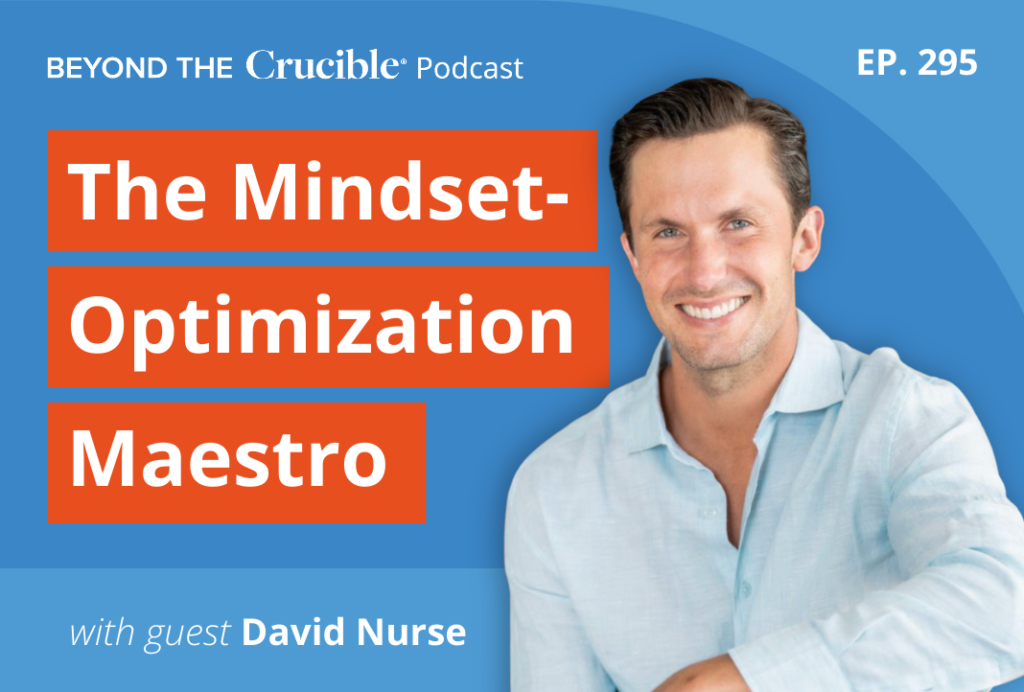
Meet the Mindset-Optimization Maestro
Meet the Mindset-Optimization Maestro
From coaching CEOs of Fortune 500 companies to transforming the mindsets of sports teams, David Nurse specializes in helping high achievers break through barriers, unlock their flow state and discover the untapped potential that’s already within them.
What sets Nurse apart is his ability to make mindset transformation relatable and actionable. He delivers real tools that companies and individuals can immediately apply to maximize performance, culture, and creativity, unlocking the mystery of mindset optimization.
To explore Beyond the Crucible resources, including our free Trials-to-Triumphs Self-Assessment, visit beyondthecrucible.com.
Enjoy the show? Leave a review on your favorite podcast app and leave a comment at our YouTube channel. And be sure subscribe and tell your friends and family about us.
Have a question or comment? Drop us a line at info@beyondthecrucible.com
—
👉 Don’t forget to subscribe for more leadership and personal growth insights: https://www.youtube.com/@beyondthecrucible
👉 Follow Beyond the Crucible on Facebook: https://www.facebook.com/beyondthecrucible
👉 Follow Warwick on LinkedIn: https://www.linkedin.com/in/warwickfairfax/
👉 Follow Beyond the Crucible on Instagram: https://www.instagram.com/beyondthecrucible
👉 Take the free Trials-to-Triumphs Self-Assessment to discover where you are on your journey of moving beyond your crucible and how to chart your personal course to a life of significance: https://beyondthecrucible.com/assessment/



Transcript
Warwick Fairfax:

Welcome to Beyond The Crucible. I'm Warwick Fairfax, the founder of Beyond The Crucible.

David Nurse:

I believe life is this long hallway, right? So, if you're listening, imagine a long hallway. You're at the start of the hallway, you look down that hallway, and there's doors on each side. And everything that we do is learning, teaching us, preparing us for the next thing along the path.

Gary Schneeberger:

That's our guest this week, David Nurse, explaining just one of the mindset practices that will help us get from setback to significance. He's a former NBA assistant coach, listened closely to learn what he helped the Brooklyn Nets accomplish, whose insights have helped thousands across the globe take action and live with alignment.

Warwick Fairfax:

Well, it's so great to have you here, David, and loved reading your book, Pivot & Go: The 29-Day Mindset Blueprint to Redefine and Achieve YOUR Success. I know that's your first book. You've got a couple other books since. And just a little bit about David. So, David, for the past 15 years, has been blessed to help the world's top performers unlock the zone and actually stay there. So, that's Fortune 500 CEOs, NBA All Stars, elite military units, Hollywood A-listers. And growing up as well here, David chased his own dream to be a professional basketball player. And that led him to have two Guinness World Records, which we'll have to find out about. The stint with the Brooklyn Nets in 2016, and he helped take their three point shooting from 28th and the league to second, which is very impressive. He's worked with over 150 NBA players, three books, Pivot & Go, Breakthrough and Do It, and has also been rated as one of the top 50 keynote speakers in the world. And he is married to his wife, an actress Taylor Kalupa. And very briefly on Taylor, she's been in a number of programs such as The Fix, Modern Family and Chosen. And I'm one of these people, not that many of us, but at least guys that like both Hallmark and Great American Family, she wrote a Christmas movie called Christmas Less Travel that I really enjoyed.

David Nurse:

Oh, nice.

Warwick Fairfax:

About Old Red, the Red Pickup. Great movie. So, well done, Taylor. Not only she's a-

David Nurse:

Oh, nice.

Warwick Fairfax:

... wonderful actress, she's a great script writer. So, well done.

David Nurse:

I mean, yeah, she's awesome.

Warwick Fairfax:

So, there you go. You can tell Taylor... When I think of Taylor, I think of Big Red and Christmas Less Travel. So, there you go. So, David, tell us a bit about growing up. I know you grew up in Iowa in a small town and your dream very early on was to be an NBA player. A lot of kids think that and their parents are thinking, sure. But just tell us about what life was like in Iowa and that dream that just animated your young life and yeah.

David Nurse:

Yeah. I mean, I think sometimes it's a blessing to have incompetent confidence to an extent. And my parents were so encouraging and I told them I wanted to play in the NBA from as early as I could remember. So, every waking hour was centered around basketball, shooting in my driveway when it was snowing in Iowa, going to any camp that I could. They probably should have said play tennis or golf, something that a 6-foot 2 guy with a vertical leap about two inches would have had a better chance at. But I just loved it. And I think there's something really important from a young age of chasing your dreams and something you're passionate about. It led me to play college basketball and led me to play professionally overseas. Now, I always thought I was still going to play in the NBA when I was playing professionally overseas in more of a Will Ferrell semi-pro type of league, as you know, work in Australia where I was at, but...

Warwick Fairfax:

And what was the name of the team in Australia in Adelaide?

David Nurse:

Yeah, Adelaide. The Adelaide Bearcats. Yeah.

Warwick Fairfax:

Yeah. Great night.

David Nurse:

It was such a fun experience. I mean, I think the life experiences I got to be able to see the world through basketball was probably more of a blessing than I ever had imagined. Now, I wanted to play in the NBA and still had those dreams, but when the doors shut in my third year of playing professional basketball in Northern Spain in the Basque region where they don't even speak Spanish actually, it's a wake-up call. It was a moment that I had that I got cut from the team and I go back home and I'm living on my parents' recliner chair. They're living outside of Kansas City in the time in a small town of Missouri. And I'm a big believer in these moments in our lives. I call them snapshot moments where you can remember vividly exactly where you were, what was said. And they're moments, they're pivotal moments that give you this opportunity to take one of two paths. I was feeling bad for myself. I was sleeping on my parents' recliner chair for about six months. I didn't have any backup plans. I probably should have had some backup plans in college of like, "Hey, what if the NBA doesn't work out?" But I didn't. So, my mom was doing dishes and I remember this vividly and I was kicked back in the recliner chair and she said, "David, when one door closes, four open and an entire beachfront patio overlooking the ocean." I was like, "Mom, what? Come again. I thought it was one door, one door. What's this beachfront patio and these four doors thing?" What she was telling me is that everything that I'd done to that point to play in the NBA was learning these transferable skills that I could use for something else. My path that God had planned for me was not to play in the NBA, but it was to coach, to help players who had more God-given ability and athleticism and height than I did. So, I made my pivot moment, hence the name pivot and go, these snapshot moments where you get the chance to either keep running into this wall that's ahead of you or pivot to the next thing. I believe life is this long hallway, right? So, if you're listening, imagine a long hallway. You're at the start of the hallway, you look down that hallway and there's doors on each side. And everything that we do is learning, teaching us, preparing us for the next thing along the path, along the hallway. We go into one door. My door was professional basketball with air quotes, and I learned from that. The next door is, I want to coach in the NBA. So, I went all in. I hand wrote a letter to every NBA GM because I had no NBA connections at the time. I did it old school style. I put it in the mailbox and I sent it out. I didn't get anything back. Month and a half goes by, I get a phone call, 310 area code number. It was the GM of the LA Clippers. His name was Gary Sachs. And it was the nicest guy. I think he did it just because he just has such a good soul. It was a quick conversation. At the end of it, he said, "Look, if you're ever in LA, look me up, we'll grab coffee." Basically, "Good luck with the rest of your life, kid." But that door was opened, right? He gave that opportunity. So, I took that opportunity. I spent all my money, I stole some of my parents' money to be able to book a ticket, to go out to LA that following week, acting like I was going to do a basketball camp so I didn't look desperate. But I prepared for that meeting and Gary and I, we hit it off. That was the entry point to every connection that led to throughout the NBA, which is now friends with almost every team, eventually led to coaching with the Brooklyn Nets. So, the story is, it's much longer and we'll get to that crucible moment with the Nets when I thought That I'd made it and when I was thinking I was a little bit too big for my britches there. But the point of it is like everybody has these moments, everybody, when you think what you wanted was taken away. Nothing just happens easily. God doesn't do it that way. We have to learn, we have to grow. And that was my moment where I was like, "Hey, feel bad for yourself for getting cut from your dreams that didn't work out or pivoted to something even better and reaching out, taking that chance, even though I didn't know, like Gary could have never got back to me." Nobody could have got back to me, but I would have been at the same spot, you know what I mean? I think life is about taking those chances, taking those shots and knowing that what's the worst that can happen, that somebody says no, and then you're at the same spot that you are. So, to be able to get to that spot, the NBA connections, it happened through other people and Gary was that one for me.

Warwick Fairfax:

It's really a remarkable story. And you write a lot in your book about resilience. I mean, talk about that earlier crucible when your whole dream was to be an NBA player. I mean, 6'2" doesn't sound that short, but obviously in basketball, it's a different average high. And I remember you write something funny. I think the pediatrician promised your mom or parents you're going to be 6'7". And it's like, seriously, how could you be five inches wrong? Because that could have made a difference. And you played in Spain, Australia. I think your dad was a coach for a... To be honest, I didn't grow up with the NBA, but an NBA D level, one level below the NBA. And even he said, basically, "Sorry kid, I got to cut you." It's like you're an uncle...

David Nurse:

As an uncle, yeah. I hope my dad wouldn't do that to me, but my uncle did.

Warwick Fairfax:

I mean, it's like, are you serious? So, when you realized that you were playing countries all over the world and you were not going to have a career playing basketball, how did you deal with that? Because that original dream ended then. A lot of people would just get very angry, very bitter, and not even think of pivoting to coaching. How did you decide not to just be angry and bitter and say, "This is so unfair. 6'2" is not that short. Come on, I can shoot, which obviously we'll get to later"? I mean, what's the problem here? How did you not get bitter and angry about the whole thing?

David Nurse:

Yeah. I mean, I think at the end of the day, my hope and trust is in Jesus. That's the choice that I made when I was 22 years old, that his plan is better than my plans. Sure, I'm going to go for it and have my dreams and stuff. But even if I feel bad for myself, which I totally did, it wasn't a quick bounce back like, "Hey, okay, that didn't work. I'm onto the next." I felt the feelings and everything, but I also knew that if this door was meant to open, it would have opened. So, I need to look for other doors and there's other ways to get in the NBA and my gifts that God gave me are better set for leading, for motivating, for coaching. And so, that's what led to coaching in the NBA. Now, hey, when I was there, you learn everything from every situation that you're at. I'm a big believer in it. It's not really about wins and losses. It's about learning and growth from that learning. And when I was with Brooklyn, I was 28 years old. So, I was young, a young NBA coach. And we had, right when I came on, we had this super hot streak, went from 28th, which is almost last in the NBA and three point shooting percentage, all the way to second. So, I was getting all this media and New York media, NBA media, like this new development coach and he's doing such a great job. So, of course I was drinking my own Kool-Aid of like, "Eh, I got this. I'm in this league for the long haul." And at the end of the year, the head coach got fired, which if you have a bad record, that happens in sports. And when that happens in sports, 99% of the time, the entire staff is gone as well. So, as quick as I thought that I made it to my mountaintop moment, I was going down the other way and the crucible moment happened again where I poured five years into getting into this NBA coaching job. So, I said I met Gary Sachs, but I didn't just wait for him to make calls. I went and ran my own basketball camps and I had these custom-made basketballs, terrible leather, this line down the middle where you could see the rotation on it. I had them ordered from China, which it was back. They sent these a few basketballs to the Oakland Seaport. I drove from small town Missouri 29 hours out to Oakland, put them in the trunk of my car. I spent the next five years of my life traveling around the country, doing basketball camps for anybody that would take me in, sleeping on friends' couches who probably didn't consider me a friend, random people, and crashing in my car in well-lit Walmart parking lots throughout the country. So, it was a journey to get there. So, to have that moment where once again it was taken away, it was like, "Huh, gosh, here we go again." But once again, it's this path of which choice, which road am I going to take? And I'm a really big believer on the choices we make determine who we are going to be. Now there's different levels of choices. There's tier one, which are the most important, which is your faith, the person you marry and kids or not kids. I think those are the three irreversible to an extent, choices. And there's tier two and tier three and on down the line. And that choice for me to make after I got cut from the nets was another big determiner of where's my life going to go because we always get the chance to feel bad for ourselves and lick our own wounds, right? And you'll have these people, and I've seen it many times of like, "Oh, you got a raw deal. Oh, you shouldn't have been fired. You were a good coach. They're terrible for doing that." And you can agree with that crowd who's going to say that, but what good does it do? Like, you don't get anywhere from it. So, part of that, getting cut from the basketball team in Spain, getting fired by the Nets, it's just this moment in refinement in the fire that makes you even stronger for the next thing to come, even though those moments suck, even though any pain that anybody goes through does suck, totally. But if you embrace it and you know that on the other side of it, there's something great in it, and you get the ability to teach other people that are going to go through that very similar thing and help them along their path, then that's when you find the fruit of it and the growth from it.

Warwick Fairfax:

Yeah. It's so well said, David. I mean, one of the things we say here Beyond The Crucible, which is really we've learned from a lot of our guests, that phrase that didn't happen to you, it happened for you. I mean, we've had so many guests, some with just horrendous crucibles. We had a woman, Stacey Copas from the suburbs of Sydney, and she was an athlete in high school, and she dove into an above ground pool like kids do and was diagnosed as a quadriplegic. So, she went through what you would expect-

David Nurse:

Wow.

Warwick Fairfax:

... suicidal ideation and drug abuse. But later on, she's now a speaker and consultant, and she's actually grateful for what she went through, which doesn't mean that she's happy about what happened, but the person she is now wouldn't have been possible without that. Now, we've heard so many stories like that. You can't just dismiss them all as just like delusional, crazy people and what does this mean? But yet, and you did that in that you said, "Okay, this is awful. Not only do I not get to play in the NBA, I don't even get to coach in the NBA." It's like, what's next? It's not quite a job experience, but it probably felt like that at the time. It's like boils and hail. And I mean, fine. I mean, what's next? I mean, So, you probably went through a bit of that, but I'm sensing you didn't languish there for years when that happened. You probably were angry. "Hey, this is unfair. Look at my record. I understand that a coach brings in his team. I get the NBA logic, but come on. If there's one person he should have kept, it's me. So, come on, look at the record. I mean, don't you want to be second in shooting? Isn't that important in the NBA? Maybe not. What do I know? And you could have gone through those angry internal dialogue. So, talk a bit about that, because my guess is you didn't dwell on that anger almost sulking mode for too long, right?

David Nurse:

Yeah. Yeah, totally. I mean, we all have that self-bias, right? We're the coolest people in our own minds and that part of that is that the incompetent confidence that I had. And I think you need to have a little bit of that, a little bit of that type of self-belief, self-swagger to it, but it's also about life moves very fast. And at the end of the day, where you're at right now in your life is probably not where you're going to be at five years, 10 years from now. And it's so hard for myself at the time, and I think just for people to paint a picture of the future that they want, and then also be able to be flexible, nimble, be able to pivot along the road that will eventually lead to that path or a path there of very similar. And yeah, so life is choices. It's like, like I said, it's perspectives and choices. You get either one road or the other road. You get the road of, "I'll feel bad about for myself, and this will be my narrative that I tell myself that I was wronged." Or you get the path of, "Okay, what can I learn from this? What can I extract from this to be able to take to the next thing?" It's like the analogy of you squeezing a lemon, you're making lemonade from it. I mean, obviously the whole life gives you lemons things, but that's where it comes from of what is the extraction you can take from that situation to be able then to apply to a much better situation that will come. And I think the hardest thing for myself at the time, and for most people is, you can't actually feel what the tangible thing that is going to come, right? The old adage, again, I'm using all these cliches of chopping down the tree, one swing of the ax at a time, you might take a thousand swings of the ax and you don't see that tree fall down, but then there's that one swing that does it. And then you look back, you're like, "Oh yeah, I knew that was coming." You didn't at the time. Had you, you might have had more foresight to be able to be calm in the moment. I think it's just the belief though, right? And that's where my faith in Jesus and God comes into play where I know he's going to work it out. I know he's going to work it out and he does it time and time again where it's better than I could imagine. I wouldn't ever have even imagined I'd be doing the things that I'm doing now, speaking to companies and different countries and coaching CEOs and starting a protein gummies company of all things, like all these different opportunities that have come along the way of just being open to the next door that will potentially be an opportunity that I can go down that path.

Gary Schneeberger:

And that will have a Lakeside Villa and a bunch of other rooms around like...

David Nurse:

Oceanside, I'm not selling for the last year.

Gary Schneeberger:

Oceanside. Yeah, yeah. Oh, sorry. Sorry, my bad. My bad.

Warwick Fairfax:

My bad. So, I want to talk a bit about the first book, Pivot and Go. And you talk about, it's built around 29 days saying that's what it takes these habits to have a whole lifestyle change. We'll get into in a bit just these concepts you have here of success, faded, joy, passion and confidence, but to find in a bit of a different way than most of us would do, but you have a lot of really just profound insights like you have a chapter on the rich life when you were doing these camps all over the world. Yeah, you probably weren't saving as much money as maybe you could have, but yet what you saved in a sense, more important than money was life lessons. So, talk a bit about that because one of the things you say, which I love is the only treasures that you will, without a doubt, never have taken from you are your own personal life experiences, your own lessons learned, your own faith developed, your own memories created. That's not a normal way of thinking, to think about experiences when you're actually trying to build a business, but yet in the end, you learn something much greater than that.

David Nurse:

Yeah. Isn't 2020 hindsight so bad? I wish I could say I had that in the moment too, but yeah, I mean, you always remember those type of memories and those type of moments. And my whole thing with what you're speaking about there is, I set this goal of I wanted to make $100,000, which seemed like a lot to me at the time doing basketball camps. And every spot that I was in, I looked as a transactional dollar amount from a basketball camp. And what I didn't realize at the time was I was going into these unbelievable countries. I tapped into this market of international schools, which spoke English, so there you go. And to be quite honest, they didn't have very good basketball programs. So, anything that I was doing was a value add. I was able to do these camps in Singapore, in Hong Kong, in Japan, and throughout Europe. I was just looking at them as like, "Okay, the mission is 100K. I've got to get there." Instead of thinking, "Wow, I could immerse myself in this unbelievable culture in Singapore that hardly anybody from America gets to go check out and be part of and stay with families there and get to know the people." So, it is the hindsight thing of everybody's looking at like, "What's the next thing? Let me just get through this moment instead of actually sit in the moment and be present in the moment." And I've done this whole study recently on Flow State, which is essentially being in the zone where time dissipates, it's effortless effort. The thing that defines it the most is these top performers or athletes that I've interviewed and is being able to be actually present in the moment without ruminating on the past and without having anxiety of the future. And I truly do believe that the most joyful people in life are able to spend more time presently present than in the other two slots of past and future. So, the learning lesson for me, which I still struggle with for sure, I think a lot of people would resonate with this of, you're looking for the security in, whether it's financial bottom line, whether it's in identity based, whether it's in people looking to you for social media likes or whatnot, when you look in your security in something other than one, Jesus and two, also the being present in the moment, you're going to tend to be stressed, anxious, worried, and everybody wants to be in that present moment. So, it's that dichotomy and that paradoxical tension of how do we get there and how do you feel secure in that moment? And to me, what that taught me was God's got the plan. I honestly believe he just keeps beating it over my head. Whether I'm ever going to listen or not, that's the question, but I know it's there.

Warwick Fairfax:

You've talked about identity a bit and you do have a chapter in there where you talk about coming to faith in Christ. I think it's like Western Illinois University and a group called Fuel that I actually hadn't heard of, although I go to an evangelical church and all of a lot of different ministries. So, I have a sense that that grounding of faith in Christ changed your whole perspective about identity and it's a process. It's not like it's one and done. I've got all the answers. So, next time I make a mistake or bad things happen, I'll just say, "Boy, thank you, Lord. This is wonderful. What can I learn?" I realize, as they say, sanctification's a process, but my sense is that, although you probably didn't realize that that choice you made at grad school changed your life and enabled you to have some of these perspectives you have about choice and identity and the journey. So, talk about how that happened and how your faith has really influenced, I would guess everything you do and write about.

David Nurse:

Yeah. And it is that, right? It is everything that I do and write about. And it was, I think the biggest thing is, I keep coming back to just the plan and the vision and the future is, I get a lot of excitement out of waking up every day, knowing that I've got goals that I want to hit, I've got a big mission that I'm on, but also knowing that at the end of the day, none of it really matters, which sounds like, "Hey, then why are you doing it?" But it's for a much bigger purpose, but I know the pressure isn't on me. Does that make sense? It's like a basketball player who can just go out there and just like, "Hey, if you miss a shot, it's cool. Keep shooting. Just keep shooting." That's how I look at the life perspective because the best athletes that I've ever been around, basketball players will talk about the Shai Alexander who I trained who's the best player in the world right now, or being around Steph Currys and all these guys, they don't worry about missed shots because they know that that doesn't define them. They know who they are and they're like, "I'm just going to keep shooting because I've got a big purpose. I got a big mission." So, it changed my life and my senior year of college, like you mentioned, I went to this thing, fuel with a teammate of mine and I knew God, but I didn't have a personal relationship with Jesus and the people there were just, they were so joyful. They were like praising and high-fiving and like encouraging each other. I was like, "What drug are these people taking?" And I wasn't doing drugs or anything like that. I'm not sure I drink my fair share of alcohol here and there in college, but I was intrigued. I was like, "Well, how are these people so joyful?" So, I kept coming back and I kept coming back and then I realized like, wow, okay, they have the love of Jesus Christ and the Holy Spirit with them, like I want this. And that honestly was where it changed my life. And I said that earlier, the tier one choices we make, that was the best decision that I ever made. It changed the trajectory on anything that I do professionally, the way I live my life, the way that I don't feel pressure with having to perform. And the second-biggest decision I made was marrying my wife, asking my wife Taylor to marry me and I cannot even imagine what life would be like without her. She is everything as in is makes me better, encourages me, just that was another best decision that I ever made. So, to me, I'm hitting home runs in the two most important areas of life and I wish that for everybody because if you're missing those, it's going to be a rocky road. I really believe if you miss those two, you're probably in for some strife in life.

Warwick Fairfax:

Talk about those two because obviously there's a link you write in the chapter about your wife when you tried to find a future partner in life, a future wife, and it didn't happen. And you wrote... I'm just going to sounds trite, but a lot of truth is trite in terms of the sayings. I'm going to let go and let God and just... I think within three months, you were having coffee with her in Los Angeles. So, I mean, it seemed there was a mindset shift, a choice that directly, at least as you write it, led you to meeting Taylor, maybe not just meeting, but maybe being in the right place to meet her. Does that make sense? Is that what you wrote or that sense?

David Nurse:

For sure. Yeah. And I think the biggest one there is people's decision, do you settle or do you pursue what you know is great? Do you settle for good or do you go for great? And I think that's a choice we make in a lot of different areas in life. And one of the biggest detriments to people is settling. And I truly believe people will Settle for the comfortable when they know the comfortable is not the great. I had this in a relationship before I met Taylor. I was like, "It's good sometimes and it's really bad sometimes, but is this what it's supposed to be?" And I had a friend tell me, he's like, "Hey, look, the struggles that you have now in that relationship, they're only going to 10X when you're married or if you have kids." And it hit me like a ton of bricks. I'm like, "Whoa, all right." So, there is better out there. And I made a non-negotiable list of the things that I wanted in a wife. I mean, it was spot on to what Taylor is and she's even more than that. Come to find out she had 52 different things that she'd been praying about since she was seven years old that she gave to me on our wedding day and I hit all of those, which I tooed my own horn here. I've got some good qualities here, but it was basically like spot onto that. So, it showed me don't ever settle because you'll just be miserable and actively pray for the things that you want in a spouse and actively ask God to open your eyes to find that person. And you can be very, very picky. And I don't think a lot of people tell you that. I think a lot of people will say, "Well, you make the most of it. You just married somebody you made." No, absolutely not.

Gary Schneeberger:

I have an interesting, to me anyway, about not settling. And it's funny because it came from a place of absolutely the worst motives ever. So, I'm in my late 20s and I meet this woman at a journalism conference. I was a reporter and she was engaged to somebody, but I liked her. So, I said to her, this is the phrase I came up with, "Never settle, strive." And it was purely selfish on my part. But guess what? 35 years later, that has become a motto of mine, and it has been for 35 years, this idea of not settling, striving, moving beyond, don't settle for the thing that's here, right? Don't settle for the grass, right? Pull up by the weeds. I mean, clear things out, do those kind of things. Don't settle for what looks like it might be good. Go after the thing that you know is good. So, I love hearing you say that. And I hope our listeners and viewers grasp that idea that you're not going to find the great movements of your life in settling, right? When I'm ready to go, I'm going to list the hundred things that I have done in my life. And I guarantee you of the top 100 things I've done, it's not going to be any time I spent watching Netflix. I can guarantee that's not going to be one of them. It's taking action and doing something towards the goals that you want to achieve.

David Nurse:

Man, I love that. I was telling somebody this the other day, and isn't it funny? I honestly, I can't remember series that Taylor and I watched like two weeks ago. We watched it in the evening, it's just like a little nighttime routine. We'll watch a show and stuff, and we'll be so into it. Two weeks ago, I can't remember the name of it. I can't remember what happened. What does that show you? Was that really important? Probably not.

Warwick Fairfax:

No, that's so good. One of the other things that's really interesting here is obviously the story you shared about sending handwritten notes to the 30 GMs and the NBA. I mean, that takes, I don't know if an insane level of confidence, persistence, it's remarkable. But one of the other things you say, which is very counterintuitive, everybody thinks networking is great. Find the people that can do stuff for you. And it's all about what they can do for you. But yet your mindset, you talk about having, was it like the Golden 15, you had this incredible instance in which here you were coaching on the coaching staff of the Brooklyn Nets, you're in Dallas, Dallas Mavericks, and Mark Cuban is there. He's on the court just practicing his shot. And you did something that I don't think anybody would actually do. It's like Mark Cuban, billionaire, goodness does. So, talk about what you did and what you didn't do, because it's incredibly counterintuitive, that whole instance. It's really a window into your philosophy that's not what many people would have.

David Nurse:

Yeah. I gave him shooting lessons. I gave him shooting lessons on the court before that game. And it wasn't out of a way of like, "Hey, I hope Mark can help me start a business or invest in something that I do someday." It was genuinely out of a... I had a passion for teaching people how to shoot a basketball. As weird as that might sound, I loved when people would become better shooters, more for the point of they become excited about what they were passionate in. To me, that vehicle was shooting a basketball, which I later realized is inspiring people for what they love to do and helping them uncover roadblocks to be able to get there. For Mark, he loved basketball. He loves it. And he was a really bad shooter and he's better now and not all thanks to me obviously, but gave him a few little pointers. And I told him I'd send him more drills because the real players had to start coming to warm up before the game. We were in Dallas before a Brooklyn Nets and Mavericks game. And he's like, "Yeah, he was really excited about it." So, I sent him over more drills in an email and just sent him an email the next day thanking him, right? Just didn't expect anything to come back from it. And I got an email five minutes later just thanking me for the time and everything. And we stayed in touch, are still in touch to this day. And if I ever have a business question, I can send Mark an email and ask him a question. And it's like, what better person in the business world to be able to have pick their brain or tap into than Mark Cuban? But that was all because I was helping him with something he was passionate about. I wasn't going up to Mark and saying, "Hey Mark, I've got this business question. Can you help me with the business?" So, there's different angles to be able to help people. And I think there's two types of people. There's givers and there's takers. And whether you get burnt by somebody you pour into, and I've been burnt many, many times and spend a lot of time, I'll serve people, I'll serve people, but I'll just keep doing it because it's all going to come back in the end. I don't know how it's going to come back. And there's been crazy ways where I did not expect something at all of a seed that I planted by serving somebody years ago and then they come around full circle. Like even this protein gummies company that I started, when I started raising money from it, I reached out to people who I'd served or knew years ago and they're like, "Yeah, I'm an investor. I would love to invest in this." I'm like, "My goodness." So, it just goes to show you is don't transactionally use somebody in a relationship, do it for the betterment of what you have gifted in you to be able to help them get excited, be passionate about what they're doing and then let it sit. Stay in touch with them, cultivate the relationship and maybe something will come back to you in the end. And in my own life, I can only speak from my own experiences and what I've seen in friends too, is it does come back to you. And it comes back to you from the right people as well. So, yeah, that's the crazy Mark Cuban story.

Warwick Fairfax:

Yeah. I mean, that's just remarkable that you, and you talk about the golden 15 of having 15 relationships that you pour into. And again, your philosophy is not what you can get out of them, it's what you can give to them and how they can help you be a better person, but not about what they can necessarily do for you in your career. That is so counterintuitive. That is not traditional networking. It's anything but...

David Nurse:

Traditional networking just seems... I hated it when I was in a room and I'd be having a conversation with somebody and I could see their eyes darting around me, like looking up at who else is... I was like, "All right." And then you just make those decisions, right? You're like, "This is not a person that I want to be. I'm going to make these life decisions that reflect the better side of it and the human relationship side of it, instead of the transactional networking side of it."

Warwick Fairfax:

No, it's so well said. So, really at the end of the book, you summarize, you talk about relentless consistency, which obviously is in part being consistent in how you live out your faith every day. We'll have good days and bad days, but from my perspective, what's the trajectory? What's the arc of your life? If it's a graph, is it like down or is it up in terms of how you live out your faith and you redefine a series of terms, success, failure, joy, passion, confidence. So, talk about how, because your definitions are very different than the world's definitions. I mean, they're radically different. So, talk about those because none of them is what people would expect.

David Nurse:

Well, it all started for me in basketball players talking about going through shooting slumps. And every time somebody would talk about a shooting slump is where you're missing a lot of shots, their whole body language would just change. And what I realized is like, well, what if we changed the word slump to hippopotamus? Would it change it? And they would laugh and look at me crazy like, shoot, shooting hippopotamus, but like, look at that. It's just a word that you're letting dictate how you feel. And that's what got me onto this of like, whoa, why do we have to let these words that were taught be able to define how we feel of it? Like what if failure meant something different than what the world teaches us? What if wealth, what if confidence, what if they all meant something of a different fashion? And I'm a big believer in defining your own words, especially using failure, for example, like the two greatest basketball players of all time, Kobe Bryant, Michael Jordan, and their mental coach is a good friend of mine, George Mumford, and he said they would look at games, they would look at wins and losses, not as wins and losses. They didn't care about that. They looked at things as momentum and learning. So, if they had a great game, they're like, "That's momentum. I built some momentum on this. I'm going to keep doubling down on this." So, if they had a bad game, they're like, "All right, how can I learn from it?" And it just changes the whole trajectory because you're not defining yourself as a winner or a loser, but you just love, like they did, the joy of the competition, but it's the competition with self, not that necessarily the competition with your neighbor or somebody else on social media. How do you continue to strive to be the best version of yourself? And I think, and it's also once again, it's not in a, "Hey, the pressure's on you." This is the joy. The joy of the constant growth and relentlessly pouring into yourself so that you can better others. And I think a lot of that we have to start with, a good spot for people to start with is redefine your own words. What does rich mean to you? What does it truly mean? Is it money or is it time with your spouse, your kids doing incredible experiences and adventures? What does failure look like? What does confidence look like? What does consistency look like? Define your own main important words, and that's where that concept came from. It's served me very well in life.

Warwick Fairfax:

Yeah. I mean, you've talked about failure and that's really good. It's not a loss, it's a lesson. True success isn't tied to anything the world has to offer. It's living at each stage to come more fully who you are made to be, knowing you are doing so for a much bigger purpose than yourself. That truly is a great definition. Joy is understanding that extreme struggles and drastic changes you go through, all part of the adventure, shaping you into who you were made to be, passion, speaking into existence, what is it you want to be and taking their daily steps on the path to reach that goal. I love this one about confidence, being comfortable in your own skin, no matter how quirky it might look to you. And it's the knowledge you have a gift from God, specifically craft and creative for you. We're all quirky. We all have our things that our spouses know. Some they love, some they find annoying, but that's okay. We are who we are and being comfortable with yourself what's in all. I mean, this is really game changing all of these concepts. They're not normal concepts. I mean, do you find people look at you like you have two heads when you talk about these terms and say, "Say what?" Because you're talking at a foreign language for each of these words.

David Nurse:

Yeah, sometimes. I mean, the comfortable on your own skin is a fun one for me because I'll say things and do things in public that my wife's like, "What are you doing? What are you doing?" But it's just to see how people react and see how people feel and just show that be yourself. That's the most attractive quality somebody can have is just truly being who you are, not trying to put on a mask or trying to act like somebody that you're not, but just truly be comfortable with who God has created you to be and comfortable in your own skin. So, yeah, it's a different way to look at things, but I think when people hear it, they're like, "Yeah, I want that." That's very freeing for me.

Gary Schneeberger:

And I will display that I do that myself with all the bracelets that I'm wearing. I'm a devotee to that.

David Nurse:

I love it. I love it.

Warwick Fairfax:

So, I like how you end your book talking about choice and we all get to choose how we want to live. I know in my case at Beyond The Crucible, I love what I do with the podcast, helping people realize that they're not defined by their worst day because I, as listeners know very well, I was in that space, gosh, back in my 20s and early 30s when I did a 2.25 billion dollar takeover from my family's 150-year-old media business, which ended up after three years not working. So, am I going to be defined by a 2.25 billion dollar failure? I'd like to think not. And I think what's important to me, and fortunately for me, I found the Lord during my undergrad days at Oxford, but I really try and live that. So, for instance, I wrote a book Crucible Leadership a few years ago and I went around speaking and I'm not a natural speaker, but I got with some training got to, I think competent to the point where at least judging by the audience, I was effective even though I'm not a natural speaker, but I came to realize I don't enjoy that and I blessed financially in that I don't have to do that. And so, I do write blogs, podcasts, we're very active on social media, but I don't like traveling all over the place. And so, it's like, well, if I don't have to, I'm not passionate about it, even if I'm effective, then why do it? I get to choose to create my own life. I'm an elder at my evangelical church. I'm on a few other nonprofit faith-based organizations that I contribute to with some strategic advice and I love all that. That's part of what I love to do. So, everybody gets to choose their own adventures, choose their own life, but so often we're living the lives of others. And you have so many stories in your book about people living, certainly in sports, living their parents' dreams, which many athletes do. So, talk a bit about, I know it sounds simple, but you have a choice how you want to live your life. Don't live what you think people want you to live. And it seems like you've lived that to the max, is right? You constantly try to live in light of what you feel called to by the Lord, not because of what anybody else is telling you to do, right?

David Nurse:

Yeah, totally. And thanks for that. I mean, it is one thing that I do really make sure that I stay away from what the media is saying or what the world is saying, like this is what you need to pursue. Because I feel like they try to funnel you in a way that do this, do this, do this, don't take chances, don't take risks, just go with the flow. And that never turns out to be the right way. And it's, my dad was, and it's funny saying the masses are fill in the blank with that, so don't follow them, run the other way, run the other way fast if everybody's going one way. So, I think that's really stuck with me. And it's just been, whether it's very uncertain times when you go your own path, because it is uncertain, but you're doing your own path, your own thing. And the best way to summarize the whole podcast itself is God does have the plan. He's not going to leave you hanging. Go and just take action on your dreams and your goals and what God's called you to do, but know it's probably not going to be exactly what you foresee it to be, but it will be better because God has the ultimate plan.

Gary Schneeberger:

We promised David to get you out for your next meeting that you have. I also promised that before we did that, I would give you the opportunity to let listeners and viewers know how they can find out more about you on the worldwide web. How can they find more about David Nurse?

David Nurse:

Yeah. Website is davidnurse.com, social media, David Nurse NBA. Books are all out there in Amazon. Company is called More or Less Protein. It's Protein Gummies. It's a whole nother story in itself about relationships lead to incredible things. But yeah, I'm very easy to get ahold of. And I just want to thank you guys for this opportunity and thank you guys for what you are doing. You are using your skills, your gifts, abilities, and a platform to be able to show people the true light. And that's so needed, especially in today's day and age.

Warwick Fairfax:

So, David, let's say, there might be somebody here listening and it might be their worst day. They might think there is no hope. They're defined by that faded, by getting fired from that job. What would a word of hope be for that person?

David Nurse:

Just keep going. Don't give upness is the greatest skill that you can have. What if there's a word called don't give upness. Just don't give up. Keep looking at different opportunities of what are the skills you've developed through that thing that you just got fired or the door slammed in your face? Who are people, truth tellers around you that you can seek wisdom from who have been there before? Ask them, have them guide you. Somebody has gone through the exact thing that you're going through. Know that God has the overall plan. So, I know that wasn't just one thing, it was about three, but I think those in combination make a nice sandwich together.

Gary Schneeberger:

Well, I've been in the communications business long enough to know when the last word on the subject has been spoken and our guest today, David Nurse, has just spoken it. So, Warwick, we have just mere minutes ago finished our interview with David Nurse. Lots of great things. I know you were really excited about this going into it because you read his book and we're really moved by a lot of what he had to say. So, let our listeners and viewers know what's like one big takeaway you'd like them to take with them after they see this episode.

Warwick Fairfax:

Life is about choice. We use that word often up Beyond The Crucible and certainly the way David Nurse has led his life. He's made a lot of very good choices and it's really mindset shifts, which he talks a lot about in the book that we focused on. That was the one that he said us. It was actually his first book. It's called Pivot & Go: The 29-Day Mindset Blueprint to Redefine and Achieve YOUR Success. What's remarkable about David's story is here he is, is somebody that's very successful. He had a stint as part of the coaching team with the Brooklyn Nets. He has worked with over 1150 NBA players, helping them become better players and just coaching them in all aspects of their life. His achieved remarkable success, three books speaks all over the place, was voted I think one of the top 50 keynote speakers in the world. He's had a lot of success, but yet as he puts it, he comes from a small town in Iowa, not from any particular background of wealth or influence. And yet he had this dream of being an NBA player. Now he's not short his six two, but as any basketball fan will know, six two is still on the shorter side if you want to play in the NBA. A few more inches would have been helpful, but yet he didn't give up and he had all sorts of roadblocks. He ended up playing in Spain and Australia and just different leagues to try and make it to the NBA and it never worked out. So, in his 20s, he had to give up that dream. So, then he had this dream of being a coach and he achieved that. He was on the Brooklyn Nets coaching staff and helped them go from like 28th and shooting to second, which is pretty good, like outstanding. That was his expertise amongst other things is shooting. And yet a new coach comes in and as often happens, a new coach wants his own stuff. Well, that's common, but I'm sure David felt at the time, "Are you kidding me? Look what I've done. From 28th to second in shooting, you got to fire me?" And it's like, I'm sure they probably said things like it's not personal, but we're going in a different direction, all those wonderful phrases that we hate to hear. And so, he was out of a job. But yet, both of those crucibles, both not making it into the NBA and then getting fired as a coach in the NBA, yes, I'm sure there were periods of being angry and frustrated, yet he didn't let get him down. And I think one of the keys was his faith in Christ, which happened during his college years, gave him a different perspective that were not defined by each individual failure. Life's a journey. What can you learn from it? So, his capacity to learn and think differently is crazy. He's done bold things that I've rarely heard anybody do. One of the reasons he got into the NBA as a coach is he wrote handwritten letters to the 30 general managers of the NBA. After a month and a half, one got back and he talked about himself and maybe a few things about the team and that one relationship led to others that then led him to being a coaching staff in the NBA. Well, his philosophy about networking, which is not networking. The story he shared where he meets Mark Cuban, the then owner of the Dallas Mavericks when the Brooklyn Nets were playing the Mavericks and is out there before the game shooting and David Nurse being an expert on shooting gave him a couple tips and said, "Would you want me to give you some more tips?" "Sure." So, he gave him his email and he gave him a bunch of tips on how to shoot better and it really helped. Not once did he ask Mark Cuban, who's a billionaire, for help with anything. Now, who does that? I've never heard of anybody you think," Mark Cuban, he can take me to the next level in basketball or anything else." I remember at the time he's on the coaching style for the Nets. So, his focus on giving to others and just almost this ministry mindset of so many stories in his book of how he's tried to help others. He's been successful, but not because he's put his own agenda first. He's really in a sense tried to put the Lord's agenda first, be it in his marriage or in his career and he's constantly saying, "Okay, so this didn't work out. So, Lord, what's the plan here? What am I meant to learn?" He has this almost superhuman, I'd say, God-given mindset about not letting failure get him down and saying, "Okay." He has massive persistence, massive courage of trying things, no lack of courage here, but yet he is not defined by his worst day or his worst getting fired. His mindset and the way he chooses to look at life, we can learn a huge amount from us as we all go through the challenges we have in life.

Gary Schneeberger:

So, folks, until the next time we're together, please remember this. We know that your crucible experiences are difficult. David talked about several crucible experiences that he went through that were very difficult. Warwick, you know, has talked about his before. I've talked about mine before, but here's the other thing we know. We know that if we learn the lessons of our crucibles and we apply those lessons moving forward, it's not the end of our story. In fact, it can be the beginning of a profoundly new story that leads to the best destination you can possibly be led to, and that is to a life of significance. Welcome to a journey of transformation with the Beyond The Crucible Assessment. Unlike any other, this tool is designed to guide you from adversity to achievement. As you answer a few insightful questions, you won't just find a label like the helper or the individualist. Instead, you'll uncover your unique position in the journey of resilience. This assessment reveals where you stand today, the direction you should aim for, and crucially the steps to get there. It's more than an assessment. It's a roadmap to a life of significance. Ready? Visit beyondthecrucible.com. Take the free assessment and start charting your course to a life of significance today.