
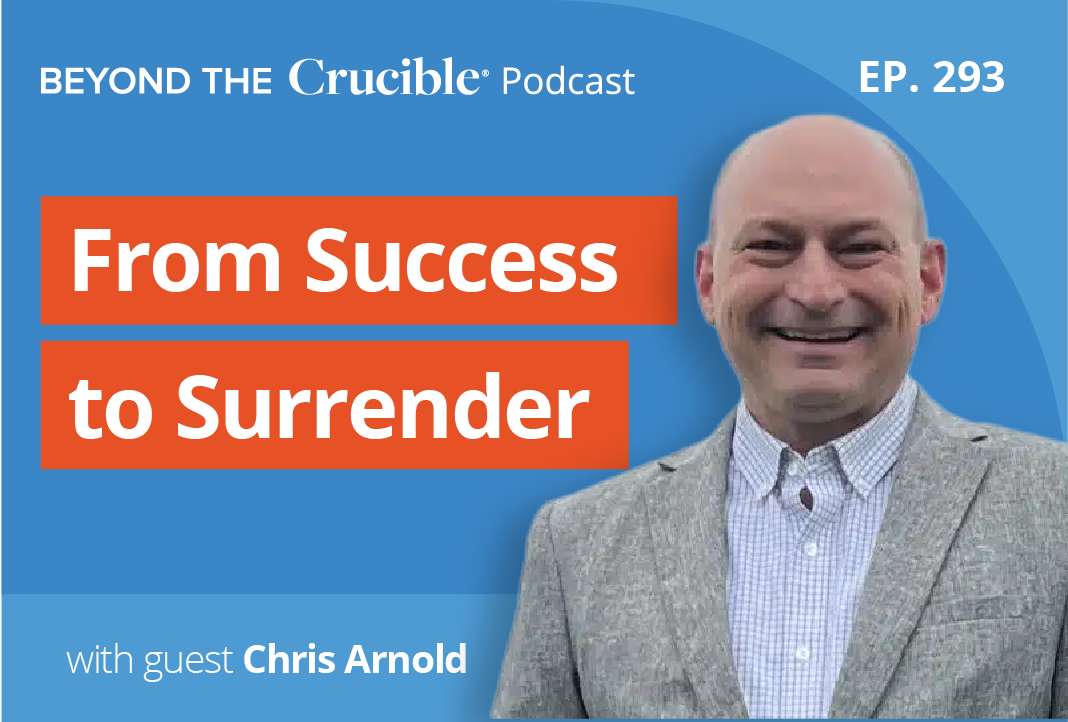
From Success to Surrender: Chris Arnold
From Success to Surrender: Chris Arnold
Our guest this week, Chris Arnold, says he dialed into a deeper, more fulfilling calling after he was let go from his six-figure corporate job. That’s right, his crucible didn’t happen to him, he says, but for him.
It was only after being freed from what he describes as the “golden handcuffs” of his job that he was able learn the lessons he’s packed into his book, FROM SUCCESS TO SURRENDER.
He and Warwick go through the key lessons he’s learned along his journey, including “success isn’t measured by what we achieve but by who we become” and “our greatest growth often comes through our deepest struggles.
—
👉 Don’t forget to subscribe for more leadership and personal growth insights: https://www.youtube.com/@beyondthecrucible
👉 Follow Beyond the Crucible on Facebook: https://www.facebook.com/beyondthecrucible
👉 Follow Warwick on LinkedIn: https://www.linkedin.com/in/warwickfairfax/
👉 Follow Beyond the Crucible on Instagram: https://www.instagram.com/beyondthecrucible
👉 Take the free Trials-to-Triumphs Self-Assessment to discover where you are on your journey of moving beyond your crucible and how to chart your personal course to a life of significance: https://beyondthecrucible.com/assessment/



Transcript
Warwick Fairfax: Welcome to Beyond the Crucible. I'm Warwick Fairfax, the founder of Beyond the Crucible.

Chris Arnold: The light bulb coming on of and starting to ask the question around significance. What's significance? And just really starting to... I mean, I was never in the first half of my life trying to look through the lens of what's significance. And so it was during the season. I was like, okay, significance. What does that look like?

Gary Schneeberger: That's our guest this week, Chris Arnold, discussing how he dialed into a deeper, more fulfilling calling after he was let go from his six-figure corporate job. It was only after being free from what he calls the golden handcuffs of that position, that he was able to learn the lessons he's packed into his book, From Success to Surrender. He and Warwick go through all of those lessons in this week's episode, including success isn't measured by what we achieve, but by who we become. And our greatest growth often comes through our deepest struggles.

Warwick Fairfax: Well, Chris, welcome. It's wonderful to have you on the podcast and definitely enjoy learning more about you and reading your book, From Success to Surrender. Love that title, Finding Your True Purpose in God's Perfect Timing. So we're going to talk quite a bit about what success to surrender means and a bit about Chris. Chris has spent 25 plus years as a founder, executive CEO, and advisor, launching ventures, leading teams, and helping leaders navigate growth crisis and transition. Says he lives in Indiana in Zionsville. Is that correct?

Chris Arnold: Yeah.

Warwick Fairfax: And with his wife, Lisa, and I know you have two kids having read the book, son and daughter. And you're active in your local community and mentor leaders and couples in the seasons of change. And I also saw another page that you speak from the boardroom and the breaking point, former corporate director and business advisor. He's lived a painful gap between success and significance. His journey through job loss, financial uncertainty, and spiritual awakening, uniquely positioned him to guide leaders seeking purpose in the marketplace. So a lot of good stuff. I love the phrases I read on the website, guiding leaders and families towards purpose-driven success. A lot of great things on there. So before we get to the crucible, Chris, talk about what was life growing up like for you? Talk about your parents, because they had a certain set of values and expectations for you that kind of set you, what influenced your path.

Chris Arnold: Well, absolutely. And thanks again for the invite to be here. So yeah, growing up, I grew up in a small town in Indiana, just west of the Indianapolis area. And my mom and dad were self-employed. My mom and dad owned a commercial laundry and dry cleaning business and a retail clothing business. And so I can remember growing up and working alongside dad and mom as early as kindergarten, I would get out of kindergarten, I'd be working on the flat iron folding sheets with the old ladies, their commercial laundry business. And just a lot of fond memories growing up, working alongside my parents and my sisters as well. They both, we all worked together. Self-employment sometimes is not everything that's cracked up to me. So mom and dad wanted the kids to go off school, get good grades and get a real job. So that's what all three of us did. We all went to college. I went to a school, engineering school, Rose Holman Institute of Technology, and I graduated from there in 1991. And then I was a mechanical engineer and went off into the metals industry at that point in time and started working in the metals industry.

Warwick Fairfax: Yeah. I mean, talk about pre-crucible. What was your frame of mind as you sort of navigated your way through life?

Chris Arnold: Yeah. I mean, it's a great question because to your point, I mean, the values of my dad I always talk about with teams are things like integrity, honesty, and hard work. My mom was a very driven person as well. So really both parents, very driven, hard workers, and that's how we grew up. I mean, we grew up working hard and grew up with the anticipation that if you worked hard, then you could achieve great things.

Warwick Fairfax: I guess 2008 was it was that the defining year. And I read somewhere that a few years back, maybe it was 2003, that your company got bought out, at least your division by a private equity firm, which I think against private equity, but that's never a good thing. If they tend to be focused purely on... I mean, it's fine to focus on money, but it's not always a long term horizon. A lot of certainly in corporate America, it's often what's quarterly earnings per share and how's that all work? And so it can change the dynamics of the company and how it looks at strategy and say long term potential is probably short term potential. So yeah, once that happened, I imagine some people might have been nervous, "Gee, what does this mean?" And sometimes you get a right to be nervous. So leading up to 2008, it felt like you felt that something was going to happen, like the writing is on the wall. So talk about, I mean, how did you feel like you knew? Because it sure felt like when the conversation happened, "Hey, Chris, can you come to my office?" There's a certain tone in that conversation sometimes. It's like, "Hm, this doesn't sound good." So how did you kind of know?

Chris Arnold: Well, and it's interesting that you mentioned 2003 and the buyout. So prior to that time, I was on the fast track. I mean, in early 30s, one of the youngest site leaders in a billion dollar multi-billion dollar manufacturing corporation. And so, and my success to that point was inspiring teams and employee engagement and really just the facility I was at in 2002, 2003 timeframe was a turnaround type of opportunity with a new acquisition and just really a great success story. And then in 2003, what ended up happening was is that the private equity firm took over. The gentleman that took over as president of the company, I wasn't necessarily 100% aligned with him initially on, myself and several on the regime. So actually several people in my regime got their papers during 2003 to exit. I was able to continue to stay on board, continue to build trust in that relationship. And for the next few years, I mean, we started to do a lot of great things with a turnaround from another facility and a new facility that we built in Arkansas in 2006 and 2007, which I had the privilege of leading the team to do. So again, during that whole season though, especially again, kids were probably at this stage, I'm thinking 10 and eight years old, my son, 10, daughter, eight years old, and I'm doing a lot of traveling. So I mean, until 2005, I'd leave out on a Monday and I'd be back on Fridays. Again, great success story, same thing in '06, '07. I mean, we had a second house on a lake and I can remember distinctly one summer that I never even saw our primary residence. I would meet the family at the lake house and we'd enjoy a weekend together. I'd wash my clothes and then I'd be off on Mondays again. So there was just things in my life that just I wasn't completely fulfilled and just the priorities I was wrestling with from a faith standpoint, I tell people I accepted Christ when I was in middle school. So there was a little bit of a faith element to things and a little bit of conversations that I was trying to have with the Lord along the way and some of these trips driving back and forth. But at the end of the day, I just was wrestling quite a bit on where I was at. And I tell people that I couldn't make the decision. It's the traditional golden handcuffs. I mean, making a pretty good six figure income and again, having the house, the kids, the lake house, second house. I mean, not that we were living extravagant lives, but living meaningful lives. And so I tell people, God made it for me. And so in 2008 when the economy tanked, myself and a couple other executives were approached with severance packages. And yeah, that moment is a very memorable moment on multiple occasions. So I think you kind of alluded to, I got a phone call to head back to the corporate office at one of our manufacturing facilities. A couple of people had been let go the day before and I just called my wife on the way to there and I said, "Honey, I think that today might be the day." And so I arrived back at the corporate office. I actually packed my stuff because I was like, "I'm pretty confident this is it." So my stuff was in a box, created up, ready to go when the senior director of HR came in and said, "Hey, you got a moment to come down to the conference room." And so he walked into the conference room and of course did the typical conversation around, "Hey, we're going to downsize, let you go." And walked, I drove a company car, so cab ride on the way home and they called the cab and we were just waiting there. The HR guy was so embarrassed because the cab was late, so we're standing outside just waiting. And so the cab driver finally comes up and I'm getting in the car and I said, "How's your day going? So I guess it's going better than yours." And I said, "You never know, brother. This could be the best day of the rest of my life."

Warwick Fairfax: Because he saw your little crate with a dead giveaway that you might have gotten let go, right?

Chris Arnold: Yeah, absolutely. Yep. So it's about 45 minute ride from the corporate office to my house and we enjoyed a great conversation. So good that once he got in my driveway, he wanted to continue the conversation. So he got out of the car. We continued the conversation, walked out to the pond behind my house and had some good conversations about fishing and took him back and showed him a fish that my son had caught and just really had a great conversation with him. And he said, "Brother, you're going to be okay." He said, "I'm a cab driver, but I'm also a counselor on the side. That's really my primary role. And a lot about this is just how you react to your circumstances. And I can tell that you're going to react in a positive way." And then stepping inside, Lisa was sitting there on the couch and I just, as I walked in with my boxing hand, I mean, she remembers this to this day is like seeing me walk in with that box and just being brokenhearted, but yet screaming at the top of my lungs, I'm free and really feeling like that and experiencing that in that moment was like, "Yeah, it was tough and nobody wants to go through that experience." However, there was a sense of freedom at that moment of saying, "Okay, don't know what's next, but I do know that this feels right."

Warwick Fairfax: So talk about those early days. I think you had, I don't know if it was 40 days, but a period of time in which you reflected basically as you journaled and prayed, "Well, God, what next?" And I felt like some people talk about doing business with God or maybe it's God doing business with us depending on how you look at it, I suppose. But it felt like those were pivotal days in your life. So what were some of the thoughts and the discussions that were going on in your head between you and yourself, you and God, God and you? I mean, there was a whole series of dialogues going on. So talk a bit about those dialogues as yes, you were free, but there was a lot of things to think about and consider and, gee, where am I going with my life? Where have I been? Where do I want to go? There was a lot of very deep discussions you were having.

Chris Arnold: Yeah. Yeah. And so I mean, Rick Warren's book, The 40-Day Purpose, what is it?

Gary Schneeberger: The Purpose-Driven Life.

Chris Arnold: The Purpose-Driven Life. Yeah. It was popular back in those days. So I think that's kind of what probably set the context of saying, "Hey, look, I'm just going to take 40 days." And so it was intentional that I wanted to carve out 40 days and just really lean into and take this time, knowing it was a great pivotal time in my life. Again, I had a severance package, so I had some time. I didn't necessarily have to rush and go find the next opportunity. And so it was very intentional that I wanted to take 40 days, but again, at that stage, it's like, "Okay, now what? Okay, I'm going to take 40 days. What's this look like? " So I mean, I would just get up in the morning and pick up my Bible and a notepad and I'd look for a particular verse and start going through and journaling and writing at that point in time on just things that were coming to mind, thoughts that were coming to mind. And actually, this is the season of my life too where I started to pick up journaling and I think it's just a discipline that I highly encourage everyone to do. I've been journaling ever since that time in my life. And as I look back during that season, I tell folks that there were ... The themes that were really coming up is that I would told you that God and family were priorities in my life. However, reality is I wasn't off track, totally, but they weren't the priorities. It was all about my career and career success. And so, and even in the career aspects of things, I was huge on employee engagement, servant leadership, but at a deep level, what God started to convict me of is that a lot of that servant leadership was achieving what Chris was trying to achieve. So motivating teams was more about, okay, Chris and the goals and everything that he was trying to accomplish, I really got that personal conviction. It sounds harsh to say it that harshly, but it was at the end of the day. So reordering things, I mean, stepping away from that and saying, "Okay, I want to really be intentional about reordering things. God, I really want to put you first. I want to put my family next and then beyond that, then I want my career to kind of fall in alignment." So it was during that season as well that I think some of my... I started to work with mission statements, vision statements for my life. I mean, we all do this for business a lot of times, but we sometimes neglect trying to do it for ourselves. And I think a mission statement and a vision statement started to evolve at that point in time. One of the lens that I kind of filter through things even yet today that came is to experience freedom and flexibility to serve God wherever I called without concern for income. So it was just, that's a lens that even today, I mean, it's just what I really filter things through is that experience of being able to experience that freedom and flexibility that I wasn't experiencing because at the time that I was doing all that traveling and everything, I was missing ball games. And that's the thing that I distinctly remember about my dad in self-employment was that, man, he worked hard, we worked hard, we worked a lot of Sundays and nights keeping the place running, but at the end of the day, I never remember my dad missing a ballgame. And that was something that I looked at and said, "Look, yeah, I want to be that too. I don't know what this looks like for me, but I just know that from a value standpoint, I want to get some things realigned and make sure that my priorities are in order."

Gary Schneeberger: So we ask our guests all the time, folks, you may not know this, we ask our guests to fill out a forum so we can ask intelligent questions when we're doing the interviews. And one of the things that you said, Chris, to the question about the best advice you could offer people was the most critical action is to slow down and listen. And you just described that a little bit, and we talk a lot at Beyond the Crucible about self-reflecting. In fact, we have what we call the actionable truths of Beyond the Crucible, and that's one of the top ones is self-reflection. And you sort of walked through that a little bit. After a setback, let me ask you this, right? The most critical action is to slow down and listen, but that can come. Yes, you were reading your Bible, you were communing with God, but even people who perhaps don't have the same faith that you have, it can come in the form of self-reflection, right? Because you talked a little bit about self-reflection. What we tell ourselves truthfully about ourselves is an important part of how we bounce back from a crucible. Talk about that a little bit.

Chris Arnold: Yeah, that's a great observation and slowing down and taking time. My wife and I were actually just talking about this a couple weeks ago, that during that season, I could have gone off and gotten another job. I could have started looking for the next corporate opportunity, but it was the fact that I took time and intentionally slowed down and said, "Okay, I'm not. " And even to that point, career coaching wise, I actually encourage folks to identify what the runway is. And often that runaway is longer than what they tell you, if they really stop and think about it. And then I said, "Break it out in thirds." And I said, "For that first third, don't take anything. Just stop, slow down, listen, and open up to the world of possibilities." And really, and to your point, Gary, I mean, a lot of it is self-reflection too. I mean, it's getting into, how am I wired? How am I created? What are my gifts? What are my talents? And coaching, I think you guys are both familiar with coaching process. And the first step of that is a lot of times is just getting people conscious of who they are. And so that was the season. And in the season that I think that really when you get into the 40 days, that was a lot of it was just the self-reflection, getting conscious of who am I, what are my gifts, what are my talents, how am I created? And then it was like, okay, now how do you go from that, take that next step? Where do we go from here? And that's where the journey really began. I mean, yeah, that was just the beginning for me. And then the journey started to unfold from that point.

Warwick Fairfax: One of the things that happened then, which was frankly painful to read, there was one time when, I guess you've got two kids like Chris Jr. And Kylie, right? And then your daughter, Kylie, something happened that day at school. And so you were asking about it and you asked some question and your response was that Kylie said, "Why do you care? You haven't been home the past five years." That has got to be every parent and as a dad, every dad's almost like worst nightmare talk about, and you write, you say it's a punch to the gut as it would be. There's self-reflection and then there's... I mean, that must have... You were thinking about this anyway, but that must have really said, "Okay, I got to do things differently because I don't want to hear Kylie or Chris say that to me again." I mean, that's obvious, but talk a bit about that because that had to have been painful. But amongst the pain, there was also value. It gave you opportunities, "Okay, I'm going to do things differently."

Chris Arnold: Yeah. As you were just reading that, it brings back the experience and almost tearing up a little bit, just thinking about the moment that that all transpired. And again, that's truly how she felt in that time and then in that moment in that season, and it was humbling to really reflect back on that and say, "Wow, as a mirror, back to me, something that I already knew, but to hear that directly from her child." Matter of fact, before I put things in the book, I've made sure that I've reviewed them with the kids and said, "Hey, this is a circumstance that I put in the book." And we just talked about it this past year again. And so it brought back some memories of that season and what's not in the book also that we cherish as a family is that she was approaching middle school at that time, but middle school started to be difficult years for her. And then into high school, she really had a lot of mental health challenges and ultimately transparently at age 15 was suicidal and just some very difficult moments at that. And so as a father, a couple things for that. One was I was blessed to be home to deal with that. So we look back on that season because I chose the career option that I did with coaching and the freedom of flexibility to be home more, I was there to support the family at that seasonal life. And I was the one that was taking her to counseling sessions and various things, which was a tremendous time of our looking back from that aspect of our life. But yeah, I mean, as a father too though, don't you even bet or have to doubt that I wasn't wrestling with, okay, all these years I was away from home, is that the reason we are where we are today? Because of not being there as a father, was I the absent father that led to a lot of the mental health challenges that she was suffering from? So yeah, there was some seasons there that, again, go back to self-reflection. I really had to start wrestling during those seasons as well about me as a father. Now, we've coming out on the other side of that and sure, there's things, but again, I wasn't the cause for all that now that we're on the other side of it.

Warwick Fairfax: So I want to talk a bit about calling and vocation. You've got so many good things in your book. I love this quote by Frederick, is it Buechner, Buechner? I'm not sure I pronounced that.

Chris Arnold: Yeah. Buechner, I think is probably it.

Warwick Fairfax: Warwick Fairfax: Buechner. Okay. Your calling is where your deepest passions meet the world's greatest needs. I mean, I think I've come across that, but I love that. And you were really trying to find out your calling. I love the questions you have in here that somebody posed to you about helping to figure out calling. What do you think about most often? What do you worry about? What do you complain about? Where do you run for comfort? Where does the majority of your money go? What affirmation do you crave? What makes you happy? How do you describe yourself to others? And I think somewhere in here, you talk about your gifts of being administration and wisdom. And yeah, so talk about, because that must have been huge because a lot of people run around in life not knowing how they're wired. I think you came across halftime at one point that also has a lot of hugely valuable material. So talk about how did that help you navigate your life as you started off in coaching and consulting, just really understanding from your perspective how God wired you. That must have been huge because a lot of people, they just run off, get a job and they're not thinking about, "Gee, what's my gifting and wiring?" Just off they go. What am I passionate about? It's like, "I'm passionate about being able to pay my mortgage and rent. That's what I'm thinking about and that's it." So just talk about what that meant for you and why it's so important for people.

Chris Arnold: Yeah. You mentioned Bob Buford in halftime and it was during that 40 day season or shortly following that I ran across that book. And again, the theme through that is from success to significance. Actually, I had somebody at halftime just after my book launched, mentioned to me, said, "Hey, I think your book title is actually Buford's original title, From Success to Surrender but they told him that it would never sell because of the word surrender." And I went back to Bob's passed away, so nobody knows, but they believe that that is... I went back to halftime and they said they do believe that is true. But also what they talk about in that is that in order to go to significance, they do talk through people around this whole process of what surrender look like. So the light bulb coming on of ... And starting to ask the question around significance, what's significance? And just really starting to... I mean, I was never in the first half of my life trying to look through the lens of what's significance. And so it was during the season I was like, "Okay, significance. What does that look like?" And then even things like, "Hey, were we created on purpose for a purpose?" Again, never wrestled with any of those kind of things before. So starting to try to process through, "Hey, are we created on purpose for a purpose?" And if so, if we're called to do something, then how specific is that calling? So that's always the paradox that I think that over the last now, probably 15 years, I've wrestled with, watched other people wrestle with is like, okay, they really wrestle with, okay, in my worldview, if God has a specific calling, then how specific is that calling? So yeah, I've spent a lot of time trying to work through that. I think that the light bulb that's come on for me though is that, yeah, I believe that all of us are created for a specific purpose. And ultimately, we're wired with gifts and like you've mentioned, I mean, administration, wisdom, faith is the other one as well that's a spiritual gift of mine. And then just the leadership abilities, all those gifts, those are the ways that I'm wired. And then how do you walk that out? Is there a specific way or a purpose? And what I also did and fell into the trap of a lot of time, which I see happens a lot of times, is I started to tie it to a vocation. Now where I'm at today, so my purpose simply stated is to come alongside leaders and help them discover their purpose and intentionally fulfill that purpose. That's what I'm created to do in short. And so looking through that lens, what I discovered is like, yeah, I do that as a coach, but I also, we'll get to probably here in a few minutes. I was president and CEO of a company for seven years during this journey as well, and I was still fulfilling that purpose through... And it also goes back to what I told you earlier about having a vision statement, experiencing freedom, flexibility to serve God wherever called without concerned income. Again, when you go into evaluating president and CEO roles, those were lenses that I kind of filtered that through. So yeah, this whole aspect around purpose and helping people discover what that is for them and their lives is something I'm passionate about. My sense is it's something you're passionate about as well.

Warwick Fairfax: Oh, absolutely. But it's interesting, your journey back was not necessarily a linear, smooth one. It might not have been the same level of crucible, but there were challenges. I mean, life is not easy. It reminds me one of my favorite quotes from a former prime minister of Australia back in '75 during the election, Malcolm Frazee was a conservative. And in a moment of madness and honesty, he said life wasn't meant to be easy. How many politicians have you ever heard say that? I mean, it's just like, it's true, but it's not really a good political sales line, but anyway, but it's true. So one of the things that people of faith and beyond wrestle with is most people these days, it may not be religious necessarily, but they're spiritual, they want to make a difference. And so sometimes for believers, there can be a sense, "Well, if I really want to be fully on board for the kingdom and for God and Jesus, gosh, I need to be in some overtly Christian ministry.

And there was a bit of wrestling with that. And then a number of people said, "No, God needs people in the marketplace who are believers." It's not so much from my perspective saying Jesus lives every day, but more in how you treat people with integrity and honesty and care for them and love them. And as I look at it. But you wrestled with that a bit. And as we'll get into, you even had a couple times when you almost became executive pastor of two different churches, one in Kentucky, one in Indianapolis. So it's not like you... So talk about that whole, because that seemed like a throughline too is it okay for me to do my consulting coaching and then see over business? And because it's easy sometimes in church, you see people in missionaries overseas and it's like, I guess that's the A team, right? I guess I must not be the A team, which is completely biblically wrong, but it's tempting to fall into that. Or I'm not leading some nonprofit to help bring clean water to a Third World country. I'm just making money. Even if you're not a person of faith, it's easy to believe I'm a sellout because I'm not really helping people. Heaven forbid, I'm a corporate lawyer investment banker. How's that redemptive? I'm not saying that's true, but it's easy to think that. So talk a bit about what that meant for you and what that means more generally, this wrestling with your power.

Chris Arnold: Well, you're right. It's a big part of the story. And for me, there's a marketplace ministry that's headquartered here in Indianapolis, Indiana. So in 2009, I had some people encouraging me to step in and join it and sit in it as it's personal advisory boards for Christian business owners. And so I chose to go ahead and sit in an advisory board. And over the... I distinctly remember one advisory board in February of 2011 where I walked into the room and I said, "We rate our issues on a scale of one to 10, 10 being absolutely critical and needed to get on the table." And so I said, "I guess I better say I got to attend today." And the facilitator says, "What is it?" I said, "Well, I got a $12,000 tax bill and I'm really not sure I'm going to pay. However, that's not the issue." The issue is, am I doing what God's calling me to be doing in life?

It's because it's like there's just things we're not clicking. Again, using the financial barometer, I wasn't, again, still trying to live the six figure lifestyle, hadn't backed out. We didn't really downsize a whole lot in our lifestyle. And then in 2012, that marketplace ministry began to expand nationally. And so they needed someone to step in the Indianapolis area and start facilitating groups in the Indianapolis area to allow the leadership team to really focus on growing the organization. And so in 2012, I joined as a chapter president was the title that they use and started facilitating groups. And in 2012, that whole year, I mean, I would talk to people and two out of three people I would talk to would join. And so I was like, "Man, this is it." I built four groups and I distinctly remember sitting with the CEO of this organization in January of 13, kind of looking back on 12 and saying, "Hey, you're only a few people away from ultimately being a place where you've got financial sustainability and so on."

And then lo and behold, in 2013, I talked to a hundred people and two people joined. And I'm like, "What in the world is happening?" So really wrestling again, thinking that, okay, I have marketplace ministry, facilitating this group. So I was doing what God was calling me to do and thinking now I'm in this season of reevaluating, okay. And then even getting to the place where just through some unique circumstances, I take a spiritual retreat day generally every first Friday of the month. And through these circumstances, having a spiritual retreat, I'd gone to Kenya in September, had a good experience there and just came back from that and October was really wrestling, trying to understand and just through some unique circumstances, felt that God was really convicting me, "Don't turn my father's house into a marketplace."

And so it was, again, coming back to money, really convicting me at a heart level, and that's one of the biggest things that as you read the book that I really had to turn loose of, and still today is continually my thorn to my flesh probably of just financial security and turning loose of the financial security in life and leaning in on the promises that provision will be there. So yeah, that ended up... At that season, I wrestled, ultimately ended up wrestling so much that I went to the organization and said, "Hey, look, these groups that I'm actually getting paid a substantial money, amount of money to facilitate, I'm going to have to back down on them because I'm so convicted over this and give them up." I kept one group that was kind of a nonprofit group that I've still facilitated to this day, but I needed to transition at that point in time. And that's 2015 timeframe, and then that's where it picks up with you alluded to, "Well, maybe I'm being called to be an executive pastor." So I started interviewing at that point.

Warwick Fairfax: Yeah. Just one of the things you talk about in the book is wrestling with financial security and money as an idol, you call it, which I'm not familiar with. We all have idols where we can put our significance in things that are not eternal or not necessarily in line with our beliefs and values. So that's something you wrestled with, which we all have them. And so that really was a bold step of faith to do what you did. But just before you got into, I think it's uplift that non... Uplift [inaudible 00:36:38].

Chris Arnold: Uplift Good Food On Purpose.

Warwick Fairfax: Yeah. If there was a plan for you to be in ministry, it sure seemed like there were two big signs that not in a traditional sense. If you believe God speaks through circumstances, and they were not easy. The one in Kentucky and the one in Indianapolis, I think your son at one point said, "Hey, basically don't get your hopes up too much." And maybe he had a prophetic word. I don't know.

Chris Arnold: Yeah.

Warwick Fairfax: So there you go.

Chris Arnold: Yeah, that's definitely a memorable moment as well. Yeah. The one in Kentucky, I mean, we really felt that the handwriting was all over the wall that we were going. And to your point, we were sitting at dinner one evening and Christopher says, "Hey, you guys got to stop your dreams up about Kentucky." And I'm like, "Son, we never know what God has in the store, but man, the handwriting is pretty clear on this one." And he's like, "Well, okay, but you might need to eat some humble pie." And we generally don't have our phones at the table, but it was sitting behind me and I heard the phone buzz and I just grabbed it and picked it up. And lo and behold, it was the email in the inbox from the senior pastor saying, "Hey, we're choosing to go in another direction." So boy, if you don't think that that was a humility, tested humility, that was-

Warwick Fairfax: It feels like in both cases, I guess you probably don't know, but you were down to the last two or three. You weren't like one of 50.

Chris Arnold: I was second runner up on both occasions. Yeah.

Warwick Fairfax: So what did you make of that, saying, "God, what's the deal here? Why get me so close and then shut the door on my face?" So I'm sure you've had those conversations. Did you get any sense of what all that meant and why you got so close, but then the answer's no?

Chris Arnold: I think it's just part of the whole journey of stripping a lot of things away and faith and trust and then again, stripping my finances away too. I mean, at the end of the day, we went negative net worth. We went from a substantial network to negative net worth during this season. So we were at this... As I was interviewing for the second one in late 2015, early 2016, we were going negative at that point in time. And again, wrestling with the fact that shouldn't I be earning a living and trying, not that I wasn't trying to do some other things to earn a living, it just wasn't happening for me. So yeah, I think just coming to the end of myself, sometimes we use the depth of self experience and that was like the final nail in the coffin for me, I think, is like that whole season of interviewing for about a year period of time and not being able to even land myself in a church. It's like, "Are you kidding me? I can't even go serve at a church."

Warwick Fairfax: So that wasn't to be. And then in 2016, you became CEO, excuse me, of Uplift. So because you were there for seven years, so that sounds like that was really fulfilling. You felt like you were doing good for this company, providing sustainable, healthy produce. That must have been a pretty cool season. You're using your gift of administration and faith. You must have felt like, "This is it, Lord, I'm here for the next 20 years. Let's go."

Chris Arnold: Yeah, the quarterback was back on the field, man. It's one thing to be a coach. It's another one to get the quarterback back on the field. So yeah, I mean, through some circumstances, I had a couple friends that had approached me really just to, as sometimes happens in the coaching consulting world is step in, help them out. And that's how it was initially is, "Hey, can you step in?" And indoor farming, growing lettuce indoors was under lights was ultimately the business venture that was an emerging technology all over the world, candidly, back in that season and the US was really starting to take root back in the season of life and stepped into that and as you often do as a coach consultant for six months, kind of determined, "Hey, the current business model was not going to be successful." Ended up deciding to go ahead and let the original founder go at that season, but we're sitting there with significant investment funding and went to the board and said, "Hey guys, you can get out now, cut your losses, or we can go... There's a lot of excitement in this area. We can go look and see and try to find somebody to partner up with and that can provide a turnkey farm solution and we can go have a good run at this." And so they chose the latter. So US-wise, we did due diligence on some folks in the US, just couldn't find the right partner with the right technology emerging at that time. And so came across a company out of the Netherlands, Plantlab was the name of them and really struck up a great relationship with them and came to a place of deciding that we wanted to partner with them in a 50-50 joint venture on bringing their technology to the US. So yeah, to your point, yes, in the zone at this season of things, things were... It's like this business is never completely easy, but ultimately waking up every morning, energized, thinking, "Man, we're finally there, man." From a Christian's perspective, "Hey, you molded my heart, you got my heart, my values in the right place, and ultimately let's go do this together." And so to that point, I mean, yeah, Uplift, the brand that we launched was Uplift, Uplift Good Food On Purpose. It was somewhat of a social impact. There was a community, a nonprofit that I was one of our investors in combination with several for profit folks, and really had a plan to get back to the community, create jobs in that community, and then healthy produce. And then that ended up moving forward to a potential partnership with a large food distributor, Cisco, throughout the worldwide food distributor, and had intent to build multiple farms starting out in the US and major metropolitan areas in the US, and started to go through the construction estimates on a farm, and this is kind of fast forwarding into, we're all way into 2022 now, that we were fast forwarding into basically, and came off of that in Pompano Beach, Florida was going to be the first joint venture farm there, highly automated, show-place, good place to fly people into, and show the place off. And just once we got all the estimates in, it didn't pencil out on paper. So we had to make the tough decision to pull out of the North American market, and unfortunately since that time, this past year, pull out of the worldwide as well, the company shut down worldwide. But yeah, great run from a culture standpoint, probably, I mean, other people listening to this might debate this, but I think we were known as having probably the best operation here in Indianapolis, Indiana. And the reason I attribute that is a lot around the culture that we were able to build. It was very much employee engagement. I'm a huge Patrick Lencioni fan of five dysfunctions as a team, so trust, conflict, those kind of the five aspects of that. And then brought in some great young leadership, also brought in folks that were second chance employment as well. I mean, people that had historical backgrounds and were just thankful to have a job and have a great family to come into and work with on a day-to-day basis.

Warwick Fairfax: So you mentioned in 2023 when that company decided to pull out of the North American market, talk about what that was you were going through because that's another season of reflection. You've had a number of seasons of reflection, and this is another opportunity. It's like, "Lord, can I just be done with these seasons of reflection, at least not this kind? I think I got the message." He said, "Well, Chris, I've got a few more lessons." "Oh, come on. Enough of the lessons. I'm ready to graduate." But such as life is really that way. So that must have been tough because it's like, well, now what? I was in the zone, as you said, the quarterbacks on the field, that must not have been easy when that ended. All the business reasons made sense of why potentially, but still, what were you thinking then when that ended? Because it must not have been easy.

Chris Arnold: You captured it. It was like, "Okay, now what? Why again? Are we going here again?" I've been here before. So to your point though, I mean, yeah, I think as that happened, I mean, you always go back into reflection mode. It was like, "Okay, what am I supposed to be learning from all this? What are you teaching me from all this?" And I tell people that it was subtle, but it was... And again, this is in my world and in my belief system, but being more connected to the dream than I was connected to my Lord. So I started chasing after the dream and all the things we were great things we were doing together and kind of subtle, but left that relationship, one-on-one relationship I had with my heavenly father, not totally in behind, but it just wasn't like it once was and now is.

Warwick Fairfax: Yeah. Just for listeners, whether you're people of faith like Chris is, the broader issue is you can have a set of beliefs, but we talk about this a lot, mission drift, and you can subtly drift so that the dream, the mission becomes an idol. There's nothing wrong with having healthy, nutritious produce. Nothing wrong with that. That's a good vision, but the key is make sure that that doesn't become an idol. "Hey, look at me, I'm Chris Arnold and I'm doing these wonderful things and you should respect me." And that probably is not a verb on the top of your mind, but there might have been a few grains in there. And anybody, that can happen to any of us, whether irrespective of what your belief system... We talk about idols a lot. You never want to have money or what you do as an idol. So I want to talk a bit about what you do now, because you say that this whole thing has clarified your calling to use your gift of wisdom, to lead people in the intentional discovery and fulfillment of their God given purpose. And I love what you talk about is the truths that you say echo through the book. And these are profound. Success isn't measured by what we achieve, but by what we become, God's timing is perfect even when it doesn't match our schedule. Our greatest growth often comes through our deeper struggles. True freedom is found in surrender, not control. Every closed door can hide unexpected blessings. Ministry happens wherever God places it. So talk about what you do now and maybe some of the key two or three things that God has taught you in this journey.

Chris Arnold: Yeah. Well, yeah. I mean, what I do now is coming alongside leaders and their families is another thing. My wife, Lisa and I, she's joined me in this effort. We just did a sideline on her part of the story. We started doing premarital counseling back in 2019. Some girls approached her and said, "Hey, will you do premarital counseling?" So we evolved into that world. And then since that time, I have partnered up with our church and we do premarital and then I'm also ordained to do weddings. So marriage and family is an element that we brought to it. And then my daughter-in-law also has come along beside us as well with my son and their health journeys and she's a health coach too. So we're really looking to come alongside leaders and their families, help them go through this process of alignment and start to ask the questions and recognizing like we've talked that you don't figure this all out in 40 days. I mean, there is a journey that you need to go through. And then that's also part of why the book actually... The book was actually written in 2018. It wasn't until this past year that I actually published it. Just a quick sideline on that, one of the things that I was really wrestling to get to finish the book. And the reason being is that I wanted to get to the top of the mountain and look back and be able to tell that uplift story and be able to talk about, "Hey, here was the journey. Yeah, I went through the valley and ultimately, but man, whenever the 23 event transpired and that ended up really..." And if you're reading the epilogue of the book, I mean, I talk about, hey, God really convicted me that, hey son, it's not about the particular destination. It's about the journey. And so that was really what sparked the idea of... I'd always wanted to tell my story because I felt like people could learn from that journey. And so that's basically what I ended up doing was the book was getting very intentional about finishing the book and getting it published, but also in the effort of publishing the book, making sure that it does more... It's a teaching memoir. So as you know, I mean, ultimately at the end of each chapter, there's questions that are reflection questions. There's also, we've built into this also a whole... I'll share more about our website and information later on, but if you come to our information, you'll see that there's a 40-day journey that we, because the 40-day journey was so important to me, so we put together a devotional series and a study companion guide that kind of goes with all this stuff. And again, it's really packaging up a lot of the things that I learned in my journey such that in this coaching relationship, it's the foundation and a lot of times at the starting point for someone to come in and start to work alongside and wrestle through some of this stuff.

Warwick Fairfax: As we close here, you've got some profound thoughts that you're talking about on the epilogue, and this is really worthy of people reflecting on. The season has crystallized the core message of the book, true transformation happens in the walking, not the arriving. We can get so focused about getting to the top of the mountain, which you did even back in the uplift days. I want to write the book when I'm at the top of the mountain. I'm sure now you'd say that was probably a wrong promise, because it's not about the top of the mountain, which obviously you've learned and I've certainly tried to learn. Each closed door, each desert season, each moment of surrender shaped us more than any achievement could. Just the beauty and the power of surrender. You talk about these three truths, every step of surrender shapes us more into his image. In other words, God's image. Our greatest ministry often flows from our deepest struggles. I've got a whole podcast about, talks about my failures. It's pretty much, I mean, other people's challenges, but for me, my failures, I've learned a lot through that. When we walk with God, we're always exactly where we need to be. And I love this thing, and I don't know if you have it there on your desk, but there's like a little... I don't know what you call it, if it's a sailboat or something. Ship.

Chris Arnold: Yeah.

Warwick Fairfax: So on it says, "The man who walks with God always gets to his destination. Just the power of God, whoever you feel is up there, your core beliefs and values, it's walking with those rather than focus on the destination." Do you have that there just to show people-

Chris Arnold: It's across the room. I can go grab it if you'd like me to.

Warwick Fairfax: Why not? Why not? Because it's a pretty powerful thing. Might want to grab it.

Chris Arnold: Yeah. It's across the room where I can look at it, but...

Warwick Fairfax: There we go. And on that, on that boat, again, the man who walks with God always gets to his destination. So folks, what we're saying here is it's about the journey, not the destination. Don't get so focused on, gosh, when I get to the CEO or get a million dollars or five million or whatever, then I'll be happy. No, I don't care what your beliefs and values are. Success in of itself doesn't make you happy. It's the journey. And that's really, I think, maybe what you're talking about, surrender, right? It's like it's enjoy the journey, surrender the outcome. Is that like a fair summary as we close?

Chris Arnold: I couldn't have said it any better.

Gary Schneeberger: That sounds you heard folks was the captain turning on the fast and seatbelt sign, indicating that our plane is descending to land this episode of Beyond the Crucible. Until we do that though, so put your peanut bags away, but we're not quite there yet. I'd be remiss, Chris, if I didn't ask you how our listeners and viewers can reach you on the internet, learn more about your coaching and anything else that you may have that they can explore.

Chris Arnold: Yeah. So there's multiple ways. Probably the easiest way is to go to our book website, which is fromsuccesstosurrender.com. And then well through that, you can navigate to a couple other different sites. I've got chrisarnold.org and then the lastinglegacycollective.com. And then I'm very active on LinkedIn as well. I think that's probably how we got connected.

Gary Schneeberger: Warwick, as always, the last question or questions of the guest are yours.

Warwick Fairfax: So Chris, there might be somebody listening today, maybe today's their worst day, maybe they've been fired from that job that was either in the C-suite or was going to lead to the C-suite. Maybe they were like your son who had a dream of being a high school quarterback and maybe college quarterback and to have injuries that basically the doctor says, "You got to give it up." Maybe you're either the C-suite executive that got fired or the high school kid that could have been the quarterback like his dad. So what would a word of hope be to somebody that's in that position which they feel like my dreams have just turned to ashes and what now?

Chris Arnold: Well, first of all, it's acknowledging that it's not easy. I mean, it is a painful experience as much as it's looking back, telling the story and even talking about the fact that freedom walking into the door, it's easy to sit here and say that, but yet, yes, there still was a lot of pains and suffering through that. So experiencing that, yet recognizing it's not the end of the world. And that too, the story that hopefully you've heard today is that I've been joying life and it was a transitional, very pivotal point in my life that freed me up to do some great things on going out and serving people in a completely different perspective, which hopefully you can tell that I'm going with great joy on a day-to-day basis.

Gary Schneeberger: Folks, I've been in the communications business long enough to know when the final word's been spoken on a subject and our guest, Chris Arnold, just spoke it. Warwick, we just finished our discussion with our guest, Chris Arnold. And as we always do when we have guests on the show, I ask you, what's the big takeaway from Chris's crucible story and his bounce back story and his life of significant story? What's the big learning that we walk away with from our interview with Chris today?

Warwick Fairfax: Chris Arnold is a fascinating guy. He went through the crucible of being on track to doing exceptionally well at a company in Indianapolis. He was making quite a lot of money and with the prospect of making more and was going to very successful, worked hard. And on the surface, it seemed like he was living his values, he's a person of faith, but yet in practice, he was away most of the week. He missed a lot of his son and daughter's games and activities they were involved in. And so in a sense, it's a very sobering lesson. Whether you're a person of faith and his faith in Christ is of course who he is, whether you're a person of that faith, some other religious faith, or just him or broadly, just other spiritual paradigms, it's very easy to drift from your beliefs and values and your mission. And it's very easy to have money or success as an idol. Nothing wrong with success, but when your whole sense of self gets defined in what you do, how much you make, that is never good. And so when he got fired and let go, he had enough self-awareness to realize there was a problem. He wouldn't have left voluntarily because how do you give up that kind of career income and prospects, but he felt freedom, but yet it wasn't an easy journey back. There were a number of things, like you thought, "Gosh, I'm a person of faith, maybe I should be an executive pastor." Twice, it got down to two people and he was not the person that was picked. That's devastating is what's up with that. Then his CEO for, I don't know, six, seven years of a company called Uplift that is about producing healthy food, and that ended up ending. It's been a journey coming alongside people, coaching them, consulting with them, mentoring folks, including families. And his profound wisdom is, he says, "True transformation that happens in the walking, not the arriving." It's not about getting to the top of the mountain. Life is never about Oh, when I get to the top of the mouth and I'll be happy. Life is about being happy in the journey, having a sense of joy through the bad times and the good times. Hard to have joy in the bad times. I fully realize that. We've all been through that. We're just saying life is going to have its ups and downs, but enjoying the journey, the times that feel like that are tough, there can be so much learning and wisdom that both Gary and I have certainly learned in our own lives. And so it is really about the journey, not the destination. This is something I'm sure you might have heard before, but Chris Arnold's life is a testament to don't focus on the destination, focus on the journey and make sure that you live your beliefs and values along the way. Don't be that mom. Don't be that dad who, when your kids grow up, if you have kids say, "Mom, dad, you were never around. I was hurting. I had a big game. You were not there. You were not present. I needed you and you didn't show up." There's always, well, hopefully there's always forgiveness. There's always redemption. But you don't want to be that mom or dad. You don't want to be that sister, that brother, that uncle, that aunt, that friend who was not around. You want to be somebody that lives your beliefs and values and not just have them as a bumper sticker, as the company that a lot of us have heard of, Enron that was very notorious for, went under because they had all sorts of scandals and financial impropriety, but yet their mission was all about caring people and uplifting them. But they weren't living that. You don't want to be CEO of an Enron kind of company when you're not living your beliefs and values. You don't want to be the kind of person that says, "Yes, that person, their beliefs and values sounded good, but they really didn't live it. And their family, their friends, but all say that." You don't want to be that to be your legacy. So Chris has spent years trying to make sure that he lived in light of his beliefs and values. And even when he was trying, after he got fired from that company all those years ago in 2008, it still wasn't easy. And he was trying. It still was tough not to have finances and success as an idol. So it's not only is life a journey, life is a journey trying to live and lie to you with beliefs and values. That isn't easy, but let us at least try. And when we go through challenges, let's see them as gifts that happen for us and not to us. And so, okay, maybe I need to up my game in terms of living my beliefs and vanities. Maybe I'm too focused on the destination, not the journey. So a lot of wisdom that we can learn from Chris Arnold.

Gary Schneeberger: So until the next time we're together, please remember this. We know your crucible experiences are difficult. Chris, despite the fact that... He chuckled quite a bit through talking through his, despite the fact that when he went through his really big crucible, he actually said, "I'm free at the end of it." There were some struggles that went with that. But you heard it here today, the good news about his story, and it can be the good news about your story too. It's not the end of your story, your crucible isn't. In fact, if you learn the lessons from that crucible and you apply those lessons moving forward, the destination it can lead you to is the greatest destination you can ever reach. And that is a life of significance. Welcome to a journey of transformation with the Beyond the Crucible Assessment. Unlike any other, this tool is designed to guide you from adversity to achievement. As you answer a few insightful questions, you won't just find a label like the helper or the individualist. Instead, you'll uncover your unique position in the journey of resilience. This assessment reveals where you stand today, the direction you should aim for, and crucially the steps to get there. It's more than an assessment. It's a roadmap to a life of significance. Ready? Visit beyondthecrucible.com. Take the free assessment and start charting your course to a life of significance