
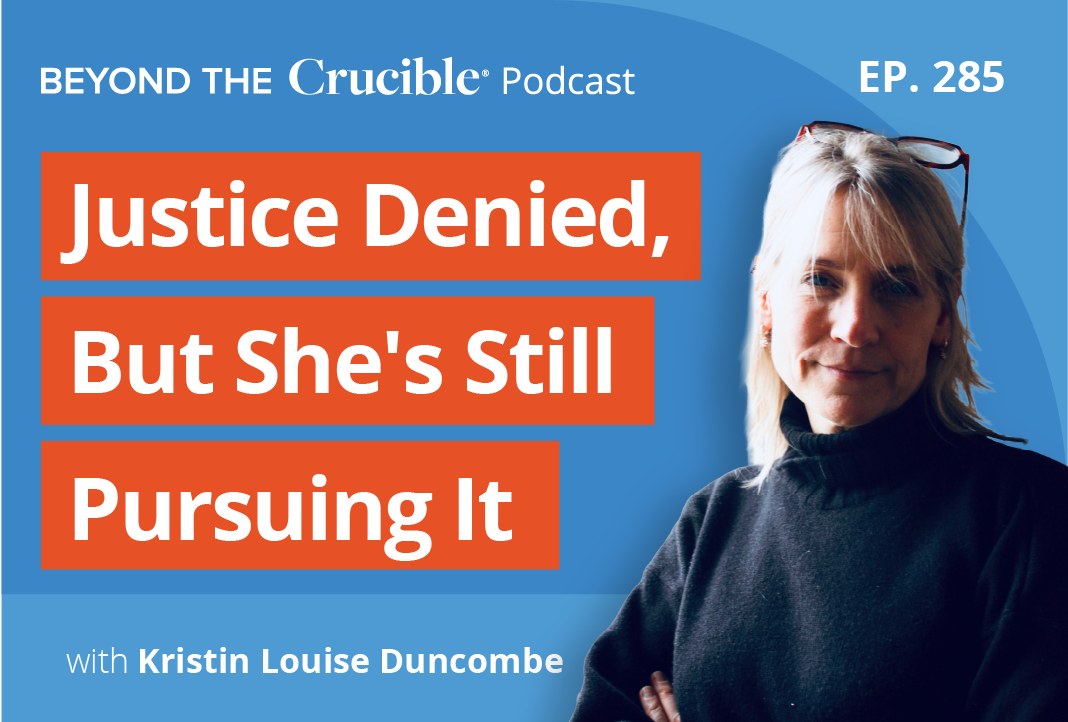
Justice Denied, But She’s Still Pursuing It: Kristin Louise Duncombe
Justice Denied, But She’s Still Pursuing It: Kristin Louise Duncombe
Our guest this week, Kristin Louise Duncombe, describes this week the horror of the molestation she suffered as a preteen girl at the hands of an American diplomat who was also her best friend’s father.
Even after her abuser was exposed, he was not brought to justice by the American government for decades — and still, to this day, never for his abuse of Kristin. That’s why she’s still fighting to bring her story to light.
To explore Beyond the Crucible resources, including our free Trials-to-Triumphs Self-Assessment, visit beyondthecrucible.com.
Enjoy the show? Leave a review on your favorite podcast app and leave a comment at our YouTube channel and be sure subscribe and tell your friends and family about us.
Have a question or comment? Drop us a line at info@beyondthecrucible.com
—

Don’t forget to subscribe for more leadership and personal growth insights: https://www.youtube.com/@beyondthecrucible
Follow Beyond the Crucible on Facebook: https://www.facebook.com/beyondthecrucible
Follow Warwick on LinkedIn: https://www.linkedin.com/in/warwickfairfax/
Follow Beyond the Crucible on Instagram: https://www.instagram.com/beyondthecrucible
Take the free Trials-to-Triumphs Self-Assessment to discover where you are on your journey of moving beyond your crucible and how to chart your personal course to a life of significance: https://beyondthecrucible.com/assessment/



Transcript
Warwick Fairfax:
Welcome to Beyond the Crucible. I'm Warwick Fairfax, the founder of Beyond the Crucible.

Kristin Louise Duncombe:
It all came pouring out that, in fact, I wasn't the only victim. There was girls throughout the community that he had been molesting on a regular basis as he had been doing to me, and an investigation was conducted, and six months later, the State Department said, "Case closed."

Gary Schneeberger:
That's our guest this week, Kristin Louise Duncombe, describing the horror of the molestation she suffered as a preteen girl at the hands of an American diplomat who was also her best friend's father. Even after her abuser was exposed, he was not brought to justice by the American government for decades, and still to this day, never for the abuse of Kristin. That's why she's still fighting to bring her story to light.

Warwick Fairfax:
Kristin, thank you so much for being here. I really enjoyed learning about you and reading one of your books, and it's an honor to have you. So I'm just going to give just a brief introduction so people will know a little bit about you. So Kristin is Kristin Louise Duncombe. She is an author, therapist and coach. She's done in addition to therapy, she's a therapist, does couples counseling, life coach and is an author who's lived in Europe since 2001, currently in Paris at the moment.
She's written a number of books, including Trailing: A Memoir, Five Flights Up and her most recent book, OBJECT: A Memoir. And we're going to be spending a lot of time focusing on the background to OBJECT and that book. So I just launch in and we often ask people, so what was life like before The Crucible? Or what was the background? And your Crucible was at such an early age, it's hard to really answer that question, but just talk about what life was like for you, because you grew up, I guess, as a child of somebody in the US diplomatic service. So just talk about what was life like for young Kristin?

Kristin Louise Duncombe:
What I can tell you is, well, two things. One, that person that I was is still very much here and who that person was, I was a super anxious child. I had all sorts of anxiety disorders that, this was the late seventies before everyone was sort of savvy about therapy and people didn't take their kids for diagnoses. So none of this was diagnosed. But what I can tell you, looking back at all the symptoms, is that I had emetophobia, which is the fear of throwing up. I had hypochondria, which is the fear of disease. This is at a very young age, 7, 8, 9. I already had all those problems. I also had a tic disorder, so I would sit there in class and became the ridicule of so many classmates doing things like this just compulsively.
So I was an extremely anxious child, and I was quietly creative because as a kid I was a voracious reader and I dreamed of writing books, and that was always my objective.
But then after the various things took place in my life that I think we'll go on to talk about in greater depth in this interview, happened, I think that I developed a very big persona, I think, and who knows, maybe I would've developed that persona anyways, I don't know. But I think that for me, one of the results of the things that I went through as a child, and we haven't named it yet in the interview, but dealing with childhood sexual abuse, is that I learned to disguise the anxiety.
As a younger child, having all of that free-floating anxiety, I found things to focalize it on. I'm going to throw up. I'm afraid someone's going to throw up, or I think I have leukemia, or all the things that I went through as a kid. But then once I was actually a little bit older and in this situation where I was being regularly abused by my best friend's father, suddenly there was something very concrete to be anxious about. And I think that I coped with that by becoming a character.

Warwick Fairfax:
So let's talk about that abuse, that sexual abuse that you suffered, which obviously is the focus of your latest book, OBJECT. So just talk a bit about what happened, how it happened, just what country were you in when all this happened? So yeah, just talk a bit about that.

Kristin Louise Duncombe:
Yeah, yeah. And I'm always happy to talk about it because I feel that... And just disclosure, I'm not about to say something extremely graphic, but one of the things that I am bothered by is how language masks the reality of what we're dealing with. And so to tell you the full story, when I was 10 years old, that's when my family moved to West Africa, to the country called the Ivory Coast, Cote d'Ivoire, and the US Embassy community there was very small, very close-knit. This again was before all the major security problems and everything.
So you could just sort of walk into the embassy. There was the Marine Guard there, and it was just a totally different life. So a small, close-knit community. I went to the international school, I went to fifth grade, met this girl who was also a new student. Her name was Rose, another American kid whose dad was one of the diplomats at the embassy.
So my parents got to know their parents. The name of this person in question that I'm about to tell you about is William Mulcahy. So William Mulcahy was a senior diplomat with USAID, and he was my best friend, Rose's, father. And their family, the Mulcahy family was an Irish Catholic family from Massachusetts, lots of children. Rose was the baby. She was the last child still at home. And because, as I was saying, I was the middle child in my family of three, I think I kind of got lost in the shuffle sometimes. When the doors were thrown open at Rose's house that I could just go hang out there as much as I wanted, I went. Rose and I became inseparable, best friends. And it was something that I yearned for, especially after the earlier years of having been anxious and kind of bullied at school back in the States and all of that.
So early into my friendship with Rose, her father, who was a very, very jovial, popular, well-loved community member, everyone loved Mr. Mulcahy. He was like the quintessential grooming pedophile, because everyone was wrapped around his finger. He started molesting me. And when I say molesting, what I mean is that I was 10 and he was a 50-year-old man who would regularly at any moment come up and put his hand down my pants or put his hand up my dress, or put his hand in my bathing suit and do what he was moved to do.
And the reason I'm specifying that is that I think that one of the things that became so much part of the mental, I don't even know what to call it, but the mental game that happened to me as a child is that it could literally happen at any moment. For example, in my book, there's a scene where Rose and I are making pancakes, and he comes home, and Rose's mom is having a migraine.
So he sends Rose just to the back of the house to give the aspirin and some tea. And just in that brief amount of time, he came at me and he did his thing. But maybe that endured 20 seconds and then it was over. Then there was other moments where he had more free access to me, like driving me home from a sleepover date with Rose, where he could take things further. But it's just to say that I lived with this constant uncertainty about what is going to happen next. And the reason I'm clarifying that is because what I was saying earlier about, there's still sort of a shy, nervous child here, but that child also kind of became a character. Both parts, both of those parts of me are real, and there's no way for me to know, if all of that hadn't happened with Mr. Mulcahy, how would I be today? Maybe I would just simply be a nervous wreck. I don't know.
But I really got accustomed to shape-shifting, because when he would do those things to me, I would go just frozen and let him do it. And then the minute someone came back into the room, "Let's flip pancakes, it's your turn." And so that becomes a coping mechanism that has benefits and disadvantages. The benefit is, because of course, I still have some of that capacity to shape-shift in my life today, and it means I can just show up for a podcast. I'm not nervous. I know that I can show up and get along and it will be okay, and it's all sincere. I'm not trying to suggest that-

Warwick Fairfax:
Yeah, I get it.

Kristin Louise Duncombe:
But the part of that capacity to shape-shift and really just fit well into any situation that can be a disadvantage is when you actually need to have a stricter boundary, and you're so adept at just breaking into role that you lose sight of, "No, no, no, I shouldn't be shape-shifting here. I should be saying no." And so that is something that in my adult life I have had to really learn how to do, how to stop accommodating and shape-shifting so much.

Warwick Fairfax:
So how long did this go on for, this abuse by this man?

Kristin Louise Duncombe:
The abuse? The abuse went on for two years. It stopped when I was 12. And I mean really just to drive the point home, the Mulcahy family was very good friends with my family. So we would have Thanksgiving together, Christmas, New Year's, things like that. And oftentimes the molestation, it would just be happening under the table while we were all having family time. So it was very confusing. And then what happened is that he, Mr. Mulcahy molested another child, a new kid that had just arrived at post. And what was pieced together later is the reason she told on him was because she hadn't been there long enough to know of his great reputation and everyone loved him and all of that.
Because what came out after this girl, it was a 10-year-old girl, told on him, her father immediately went to the security people at the US Embassy, who I think did act appropriately insofar as they took the allegations seriously and they sent him back to Washington. He was sent back to Washington in a matter of three days. He had three days to close up his life. But what was totally inappropriate, and this is really the crucible that I'm with today, is that no one in the community, including his own wife, was told the truth about why he was leaving.
The story that was spun was that he had been given this big promotion and was needed in Washington and it was urgent, and he needed to be there in three days. So overnight, the community rallied around the Mulcahy family, helped them pack up, sell their car, get rid of everything else, and then we drove in a convoy. It was a convoy of six or seven cars of families, so devastated that the beloved Mr. Mulcahy was leaving. There was a champagne toast for him at the airport.
And then off they went, Mr. Mulcahy, his wife and his 12-year-old daughter, Rose, my best friend. And a few days later, it all came pouring out that, in fact, I wasn't the only victim. There was girls throughout the community that he had been molesting on a regular basis as he had been doing to me. And an investigation was conducted. And six months later, the State Department said, "Case closed." They said, "We need to protect William Mulcahy's civil liberties. He has diplomatic immunity," and at the time, at least in the United States, there's no federal law against pedophilia, so there isn't even a crime to charge him with.
So he did not lose his job. He was not prosecuted. His family continued to not get the information about, or his wife, I should say, about what he was actually up to, because jumping around in the story, 22 years later, he was finally stopped.
By then he had retired from the Foreign Service and was serving as a Eucharist Minister on Cape Cod, Massachusetts in charge of the children's program. And he was caught red-handed raping an 8-year-old girl. And that is when he was finally arrested. And then there was an opportunity to, for all of us victims, from way back when to discuss and liaise, and to expose what had actually happened because everything had been kept silenced and under wraps. And anyways, this is a very long-winded way of saying, so as it turns out, several of his own children, including my friend, Rose, were long time victims at his hands, and everyone was just under the cult of silence.

Warwick Fairfax:
So I'm thinking, when did your parents find out? And I think from my understanding, they tried to do something. And I'm curious, did you ever talk to your friends, that you're thinking, gosh, maybe they were molested or was, it kind of sounds like, I guess two different questions, but when did your parents find out and what they did do?

Kristin Louise Duncombe:
So my parents found out the night that the Mulcahys left. We took them all in this convoy to the airport. They left. And that night, sometime that afternoon, I mean I was an oblivious 12-year-old, so I don't know the exact details of how it happened, but after they were on the airplane flying back to the states, the security officer at the US Embassy notified the various families that he knew were in the Mulcahys sphere and said, "There's been this allegation, check it out in some way, shape or form with your child or your children." And so all around the community that night, parents were having conversations with their children, and that's when the truth came out.
It was that night that I said to my parents, because they couldn't believe it. The way they even set up the conversation with me was, "It's so awful. Poor Mr. Mulcahy, he's such a lovely man. It's so awful that someone would accuse him of this. You wouldn't know anything about it, would you?" And I told them, that night, I told them everything and it was a major crisis in the community.

Warwick Fairfax:
Did they believe you?

Kristin Louise Duncombe:
Oh, they believed me immediately. They believed me immediately. But it was so emotionally violent, it was actually for me, when I think about that trauma in my life, and I know this might sound a little bit strange, but for me, the almost bigger trauma than that ongoing thing that I was in with Mr. Mulcahy, was when it was all exposed and the limelight was on me, and it was being named what he had been doing to me and what I had been enduring and how awful it was and how disgusting and how perverted, and that was so incredibly traumatic. It was deeply humiliating.
It was, the same thing was happening to other girls in the community. So yes, then we had to have these community meetings where the focus was on what he had done to us, it was just extremely humiliating. And my parents, along with some of the other parents and the doctor at the US Embassy tried to fight back to get some sort of resolution to... And no one was thinking in terms of money, nothing like that at that time. The focus was, wait, he's not going to be prosecuted? So they did try to fight back.
And I have in my files printed out, in an old manila envelope, I have copies of some of the cable telegrams that went back and forth because this was 1982. As you know, I don't even think there was faxes yet. It was all a totally different... But what happened is, is that the State Department told the adults, and that includes my parents, and excuse my language, but I'm just going to say it, "Just shut up and fucking move on because he is not going to be prosecuted. And your role as US diplomats is to represent your country with a good attitude. Move on."
And that is what happened. And I personally, now this many years later, I'm in touch with many of the victims from the time, and everyone's got their own reaction to what happened.
I personally am not angry with my parents for not doing more because I understand how a silencing happens. Sometimes people say, "I can't believe your parents didn't do blah, blah, blah, and they should have done blah, blah, blah." But I feel like that is the attitude of someone that thinks it's easy to be A, a whistleblower and additionally to be a whistleblower when your entire life is dependent on the person you're supposed to be blowing the whistle against. So it's quite a parallel. I felt like I had to just go along with what Mr. Mulcahy said, because who would believe me? He was Santa Claus at the Ambassador's Christmas party.
Everyone loved him. He was so popular, and the complicating facts, even I loved him. He was like the jolly, nice... It was a very confusing and complicated thing.

Warwick Fairfax:
Yeah, I mean, it's such a horrific story. I mean, the actual abuse is horrific, but the lack of justice, as I think you've mentioned, feels worse. There are lifelong consequences from abuse, but I think as you've indicated, there's as much lifelong consequences when nothing is done, obviously, whether it's a state department or the church or certain religious denominations or probably other organizations, Hollywood, you could pick your institution. It's widespread and people want to cover things up for... It's like they're more concerned with saving their institution than doing what's morally right.
I want people to understand just the gravity of what you went through in the life altering consequences, because you write in your books and in your first memoir, Trailing, it just felt like, I think you say that in your current book, that you were left feeling extremely unimportant. And the self-image. And so that played itself out in relationships with men. And so just talk about how the consequences weren't just the abuse itself, which is bad enough, but the sense of what it did to your sense of self-agency and self-image. So just talk... Because that played out over the next 20 years with marriage and being in Africa, and just talk about that journey.

Kristin Louise Duncombe:
Yeah, no, I mean it's such an important question, and I thank you for the opportunity to speak to it because I think that for me, the major consequence of the abuse and then how it was handled, the cover-up in this message that what happened to those girls doesn't matter, but what happens to him does matter.
We have to protect his civil liberties, because I have a letter where my dad said, "But what about the civil liberties of the children?" It's like it just didn't exist. We didn't have those liberties. No, I just think that for me, the major consequence, as I was describing earlier, is I learned early how to get along. I learned how to... Yeah, the best way to say it is to shape-shift, to show up and be able to make any situation okay, to be able to join with people easily, to be able to fit in, even if it's not a fit.
And what that meant for me as I turned into a teenager and then a young woman, and all the politics, the things that play out between men and women started, is that I... The easiest way for me to say it is I would get chosen, and I thought, "Well, if you choose me, then I have to make your choice worth it." I never thought, "Well, okay, you are choosing me, but am I choosing you?" Because I was totally outside of myself. I was living... And the reason I call the book OBJECT, is that at a certain moment, and I think this happens to a lot of girls and women, even if they haven't been sexually molested that way, but just because of the way society is and with all the pressure on what you look like in being sexy and appealing and all of that, I lived not as the subject of my own life.
And I like to clarify that when you're a subject, you are functioning from the inside out. You're inside yourself looking out and deciding, "What do I think about that thing or that person, or what do I want? What do I desire?" And you're staying oriented towards what you want. I functioned as an object. An object is outside of themself, constantly looking at themself to figure out how do I appear in this moment? Do I appear pleasant? Do I appear accommodating? Do I appear sexy? Do I appear nice and generous and kind?
And it's all about appearances. And so what happened for me is that I allowed myself to be chosen over and over and over again, and ended up in one relationship after another that I didn't really want to be in. Not trying to make it sound like everyone I was involved with was a horrible monster. No, I fortunately got chosen by some nice people, but I did also get chosen by some pretty horrible people too. And my teenagehood and my young adult life is largely characterized by rolling from one dysfunctional relationship to the next. And in each relationship, what I was doing was just trying to accommodate.

Warwick Fairfax:
What's interesting about your story is, you felt like you were an object in which your choice, your viewpoints were irrelevant. An object doesn't have choice. It's an object.

Kristin Louise Duncombe:
Right, no, an object has no choice.

Warwick Fairfax:
And so therefore, your goal was to be, in this case, whatever the guy wanted you to be, and what would appeal to him, and personality, dress, everything. And your choice didn't matter. So if somebody liked you, then you had to make them happy. And with your husband, is it Tano-

Kristin Louise Duncombe:
Tano. That's not his real name, but the reason I gave him that name in all of my books is that he's Argentinian. And for anyone that knows Argentina, you know the Argentines, they give people nicknames.
El Tano means the Italian, like so many Argentinians, he's from an Italian... Yeah, so he's Italian. Yeah.

Warwick Fairfax:
I'm with you. And so as you paint him, he wasn't like this horrendous person. He had issues, but I think that's probably fair. But the point is not so much him, but as you're getting to know each other and the US and New Orleans, and it's like he's older and he wants to be this medical doctor in Africa in different places, which is a very noble thing. And you had a degree in counseling. It's like, well, how do I do that there? And I don't know, he says, "It'll be fine so long as we're together." I think it's probably every third page that he says that, which it's not bad in of itself, but there's a context of the comment. And so it just felt like it could have been anybody else. It didn't have to be Tano, it could be whoever, but it's just like my choice and my career and my interests don't matter.
But there was another episode in which it feels like you are becoming more stronger and more your own advocate, and this is obviously after the book was published, the original book, when you were going to take your kids on a cross-country trip in the US, because you were more present, your husband was running around the world doing laudable work, but you were the caregiver who was there 24/7 with your daughter and son. And so naturally they gravitated to you and your stories and history and family, and you wanted to take your kids on a cross-country trip, and your husband said, "Well, I'm not going to the US." It's like that seemed to be the straw that broke the camel's back.
And for somebody who's a people pleaser, it's like, not this time. So it felt like, I don't want to say a breakup is never a victory, but in terms of your own development, standing up, it felt like it, it was a huge victory for you, for Kristin. So just talk about that episode and what that says about who you are becoming at that moment.

Kristin Louise Duncombe:
Yeah, no, it's such a great question. And so just to give a little context for the listeners, because what we're talking about is my first book ends with us reunited, me and my husband because in the first book we split up because he's having an affair and the whole thing, and we are reunited in Paris, and we make our home here. But my second book, which I didn't send to you, but it has to do with when he wanted me to become a trailing spouse again, and I said no. So already I had found a new sense of... I mean, I think one of the best things that actually happened to me is that affair that he was having early in our relationship because that was so unacceptable, it forced me to get, excuse my language, get some balls and be like, "I'm not putting up with this crap."
And that's when I took our daughter, she was two at the time, and I left him and I came to Paris, blah, blah, blah. In the middle of the two books that you're referring to, I refused to become a trailing spouse again until I get worn down and I become a trailing spouse again. But there's some other interesting lessons that happen in that book. And the third book that, it starts with this scene that you're talking about when my kids are at an age where they just are so interested in travel and they want to know more about the United States, because for them, the United States is Washington once a year to go see my parents, and my daughter had studied in her history class in French school, they had studied the American dream.
And so we had talked about Jack Kerouac. And anyways, that's where the idea came from, that we could take this great American road trip. And the straw that broke the camel's back is that when I asked my husband if we could plan this, his answer was that I was out of my mind that I would ever expect him to give a single dime ever again to the evil United States of America. And then he said, "Because look what they just did in Afghanistan." And then he cited this thing that had happened in Afghanistan, which admittedly was horrible, but it was one of those things, it's like, "How is that my fault?" It's not my fault that the US government bombed Kunduz, Afghanistan. It is simply not my fault.
And I think that that fury of being made responsible for something, and that I had been for all the 20 years we were together, he made me responsible for things like that. It finally just was too much, and I just snapped. I had never... The night that I told him I wanted to separate, that was not planned.
I had not been thinking of it. I mean, deep down, for many, many years I had been thinking, "This is so not the life and the relationship I want to be having," but I never ever thought that I could leave. And that literally just came out. And it's so amazing. I don't know if this is an expression or if I just think it's an expression, but sometimes when I talk about this, I say, it's like how the expression goes, the worst part was saying it, saying, "I want to separate. I cannot do this any longer." Once I said that, I was filled with relief.

Warwick Fairfax:
So I want to talk about how you have evolved since, because there are lifelong consequences from abuse and being felt like unimportant, and the scars never go away, but you learn to deal with them and hopefully improve. And obviously you counsel a lot of people, so you know all this better than I do. But where would you say you are now in terms of your own agency, self-respect, where you are, because probably a spectrum from object to subject, from I'm fully worthy to I'm fully unworthy. Where would you say you are on your healing journey now, what's Kristin [inaudible 00:35:22]-

Kristin Louise Duncombe:
That's such a great question and I'm going to answer it totally honestly, I've already kind of alluded to it. So I think that I'm mentally and emotionally healthier than I've ever been because I feel safe with myself. I feel centered in myself. I feel very much like the subject of my own life. But as I was referring to a moment ago, I feel like I haven't tested this new me out there in the choppy waters. For example, and it's fun to say this too, in speaking to two men, I think I'm a little bit afraid of men. I don't mean afraid like, "Oh, I'm going to get jumped." I'm afraid of that too. But I don't know how the new me would be in a dating context. And I guess I'm a little bit afraid to try, which I should clarify.
And if anyone reads my book OBJECT, they'll get a nice big dose of what it means to be newly on the apps post long, difficult marriage, because I did do all the apps.
And that's really what launched me into my main healing journey is because I got out of my marriage and I started dating, and oh boy, it was like I regressed right back to where I left off, and there I was getting chosen like crazy and just accommodating. And there was part of that that was great, how wonderful to feel desired and wanted and solicited after many years of feeling unimportant, et cetera.
But I learned a lot in those years of dating. And what I learned is the model that I am in with men that I'm dating, it's not a healthy one. And that's when I really stepped back and have really taken years now just to be on my own and to not find any sense of my value or my worth coming from my desirability to men, which for me is big and important because so much of my self-worth came from feeling like a successful object, but now I'm getting older, and I would like to date, but I just don't quite know how to manage all of that.

Gary Schneeberger:
I want to take another run at the question that Warwick asked you three minutes ago. In the context of what we say a lot at Beyond the Crucible, because dare I say, before I ask this question, I will say, you are the first guest I'm going to ask this question to that I don't know what the answer's going to be.
We have a thing that we say about crucible experiences. They didn't happen to you, they happened for you, because guests will talk about the lessons that they learned from the trials and tragedies and traumas they've gone through have helped them as they've moved forward in their life. And as you're talking about this, how would you answer that question? Are you at a place, have you arrived at a place, will you ever arrive at a place, where you look at the things that you've described so far in this episode, the things that you've lived through, that you've written about, that it didn't happen to you, it did indeed happen for you in some way?

Kristin Louise Duncombe:
Assuming I'm understanding the question because my answer is going to probably sound very quick to just agree with that. But yeah, I think it's already totally happened. Everything that's happened to me in my life, I feel like, "Oh, well, that was a good story." And ultimately I am a storyteller. And so I feel that the material that my life has brought me is something that I have been able to use to make, A, as a writer, I've been able to use it to make sense of the story, but just more largely as a person, I feel that those things happened for me because they have allowed me to tell my story. Just digressing a little bit, but I think it fits. One of the best compliments I ever got, and I will never forget this, I hold it so close to my heart, came from a writer that I very much admire and who was a mentor for me when I was learning early, in the early days of learning how to put a book together.
And he said to me, he's like, "The thing that you have going for you is that you run straight into danger, and that's how you get a good story to tell." And he said, "So your problem isn't lack of story, but you run so quickly into every danger zone, you have too much story. So you have to figure out what's the main story line."
But to add something to that, I think that for me, this idea of it happening for you, I think what I'm still figuring out now is how to feel, I hate to use this word, but for lack of a better one, how to feel entitled to insist that the stories I have to tell are important. Because in particular, this one about the State Department covering up this Mr. Mulcahy's abuses and what that led to, by covering up his crimes, they paved the way for him to rape and molest children for another 22 years.
That's serious. There's a whole trail of victims, and something that has been extremely hard for me in terms of feeling important and continuing to feel like that I have the confidence to keep talking about my book and to keep promoting it, is that I feel like the mainstream press has not treated my story with any importance. I tried to get a mainstream publisher, I was told across... I got lots of requests from agents, expressions of interest, but everyone told me, and this is why my Substack is called a Dime a Dozen, and the reason it's called a Dime a Dozen is one agent told me sexual abuse stories are a dime a dozen. And if you are not famous, and if you don't have a major platform, no one's going to buy the book. So for that reason, passing. And that message is-

Warwick Fairfax:
Is sexual abuse in the State Department a dime a dozen?

Kristin Louise Duncombe:
That's what I say.

Warwick Fairfax:
I mean, [inaudible 00:43:44].

Kristin Louise Duncombe:
And so now I'm beyond the publishing part of it because the book is out there now, I just did it myself, but I continue to write to different newspapers in either... Every time there's a letter or every time there's an article in a newspaper where you can write a letter to the editor, if it's something related to abuse, me too, if it fits, I write. My letters never get chosen to be published. I understand, there's thousands of people in writing, so I'm not such a prima donna that I think, "Oh, you should be choosing me." But I've also written heads for papers, don't get any feedback.
I've contacted reporters at certain specific papers to say, "Hey, I'm sitting on this story. Don't you think this could be an important story?" And no one is interested. And every time that happens, every time I get a rejection or get ignored, and that's the thing in this business, you don't quite know when to conclude that you're just being ignored because some people, you write to them and then three weeks later they do write back to you.
But some people you write and then you never hear from them ever again. So it's like you don't even know what the parameters are. Like, have I been ignored? Have I not been ignored? But every time I have to grapple with this stuff, the thing that still lives inside of me is, "Oh, I feel unimportant and I feel deflated." And then I have to find it in myself to just say, "Okay, well, you know what, that's how you feel, and that's fine, you can feel that way, but you have to proceed anyways."

Warwick Fairfax:
Yeah, I mean, that's to me, the ultimate shift, I mean, at least from my perspective, I'm a person of faith. So in my paradigm, I think it's true of many religious philosophies and to my Christian faith, like Psalm 139, we're wonderfully and created by God. We have inherent value as human beings, we are worthwhile, we are very valuable. And I think there'd be other religious and philosophical ways of thought. So to me, I know what I'm saying sounds obvious, but self-worth can never come from another human.
Good marriages, as you know, you do a lot of counseling, happen when both parties feel that they have inherent self-worth and they're not looking for somebody else to validate their self-worth. That's not... They like them, like being with them, but they don't need validation from anybody because they believe they're inherently valuable. And I believe everyone in the planet is inherently valuable.
So you have value within yourself no matter what the state department or the journalists do or don't do. And doesn't mean, sometimes it's not about you want to win, but the fight itself is worthwhile. The fight means, and I know you know this, you're standing up for other young girls, or sadly young boys who are abused. If you save one person-

Kristin Louise Duncombe:
Because there were some boys in that as well.

Warwick Fairfax:
If you save one person, it's worth it, right? If you help one person who is now an adult, have a better tomorrow than they had today and have a couple more ounces of self-worth, I know you know this. That's why you're in the fight, if you will, to help people. But that kind of make sense, is that you probably do it in your counseling, helping people understand that you cannot find self-worth in another person. It has to come from within, whatever that means to you. Does that kind of make sense? And sometimes-

Kristin Louise Duncombe:
Oh yeah, totally. But I mean, I think it's so interesting because for myself, I feel that it's a new type of self-worth that I have, that what I am actually pissed about and what I want, because I just feel that it would help me. I think it would make me feel better. I would like an acknowledgement from the State Department. That's all I want. I want an apology and an acknowledgement that they did wrong by a community of girls. And that's one of the reasons-

Warwick Fairfax:
And they've never done that.

Kristin Louise Duncombe:
No, no, no, no, no, no, nothing. 10 years after the cover-up took place when I was having a series of mental health problems, I was 22 years old. Another sexual abuse story took place where my parents were posted at that time in Nigeria. It wasn't the US diplomat, it was one of the Nigerian guards. He molested a little boy and he was fired and the family was repatriated, and there was a whole big thing. And my mother went to the person in charge of the investigation and she said, "So what's the deal? This happened in my family 10 years ago, and we were told to just shut up and move on, and now my daughter's having all these problems, blah, blah, blah." And when she did that, next thing you know, they were giving her a name and a number, and they said, "Well, tell your daughter to get in touch with this person at the State Department because they will pay for her therapy."
So the story's a little bit more complicated than that, but I had to fill out, what's called a tort claim where I had to quantify the number of times Mr. Mulcahy did X, the number of times he did Y, the number of times he did Z. And I sent that in, and a couple of weeks later, I received a check in the mail for $20,000 to cover the cost of therapy. That was in 1992.

Warwick Fairfax:
This wasn't a gag or they weren't asking you to be silent for that, were they?

Kristin Louise Duncombe:
No, they were. What they said is that by accepting that money, I would go away and stop bothering them.

Warwick Fairfax:
Did you take it?

Kristin Louise Duncombe:
Oh yeah, I took the money.

Warwick Fairfax:
Okay, okay.
You didn't have to sign something-

Kristin Louise Duncombe:
Now you're trying to bother them. I consider it, and I mean, I am not a lawyer, clearly, but I consider it all null and void because now the years have gone on, and I think, "You jerks, this 22-year-old kid who was in major mental breakdown, and you give her 20,000 bucks, which was nothing compared to what that guy did-"

Warwick Fairfax:
Just to pay her off basically.

Kristin Louise Duncombe:
Yeah.

Warwick Fairfax:
So that she'll go away. I mean, it's a sobering story. I guess you've already answered this, but when people say, "Who is Kristin now?" Can you say, "Well, what happened to me did not defeat me. I'm still here and I'm not living my life as a victim? Doesn't mean I'm a hundred percent whole, whatever that means." But how would you characterize yourself as somebody who said, "This is tragic, but-"

Kristin Louise Duncombe:
Well, okay, so now I'm going to throw a curveball in and we don't need to get into the details of it, but it's just to say, I mean, that is a big, huge story in my life, but it's not like the only bad thing that's ever happened to me. So I don't even think of the sexual abuse as like, that is the one singular thing that makes my life difficult. No, I think that it's one of several complicated things that I've had to deal with in my life, one of which is what we started with. I mean, moving countries every couple of years also creates a complicated, I mean many wonderful things about it as well.
But no, I have never felt like I'm just hopelessly damaged, nothing like that. But I think what was complicated for me is, how to say this, the damage, if I can use that word that has been inflicted or that has manifested in me, is also my strength. So the parts about me that I think are good and help me have a relatively happy and successful life in spite of difficulties, it's also the stuff that sprang from difficulty.

Warwick Fairfax:
And that's the thing that, just to elaborate on what Gary was saying earlier about it didn't happen to you, it happened for you. I mean, we have had many guests with quadriplegic, paraplegics, abuse, and we've had a number of people say things that I find psychologically incomprehensible. They're saying they're grateful. I mean, we had a woman, Stacey Kopass, who dove into an above-ground pool in the suburbs of Sydney. She was diagnosed as a quadriplegic and she had suicidal ideation, substance abuse, everything you would expect, and her truth, and look, I'm not here to argue with her truth, it's her life, her story, she says, "Yeah, I was some athletic, carefree girl, and the person I'm now, a speaker, consultant, coach wouldn't be the person I'm now." And she says she's actually grateful for it.
I find that incomprehensible, but she's not the only one who said that. When more than one people say that, it's hard to say, "Well, you are wrong. You can't be grateful." It doesn't mean that she's glad that it happened. It doesn't mean that somebody's lost a loved one. It doesn't condone what happened.

Gary Schneeberger:
I am going to jump in and do what I do at the ends of episodes. I try to guess when I think Warwick's asked kind of a second to last question, but I also want to make sure, Kristin, that I give you the opportunity that listeners and viewers can find you on the internet because you are a counselor and they can learn both more about your books, but they can also learn about your counseling services. Let people know where they can find you on the worldwide web.

Kristin Louise Duncombe:
So the easiest way to find me is to just type my name in, Kristin Duncombe or Kristin Louise Duncombe, either works and instantly a bunch of things will come up, including my website, which is KristinDuncombe.com.

Gary Schneeberger:
And help people who may not be champion spellers how to spell both of those words.

Kristin Louise Duncombe:
K-R-I-S-T-I-N D-U-N-C-O-M-B-E, Duncombe, Kristin Duncombe.

Gary Schneeberger:
Excellent. Warwick, last question or two questions that are as usual as always yours.

Warwick Fairfax:
So Kristin, there might be somebody who is listening today and maybe today's their worst day. Maybe they're being abused, maybe they've felt othered, if you will, that they don't matter. They don't have any self-worth and they're just an object. And I mean, you can feel an object without abuse. There's different levels of abuse, different levels of challenges, but somebody that feels either abused or that they really don't matter. They're just an object. What would a word of hope be to that person?

Kristin Louise Duncombe:
Okay, so I think that question's a little bit complicated because of course it's so case-by-case what feeling that way could feel like to any person. So what I would say, just sort of generally speaking to anyone who's struggling with just their sense of self. I would say, you know what? It's awful and scary when you feel so blue, you don't have to figure this out right now this moment, it is okay to just, whatever your safe place is, if it's climbing into bed, if it's vegging out in front of the television, if it's taking a walk, if it's going and having an ice cream, whatever it is, you don't have to overcome that scary feeling right now today. Just find a way to be safe with yourself, and then let's get a plan in place for some more over time things that you can do to move out of that belief system.
But the reason I start with just, you don't have to manage this right now is because what I have learned, both dealing with my own issues, but also as a therapist, is that so often when painful feelings come, they are exacerbated and compounded by this reaction that most of us have, which is, "Oh my God, I've got to make it go away right now. I can't live with this. It's horrible." And then we do everything to try to make it stop. And I think that the best thing you can do is just say, "Okay, there it is. Those horrible feelings. I feel like absolute, you know what, and I accept it for right now, I'm just going to accept it. I'm just going to deal with it by staying still or whatever." Because fighting it usually only makes it worse. So that's actually what I would say.

Gary Schneeberger:
Friends, I've been in the communications business long enough to know when the last word has been spoken on a subject, and our guest, Kristin Louise Duncombe has just spoken it.
So Warwick, we've just concluded our interview with Kristin Louise Duncombe, and wow is my summation of it, which is why I don't give the summations here, you do, because you'll have something much more intelligible to say, much more profound to say about it. But Kristin's story, it's heart-rending story, and yet at the end of the story, she was happy, she's optimistic about the future, and she's living a life of significance. And there's a lot of stuff to choose from, what's the one thing that stands out to you about Kristin's story?

Warwick Fairfax:
What's heart-wrenching about Kristin's Louise Duncombe story is she was a child of parents that were diplomats. They were in the US State Department and they were living at the time in Africa, the Ivory Coast. And what makes this story so heart-wrenching, is that she was abused by somebody that was also working for the US Diplomatic Service for the US government.
And he was somebody that was well-known to the small circle that was in the US Embassy, in Ivory Coast. He was this fun-loving person that everybody liked, but he had this dark side in which he sexually abused, not just Kristin, but a number of other girls her age that were part of the diplomatic service part of, the kids. And as horrifying as that abuse was, what was worse from Kristin's standpoint is the US State Department as then was in the early eighties, they did nothing.
They swept it under the rug, much as some people in some churches, some other institutions, Hollywood have done. And he was called back, but he wasn't reprimanded. They were told to keep quiet, not to say anything. Her parents tried to fight for her, but they just... It's not easy because their livelihood is in the State Department. They tried to fight even 10 years after, when more abuse happened by somebody else at a different embassy, they tried to fight for Kristin. What was horrifying is the State Department did nothing. And to this day, there's been no apology. She's not looking for money, she's looking for justice, for an apology. And what that did to her, the abuse was bad enough. It made Kristin feel like she doesn't matter, that she has no value, because what happened wasn't acknowledged and this guy would go on to abuse people for maybe decades after.
And so that's the tragedy, is not just the abuse, but it made her feel worthless, that she didn't matter. In her recent book OBJECT, she views herself as an object in that the only value she has is by being pleasing to other people and other men. If she makes them happy, she has some value, but feeling an object, it makes you feel that you have no inherent value. The good news is that there is still scars, but she spent her life counseling, coaching, speaking up for others, advocating, and she's somebody that laughs, is definitely in a better place.
But the tragedy is just the pain that she went through, of feeling that she was an object without value, which has colored her relationship with other people and men for decades. So that's the tragedy of what happened. So I guess the summary is, the abuse was horrific, the cover-up for her and the lack of recognition, it made it, in her words, so much worse. And that was so tragic.

Gary Schneeberger:
As you listen to her story, I mean one of the most heart-rending episodes we've had, but you should know that she laughs frequently. As we were preparing to go on this recording, we asked her how to pronounce her name and she told us it's not Duncom, it's Duncombe. At which point I looked at my picture in the camera and said, "I know all about that. I have been done with combs forever." This is an example, folks, of an episode that we understand your crucibles are tough. We understand that, you listen to Kristin's story, it is tough. You've heard Warwick's story, it is tough, but here's what else we know. And Kristin's living proof of it, that they're not the end of your story.
In fact, if you learn the lessons of what happened to you, you can turn them into an opportunity for you. And what it can do for you is it will drive you toward a destination that can be the greatest destination you'll ever reach, and that is a life of significance.
Welcome to a Journey of Transformation with the Beyond the Crucible assessment, and like any other, this tool is designed to guide you from adversity to achievement. As you answer a few insightful questions, you won't just find a label like The Helper or the Individualist. Instead, you'll uncover your unique position in the journey of resilience.
This assessment reveals where you stand today, the direction you should aim for, and crucially, the steps to get there. It's more than an assessment, it's a roadmap to a life of significance. Ready? Visit Beyondthecrucible.com, take the free assessment and start charting your course to a life of significance today.