
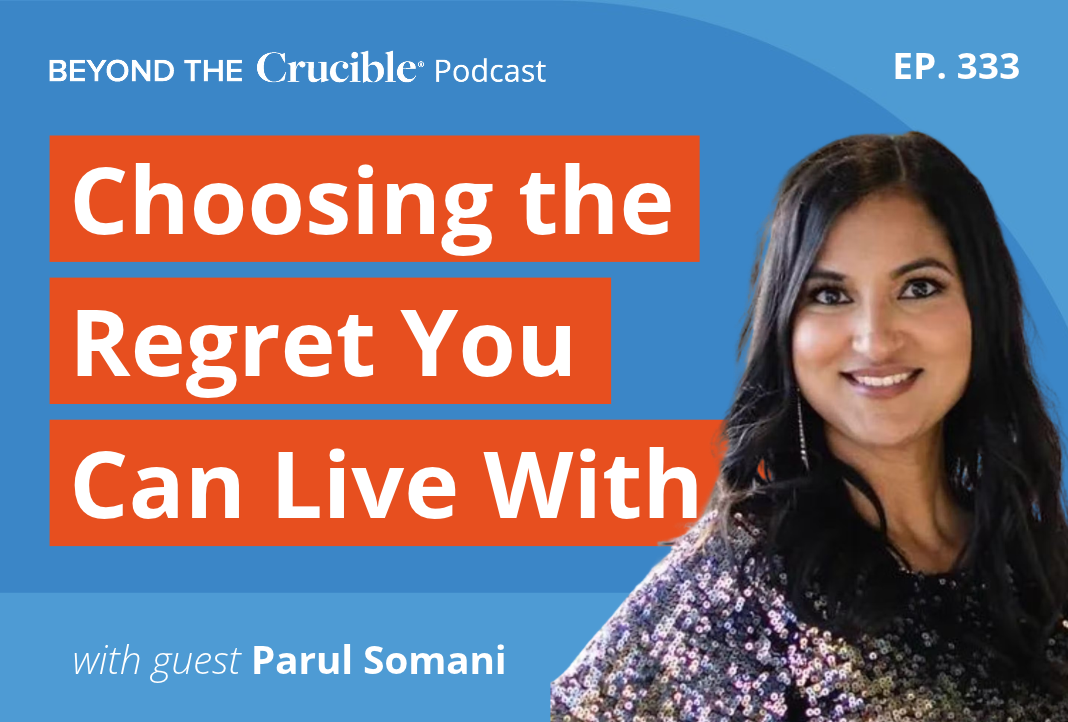
Choosing the Regret You Can Live With
What do you do when every available choice carries risk, uncertainty, and the possibility of regret?
In this episode, we sit down with Parul Somani, a cancer survivor, decision strategist, and bestselling author. Her answer emerged during the most frightening season of her life: an aggressive breast cancer diagnosis shortly after giving birth. She discovered that making the best decision isn’t about guaranteeing the best outcome. It’s about understanding what matters most. Parul introduces the five phases of her Path of Least Regret framework: awareness, processing, exploration, decision, and adaptation. She explains why emotions are valuable information, how to overcome mental roadblocks, and why changing course doesn’t mean you’ve failed. You’ll also discover the power of “grounded hope,” which means acknowledging painful realities without surrendering to despair.
To learn more about Parul Somani and her work, visit https://www.parulsomani.com
Have a question or comment? Drop us a line at info@beyondthecrucible.com
—
👉 Don’t forget to subscribe for more leadership and personal growth insights: https://www.youtube.com/@beyondthecrucible
👉 Follow Beyond the Crucible on Facebook: https://www.facebook.com/beyondthecrucible
👉 Follow Warwick on LinkedIn: https://www.linkedin.com/in/warwickfairfax/
👉 Follow Beyond the Crucible on Instagram: https://www.instagram.com/beyondthecrucible
👉 Take the free Trials-to-Triumphs Self-Assessment to discover where you are on your journey of moving beyond your crucible and how to chart your personal course to a life of significance: https://beyondthecrucible.com/assessment/


Transcript
Warwick Fairfax:
Welcome to Beyond the Crucible. I'm Warwick Fairfax, the founder of Beyond the Crucible.

Parul Somani:
It was a Saturday, the weekend of Father's Day and on Mira's one-week birthday. I'm holding her in my arms on bed when I get this call. Again, when you get a call from a breast surgeon on a Saturday, it's cause for concern. Sure enough, the breast surgeon says, "I'm sorry, but the mass is malignant after all."

Gary Schneeberger:
That's a devastating diagnosis for anyone to receive. For the mother of two daughters, including her newborn, Parul Somani, faced not just an uncertain future, but also some difficult decisions about how best to treat her cancer. As she discusses in this episode, she weighed options and trade-offs and created a framework that's now a book, both called The Path of Least Regret.
The concept was not about finding a perfect answer, but choosing a course she could stand behind, given the information and values available to her. It's a five-phase framework for navigating the emotions of change and difficult choices, drawing on her experiences with cancer, career loss, parenting, and caregiving alongside research and coaching [inaudible 00:01:22].

Warwick Fairfax:
Well, Parul, it's so good to have you here. Parul is Parul Somani, and she is a decision strategist and keynote speaker and the number one Amazon bestselling author of her new book, The Path of Least Regret, Decide With Clarity, Move Forward with Confidence. Her work helps leaders and high achievers navigate uncertainty, change, and high stakes decisions with greater clarity, resilience, and attention.
A graduate of MIT and Harvard Business School, Parul brings more than two decades of leadership strategy and operational experience to her work with organizations and high achievers. She began her work with a career at Bain & Company where she rose to senior manager, advising private equity firms and executive teams, later held leadership roles in Silicon Valley startups. A signature at the path of least regret framework, integrates business strategy, behavioral science, and lived experience to help people clarify what matters, evaluate trade-offs, and move forward with confidence when there's no obvious right answer.
So I want to get to your book, which we'll get to in a bit, which I loved, The Path of Least Regret. It really made me think some of my decisions in my life and what is the path of least regret even evaluating decisions that we're making now. So it's phenomenal insight. Before we get to that, tell us a bit about your background. What was life like for young Parul? What was your hopes and dreams?
Rarely is our life linear. You probably didn't grow up thinking it's going to be something about regret. I'm going to write a book. It probably wasn't that, but what were you thinking, hopes and dreams as you grew up, and what was your family like?

Parul Somani:
Yes. Well, so growing up, I was born in India, but I grew up in the Pacific Northwest between Portland and Seattle and had a very classic immigrant upbringing where I would see my parents work very hard and through observation, they just valued work ethic and knew that I needed to work hard as well. I was always very social. I was a dancer.
I continued Indian dance for 35 years. So that always played a very big role in my life and taught me stage presence, which I do actually get to utilize now in this unexpected career path. When I was a high school student, I was very active in speech and debate. So I had somehow determined for myself that my career path was going to be a corporate lawyer for a high-tech company. It was very falsely precise and unexpected for a high school student to think this way.
I think it was indicative of what my mindset was at that time, which was that you just can plan everything out and that if you make the plan, then you work towards it, and then life will just carry forward. It was definitely a lesson that I learned the hard way that life is non-linear, career is non-linear, and what you think is important to you at one stage of your life may evolve as you and we all evolve. I definitely would not have predicted that I'm doing what I'm doing now.

Warwick Fairfax:
Tell us a bit about your career and where you went to school, and what were those first steps as you began to find your career path?

Parul Somani:
So I went to MIT for college and majored in electrical engineering and computer science. That was very much the output of this plan that I thought I had in high school. I'm like, okay, I'm going to get this engineering background, then I'm going to apply to law school. That is what led me to MIT and to the major of choice.
It was only when I got to college that I feel like my world was opened up in terms of other career paths that exist. Growing up in the Pacific Northwest, I was not aware of the world of banking and consulting and all of these career opportunities that became available in college. It's not totally clear if it was due to true alignment or if it was due to these were the internships that were now considered prestigious and everyone was applying to, but I ended up on this career path in college that was more in the business route.
I had a very specific time period where I'm like, "Oh wait, do I take the LSAT or do I take the GMAT? Which graduate program am I actually interested in now?" And realized that the business world felt more aligned with my interests by that point. I joined Bain & Company after graduation in management consulting in the Boston office.
What started as a, "Oh, this will be a great early career opportunity," ended up being a culture and work that I loved. I ended up staying at Bain for the span of nine years, both before and after getting my MBA at Harvard. I ended up working across four different offices, including helping start their first India office outside of Delhi. Then there's twists and turns that come soon after that. That was the early part of my career.

Gary Schneeberger:
Good foreshadowing. Good foreshadowing.

Parul Somani:
More to come.

Warwick Fairfax:
Speaking of that, so you were working hard, and I think there's one incident where you were taking a taxi from Napa north of San Francisco to a birthday dinner. I think you were at a conference. Just talk about that because it felt like, I guess at that point you had your oldest daughter at this point. So just talk about that kind of, I guess it was one of the crucibles in your journey. So what was that and what did that painful experience cause you to decide? It was a fairly significant time in your life.

Parul Somani:
Yes, this was definitely an inflection point in my career and one that I imagine many people face actually, which is this tipping point of burnout that has slowly been eating away at them. It's so easy to dismiss it or not listen to it, or just get caught up in the inertia of the career that we've led for so long that it's scary to think of what a different job or career could look like.
So for me, I had been at Bain for many years and at different points along the way had recognized why I was still staying. It was initially professional growth opportunities. It was loving the culture. It was the flexibility that it was going to give me from being in one geography to another. By the time 2013 came along and I was nine years after I had joined, I was now a senior manager.
I was dedicated to a private equity retainer team, which is a very demanding client. I had had my older daughter who was a toddler by this point. The client services lifestyle had definitely started having an impact on my health, just trying to be there for my daughter while also excelling at my career. That would lead to working till two, three in the morning and then giving presentations at eight, nine in the morning.
There was this specific experience of a summer offsite. So it was a company offsite actually in Napa, which is a great bonding opportunity. It's meant to be team morale building and uplifting and meant to be no work. The more senior you are, the less some of those rules tend to apply. A few different things happened at this offsite. One, there was a keynote talk by Tim Tierney who had previously been head of Bain and then launched Bridgespan Group.
He shared how he thinks about our working years. Let's say you have 70 working years and you think of each decade as a day of the week, Monday through Sunday. That for him in his career, it was now Saturday. He was really thinking about what does this last day or this last working decade of his life look like and what is that impact that he wants to have? Coincidentally, this offsite and this talk was happening on my birthday.
I'm listening to it and actually wondering how there's not a mass exodus out of the consulting work. I can't imagine everyone here is feeling like they're living the mission and legacy that they want to leave behind. I did find myself asking, I'm like, "What day of the week is it for me? Is it Tuesday? How am I spending my week?" Then there ended up being this accumulation of other experiences, one working through the entire offsite, a lot of micromanagement by the client.
Mind you that this has been months of buildup by this point of questioning whether I want to continue this work or not. On the final day of the offsite, I end up missing most of the social events and I miss the final, the bus that's going to take us all back. I need to take a taxi from Napa all the way down to the peninsula.
So about an hour and a half, two hour ride where I have to work on my laptop the entire drive down. I'm incredibly car sick. I'm just frustrated by a number of things that have happened at this point, already introspecting and wondering if I should be doing something else. This nauseating car ride took me straight to my birthday dinner with my husband.
By the time I got there, I actually just fully broke down in tears and realized that I think the time has come to quit. I had no idea what I was going to do next. I didn't have anything lined up, but it was a moment of epiphany and honesty of a feeling that I had been having for a long time and just hadn't been either fully listening to or at least acting on.

Warwick Fairfax:
It tends to happen as when you ignore those deep inner feelings from your soul, so to speak, a bit like a volcano, it breaks through eventually. We can't shut it down and it kind of did. You probably thought I'm working all kinds of hours on my birthday and not even able to fully attend the conference and some of the fun things. Probably late to my birthday, what about my daughter? I think it's Dia? How do you pronounce your older daughter?

Parul Somani:
Dia.

Warwick Fairfax:
Yeah.

Parul Somani:
There's additional context here that I hadn't shared, which is that after she was born, there was medication that we needed to provide her for about a year. One of the side effects of that medication was low blood sugar. The challenge with a baby, if they're having a reaction to low blood sugar, is let's say they're sleeping through the night. You don't actually know if they're just peacefully sleeping through the night as one would want their child to do, or if they're having a low blood sugar reaction.
So this medication required me to feed her, nurse her every three hours throughout the night. So even though I was also working this over 60 plus hour a week job, sometimes 80 hours per week in management consulting, I was also waking up throughout the night every few hours to tend to my daughter. So there was a lot that was contributing to the burnout.

Warwick Fairfax:
It's like something's got to change here because you can't keep doing it. So you pivoted to something else. I think it was like a startup. So talk about that because that then leads to probably the biggest crucible that you've had. So talk about what was that shift like? It seemed like initially it seemed pretty good.

Parul Somani:
Yeah. Well, two weeks after I finally left Bain, I learned I was pregnant with my second daughter. I was like, "Oh, okay. Well, I'm right in the middle of this career transition as well." I had realized by this point I want to transition into the startup world. I didn't necessarily have an issue with working hard. I just wanted to be more passionate about what I was working on and feel like I was part of building something and tying back into that question around legacy and now wondered, "Okay, how am I going to handle the startup recruiting with pregnancy and all the things?"
I did decide that I would rather join something sooner rather than be second trimester recruiting or wait until after the baby is born and all of that. It was initially a challenge because there is a redefinition of your identity that has to happen when you move from consulting into an operating role. It can be challenging to even describe to someone who might be less familiar with what management consultants do of like, "Well, so what exactly is your skillset? You're not a coder. You're not a salesperson."
So there was a process of meeting with startups and wanting to find that role that would help me transition and build that operational experience, but also be with a team and a company culture that is going to be supportive of motherhood and the demands of working parents. I ended up meeting with this female CEO of a consumer tech startup that was structured to be a great role I was excited about. She seemed great.
Yet I also knew that my test was going to be how she responds to me sharing the news about my pregnancy and if there was any, because I was in my first trimester and wanted to make sure that she knew that this was my circumstance before I accepted. If there was any hesitation or feeling that I would know it's not the right place for me. I was so thrilled that when I shared the news, she had this huge smile on her face and her first question was, "How can we best support you?" Ended up accepting the offer in that meeting itself. It was six months into this job that a confluence of things then came together.

Warwick Fairfax:
Talk about those events. I think it was what, 2014 was it when you're about to give birth to your second daughter. So just talk about those circumstances. I think, is it Mira? Is that how you pronounce it?

Parul Somani:
Mira, yeah.

Warwick Fairfax:
So there was all sorts of things going on. You had had an exam, I think an OBGYN. So just talk about, there's all sorts of complications. You had that breast exam and things there, but then you've got health challenges with Mira and there was all sorts of crucibles and confluence of extremely challenging events. So just sort of lay out that timeline for us of what happened when. There were ebbs and flows from, oh, okay, this isn't that bad, to actually maybe it is. It was really a roller coaster within almost a few days or a few weeks. So just talk about that rollercoaster.

Parul Somani:
It was all very condensed timeline. Yes. It's fascinating because this was back in 2014, so many years ago. Yet I remember the day by day timeline, even this many years later. I know June 5th, what happened, then June 7th, and then June 9th. I know the whole timeline. I won't bore your audience with that level of specificity.
It did happen in such a compact way where it was actually a Friday and my team, my startup team that I had now been working with for about six months had just thrown me a surprise baby shower. I had just been enjoying this baby shower at the office, had come home late from that. That evening itself, my water broke two weeks early. We went into the hospital for what needed to be a C-section.
That pregnancy had gone very normally. So other than the early delivery, there was nothing particularly to be concerned about. Then a few hours actually, or soon after Mira's delivery, she actually stopped breathing. Not even hours, what am I saying? It was very soon after. She had to be intubated and we had to be ambulance transported from the hospital I had delivered her at to another hospital about an hour away that had an acute NICU.
The communication from the medical team was so poor because they essentially said, "We don't know if it's neurological. We don't know if there's a cardiac element, and we're going to have to run all these tests." My husband and I were thrown into what up until that point was the scariest experience of our life, filled with the most uncertainty, the most fear, and that sense of just you have no control of what's happening. As much as you want to fix it, you actually just can't.
We are having days of her in the NICU. In parallel to that though is this whole other storyline that's happening, which is that just two days before my water had broken, I had actually felt a lump in my chest. I had been told that it's nothing to worry about because I was only 31 years old at the time, I was pregnant, and that it was most likely a clogged milk duct.
We had insisted on an ultrasound, but then I never actually made it to that ultrasound appointment because my water had broken. If a newborn and C-section recovery isn't crazy enough, of course, with this NICU stay and everything layered on top of it, it would have been so easy to dismiss any concerns that we had had. My husband insisted that we get an ultrasound and biopsy even while we were still at the hospital for my newborn.
He ended up wheeling me on a wheelchair because I still couldn't walk from my C-section, from the NICU to the neighboring breast clinic for an ultrasound and biopsy. Even there, the breast surgeon said, "The tissue feels soft. It's nothing to worry about. I'll let you know the results, but go and enjoy focusing on your baby."
So we were fully consumed more so by what Mira, our daughter, was going through, but thankfully after days of testing, she was discharged with a clean bill of health. The ultimate conclusion was that it most likely was some breathing transition difficulty that often happens during the C-section. I remember thinking that would've been helpful to know if you had led with that, that that's possibly what it is, but we're just going to test to be sure versus leading...

Parul Somani:
... possibly what it is, but we're just going to test to be sure, versus leading with all of these more extreme possibilities, that would've been much more comforting. So communication matters. The words people use really matter. But at this point, we were just thankful that she was healthy. And so we were able to go home and have what felt like two joyous days where our family felt healthy and complete. But then it was a Saturday, the weekend of Father's Day and on Mira's one week birthday. And I'm holding her in my arms on bed when I get this call. And again, when you get a call from a breast surgeon on a Saturday, it's cause for concern. And sure enough, the breast surgeon says, "I'm sorry, but the mass is malignant after all." And it's that after all that always sticks with me because no one thought it was anything just because I was young and because I was pregnant and they were convinced it was nothing to worry about.
But it turns out I had stage two triple negative breast cancer, which is highly aggressive. It's the most aggressive type. And I embarked on a journey that would take me through 10 rounds of chemotherapy, bilateral mastectomy, breast reconstruction, and the entire emotional roller coaster that is facing your mortality while also doing it as a young and newish mother and all of the aspects of life that you think you have still yet to come and look forward to.

Gary Schneeberger:
As you were going through that, as that emotional roiling was going on or about to go on, you'd already gone through a bunch and now here comes some new stuff. You mentioned that it was your 31st birthday, that number 31, 31st birthday in your family, in your husband's family, that also had to have added because of what... Describe what happened in your husband's family when his mother was 31, because that had to add some emotional weight to what you were going through, which was already very heavy.

Parul Somani:
Yes, absolutely. I mentioned that this was the weekend of Father's Day and the reason that aspect is important in the story is because my husband wasn't home at the time that I got the call because he was with my dad and with my older daughter out celebrating Father's Day and out at a fair. And so when he came home, I actually then needed to tell him this news. And I remember my mother was home with me and I remember her asking, "Oh, should we call them back?" And I was like, "No, let them stay out. Let them enjoy the fair because this is going to be their last couple hours of joy and peace for what's going to be quite a while."
And so when he came home, I was just trying to smile and ask about how the day was, but he could tell right away that I had been crying and I could see the panic rise in him and he was like, "What's wrong?" He's like, "Did the breast surgeon call?" And I told him, "It's breast cancer."
And the context that's so important to this news is that I was 31 years old. His wife who was now 31 years old being diagnosed with breast cancer. And his mother had actually passed away from breast cancer at age 31 when he was just a young child. And so his reaction to this news was very much informed by that childhood experience and relationship with breast cancer that he has. And it was so heartbreaking because his immediate reaction was just that, "I can't do this without you." And it was just jumping to what could possibly be the worst case scenario of this diagnosis and can't do this without you being life, being parenting, being all the things that we expect to do growing old together. So yeah, we were young and definitely did not expect this to be hitting us at that time.

Warwick Fairfax:
What's amazing about this story is, I'm sure you've obviously looked back at this a lot, just with your husband Ash's biological mother dying at 31. I think you had a history in your family of the BRCA gene which can indicate breast cancer. With all of those things, I think I read in your book somewhere that you could have easily dismissed that because I think the doctor said it's a blocked milk duct. And then with Mira, obviously it seemed like things are going fine, you're breastfeeding, no problem. You could have easily dismissed it between your BRCA gene. I believe you're right, Ash encouraged you to say, "No, let's take a look." I think the two of you together with your backgrounds in both families, it feels like you talk about silver linings, but in some sense your experiences served you to dig deeper and take the extra step when you mightn't have.
I'm sure you've looked back and say it's tragic what happened to your husband's mother and the BRCA gene, but those two things change your perspective. Does that make sense in a way that it might not have shifted without that?

Parul Somani:
No, 100%. So there's a lot of family history that factored into this situation. On one side is my husband's experience with his mother and that shaping his concern and emotion and reaction to the diagnosis. On the other hand, there's my family history where my own mother is thankfully thriving to this day, but she also faced a breast cancer diagnosis in her early 30s when I was a child. And for decades, no one had ever questioned why she might have gotten it at a young age. She had never been offered genetic testing. But when I was 29, so after I had my first daughter, but before I was pregnant with my second, I had actually gotten genetic testing done. And I was the first in my family to learn that we carry a BRCA or BRCA1 mutation. And ultimately, we then realized that my mother carries that as well, which is what led to her early onset diagnosis.
And when I had first learned that I carried this mutation, it felt like this diagnosis being received right at that moment. It felt like this terrible news that I needed to process and understand what it means. And yet that's also knowledge that became life saving information. It's because I knew that I carried this mutation. It's because I knew that I had a very high risk for breast cancer. It's that information that empowered me and my husband to then advocate for an ultrasound and biopsy, even though I was being told it's nothing to worry about. It's what eventually pushed us to, even though we were worried with everything happening with Mira in the NICU, it's what pushed us to have Ash wheel me to the breast clinic and get that ultrasound and biopsy anyways.
And when I look back at that time, it's actually terrifying to think about how easily we could have dismissed the lump, not only if we hadn't known the genetic information or if we had believed what healthcare providers were telling us at that time, which even with a BRCA mutation, that's saying I have a high risk for breast cancer in my lifetime, that risk really comes high at 70, 80. At 31, it's still a quite low chance of breast cancer. And when I had, after delivery and my milk came in, I actually couldn't feel the lump anymore. And so I would have breastfed for a year like I had my first and wouldn't have felt that lump again until a year later. And the diagnosis and the prognosis would have been just entirely different by that point.
What was once very hard information to receive of learning about that mutation over time actually became this life saving piece of knowledge that we were able to tap into. And that's where our source of strength for advocating for ourself came from.

Warwick Fairfax:
So talk a bit about, you had decisions to make about what kind of treatment you're going to have. There were two options. And it was really, from what I've read, in trying to decide between those two options and being a creative soul, you obviously picked a third one that they didn't offer. But the whole path of least regret as I read it was birthed in that excruciating decision. So talk about what that decision was and how there was really two concepts you're trying to optimize for. So the book was birthed out of that horrific decision you had to make. So talk about what the decision was and how that birthed the mission that I think you've been given in life is The Path of Least Regret.

Parul Somani:
When I was diagnosed, I was very naively thinking that breast cancer has been around for a long time. The doctors will tell me what I need to do and I just need to then execute the treatment plan. And I was very shocked to learn that it's more of an art than a science. And the more oncologists I get opinions from, the more opinions I will get and the more options I will be presented with. And I was very surprised to have the oncologist and care team ultimately asking me what treatment plan do I want to pursue? And it just felt like this question and this decision that I had never been prepared for. When it comes to decision making, one, realizing that we're never actually taught how to make decisions and that journey of decision making and our approach to it might very well be shaped by either our upbringing or the career that we had.
And so in my case, it was a very logical data-driven approach to decision making. And that's what I was starting off with, even with this treatment plan decision is jumping into the data, getting the second and third opinions, talking to other patients and diving into the studies and looking at how does recurrence rate change with different chemotherapy regimes. And the more I dug into the data, the more I realized that this approach to decision making was not serving me. And it's because when it comes to these decisions that matter most that are so emotionally charged in nature, there's so much uncertainty on the other side. There's no level of analysis that I could do that was going to assure me what would be the right choice for me that would tell me like, "Oh, if you just do this plan, then you will have no recurrence, you will have no lingering long-term side effects, and clearly it's the right choice." And there was a very specific day in July of 2014 where I had this conversation to myself where I realized there is no easy answer.
There is no path of least resistance. And so what is my path of least regret? And that question was almost like this mental shift in my mind where it just completely transformed my lens on decision making because I was no longer asking myself the question, what is the right answer? It was the question of what is the regret that I can most live with? Because I'm not going to be able to make any choice that's going to guarantee me the outcome that I most desire. And if the cancer were to come back or if I were to have long-term side effects, what is the process that I can go through and what is the decision that I can choose that is going to give me the most peace of mind even if my preferred outcome is not achieved? And what this lens also did is really then help me dive into, well, what is it that I'm actually solving for and why is it that this decision is feeling so hard?
Because when you're diagnosed with something like cancer, you just want it to go away. You just want the treatment plan that's going to make it go away and not come back. And so instinctually, and even looking at the data, one would guess that I would just want to go aggressive. And those were the two treatment plan options I was being presented with is one that was much more aggressive in nature where the chemotherapy would be very toxic. It on the plus side has decades of data, longitudinal data available to show that the recurrence rate is minimized with this treatment plan. And yet because of the toxicity, there's also very long-term possible side effects that are related to brain health and heart health that are true concerns. And on the other hand, I was being presented a more progressive option that was anchored in more recent academic research that was very compelling, proven to be effective for my particular subtype of cancer, so less toxic that my hair wouldn't even fall out. But because it's newer, that longer term data just doesn't exist in terms of recurrence risk.
And I was feeling torn between these two options, but the progressive one, I felt like I was able to eliminate pretty quickly from the standpoint that I knew if I did that route, chose a less toxic option and the cancer came back in five years, I would always wonder what if. I would wonder what if I had just been more aggressive? And yet I was having a very hard time just choosing the more aggressive option. I was having trouble sleeping, I was having trouble eating, and I knew something felt off. And it was when I asked myself this question of what is my path of least regret, that's when I realized that the reason I was struggling with just choosing the more aggressive option is because it wasn't only lifespan that I was solving for. If it was, then that would be the clear answer. But what I was actually solving for was health span. It was wanting to live a longer life, but also wanting it to be a healthier life.
And the concern that was eating away at me that I hadn't been able to name until that point was I didn't have a problem with toxicity that would make my hair fall out. I just didn't want to take on unnecessary or potentially excessive toxicity that could then lead to these longer term side effects. And by clarifying what I was actually solving for and what concerns I was having with the options in front of me, enabled me to have these conversations with my oncology team and work out what ended up being a third treatment plan approach and one that was going to actually be my path of least regret. Not because it would somehow now miraculously guarantee me survival or what it is that I wanted, but it was because it was anchored in the clarity and intentionality of what mattered to me, what I was hoping to mitigate, and I would know, would feel like the best decision I could make at the time that I had to make it.

Warwick Fairfax:
I mean, that's really amazing that this new framework helped you make a decision that, as you write, would optimize health span, not just lifespan because you wanted to be healthy long term for your husband and your daughters. You didn't want the side effects, brain and heart health, but yet you wanted to, as best you could, crush the cancer. And so you found a middle course to navigate between that, which is not easy. So it's amazing how that would become your life's work. So talk about what happened next in the story. So I think you ended up leaving, I think that startup and went into something else, more genetic testing company. So talk about the next beats in the story.

Parul Somani:
Yeah. I mean, initially, well, my maternity leave had turned into a medical leave and I focused on my health. And yet six months later, even though some of the surgeries and recovery were still continuing, I did have this desire to go back to that startup that I had joined and really combat chemo brain by being back in that environment. And I stayed on with the team for another two years or so until we were acquired by a larger corporate retailer. And that turned into this inflection point, another opportunity to pause and ask myself, "Is this what I want to be doing?" And I realized that I didn't want to be working for a big corporate giant. I wanted to now do something more mission driven. I had made that jump from consultant to operator, but I hadn't solved for mission yet.
And interestingly, at this point, I actually didn't know what that mission would be. I know I had gone through this very life transformative experience with my diagnosis, but when it came to my career and my professional contributions, I didn't know what mission looked like. And then I came across a startup working in the genetic testing space whose mission was to democratize access to genetic testing for hereditary cancers. And it was like this mission had just found me. They are literally trying to get the test that ultimately saved my life into the hands of more people to help save their lives. And so this work just immediately spoke to me and I proactively reached out to different leadership team members at the company, not applying for any specific role, but just sharing my passion for what they do, my personal experience, my professional background, and ended up shaping a role at this company. I ended up joining on as the global head of B2B marketing for this healthcare startup.
And somewhat outside the scope of my role, I ended up also sharing my journey, the role genetic testing had played in my life, my cancer journey, and sharing that on large stages at healthcare conferences and really becoming a face and personal story of the work. So it wasn't just a job and it wasn't even just a mission. It was really the meaning that I was attributing, the purpose that I was creating from this hard cancer experience to give it this meaning and purpose. And so there was a lot that was wrapped up in that work. And so two years or so into that role, that's what made it so blindsiding when I was then laid off.
And I understand the business side of it. I've been on the other side of layoffs, like the rational side of me understands why businesses and startups particularly go through these changes, but the personal and the emotional side of me felt grief and heartbreak. And it wasn't just the hit to one's ego from a job loss, but it was like I had lost what had felt like my reason for being and the meaning I had given my cancer diagnosis. And it felt like this in a very different way, but another roller coaster like I had gone on years earlier where there was really hard emotions that you just need time to process and feel. And yet there also comes that time when you need to determine how you want to move forward.
And what I realized is the strategies and the mindsets and the coping mechanisms that had helped me navigate my cancer diagnosis and make those hard choices and move through that entire emotional journey with this intentionality and thoughtfulness so that I could ultimately be proud of it were actually all applicable in this new curve ball of my life where I was having this career transition point. And I needed to give myself that time to just feel and process my heartbreak. And yet I also decided that, okay, I might not have chosen this layoff or this time off from work myself, but now that it's here, how can I make the most of it? And I had the luxury to not have to jump right into another job. And I decided that, okay, I'm actually going to just take a few months to unwind from any burnout and be present-

Parul Somani:
... unwind from any burnout and be present with my daughters while they still enjoy my company, and then put some thought into what that next role could look like. And so I was very intentional about what turned into a sabbatical, and realized that what I thought I wanted to do was change every three months. The more time I gave myself to separate my identity from the corporate track I had once been on to tapping into, well, how have I changed over these years? What is important to me now? What is important to me in these coming years? And what does career and profession look like in that context? It was really this question of, well, what is my path of least regret for this year and this stage of my life and this layoff and how I handle it?
And giving myself that time for introspection was my path of least regret. Spending more time with my kids was my path of least regret. And it all led to what ultimately ended up being this aha moment where I was invited to be the keynote speaker at the grand opening of the new Stanford Hospital, because I had been treated there. I'd been a patient and caregiver, and realized that what I wanted to share was not about all the hard and dark clouds of diagnosis, but it was the stories of mindset and meaning and silver linings that had been created through those hardships, and that speech was a reminder.
It was kind of like tapping back into that dancer in me, who loves being on stage and working with audiences and inspiring them and moving them. And what once was through movement and dance, but now could be through words and stories and life experiences. And that fall of 2019 speech became the aha moment that led to me launching the work that I do now, which is really serving this mission of empowering people with the mindsets and tools for navigating uncertainty and change and making the hard choices that actually matter the most.

Warwick Fairfax:
One of the things I love about what you wrote is you said a friend advised you, "Wait for the bells to ring," which I love that phrase. I know from my faith perspective, sometimes you talk about that still, small voice from God, from above, but that waiting for the bells to ring, waiting for something deep within your soul to speak to you to say, "Yes, Parul, this is your path. This is your journey. This is the next step." That deep inner wisdom that I think that we all have the capacity to step into, that was so wise to take a few months, and that speech at Stanford Hospital led to Silver Linings and now the work you do with The Path of Least Regret.
Just one more question before we unpack some of the key pillars of the path of least regret. With Silver Lining, there was actually a silver lining for your dad. And you write that it wouldn't necessarily have happened, that it made a significant difference in his life, without some of the things that you went through and some of the things that your husband Ash had access to. So talk about that literal silver lining with your father.

Parul Somani:
So the context here is that my dad, as of the time of my diagnosis, had had progressive hearing loss for about 30 years. I remember when the radio volume would have to go higher and higher and the TV volume would have to go higher and higher in my childhood. And then when dinner discussions at the dining table became very animated and loud and not only because we're passionate about what we're talking about, but because we just had to be that much louder so my dad could hear us. And by the time 2014 came around and my diagnosis came around, he was nearly deaf in both ears. We could be standing right behind him and if he wasn't looking in our direction, we could be screaming at the top of our lungs and he wouldn't be able to hear us, so we couldn't talk to him on the phone or anything like that.
And we had gotten multiple opinions over the years, seeing specialists, asked if there was anything new that might be able to help address his hearing loss. And we had always been told that based on the diagnosis that he has, there is still nothing that can be done for that. And it was only when I was then diagnosed with cancer that we got access to this medical consultancy through the employee benefits of my husband's employer. And the scope of their work was definitely focused on my breast cancer treatment, so helping us understand the research and any questions that we might have on that journey.
But given that we now had access to this resource we'd never had before, I asked them the entirely out-of-scope question about my dad's hearing and whether they have any ENT specialists around the nation that they might recommend. And they came back with the name of a specialist based in Florida, all the way on the other side of the country, that we just would not have come across on our own. And he was willing to do a remote consultation. So we sent the CT scans, the audiology reports, whatever medical records we had about my dad's hearing that might be helpful to him.
And I remember, in fact, I'll never forget, actually, how I felt during that conversation because he said, "I can't be sure until I'm in your father's ear, but I think he's been misdiagnosed for the past 25, 30 years, and what he actually has can be treated by a one-hour outpatient surgery." And I remember actually feeling excited and hopeful in that moment, because it was the first time anyone had said like, "Oh, there might be something we can actually do about this." But I also remember seeing my dad's face and just how somber it looked, because he was just processing. "Misdiagnosis? My life could have been so different over these past decades."
We then waited until after my initial surgeries were done, and then I flew with my parents to Florida to meet with the specialist. And he did do the operation first on just one ear for my dad and confirmed the misdiagnosis, and was able to actually restore his hearing in both ears with this one-hour outpatient surgery. And there's a whole spiral we could go down around the state of the healthcare system, and how this misdiagnosis happened in the first place and what confirmation bias exists in the medical world.
But putting a pin in all of that for now, having my dad's hearing restored was life changing, not just for him but for my mom, for all of us as a family, who were now able to have group conversations on the dinner table that included my father and he could play board games with us. And when COVID hit and we were living afar, we were able to have weekly Zoom conversations with my parents and my kids and nieces with their grandparents, because he could actually now communicate through video conferencing. And I mean, I even remember when he first heard himself laugh for the first time in years, because he could now hear it after the surgery.
But when I think back to this beautiful silver lining that came because we were able to get the diagnosis corrected, only because we were able to find the specialist, only because we got access to this medical consultancy, it wasn't like this silver lining or positive outcome that just naturally emerged through my diagnosis and my access to this consultancy. It was through intention. It was through openness to opportunity. Even when we were going through such a dark time and navigating our own fear and health situation, it was even in the midst of that, recognizing what has changed, what are now opportunities, what are resources we didn't have access to before. How could these resources be helpful in a different context than just what they were presented to us with?
And this was one of the pivotal stories that really inspired the work that I then launched in 2019 under the name Silver Linings, because it was driven by this realization and belief that silver linings don't just emerge, but they can be created, that there are mindsets and there are practical strategies that we need to be cognizant of, and recognize that we have the agency to actually craft these beautiful silver linings and positive outcomes, even from some of the darkest times in our life.

Warwick Fairfax:
I mean, that is so profound, your dad's hearing being restored after decades. He's thinking, "I lost decades of my life." You're thinking, "We've got our father back. The family has him back. We can have Zoom calls. We can communicate." It's like he's being restored in some sense. It must have been just moving beyond description.
So I want to just talk a bit about just there's several pillars. So talk about the pillars of the path of least regret. You've got awareness, processing, exploration, decision, adaptation. Yeah. I mean, I've really been thinking a lot over the last days, just as I've been reading your book, The Path of Least Regret. I mean, it's so profound. I don't know if you feel like you were kind of digging for gold or diamonds and somehow you discovered something and it's like, "Wow." Without what you went through, it would have remained hidden under miles of granite or something, whatever analogy you want to use, but that's the idea of making a decision.
As you write, you don't know what's going to happen. I mean, like you have an MBA, you're a strategic planner, which can be good. You can also think of all the things that could possibly go wrong with an endless decision tree, which I can see about 10 outcomes. All of them go from horrendous to worse than horrendous. So sometimes strategic mindset's not helpful, but just saying, "Okay, let's park that because we don't have future data, so we can't know." How can you make a decision on information you don't have?
But saying that path of least regret, what can I live with even if it doesn't work out, that is so freeing. I mean, it's just mindblowing. So just talk about sort of an overview of what those pillars are and how you use them, just to give folks a bit of a flavor of what that is so that hopefully they will be encouraged to learn more, read your book and unpack it in more detail. So what are those five pillars? How do they work together?

Gary Schneeberger:
And speaking of your book, let me have you hold it up ... because you went and got it before we started talking ... so people can see it.

Parul Somani:
So this is The Path of Least Regret and there is a golden compass on the cover, because through this framework that I introduced, I really want people to rethink the role regret plays in their life and not just of it being this backward-looking burden and all the what-ifs and if-onlys in our life, but recognize that it can actually be this forward-looking compass that helps clarify our values and what we're solving for, and illuminates for us what that choice is that will drive the most peace, regardless of the outcome.
When I spoke about the path of least regret and its origin story earlier, I spoke about being at what was effectively a crossroads and choosing between Option A and Option B. But over the years and reflecting on not just the cancer experience, but reflecting about all of the various aspects of life that this question and this mindset has applied, it's in parenting, it's in caregiving, it's in business, it's in leadership and health and relationships and more. I realize it's not just about the decision made at a crossroad, but it's the path that you follow through the emotional journey of decision making. And the reason it's so important to understand and navigate those earlier phases of that emotional journey effectively is so that when you actually get to the point of being at the crossroads, you are able to choose with honesty and with freeing yourself from mindsets or beliefs that might actually be holding you back.
So The Path of Least Regret as a five-phase framework in the book actually begins with defining what that emotional journey looks like and what the hard emotions are that we experience, how those hard emotions can actually become mental roadblocks and hold us back and cloud our judgment, and how when we are ready to move forward with the decision making, how do we approach the exploration of the options available to us? How do we weigh the pros and cons of those options? And then how do we give ourself permission to change course if a new reality emerges in the future? And the path of least regret is specifically how do you navigate each of those phases with resilience and intention and agency and a belief in being able to control what you can control, so that you move through the roller coaster and make the decision with the most clarity and confidence that you can.
So awareness and processing is really about giving yourself the permission to feel by naming the hard emotions that you're feeling, giving yourself permission to process them, recognizing that it's not weakness to feel those feelings but it's actually data, recognizing that your emotions are actually data points that are telling you what is important to you, what feels off, what changes need to be made. And only by pausing and looking inward and listening to them can you actually then begin to understand both how you're feeling and how you might want to move forward.
Processing is about recognizing what might be those mental roadblocks that are holding you back and strategies for overcoming them. Exploration and decision are about really defining what your north star is. What is it that you're solving for in this phase of life or in the context of this specific situation, and how does the awareness of how you feel about the options, what do they reveal about what your risk tolerance is, what's important to you, what's not, and what does that mean for what could possibly be a third option, right? An option that you hadn't even considered before that might be a little bit more out of the box, but would actually be your path of least regret, the choice that you feel the most comfort with.
And even once you're on the path of pursuing your path or you feel like a decision's been made, recognizing that we're all continuing to evolve and change, and there might come a time where what was once your path of least regret now feels like a new season of inertia, or a new acute curveball comes and throws you off course again. And so adaptation is about recognizing that sometimes we do need to take a detour, and a detour or a change in path is not a failure of a past decision, but it's actually an active realignment.

Warwick Fairfax:
Yeah. I mean, it's so, so powerful. I love every one of those phases. I mean, certainly for driven MBA types, it's easy to say, "Look, emotions are irrelevant, let's focus on the data, let's focus on the different factors, the decision makers, the different parameters, let's all be very logical and analytical," which is not wrong, but everything in of itself that can lead to problems is you've got to be aware of your own fears and hopes.
Sometimes in the course of your life, a joy came out of a potential pivot to silver linings. Well, that's an awareness of your emotions. Other times it could be fear and anxiety. That's also data, but of a different kind that most of us want to just ignore because we feel like emotions are bad, which is they're not right or wrong or good or bad, they just are, and you should pay attention to them like you would any other part of your overall health. So I love that.
Overcoming mental roadblocks, it could be barriers in your past or fear from past health diagnosis like you and your husband Ash had, which fortunately wasn't a roadblock, but we all have constructs in our minds and history that may unwittingly stop us from making good decisions. I realize, "Am I making a rational decision or a fear-based decision based on what happened to my father or sister or dad or mother?"
I love defining your north star. What are the values, beliefs, philosophies that you hold dear? How is it in line with your faith, philosophy, value, whatever it is? I believe strongly we all have beliefs. It's not so much whether it's right or wrong, but whatever your belief system is, you've got to honor that, honor your history and your heritage and whatever that means to your values, don't ignore it. Maximize peace of mind, allow for details. It's such good stuff.

Parul Somani:
Thank you.

Warwick Fairfax:
There's a couple other things in the book that I wanted to just briefly mention in particular. I love the title of Chapter 7, Travel Companions, because what's kind of interesting is we have a similar concept except we call them fellow travelers.

Parul Somani:
Oh, there you go.

Warwick Fairfax:
And my book, Crucible Leadership, came out a few years ago, 2022. I don't know how specifically I got into it then, but in past podcasts and blogs and this idea of just having people with you on the journey. In our case, when we talk about fellow travelers, we talk about people who both encourage you as well as people that might have complimentary skills that you don't have in a business or other setting. But just talk about ... and I think you had a group, To Work or Not to Work with some other women may be successful and you have kids and how does this all work, but talk about why travel companions are so important.
Because then certainly in the U.S. culture, there can be almost the worship of the rugged individualist, that, "I don't need help. I'm good. I'm my own island and I can figure it out." A lot of parts of U.S. culture are wonderful. That particular, being an Australian, I'd say it's not. The whole rugged individualist, "I don't need help," is not helpful, at least in my opinion. So talk about why travel companions, it's not a sign of weakness, it's a sign of intelligence and strength, and it's so helpful as you're trying to navigate your way through the path of least regret.

Parul Somani:
So the book itself is laid out where several chapters are laying out the framework and the phases and how you navigate each of these phases, but there's a set of chapters that I have in Part 3 which are actually overarching resilience-building strategies. And I think these were very important and meaningful for me to want to include, because understanding the emotional journey and knowing how to navigate it individually is one thing, but there are certain aspects of our life and strategies that if we exercise and build our resilience throughout our life, then that emotional journey becomes one that is less painful to navigate and less lonely to navigate.
And so, one of those resilience-building strategies is this chapter you're referring to, Travel Companions, and it's specifically nurturing friendships in adulthood and recognizing that as we get older, it becomes harder to have those social circles in our life that we can turn to, both in times of celebration and in times of need. And those social circles can also serve as accountability partners for us, as we are moving through hard choices and as we are trying to figure out what feels aligned to us or not. Who are those people who are going to push us and keep us honest about what we said is important to us and whether we're actually making the hard choices that are going to best serve that?
And so To Work or Not to Work was an example of a group that I wrote about in the chapter that came about very organically where it was a group of girlfriends. We were about to go see J.Lo's 50th birthday concert and just looking forward to a fun night, and we had gone to dinner.

Parul Somani:
Just looking forward to a fun night. And we had gone to dinner beforehand and had all these conversations about where each of us were in our career and they were all very different. Some had been working for 20 years and looking to transition out. I was in my transition period at this point between startup and layoff and figuring out what comes next. And then there was others who had been not working for seven to 10 years, focusing on raising their young children, and were now wanting to get back into a part-time or full-time role. And after the concert, it was interesting because what actually was the thing we remembered most was despite how much fun we had at the concert, it was actually all the conversation that we had started at dining at that restaurant.
And so I then invited those same girls to my place and added a couple of other women who were going through similar career choices. And when I put us all on a WhatsApp group together, I named the WhatsApp group To Work or Not to Work, That Is The Question. And it was great because when we met as a group, it wasn't just a group of ladies catching up socially or friends meeting up. It was a very intention-based gathering. It was one where we knew we were going to share with each other what our goal or aspiration is for our career and how that integrates with our life in the year ahead. And that in each meeting, we were going to be responsible for giving an update on how things have changed. What is it that we've done since the last meeting to now? And we're going to ask each other questions to help push us forward.
And even members of that group had shared that just knowing that there was a group of people who were kind of waiting for an update, that held them to an accountability that they didn't necessarily have before because they didn't want to be the person who was like, "Oh, I haven't actually done the thing I said I wanted to do or made any effort towards making that happen." It was just an example that a group of women who didn't all necessarily even know each other before, I was the kind of connecting point for all of them, could create such a strong bond and one that was filled with honesty and accountability simply because we had set that as the intention for the gathering.

Warwick Fairfax:
That's so good. There's one other thing in the book that I really love and it's a chapter that talks about grounded hope. And I love what you write. You say, "This isn't easy work. Grounded hope takes practice. It requires us to sit with discomfort and not turn away from it. It asks us to resist both toxic positivity and hopeless despair. But when we lean into that tension, when we confront the brutal facts, and still choose to believe in a better outcome, we create a pathway forward. And sometimes that's where the most beautiful things happen." I love that phrase "grounded hope." I've been thinking about that a lot in the last few days. So talk about that because that's so helpful. It's not pie-eyed idealism and positivity. It's not hopeless despair. Again, it's a third way, like that diagnosis.

Parul Somani:
Yeah.

Warwick Fairfax:
Peril finds the third way. So here's another third way, grounded hope.

Parul Somani:
When it comes to these types of discussions, there's just focus on positivity, but that can also become toxic if we're not giving space for what are the real, hard, and uncomfortable emotions. And if we're just encouraging people to move on or just remember that they're strong and that everything will be okay, we don't actually know if it will be or not. And so when we say those things, it actually makes the person going through the hard time feel more alone in their uncertainty and more fearful of the future without feeling like they have a way of talking about it and sharing their concerns in a way that will be heard and understood. And yet, we also don't want people to lose hope or believe that things might not get better.
And so I love that grounded hope is the intersection of the two where it recognizes and is grounded in the hard reality of what has happened, what can't be changed, what is scary, what is fearful, what might or might not happen, and so that we're honest about the difficulty and the pain that lies ahead. And yet, we are unwavering in our belief that we will still emerge stronger from it on the other side. That is hope that we can't afford to lose, that ultimately we will emerge and thrive, but not be delusional in what that journey from point A to point B might look like and how truly difficult that may be.

Warwick Fairfax:
Just as we kind of sum up here, I know you wrote this in the book, but talk about how your health is because from what I understand, you've been cancer-free for quite a few years. I mean, there is a silver lining to this story, right?

Parul Somani:
Well, there's, knock on wood, yes, over 11 years in remission that I am so thankful for. I wrote many years ago that we know chemotherapy ages the body, but I believe it also matures the mind. And I actually feel as much as I would have wished this diagnosis just wouldn't have happened in the first place and the pain of that experience, if I can't control that, if I consider that to be inevitable, then how lucky am I that at such a young age, at age 31, I was able to have this experience that put my life in perspective, clarified for me what are my priorities, helped me ask myself questions that many people don't until their midlife crisis decades later? And even being so aware of, "Wait," not just mortality, but as a result, what is that legacy that I want to leave behind? I was able to ask and answer those questions at an age where I still have a longer runway to be actually now able to serve that mission.
And so I actually am thrilled with what has come over the course of these past 11 years, whether it be the beautiful moments with friends and family or it be this newfound mission in the work that I do as a speaker and workshop facilitator, and now with sharing this work with the book, and I'm so excited for what might else come and be in store for me. But this is how I'm so different from that high school version of myself that I don't now just blindly plan out and define that this is exactly what the future will be. I'm much more open to how everything might unfold and realize that sometimes it unfolds in much more beautiful ways than we could have ever planned for ourself.

Warwick Fairfax:
So Parul, how is your thinking behind The Path of Least Regret sort of evolved over the years? Where is it currently? What are some of the avenues you're looking into?

Parul Somani:
It's definitely evolved a lot over the years. If I think about when I first started writing the book, it was January of 2021 and I could have written a book at that time, and yet it would have just been so different because it's taken all of these years of not just understanding and reflecting on my own experiences, but now actually speaking about these mindsets and frameworks with companies and conferences and running workshops and advising others and actually seeing how it plays out in other people's lives. And so one evolution of The Path of Least Regret was what we spoke about in terms of it's not just a question you ask at the crossroads, but it's this entire emotional journey that you go through.
And the second aspect of what I've realized about it over the years is that it's not just a decision making framework for us to use in our individual lives, but it can actually parallel from self to systems, whether that system be a family or a team or a company or even a community. When we think about decision making, The Path of Least Regret applies to these groups of people as well, but the language that we use might change. So instead of language around the emotional journey being our mental wellbeing at an individual level, it might be our morale at a team or organizational level. Instead of it being the question of, "What is my path of least regret?" it might be, "What is the path I can most defend with integrity?"

Gary Schneeberger:
Well, folks, I know that my path of least regret is to give Parul the opportunity before we land the plane on this conversation to let you know how you can find her and all that she does on the web. So how can they do that, Parul?

Parul Somani:
Thanks, Gary. I can be found at parulsomani.com for more information about my work as a speaker, author, decision strategist. Signing up for my newsletter is all available on my website, parulsomani.com. I'm also available on LinkedIn and Instagram at @pdsomani. And the book, The Path of Least Regret, is available anywhere you buy your books online, whether that be Amazon, Barnes & Noble, independent booksellers, at bookshop.org, and it's available in hardcover, E-book, as well as self-narrated audiobook. So if your listeners have enjoyed the sound of my voice, they can hear more of it with the audiobook.

Gary Schneeberger:
Awesome. Warwick, as always, last question is yours.

Warwick Fairfax:
So Parul, there might be somebody listening and watching today and maybe today feels like their worst day that could be in a pit of despair, and they've got some big decisions to make and they're just paralyzed with fear. They don't really know how to navigate their way out of the pit. Sometimes you can feel like as deep as the pit is, it can only get deeper. They're looking at all the possible worst outcomes and it's like the more they think about it, the more bad things they can think could happen. So what would a word of hope be for somebody who today might feel like their worst day and they're just despondent and they might be very capable, but they seem almost incapable of figuring out what to do and how to get their way out of this terrible place they're in?

Parul Somani:
I would want to remind them that the story's not yet over and they have the agency to write what is yet to come. And the question I would want them to ask themselves, especially if they're feeling like it's all hard decisions and they're all bad decisions and they're all suboptimal outcomes that they're choosing between, is to ask themselves, "What is the regret I can most live with?" because it's not about choosing a path that's going to give them certainty and it's not even about choosing a path that is necessarily going to be in hopes of a good outcome. But if they're choosing between trade-offs, then asking themselves what is it that they're valuing, what is it that they're solving for, and which trade-offs are they most comfortable making. Even if it's not an ideal outcome, there's at least peace of mind on the other side of that choice.

Gary Schneeberger:
Friends, I've been in the communications business long enough to know when the last word on a subject has been spoken, and our guest today, Parul Somani, has indeed spoken that last word. So Warwick, we just had a very interesting conversation with Parul Somani, who has both meaningful crucibles in her own life experience, but then has written this excellent book that you read for this episode. So talk a little bit about Parul and about her book and what listeners and viewers can learn from all of that.

Warwick Fairfax:
Yeah, it was an amazing conversation talking with Parul. I loved her book, The Path of Least Regret. That was such an incredible book, so much to learn from. It's just amazing how her book was birthed out of one of, if not the toughest time in her whole life. It was incredible. She was about to give birth to her second daughter, Mira, and she'd gone in for a OB/GYN exam, a breast exam. It seemed like, "Yeah, it's probably fine." She felt something, but not a big deal. Then she has Mira and there were some health problems with Mira early on that was sort of stressful. And she would have had a scan of her breast, but that had to be canceled because her baby was being born.
But her husband, Ash, and her really pressed in and that was because of prior crucibles. Ash's biological mother had died at 31 years before, the same age that Parul was, and Parul earlier knew that her mother had a previous diagnosis with this breast cancer. So she got scanned genetically and found she had the BRCA gene, which means that women in your family are more prone to getting breast cancer. The combination of her own family medical history and her husband's family's medical history made them do something that you wouldn't normally do when the doctors are saying, "It's probably fine. I wouldn't worry about it." And they didn't really have any evidence to say that it was worth taking the next step so that she did get a scan. Even the scan, I don't think, was completely conclusive and they both, she and her husband, pressed for a biopsy and that's when she found she had aggressive cancer.
And out of that nightmare scenario where they found out their daughter was fine, she's 31 and she's thinking, "I have two young girls, a baby girl and a girl as a toddler. What am I going to do now?" There were two options. One was very aggressive treatment and the other was a treatment that was not as aggressive. And so Parul basically found a third way because she dug down into her values and she wanted to optimize the health span, not just lifespan. So with the aggressive form of treatment, there can be side effects with brain health and heart health. And so she wanted to be healthy as her daughters grew up, but yet she wanted to combat the cancer.
So in consultation with her oncologist, she collectively found a third way that would maximize health and also lifespan. And so through that, she came up with this concept of The Path of Least Regret. And basically that is we can't know the future. We can't know what will happen. People like Parul can be data driven. She's a Harvard MBA, as I am. You can't know the future. That data is unknowable. But what you can know is, "Based on the data I have today, as well as my own personal beliefs and goals and values, what is the path irrespective of what happens that I will least regret?" because that's a path you can live with, even if it turns out to be the right or wrong decision. And that concept of The Path of Least Regret, that is eye-opening, it's mind-blowing, and it was so incredible just to hear her story.
She didn't find her calling of her mission and The Path of Least Regret immediately. She went into a couple other positions, but slowly she evolved to find her mission. She moved from where she was in a startup to a company that was doing genetic testing that certainly felt close to her purpose. But eventually, she took a break from that, took a few months off and with, as she puts it, some travel companions, which is what we would call fellow travelers ...

Gary Schneeberger:
Right, right, right.

Warwick Fairfax:
It's fascinating to have the same concept, different name. She thought the idea of just this whole work with finding silver linings out of what she went through. Part of her story is because she had access to healthcare that she didn't have before that, almost what you would call concierge healthcare with specialists. She just on a whim mentioned to one of them, "My dad hasn't had good hearing in 20, 30 years." "Well, I know this top ENT guy in Florida and he's the best in his field, one of the best that we know of." And this guy went in talking to him and said, "I think maybe your dad is being misdiagnosed." So they went to Florida, he had been misdiagnosed, and he got his hearing back after decades of really finding it hard to hear. So her company brand, Silver Linings, was in part birthed out of that.
And just her whole work with The Path of Least Regret, she talks about grounded hope, which is another concept that was just sort of really mind-blowing to me. She talks about, "Grounded hope requires us to sit with discomfort and not turn away from it. It asks us to resist both toxic positivity and hopeless despair. So leaning into the tension, not saying, 'Oh, it'll all work out and there's nothing to see here.' Ground yourself in the reality of the hard time you're going through, but yet don't go to hopeless despair. Just hold that tension between the two of toxic positivity and hopeless despair and say, 'Okay, I'm going to have grounded hope. Hope that doesn't ignore reality, but hope that says there will be a better tomorrow. I don't know when that'll happen, but it will come.'" So I loved the learning that we can get from Parul Somani and just this whole concept of what is The Path of Least Regret. Those are words to live by. I highly recommend Parul's book. Definitely worth reading and I think it can change the way that you look at your life both personally and professionally.

Gary Schneeberger:
So until the next time we are together, please remember, we understand, we know, we've experienced that crucible experiences are difficult. Parul talked about it today. Warwick's talked about it in previous episodes. I've even mentioned it a time or two. But we also know this, that when you learn the lessons of your crucible, when you move forward with that knowledge in mind and apply that knowledge, where you can head is the best destination you could ever imagine because it is a life of significance.
Welcome to a journey of transformation with the Beyond the Crucible Assessment. Unlike any other, this tool is designed to guide you from adversity to achievement. As you answer a few insightful questions, you won't just find a label like "the helper" or "the individualist." Instead, you'll uncover your unique position in the journey of resilience. This assessment reveals where you stand today, the direction you should aim for, and crucially the steps to get there. It's more than an assessment. It's a roadmap to a life of significance. Ready? Visit beyondthecrucible.com, take the free assessment, and start charting your course to a life of significance today.