
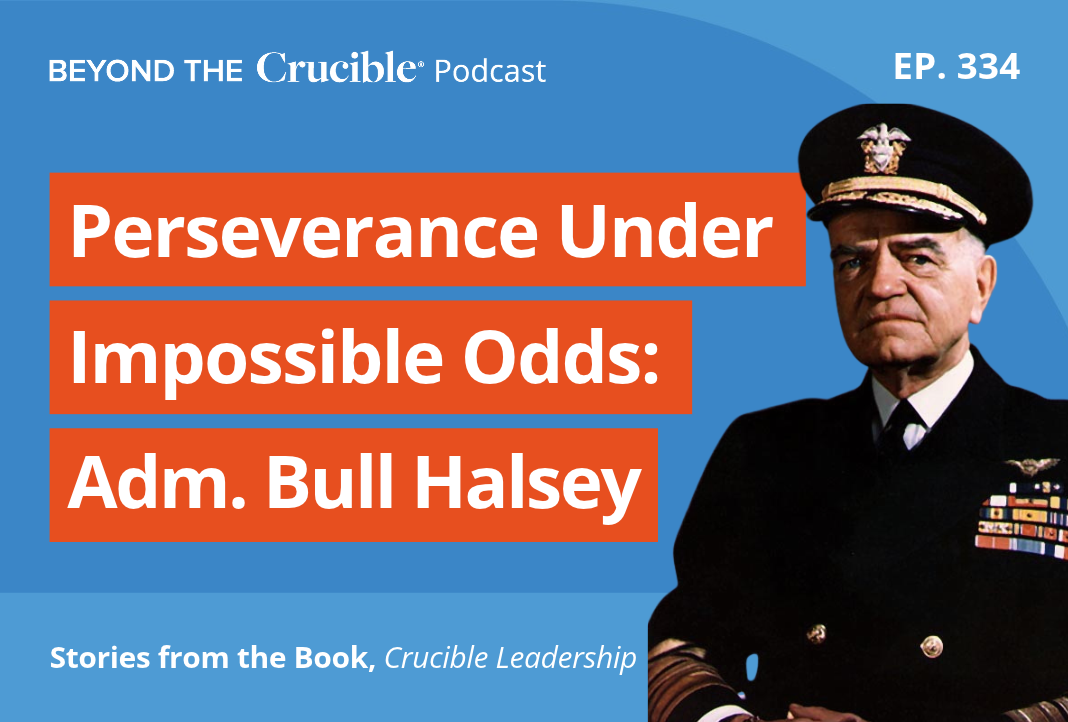
Admiral Bull Halsey: Perseverance Under Imposible Odds
What does it take to keep going when the odds are stacked against you?
In this episode, we continue our series More Stories from the Book Crucible Leadership with a story from the cutting room floor of Warwick’s manuscript: Admiral William “Bull” Halsey’s leadership during the Battle of Guadalcanal. Finding the strength to keep going begins with facing the truth about what you’re up against, and Halsey modeled exactly that. He inspired perseverance by speaking honestly about the dangers his forces faced and helping them understand why their mission mattered. His example offers practical lessons for anyone navigating a crucible: understand the challenge, ground your decisions in your values, and give the people counting on you a reason to keep going.
Have a question or comment? Drop us a line at info@beyondthecrucible.com
—
👉 Don’t forget to subscribe for more leadership and personal growth insights: https://www.youtube.com/@beyondthecrucible
👉 Follow Beyond the Crucible on Facebook: https://www.facebook.com/beyondthecrucible
👉 Follow Warwick on LinkedIn: https://www.linkedin.com/in/warwickfairfax/
👉 Follow Beyond the Crucible on Instagram: https://www.instagram.com/beyondthecrucible
👉 Take the free Trials-to-Triumphs Self-Assessment to discover where you are on your journey of moving beyond your crucible and how to chart your personal course to a life of significance: https://beyondthecrucible.com/assessment/


Transcript
Warwick Fairfax:
Welcome to Beyond the Crucible. I'm Warwick Fairfax, the founder of Beyond the Crucible. What is really interesting about Halsey, and this is a great example of leadership and how to inspire perseverance in your team, he doesn't sugarcoat. He doesn't say, "Hey, things aren't that bad. It's all good. Hey, you may think we're living in a dire situation." It's really like Disneyland. You're just not thinking right. There's no what some people would call toxic positivity. None of that. There is the truth.

Gary Schneeberger:
The truth, as we discuss this week, it's the most important thing we must know and act on if we are to live our lives with perseverance. We examine the life and leadership of Admiral Bull Halsey in this installment of our series within the show, More Stories from the Book, Crucible Leadership. By studying the way Halsey led his forces during the World War II battle for Guadalcanal, we can see firsthand how great leaders keep going. When faced with obstacle after obstacle, adversity after adversity, they don't just quit. And that's why their crucible experiences are never the ends of their story.
Welcome friends to this episode of Beyond the Crucible. You have joined us again for what we call the series within the show episodes. That's the one episode we do each month. And this year's topic is, well, I'll just give it to you right off the bat, More Stories from Warwick's book, Crucible Leadership. And that book was a Wall Street Journal bestseller in 2022 when it came out. And it's an important book because it was the book that birthed the business. There'd be no Beyond the Crucible if there had not been a Crucible Leadership. So as I said, each month we spotlight one story from the book and we talk about the lessons of overcoming crucibles and leading a life of significance that come from that individual that we pull out of the book.
We've added an interesting twist though this year. This has been kind of fun to do all your work. We've done what we call from the cutting room floor, stories that didn't make it into the final manuscript that got published. And indeed, we are at one of those this week on the show. And that's a story that did not make it into the book on Admiral Bull Halsey. You'll learn a lot more about Admiral Halsey as we talk, but what we're going to highlight is that he's an example that we can all follow of perseverance and of making difficult decisions with real consequences in the heat of battle.
And by that we don't necessarily, although in this case it is military battle for Bull Halsey, it can be battles we face every single day in a variety of situations. So don't take that too literally. So, Warwick, in every episode of the series within the show, I ask you a simple question to start. Why this leader from your book? Why have we picked Bull Halsey and what led you to pick him for your book and why are we taking time to talk about him now on the podcast?

Warwick Fairfax:
Yeah. Absolutely. So really what inspired me about Admiral Bull Halsey is quite a number of years ago, I saw a movie called The Gallant Hours, and it was a 1960 movie starring James Cagney as Admiral Bull Halsey. Now at the time I was in the middle of writing my book, Crucible Leadership, and I thought he would be a great example of perseverance. I did a bit more research, learned about him, and he is a terrific example of perseverance and having to make incredibly difficult decisions with real costs.
So a little bit of the background. So Admiral Bull Halsey, he come out of the Allied Forces during the Battle of Guadalcanal in the fall of 1942. Now this was a critical battle to prevent a strategic victory by the Japanese fleet. Halsey had to make very difficult decisions with a huge cost to ensure that the Japanese forces did not gain control of Guadalcanal, which is an island in the Pacific. So the way Halsey faced the challenges at Guadalcanal is an amazing example of perseverance.
Originally, the story of Halsey and the Battle of Guadalcanal was in what became Chapter 16 in my book, Crucible Leadership, and the chapter's entitled Staying the Course. So in the introduction to this chapter, I talk about how the fact that perseverance is tough. In life, you get continually knocked down and you have to get up again and again and again.

Gary Schneeberger:
Right. Indeed.

Warwick Fairfax:
And just when you think you just can't take it anymore, I'm done, I'm tapping out, you got to get up one more time even when you've got nothing left. And that's really what perseverance at the ultimate level is. Great leaders, I would say great people of character, they never give up. And when faced with obstacle after obstacle, adversity after adversity, they just don't quit. The crucible experiences are never the end of their story. We talk a lot about when you face a crucible, you'd hide under the covers and say, "Gosh, what they did to me was awful. The mistake I made is unforgivable, is just horrific and just give up on life."
Great leaders, great people, they say, "Okay, this was awful. What I did was bad. What other people did to me was horrific, but I'm not giving up. I'm not quitting. I'm going to get out of bed and I'm going to put one foot in front of the other and I'm going to keep going." And so that's what Admiral Halsey did at Guadalcanal. He was up against Japanese Admiral Isoroku Yamamoto. Now any amateur historians there, people that follow World War II, they'll remember that name Yamamoto. And he was the brilliant admiral that masterminded the attack on Pearl Harbor in December 1941.
Halsey knew much like, I think we've talked about before, British General Duke of Wellington, when facing Napoleon, that he was facing a formidable adversary. So much like Wellington, he was not going to quit or give up. But also like Wellington, Halsey realized I'm up against the best of the best. This guy is a genius. He anticipates what you're going to do. This will not be easy. The stakes are massive. He's going to have to have incredible perseverance when faced with a situation with very long odds and the chance of success seems small and he's up against one of the most brilliant naval commanders in history. A lot of people would say, "Wow, I'm out. I mean, this is just too tough." And sometimes we'll face challenges when it feels like the opposition, which maybe other people or just the situation is so tough, that you just want to give up.

Gary Schneeberger:
And it's interesting, Warwick, because we're talking about a military leader. Right? I know this was a movie that we spent a lot of time prepping for, but in all the things I read about the movie, it caught Halsey's personality pretty well. And one of the things that comes through in the movie is that he's not a MacArthur type. He's not a Patton type, one who is flinty and perhaps large personality that tries to control everything. He was someone who was a little bit more thoughtful, a little bit more kind in the way that he dealt with people. And it's nice to know as we're calling people through this episode to perseverance, you can do that and still be a kind person. You don't have to be hard charging in a very blustery way like MacArthur or Patton. Right?

Warwick Fairfax:
It's so true. And one of the things that comes out in the movie is he kind of has a sense of humor. It's this recurring thing where the doctor wants to give him his shots, because after all he's in the South Pacific. There's all manner of tropical diseases and he's clearly afraid of getting injections. This is Admiral Bull Halsey. You feel like he's afraid of nothing. He's actually afraid of injections. And so when the doc comes to him, "I'm very busy now." Then he tried to negotiate, "Okay, how about if I get some sleep?" Because he doesn't sleep because there's too many things going on, not much. And so he negotiates. And towards, I don't know, maybe two-thirds of the way through the movie when finally he's convinced to take his shots, his whole senior staff is watching. It's like 25 people all the way in front of him as he's taking his shots.
Now, an arrogant man would say, "Look, I'm going to do it. I'm going to do it in private. I'm not going to have my whole senior team laugh at me." I think there was some betting about whether he would do it, will he take three, four, five, and they're kind of passing money back and forth. And that takes a humble leader that could laugh at their own insecurities and not worry if they look kind of a bit foolish. I mean, this big, brave man, afraid of injections, which he clearly was, he knew people knew he was afraid, but it didn't really worry him too much. It was part of the game. So yeah, he didn't take himself too seriously, which is quite remarkable.

Gary Schneeberger:
Right. And that's a great quality to have as you begin persevering through the things that you have to persevere through. So let's start talking about that. Talk about the early scenes in the movie, Warwick, that set the stage for Halsey's role at Guadalcanal.

Warwick Fairfax:
So in the movie, the first scene that we have of Halsey is actually several years later. It's November 1945 and we see Halsey is retiring from the Navy. The war's over and his service is done. And at that point, he's talking with an aide of his who helps him, and Halsey is reminiscing about the war and the battles and he begins to remember his role in the Battle of Guadalcanal. And so then we flash back to the battle. It's fall 1942 and we see that Halsey and his senior staff, they're flying to Guadalcanal to inspect it. So at this point, he's not in control. He's just on an inspection tour of naval and military bases and forces in the Pacific.
But Halsey, he is a smart man. And throughout the movie, there's this deadly game that Halsey and Yamamoto, the head of the Japanese, falls his play. And Halsey has the sixth sense for what the enemy might do. So when you're in a challenging situation, having the sixth sense of what might go wrong and what you can do to avoid it is very helpful. So Halsey's plane was spotted by the Japanese and they assume that there might be some senior officer on it because they've got word that a lot of the senior commanders have left Pearl Harbor at US Naval headquarters in the Pacific. So then Halsey's chatting to the radio operator on the plane who tells him there's been an unusual amount of enemy radio traffic. So he's thinking, "Hmm, that makes me a bit nervous." He just has this sense. And so he wisely diverts the plane from Guadalcanal to another island, Emirau. Again, without that sixth sense, Halsey might not have been where he needed to be in the battle.
So Halsey lands, eventually ends up at Guadalcanal, and he learns that he's there to relieve Admiral Ghormley and take him out of the South Pacific forces in the Guadalcanal area. So he goes to the ship where Ghormley is and he meets him. Now it turns out, Ghormley, he's an old friend. They both went to US Naval Academy together. What's interesting is Halsey is very gracious that because they're old friends, known each other for probably 30, 40 years, Ghormley asks his buddy, "What did I do wrong? Why am I getting relieved?" And Halsey is just so magnanimous, he says to Ghormley, "The mistake you made is basically you got here first and I'm getting a lot of the credit for what you started. So basically, because you're up against a tough situation, you were here first, that's why you got relieved. Basically you did nothing wrong."
And Ghormley says to Halsey, "Thanks for that. I appreciate it." So it was just so magnanimous, so gracious, not rubbing his nose in it. Now clearly, as we'll see, Halsey is a brilliant commander. It's not that Ghormley's bad. Is Halsey at another level from Ghormley? Probably, but Halsey doesn't rub his nose in it. He's very humble about it and he's very gracious. So that's so impressive.

Gary Schneeberger:
And to my earlier point, imagine MacArthur or Patton being in that situation. What did I do wrong? You can bet that they would have some opinions about what the person whose command they're taking had done wrong.

Warwick Fairfax:
Yeah. It'd probably say Patton or MacArthur would say, "Well, it's because you're an idiot or at least you're actually pretty good, but you're not a genius. I'm a genius. So we need to bring the A-team. I know we've had the B-team in, but things are dire. So it's time for the A-team. So nothing personal, but we can't afford to have the B-team in, and so I'm here. So goodbye." Yes, that would be what an arrogant person would say. And there might be truth behind the arrogance, but they would rub your nose in it.

Gary Schneeberger:
Right. And we'll discover as we go through this episode that indeed Halsey was the A-team. So let's talk about that, the early scenes in the movie that set the stage for Halsey's role at Guadalcanal, because it starts to show that he is indeed the A-team, right? What happens early on?

Warwick Fairfax:
Yeah, it surely does. So when he's now the commander of Allied Forces around the Guadalcanal area, he meets with his senior commanders. And these are people who have been there on the ground and there's some level of dissension because things aren't going well. And when things don't go well, there's dissension. That's just human nature. So you've got General Vandergrift, and he's the commander of the Marines on the island of Guadalcanal itself. He complains that he's short of ammunition, tools, spare parts, basically everything.
And then you've got Rear Admiral Kelly Turner of the Navy saying, "Well, Vandergrift, I bet you think that I've let you down, but I just don't have the ship." So he wants to supply Vandergrift and the Marines on the Guadalcanal, but he doesn't have the ships to get there and think they're pretty dire, but the Japanese are all over the place. And then you've got Major General Roy Geiger, who's a commander of all aviation units on Guadalcanal. He says they don't have enough aircraft. So things are dire.
And what is really interesting about Halsey, and this is a great example of leadership and how to inspire perseverance in your team, he doesn't sugarcoat. He doesn't say, "Hey, things aren't that bad. It's all good. Hey, you may think we're living in a dire situation." It's really like Disneyland. You're just not thinking right. There's no what some people would call toxic positivity, none of that. There is the truth.

Gary Schneeberger:
Well, and you don't necessarily, not necessarily, you don't have to persevere through stuff that's easy. So if you tell people it's easy, they're not going to be inspired to persevere. So he knows it's not easy and that helps him persevere and helps him encourage them, show them how to persevere.

Warwick Fairfax:
So well said. If you paint this rosy picture that's not rooted in reality, you will help the guarantee that nobody on your team will show perseverance. They'll just give up at the first sign of trouble. So if you want to make sure your whole team doesn't show perseverance, start with toxic positivity and say everything's good. You'll guarantee no perseverance. So Halsey being a smart man, he paints a black picture that he says could get blacker. He says the Japanese forces keep pushing us back and that if we lose Guadalcanal here, there'll be nothing stopping them from pushing all the way to Australia.
Now, just a word of note to everybody, as people might know, I'm from Australia, so that sounds pretty dire to me. I do not want the Japanese forces in World War II pushing all the way to Australia. That would not be good. So that made me a little nervous when I heard that line. "Oh, no, stop him please. You got this."

Gary Schneeberger:
Understandable.

Warwick Fairfax:
But anyway, so Halsey goes on to say that the Japanese forces would then cut out lines of communication, supply, and the war would be prolonged for years or worse. So no toxic positivity, no sugarcoating. He tells people the truth and really what's at stake. It's not just about Guadalcanal. It's holding Guadalcanal is the key to making sure the war goes well and making sure the war isn't prolonged because the Japanese forces would then cut lines of communication and supply.
And so it's really helping people realize how important the situation is, which again, another key to perseverance. You got to help people understand the stakes, which are very, very high. So Halsey then talks to Commander Mike Pulaski and he basically heads up intelligence. He is a fantastic guy and he knows Yamamoto. He knows all about him. And then he basically says things that are going to make it harder for Halsey to persevere. He says that Yamamoto is a brilliant leader who inspires loyalty.
Now obviously, Halsey, he's an admiral, he knows something about Yamamoto, but he's getting an extra level, an extra texture of intelligence about Yamamoto. So again, Pulaski says Yamamoto is a brilliant leader, inspires loyalty, and he's a great poker player, but he says who consistently overplays his hand. So that's helpful information. So again, when you're in a battle, know your enemy, know the challenge you face, have all the information, and Commander Pulaski helps give Halsey some very valuable information about this incredible leader that Yamamoto that Halsey's up against.

Gary Schneeberger:
Yeah. And I like that you said as he was painting this black picture about what they were up against, it began to layer in and encourage his staff to be ready to persevere. That was where the building the muscle of perseverance began and it was, we go to the next point, the next point, they're not even in Guadalcanal yet. They're not even in Guadalcanal yet. So all this is happening. He's laying the foundation for that before they even get there. What then happens next when they actually get to the location that plays such an important role in the war effort?

Warwick Fairfax:
So Halsey being a great leader, he's in the Guadalcanal area on a ship, but he hasn't yet landed on the island of Guadalcanal. So what does he do? He and his senior staff, they take a plane and they land on Guadalcanal to survey the situation and frankly also give encouragement and inspire the troops. So there he meets Marine General Vandergrift, who's in charge of the forces, the Allied Forces on Guadalcanal, and he promises the pilots new aircraft in two weeks. And upon leaving, Halsey promises Vandergrift support, and men gather to hear words from Halsey. They're looking for actually a bit of encouragement.
Now he actually wanted to encourage them. He wasn't necessarily planning on giving a big speech, but they kind of wanted, so okay. So he steps up and he tells them that they're going to hang on to this island. The enemy has kept pushing them back, but the enemy will be stopped right here by you. You've thrown back everything that the enemy has sent you. And he says, "You have made this the most important piece of real estate in the Pacific." And then he tells them something incredibly wise, a great story that really inspires them. It's just really brilliant leadership.
So then Halsey tells them something that they've just learned about the Japanese. They must have intercepted a cable or something. And he tells them that the Japanese forces are already figuring out the celebration ceremony. We've seen in the movie that Yamamoto is talking to one of his senior leaders and they're figuring out a very elaborate celebration ceremony. It's almost as if they've got the chairs all mapped out and where the dais is going to be and who's going to say what. I mean, they've already measuring the drapes. I mean, they've just got it all figured out. I mean, it's kind of amazing.
And so then he puts this cable, which is translated into English, and he nails it to a nearby tree. And so, all the troops can look at this celebration note and be inspired as, I'm sure they're thinking of themselves, not today, not here. We're going to spoil your celebration. You're not going to be celebrating here on our turf. It's very wise. And basically, as I mentioned, he says that the Japanese troops are in effect measuring the drapes, and this is so motivating for the beleaguered Allied Forces on Guadalcanal.
Now, Halsey is very smart and he correctly assumed that Yamamoto will attack between October 22nd and the 26th. Again, we're in 1942. Now, Halsey, rather than retreat or bide his time, he does the unthinkable. He wants to regain initiative and goes on the attack. Now this is at a point where they're running out of supplies and men, munitions, ships. It's not like they're in a great, overwhelming, dominant place against the Japanese forces. So the last thing the Japanese will expect is for the Allied Forces to attack. I mean, they'll think they're going to be hunkering down and defending.
This makes no sense, at least from a Japanese perspective. But Halsey knows we can't just sit here. We've got to attack. Again, perseverance means not giving up. It means doing the unexpected. So he sends in the carriers, Hornet and Enterprise to throw the first punch, fully realizing that this is risky and it's not going to be easy, but he believes it's worth the risk. And he says, he believes that Yamamoto will never expect Halsey to come out looking for him.
And then Halsey mentions this famous quote, and this is what Halsey quotes. He said, "There's an old saying," and this is the saying, "No captain can do very wrong if he places his ship alongside that of an enemy." Now, the movie doesn't tell you this, but that quote is from Admiral Horatio Nelson. That's something I'm familiar with and the research I did on Nelson, which I talk about in the book. In fact, we've talked about Nelson in an earlier podcast. So that quote was very familiar to me.

Gary Schneeberger:
Right. And he was one of the, your family would pick their favorite military leaders and didn't he rank up high on the list?

Warwick Fairfax:
Oh, absolutely. Yeah. With my great-great-grandfather, John Fairfax and his wife Sarah, they play a polo game in the 1800s about who was your favorite hero. And one said the Duke of Wellington, the other was Admiral Horatio Nelson. So yeah.

Gary Schneeberger:
There you go.

Warwick Fairfax:
My father grew up telling me stories about Nelson, and then we lived in England for about a year or so in the '60s. We went to the Madame Tussauds Wax Museum in London, and they had a recreation of the gun deck of the victory, which was his Nelson's ship in the Battle of Trafalgar, which was 1805. He's not there anymore, but it was unbelievable. We could smell the sights and the sounds and it's incredible. But yeah, very familiar with Nelson. So it's funny that Halsey mentions it. Basically, the whole point is we're going to attack. We're not going to sit back and do nothing. That's the message.
Now, the attack comes at great cost, and Halsey fully expected that this could happen. They lose the Hornet, so this aircraft carrier was sunk. The Enterprise is damaged, another carrier. They lose 283 men and 74 planes. That's a huge loss. But Halsey says that they got the short end of the stick, tactically, but not strategically. So maybe you could think of it a loss in terms of in one sense, but the big picture was not because the whole objective was to hold Guadalcanal. So this makes the enemy pause because they've had their own losses.
And Halsey, again, a very astute leader, he correctly sizes up the enemy and says that ever since Pearl Harbor, the Japanese forces have consistently failed to follow up in advance. That is a key strategic mistake that great leaders don't make. In fact, I'm thinking of General Grant in the US Civil War when he was up against another brilliant leader, General Lee of the South. And one thing Grant didn't do is pause. He continually attacked irrespective of the losses, realizing that the North had an advantage, an overwhelming advantage in munitions, technology, in men. And so no matter how brilliant Lee was, he couldn't really defeat overwhelming numbers that never retreated.
The cost was huge, but it ensured success. This in one sense was a similar philosophy that they were not getting back down. But in this case, he knew that the enemy had lost planes and men and the older group, and Halsey was gambling that they wouldn't change their habit, and they didn't. And that was fortunate because if the Japanese forces had attacked, it might have been over. So Halsey knew it was a gamble, but what choice did he have? And so fortunately they did pause and Halsey used that pause very astutely and he said, "We are not evacuating Guadalcanal. We're going to hold that island and we're going to work around the clock to restore the ships, especially Enterprise, the other carrier."
And Halsey knows how vulnerable they are at this point, but he's wisely gambling, the Japanese forces will not attack again immediately, and they don't. So Halsey continues to make bold and tough decisions that really help show his perseverance. And to persevere, you've got to make bold decisions, even unexpected ones. And he sure does. He is not backing down.

Gary Schneeberger:
I'm actually going to preface before I ask this next question of you, because it's an important part in the movie and it's an important part for the discussion we're having. So we're talking about the perseverance of Halsey and the way that he imparts that to his entire strategic team, his entire military unit. And we're talking about battles. Warwick was describing battles. Guess what folks? In this movie, you don't see a battle scene. There is not a battle scene. They're all talked about, but the actual "action" that so many, almost every war movie you'll ever see has, is not shown on screen.
What's shown on screen is the debriefings, is the strategy, is the reactions of Halsey to what he's being told and what he's doing. So you can see it in action, you can see that resilience and that perseverance registering on his face as he's going through these conversations because that's all you see. You don't see anybody fighting anybody in planes and ships or any of that stuff.

Warwick Fairfax:
Yeah. Absolutely. It's such a great point. There aren't many war movies when you don't see action.

Gary Schneeberger:
Right.

Warwick Fairfax:
It's pretty stunning. And that's because the people who made this movie, they wanted to focus on Admiral Bull Halsey, how he made decisions, how he led his team, how he had a sense of humor, but also how he wrestled with these tough decisions. He knew what to do, he knew what was right, but those weren't easy decisions. Later on, we'll see that after he made a critical decision to attack later on, he has what some would call the dark night of the soul in which you see him up pretty much all night.
And the only action scenes we hear are ones he's imagining in his brain of what's going on and the battle and the voices and the radio and the gunfire. And he can't sleep because he realizes the consequences are enormous and he doesn't know who's going to survive and who won't. So you can see the agony on his face and his soul as he know he's done his duty, he's done what is necessary, but he knows there are severe consequences which will be on his. You just see tremendous humanity.

Gary Schneeberger:
Right. Okay, folks. So the next exciting war movie scene is this. Halsey meets with his senior commander. No, it actually truly is edge-of-your-seat stuff because of what they're talking about. So Halsey meets next with his senior commanders in what is arguably the most important decision in the Battle of Guadalcanal. What happens next, Warwick?

Warwick Fairfax:
This is one if not the pivotal scene in the movie. In fact, in the original draft of the book, I actually had pages of script from the scenes, which without overdoing it, maybe, but I felt so inspired at the time, but didn't make in the book, so, oh, well. But it's a great scene. And so Admiral Halsey, he's meeting with Rear Admirals, Dan Callaghan and Norm Scott. And the mission is to protect the supply ships and supply the Allied Forces on Guadalcanal. And he sent them in knowing they're up against a larger Japanese force.
This may not be a suicide mission, but it's a really, really tough battle. In fact, we learned later that in the ensuing naval action, the US Navy loses two cruises and four destroyers. Two cruises and four destroyers is a massive loss. But not only that, but Admirals Callahan and Scott, the two naval officers that are in the scene who Halsey knew them well, they were killed. And while the Japanese achieved a tactical victory, the Japanese commander ordered his ships to withdraw. Again, the whole point of this battle was to save Guadalcanal.
So the Japanese backed off. It was a great cost, but in that sense, the mission so far was successful, a huge prize for that success. Halsey's explaining to Admirals Callahan and Scott how tough the mission is to protect the Allied Forces on Guadalcanal, and they have to stop the Japanese forces reaching the troops commanded by Major General Archie Vandergrift of the Marines. And so Admiral Callaghan says the following, "Sir, we can't promise Archie," in other words, Archie Vandergrift, "So we can't promise Archie the Japanese fleet won't get through, but if it does, Norm, Norm Scott and I guarantee there won't be much left to float behind it."
Now they're smiling at this. They know how tough the situation is, but it's like we're basically going to give it our all, sir, and we're going to do whatever it takes to stop the Japanese fleet getting through. We're going to do whatever it takes to protect Archie Vandergrift, the general in charge of the Marines on Guadalcanal. And it really shows the tremendous courage that Callaghan and Scott have, these two admirals. And they know they're up against difficult odds. They know their mission to Greta Guadalcanal is critical. They know the whole strategic importance.
I'm sure Halsey made it very clear what the mission was and why, but they're in good spirits. They're smiling. They're up for the challenge. I mean, this is true heroism. When you're going into battle, not knowing whether you or your troops are going to survive and you're smiling and not making light of it, but it's like we're just going to give it our all, that's a level of perseverance and courage that it's hard to even imagine. They sure don't seem fearful. They weren't ignorant of the challenges, but they're up for it.
That level of courage and perseverance against incredible odds, it's an incredible scene and you just see how Admirals Callaghan and Scott are interacting with Halsey. And Halsey knows what he's asking of them. He knows they're up to the task. It's an incredible scene of heroism, courage and perseverance.

Gary Schneeberger:
So what happens after this battle? Because this is the apex of the film. What happens after this battle? Again, which we don't get to see, but we get to know about. We get to hear what's going on. So really the question, what happens next is a great question because that's all we really know. We don't get to see it. So what happens next?

Warwick Fairfax:
So this is where the scene after we see Admiral Halsey with Admirals Scott and Callaghan, that's sort of the dark night of the soul scene where you see him in his bathrobe and he's kind of got over his uniform and he's pacing back and forth. He's trying to sleep. He can't sleep and he's hearing in his mind the gunfire and people yelling on the radio and issuing orders back and forth. That scene, that dark night of the soul, I swear it's like five, seven minutes. It's not a couple minutes. It's a long scene with no... I mean, occasionally an aide will poke his head in and ask him something, give him information. But basically, I don't know what's going on at this point.
And why does the movie show that? Just to show the agony of leadership and how you've got to keep persevering when you've made your decision, you've given the orders, and now there's the awful time of waiting. You've got to wait to hear what happened to my... What was the result of my orders? Were they successful? How many people were killed? The waiting is agony in leadership, and that requires another type of perseverance. You're confident you made the right decision, but then there's perseverance to the agony of the wait. What's going to happen? What's going to turn out? Are we going to succeed or fail? And so that was really, really tough.
So it's now morning and we learn of the deaths of Admirals Callaghan and Scott, and Halsey receives this message from General Vandergrift. Again, he's the commander of the Marines on Guadalcanal. And the message says this, "To Scott, Callaghan, and their men goes our greatest homage. With magnificent courage against seemingly hopeless odds, they drove back the hostile stroke and made success possible. To them, the men of Guadalcanal left their battered helmets in deepest admiration." Think of that line. "The men of Guadalcanal left their battered helmets in deepest admiration."
They know that Admirals Scott and Callaghan and indeed all of the crew of those ships, they gave their lives to protect these men of Guadalcanal and to protect that strategic island in the Pacific, which was critical to the war at that juncture. So the men, the Marines of Guadalcanal, they knew the courage and the sacrifice and they admire them and they were deeply thankful. Again, this shows how much General Vandergrift and the Allied Forces in Guadalcanal appreciated the sacrifices and the heroism of Admirals Callaghan and Scott. And just to show what the Navy and the hierarchy in the military, and I'm sure the President of the United States, which is Franklin Roosevelt at this point, just to show what they think of all this, the Navy gives Admiral Halsey another star, a fourth star.
So clearly, the Navy realizes that there was great cost, but Halsey had achieved a strategic victory. He may have lost some ships and a lot of men and crew, but the Navy realized just how important this strategic victory was in protecting Guadalcanal from the Japanese forces. And then we see that Halsey is a different kind of leader. He is so generous and magnanimous. So he asked for the stars that he'd been given and he asked that they'd been sent to the widows of Admirals Callaghan and Scott. And Halsey wants this message attached to the stars. He wants the widows of Admirals Callaghan and Scott to know this, that their husbands earn me my new stars. So in a sense, he's saying these are the people that deserved the stars, not me. It's really his way of saying the reason the Navy are congratulating me is because of the sacrifices of these two admirals, Callaghan and Scott.
So Yamamoto may be brilliant, but this is where Halsey is different than Yamamoto. Yamamoto tends to pause after an engagement to regroup. This is where Halsey is more like Grant than Yamamoto. Grant never paused and Halsey is not one to pause. So he sends in forces to attack the remains of the Japanese fleet in their troop ships. By then, the Japanese fleet did not have enough ships to protect their troop ships and they're able to successfully engage them.
Now the movie stops the flashback and we're back in November 1945 and here we see this, in a sense, bittersweet part of the movie, end of the movie, where Halsey changes into civilian clothes. And apparently, it's naval tradition that when you retire from the Navy, at least back then with Admiral Halsey, that you change it to civilian clothes in the ship, in your room. And then he leaves the ship for one last time in civilian clothes and they salute him and he gets on a boat that's actually rowed by other naval officers, not like a motorboat, but an actual boat with naval offices with oars, all part of the tradition.
And at the end of the movie, we hear this voiceover saying the following, "There are no great men. There are only great challenges that ordinary men are forced by circumstances to meet." Those are words to really, really ponder. It's easy to think, "Oh, I'm not a great man. I'm not a great woman. I can't really achieve great things." But time and time again in history and in battles where you could think of Lincoln or Grant or so many people that history would say are great leaders, but they would really believe in this statement that it's more great challenges where ordinary men, ordinary women are forced by circumstances to meet.
So it's almost like there's a great crucible. They're going to step up and face that crucible where you're just going to give in, give up and hide under the covers and not meet it. People of character, people of courage, they say, "This is awful. I'm in this situation. This is awful that my team, my troops are in this situation, but I'm going to step up and do what it takes." And that's what Admiral Halsey did. So it's easy to think, "Oh, that doesn't apply to me," but I think it can apply to every one of us.
We might think of ourselves as just ordinary people. Well, greatness, heroism, courage is when ordinary people step up and meet very tough challenges and say, "Okay, this is awful. I don't know how I'm going to meet it. I don't know quite what I'm going to do. I'll figure it out. I'm stepping up to the plate. Let's go. I am not going to shrink. I'm not going to hold back. I'm going to do whatever it takes. I'm going to give my all in service of a greater cause."

Gary Schneeberger:
So, Warwick, what can we learn from the perseverance of this ordinary man who was forced to face great challenges? What can we learn from Admiral Halsey that applies to us as we seek to overcome our crucibles and lead our lives of significance?

Warwick Fairfax:
So Admiral Halsey faced a very tough situation, which he inherited from his friend, Admiral Ghormley. He realized that he had to defend Guadalcanal at all costs. Otherwise, US forces lines of communication and supply would be cut off and the war would be prolonged for years, and the Japanese forces could push all the way to Australia. Halsey was not one to give up. He knew he was up against the brilliant, the great Japanese commander, Yamamoto. He did what nobody would've expected right from the beginning. He attacks. It's like one of the first things he does is attack. It's like who would expect that? Not Yamamoto. Yamamoto was a very brilliant commander, but it's like nobody attacks when you're in dire situation. Nobody does that, but Halsey does.
And then sending in Admirals Callaghan and Scott, he didn't know what would happen, but he knew that they're up against huge Japanese forces. It was a desperate mission, but they had to do it because they had to save Guadalcanal and protect it at all costs. And so he made a very tough decision, which ended up leading to the deaths of Admirals Callaghan and Scott. But being a wise commander, Halsey knew that Yamamoto had a tendency to pause after losses, correctly guessed he would do so. Again, that was critical. He needed those days to reequip those forces to get the Enterprise, that carrier back into battle.
Halsey showed great courage and perseverance by making one gut-wrenching decision after another. He knew his decision would cross the lives of his men and ships. That's not easy. How many, he didn't know, but he knew going in there was a high likelihood that he would lose ships and many men. But that decision was necessary to bring the war to a swifter conclusion as possible. It was necessary to preserve Guadalcanal, which is hugely strategic in the Pacific. And the Navy hierarchy and President Roosevelt, everybody knew how important this was. People knew that they had to save Guadalcanal at all costs. So there was no doubt about that.
So Halsey knew how important his mission was, and I think that helped him make those tough and costly decisions. And as we'll talk about in a bit, it really helped him have tremendous resilience and perseverance because he knew these are tough decisions, but we cannot fail here. We've got to do everything we can to preserve Guadalcanal and end the war as quickly as possible. So that was some of the keys we'll touch on in a bit. So a few of us are going to face gut-wrenching decisions that Admiral Bull Halsey faced in the battle of Guadalcanal in late 1942. But when we're faced with difficult decisions, we need to anchor those decisions in our values, our beliefs, and the overall goals for our life and the situation.
We need to think of what will happen if we don't make those tough decisions, those tough and costly decisions. What will it cost our family? What will it cost our team? What will it cost, depending on the size of the decision, our nation? Maybe you're not the leader of the nation, but maybe you're one person in a battle and each individual decision can end up having huge consequences for the mission as a whole. And so when you think of your beliefs and values and how important the battle, the situation is, and yes, it may be costly, but we cannot fail. We've got to do whatever we can to succeed because lives are depending on it, jobs are depending on it, the wellbeing of our family depends on it.
When you think about why we're doing this, why you're doing this, this can help give us the perseverance we don't think we could possibly have. This will help us go one more step when we feel like there's nothing within us that has the entity to do it, because we know by taking one more step, even when we're exhausted beyond belief, we think to ourselves that others are counting on us and the mission is too important for us to give up on. And so we don't want to let our fellow comrades, family members, coworkers down. We've got to do whatever we can to help the mission succeed because it's about a higher purpose. It's about preserving jobs. It's about preserving your family, maybe where you live, your home, whatever the situation may be. When you think of your values and goals and why the mission's important, it helps you find perseverance at a level you never thought you had.

Gary Schneeberger:
So, Warwick, as we wrap this episode, what are the big takeaways from Bull Halsey's life and his leadership that we discussed today that can help our listeners and viewers make their vision a reality? What are the big takeaways from this robust discussion that we've had today?

Warwick Fairfax:
Life is not easy and sometimes we're faced with an impossible situation, we feel like we can't possibly go on. We can say like, "I'm out. This is too tough. I don't have what it takes. I don't know what I'm doing. I don't have all the people I need. And I'm scared and this is above my pay grade in terms of the intelligence that's required, the perseverance that's required. The people I have, I just don't have enough." You might feel like the chance of victory or success seems remote at best and failure seems like the likely outcome. And it's easy to say to ourselves, look, why bother? Nobody can succeed here. I mean, this is just too tough. I can't save the lives of the people in my company, in my unit.
I think there's no way I can pay the mortgage. We'll have to sell our house. I don't know that I'll have enough money to help keep my family intact and a roof over their heads. I mean, it's all too tough. I've been looking for a job for months and I can't find one. It's just time to give up. It's just too hard. And so when you say that to yourself, the point is not so much whether you succeed or fail, but we want our lives, especially when we face crucibles, we want them to count. We want it to be about something bigger than ourselves, a life of significance, a life on purpose, dedicated, serving others. So think about the people that you work with.
I've got to do whatever I can to turn this company around. It could be a small business, a large business. I've got to do whatever it takes to keep a roof over my family's head. It won't be easy, but we talk about for the sake of what and the why matters. Well, you want to keep your team intact, your unit intact, your family intact. Your values and beliefs help fuel that. People are counting on you. You will not let them down. Whether you succeed or fail is not the point, but you're going to do your level best to help them.
So when faced with a seemingly impossible situation, dig down deep and make sure your actions are anchored by your deeply held values and beliefs. And that will fuel your perseverance and resilience, and it will also help fuel the perseverance and resilience of others, as it sure did with Admiral Bull Halsey and the people under his command and that speech he gave at the island of Guadalcanal to the troops. It just motivated them to an incredible level.
It's easy to say, "Hey, I'm not Admiral Bull Halsey. I don't face that kind of situation. If I did, I can't imagine I'd be anywhere close to his level of perseverance or resilience." But when you dig down deep in your values and beliefs and know for the sake of why you're doing it, and you're thinking about a life of significance, a life on purpose, dedicated to serving others, you think about that larger mission and the higher purpose you're seeking to achieve, it will give you perseverance and resilience at levels you never knew you had. Really the point is knowing your why and for the sake of what. That gives you perseverance and resilience at levels you though would be impossible.

Gary Schneeberger:
Friends, that I usually say lands the plane on our discussion, but since we've been talking about a naval hero, let's just say the fleet has come in on this conversation about the More Stories from the Book, Crucible Leadership. That will wrap up, folks, this month's series within the show episode on More Stories from the Book, Crucible Leadership. We will turn the page next month to another story to help you turn the page and move beyond your crucible to a life of significance. We will see you then.
Welcome to a journey of transformation with the Beyond the Crucible Assessment. Unlike any other, this tool is designed to guide you from adversity to achievement. As you answer a few insightful questions, you won't just find a label like the helper or the individualist. Instead, you'll uncover your unique position in the journey of resilience. This assessment reveals where you stand today, the direction you should aim for, and crucially the steps to get there. It's more than an assessment. It's a roadmap to a life of significance. Ready? Visit beyondthecrucible.com. Take the free assessment and start charting your course to a life of significance today.