
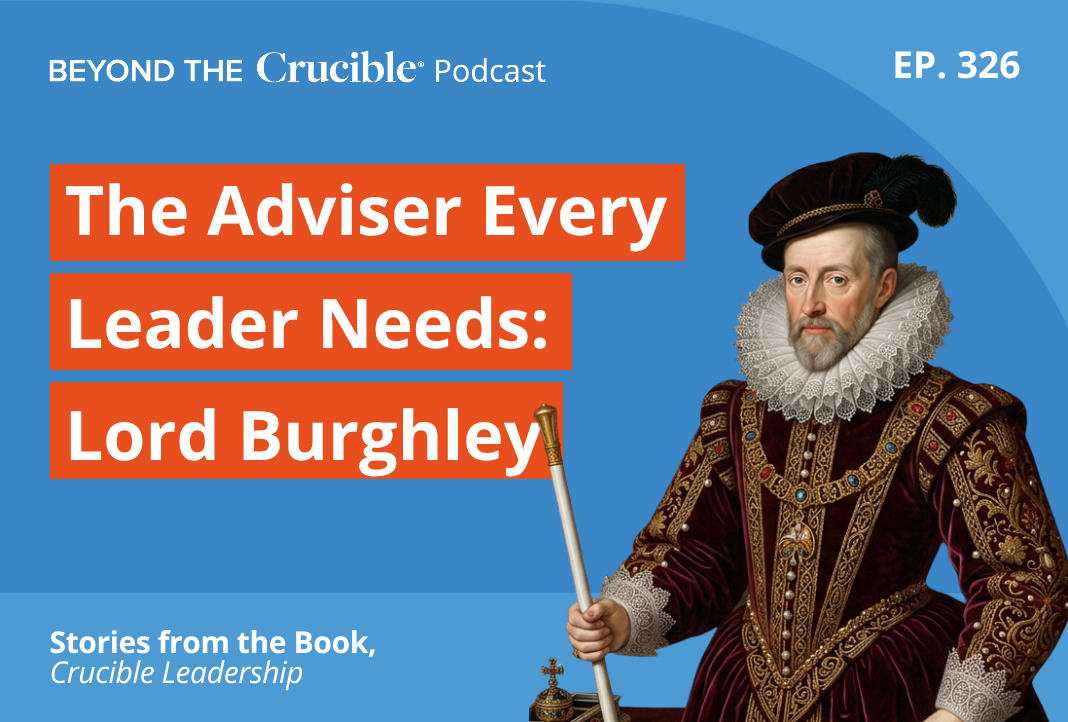
The Adviser Every Leader Needs
What does it take to be the kind of adviser a leader can truly trust — and what does it take for a leader to trust them?
In this episode, we explore the remarkable relationship between Queen Elizabeth I and her closest adviser, Lord Burghley, as part of our ongoing series More Stories from the Book Crucible Leadership. Elizabeth once said of Burghley that he would not be corrupted by gifts and would remain faithful to the state — high praise from a monarch who had every reason to be guarded. Warwick unpacks why Elizabeth thought so highly of Burghley, how he handled his role with complete dedication to her mission rather than his own ambitions, and why their partnership stands as a textbook example of what truly great counsel looks like — and what it takes for a leader to recognize and receive it.
Have a question or comment? Drop us a line at info@beyondthecrucible.com
—
👉 Don’t forget to subscribe for more leadership and personal growth insights: https://www.youtube.com/@beyondthecrucible
👉 Follow Beyond the Crucible on Facebook: https://www.facebook.com/beyondthecrucible
👉 Follow Warwick on LinkedIn: https://www.linkedin.com/in/warwickfairfax/
👉 Follow Beyond the Crucible on Instagram: https://www.instagram.com/beyondthecrucible
👉 Take the free Trials-to-Triumphs Self-Assessment to discover where you are on your journey of moving beyond your crucible and how to chart your personal course to a life of significance: https://beyondthecrucible.com/assessment/



Transcript
Warwick Fairfax:
Welcome to Beyond the Crucible. I'm Warwick Fairfax, the founder of Beyond the Crucible. Probably the finest tribute paid to Burghley was from Queen Elizabeth who said the following of him, "This judgment I have of you, that you will not be corrupted with any manner of gifts and that you will be faithful to the state."

Gary Schneeberger:
Those are pretty strong words of endorsement, especially coming from a monarch talking about an advisor. This week in the latest episode of our series within the show, more stories from the book, Crucible Leadership, Warwick unpacks why Queen Elizabeth I thought so highly of and relied so much on Lord Burghley and how Burghley handled his role with complete dedication to the queen's mission, not to his own aspirations. Theirs is a textbook example of what it takes to be a good advisor and what it takes for a leader to trust a good advisor.
Welcome friends to this episode of Beyond the Crucible. You have joined us in the first, what we would call a "regular episode" after our summer film series and our 30,000-foot level look at the summer film series. So, now we're back in the regular rhythm of the show, and that means this week, we are back to... It's been a while, Warwick, but we're back on more stories from the book, Crucible Leadership. It is what we call the series within the show, as it were.
And just to refresh your memory, especially since it's been a couple months because of the summer series that we've talked about more stories from the book, Crucible Leadership. The book, Crucible Leadership was a Wall Street Journal bestseller that Warwick released in 2022. It's an important book because it was that book which birthed the brand Beyond the Crucible. And if it wasn't for Crucible Leadership, not exaggerating at all, if it wasn't for Crucible Leadership, there would be no Beyond the Crucible business. There would be no Beyond the Crucible podcast. So, that's how important it is and that's why we revisit it. We have in 2026, once a month. Each month, although as I said, with our summer series, we were off doing that and so we haven't been on about the book series for a couple of months.
We feature one story from Warwick's book, spotlighting one key learning that helped the subject of the story overcome a crucible and can help you overcome your crucibles as well. And this year, in more stories from the book, Crucible Leadership, cleverly named from last year, which was stories from the book, Crucible Leadership, we've added an interesting twist this year and that is half of the stories that we're covering were those that made it not in the book, but on the cutting room floor. They did not make it in the final edition of the book. And the story that we're going to talk about this week is indeed one of those stories.
And the story is Lord Burghley on being an advisor to Queen Elizabeth I. If you don't have a lot of ideas of what that means, that's why we do this because you're going to get some great tips, some great insights and action steps from this historical story that we're going to go through. So Warwick, in every episode of this series within the show, I ask you a simple question to start off and that is this, why this individual from your book? Why are we doing a podcast episode on Lord Burghley?

Warwick Fairfax:
Well, it's interesting. We did a episode earlier this year on Louis Howe, who was a key advisor to Franklin Roosevelt in the '1930s and during his rise in the '1920s. So most people have heard of Franklin Roosevelt. Some may have heard of Louis Howe. Not everybody has heard of Lord Burghley.

Gary Schneeberger:
No.

Warwick Fairfax:
Queen Elizabeth was queen as we'll get into, in the '1500s. So this is a long time ago and there's a reason that we're talking about Lord Burghley because we can learn so much from what a fantastic advisor he was to Queen Elizabeth who was queen during very challenging times. So Lord Burghley was one of the key advisors to Elizabeth 1. Queen Elizabeth had a number of great advisors who were experienced and trustworthy. Her two key advisors were Lord Burghley and Sir Francis Walsingham. Probably her most important advisor, and she had a few, was Lord Burghley.
So Burghley was Elizabeth's advisor for 40 years, initially as Secretary of State and later, Lord Treasure. The Secretary of State meant something different back then. It's not the modern U.S. foreign secretary. Elizabeth was loyal to her ministers and encouraged their frank counsel and weighed their advice. So, Lord Burghley, he was born in 1520 and he died in 1598, just a few years before Queen Elizabeth died. And it's been said that the biography of Burghley is almost indistinguishable from that of Elizabeth and from the history of England. He devoted his whole life to serving his queen, Queen Elizabeth. Now, Burghley's main goal for English policy was the creation of United and Protestant British Isles. He wanted to complete the control of Ireland, forge an alliance for Scotland and protect England from invasion with the powerful Royal Navy.

Gary Schneeberger:
Yeah. 40 years serving the Queen, that is certainly yeoman service. That is a dedicated advisor. And we'll hear in this episode, folks, about just how dedicated Burghley was and the benefits that he brought to the queen. But before we get going that far, Warwick, let's begin where we start with guests on the show as we start talking about this more stories from the book episode. The backstory, that's where we start with guests. In this case, the backstory of Elizabeth I, how did she rise to the throne? Under what circumstances did she become queen?

Warwick Fairfax:
So, Queen Elizabeth I, she was born in 1533 and died in 1603 and she became queen in 1558. Now, these were certainly turbulent times that Elizabeth grew up in.

Gary Schneeberger:
Yeah, a little bit.

Warwick Fairfax:
Her father was somebody who is well known in history, King Henry VIII. And King Henry VIII was married quite a few times, six in fact. But how he got divorced is a bit different than today, different times. And so, when Henry's first wife, Catherine of Aragon, did not give him a male heir, he dissolved his marriage. Now, at the time, England was a Catholic country in the early part of his reign and the Roman Catholic Church did not recognize divorce, did not recognize the dissolving of his marriage. Well, Henry was not somebody who tolerated not getting his way, even if it was from the Pope and Roman Catholic Church. And so, he divorced anyway and Henry's second wife, Anne Boleyn, gave him a daughter, Elizabeth.
And then Henry beheaded Anne Boleyn before Elizabeth was three years old. And so, given that the Roman Catholic Church was against Henry's divorce from Catherine and his marriage to Anne Boleyn, Henry created his own church, the Church of England. It's like, fine, Rome won't recognize my divorce from Catherine and my marriage to Anne Boleyn. Fine. I'll make my own church and they'll recognize it. So that's how-

Gary Schneeberger:
[inaudible 00:08:10] new church.

Warwick Fairfax:
Exactly. The Church of England, the Anglican church, Episcopal Church, all came from this point. And so, after Henry died, Elizabeth's sickly, half brother, Edward became king. Six years later, Edward died and Elizabeth's elder half sister, Mary became Queen. Now she was the daughter of Catherine of Aragon. When Mary became Queen, being an ardent Catholic, she was bent on restoring the Roman Catholic Church in England. So this put Protestant Elizabeth in a precarious position. Protestant Elizabeth was next in line to the throne behind Catholic Mary and Mary didn't have children. So, this became an inevitable target of the plots to overthrow Mary and restore Protestantism to England. Elizabeth may not have been part of such plots, but she was arrested and sent to the Tower of London. And if anybody's visited London, you've got the Tower of London, the crown jewels. When you were sent to the Tower of London, it wasn't a good thing.
It tended to mean you were there for execution. And she narrowly escaped her mother's fate of being beheaded. And after five years of Mary's reign, Mary died. Elizabeth became queen in 1558 at the age of 25. And I'm reminded of scenes where Mary was pondering whether she would behead Elizabeth to preserve Catholicism by a 1998 movie called Elizabeth. And that starred a young Cate Blanchett. It was probably one of her earlier roles and launched her career. And as I was looking it up and reminding myself, it turns out that Richard Attenborough, who featured in our summer series Jurassic Park, a 1993 movie, he plays John Hammond, the guy that creates Jurassic Park and he creates dinosaurs, that same Richard Attenborough plays Lord Burghley in that movie. So pretty amazing, right? Because we've only just recently covered Jurassic Park. So when you watch that movie, it's worth looking at because it gives you an idea of the challenges of the times.
There were scenes in which the advisors to Mary said, "You've got to behead Elizabeth." And they would put pieces of paper in front of her basically saying, "Mary, sign this and your sister will be beheaded." And she ponders, she thinks, but she couldn't quite do it. And her advisors say, who are Catholic, "We've got to preserve Catholicism any way we can do it. You got to kill your sister," and she can't quite do it. And you see Elizabeth basically in prison in the Tower of London awaiting her fate. So, a movie definitely worth watching.
So what's interesting is in these turbulent times in which she's growing up and she's seen her father have multiple wives and kill a number of them, life was very uncertain even if you're a princess. And Elizabeth was somebody that was very intelligent. She received a first class education, quick-witted, intellectually serious, and she spent a good part of her growing up, understandably being careful with what she said and having to be quite cautious.
So, Elizabeth learned valuable lessons growing up on how she was seen by others. She also learned the fragility of life and the survival instinct was keenly earned. So those early years were very formative in terms of how Elizabeth would reign once she became queen.

Gary Schneeberger:
Right. And those difficult times that she went through didn't end when she became queen. In fact, you wouldn't make a movie starring Cate Blanchett, which got a bunch of Oscar nominations about her early days as queen if there weren't some very interesting early days as queen for Queen Elizabeth I. Elizabeth did indeed, from the moment she took the throne, she faced some challenging times during her reign as well, didn't she?

Warwick Fairfax:
Now, Elizabeth was more moderate. She wanted England to be Protestant, but she didn't want persecution of Catholics. So many feared that England would revert to being a Roman Catholic country after Elizabeth died. And you'll notice if you watched that movie, Elizabeth, from 1998 with Cate Blanchett, Elizabeth was known as the Virgin Queen. She never married. Basically, she didn't want to share control and women being in power in those days was certainly unusual. So, the Roman Catholic Church, they regarded Mary Queen of Scotts as the rightful queen of England. So when one of her advisors, one of Elizabeth advisors, Walsingham discovered that Mary Queen of Scotts was part of a plot against Elizabeth's life, Elizabeth reluctantly agreed to sign the death warrant for Mary. This is Mary Queen of Scotts. A year later in 1588, Elizabeth had to face the Spanish armada that was bent on invading and conquering Protestant England.
They wanted to restore England to being a Catholic country and put a Catholic on the throne. So, in part because of the fear of Elizabeth not having a Protestant heir and thus the monarchy falling back into Roman Catholic hands, there was constant pressure for Elizabeth to marry. And as I mentioned, given the time she lived in, she was reluctant to share power, Elizabeth said this famous phrase that she did indeed have a husband, namely the Kingdom of England. So hence, the Virgin Queen as she was known.

Gary Schneeberger:
And it's at this time, she has a husband, the Kingdom of England, right? She's dedicated to that, but she's going to need some help somewhere, she realizes, and that is where Lord Burghley makes his arrival and makes his impact, right?

Warwick Fairfax:
Absolutely. So, Elizabeth's upbringing in challenging circumstances and an intellectual curiosity perhaps made her more open than some to having first class advisors. So, Elizabeth assembled a core of experienced and trustworthy advisors such as Lord Burghley and Sir Francis Walsingham. Now, chief among her advisors, followed closely by Walsingham, was indeed Lord Burghley. Elizabeth appointed Burghley, her principal Secretary of State on the morning of her accession to the throne. Burghley was to serve as her advisor for 40 years, initially as Secretary of State and later, as Lord treasurer. Elizabeth was loyal to her ministers, encouraged their frank counsel and weighed their advice, yet she retained her power to make final decisions. Elizabeth may have had good advisors, but there was no question who was in charge.
So, it's to Elizabeth's great credit that she worked with such able advisors such as Burghley and Wasingham and really was perhaps the most crucial strength of her reign. So it's amidst such pressures of state and personal pressures that it's no wonder she sought good advice. Lord Burghley had a special place as a key advisor to Elizabeth throughout much of her reign. Now, there were times when that relationship was strained. We mentioned earlier about Mary Queen of Scotts being beheaded. And it was Burghley who wanted to push through that execution quickly. He was afraid of what would happen to the kingdom given the Catholic support of Mary and wanting her to basically overthrow and indeed kill Elizabeth. And so, Burghley pushed through the death warrant to spare Elizabeth some emotional hardship. Maybe he was afraid of Elizabeth wavering in signing the death warrant of Queen Mary, the way that Queen Mary wavered in signing the death warrant of Elizabeth.
Now, Elizabeth was outraged that Burghley pushed this execution through, but while she did argue with him at times, Elizabeth said of Burghley that, "No Prince of Europe had such a counselor." So it doesn't mean that she always agreed with his advice, but she knew that his advice was purely in her best interests. He was fiercely loyal to her and wanted to do everything he could to make her successful. So, Lord Burghley was quite a remarkable man. Burghley saw his duty was to give Queen Elizabeth the best possible advice and then to carry out whatever policy she wished. Burghley was loyal to his duty to serve Elizabeth. He was a man of discretion. He did not necessarily make it obvious outside the Queen what his views were. It's interesting, historians look at his letters and memorandum and they find it very difficult to figure out what he actually believes on any given issue because you've got memorandas stating the pros and cons of various issues, but there are a few indications of where he stood.
And one writer said that he was an eminently safe man and not an original thinker, but that he was a counselor of unrivaled wisdom. And so, that's really what you want, a counselor of unrivaled wisdom. And that same writer said that caution was his supreme characteristic. Now, given the times in which Elizabeth was queen, where you've got the tumult and the monarchy before she became queen, the Protestant versus Catholic divisions in the country and the threat of Spain, it's understandable that he'd be cautious. There was a lot of things that could go wrong, a lot of threats to England and indeed, to her reign.
So Burghley had a reputation for being efficient and scrupulous. And Queen Mary, who knew of Burghley before she died, she said of Burghley that he was a very honest man. So, Queen Mary respected Burghley also. So probably the finest tribute paid to Burghley was from Queen Elizabeth who said the following of him, "This judgment I have of you, that you will not be corrupted with any manner of gifts and that you will be faithful to the state." Now, having an advisor that it's not corrupt in an age when advisors could get a lot of profit from aligning themselves to whoever was going to win and accumulate wealth and patronage, that was a thing.
And advisors could profit by participating in royal intrigue, either support the current monarch or basically stab them in the back. So Elizabeth was very wise to seek advisors such as Burghley during these turbulent times. And Burghley's sole motivation was to provide support to the queen and to his country. And I'm sure many a leader would covet an advisor such as Lord Burghley.

Gary Schneeberger:
Yeah. And as you were talking about all of the things that he did, things he didn't do, and what was said about him by Queen Elizabeth, what popped in my mind are advisors today, modern day advisors to presidents, for instance. As soon as the president leaves office, those men and women write memoirs and they lay open all of the things that happened. There doesn't seem to be a lot of loyalty among advisors, certainly not 40 year loyalty that Burghley did. And the things that were said about him, he kept things that were in confidence in confidence and he wasn't trying to make his mark even after he... He didn't leave the service and then try to make his mark. That's astoundingly different than what we get today from a lot of advisors, isn't it?

Warwick Fairfax:
You're right. They write tell-all books about what happened and yes, they want to serve the president or the leader of their country, but there's often another agenda is, gosh, maybe once I leave office, I can be on a commentator on a news channel and I can write books and a thought leader, and this will launch my career as a sage and wise person. But Burghley was not like that. His sole motivation was to serve Queen Elizabeth. When you take your oath of office, you say, "Will you protect the country from all enemies, foreign and domestic?"
Well, there were enemies within, within England, those who wanted to restore Catholicism to the nation and those without, namely Spain, who also wanted to return England to being a Catholic country. So there are a lot of threats and Burghley was completely focused on preserving the nation, keeping it Protestant and protecting and furthering Queen Elizabeth's vision for the country. That was his sole motivation, not a book tour, not to go down history as a brilliant man. He was totally focused on his duty to Elizabeth and to be known as a very honest man at a time where honesty didn't really pay, it wasn't the best way to preserve your life. The best way was to align yourself with whoever was going to win because you get wealthy and you might live and not be beheaded.
We live in times in which you don't tend to get beheaded if the leader doesn't like your advice or you fall out of favor and the other side wins. So the stakes were a lot higher back then. It was literally your own survival. And so, yeah, honesty, not sure that was really a policy that always led to a long life, but he was honest and would do whatever he could to help Queen Elizabeth succeed and preserve her reign.

Gary Schneeberger:
I want to ask you this next question from two different directions. I want to ask you from Lord Burghley's perspective and then also from Queen Elizabeth's perspective. And that's this, what can we learn about being a good advisor from Lord Burghley, aside from not writing a tell all memoir as soon as your leader that you've served gets out of office? What can we learn from Lord Burghley about being a good advisor? And what can we learn from Elizabeth about keeping good advisors, about being confident enough to bring aboard good advisors? Because we have to learn sometimes we're going to be the advisor, sometimes we're going to be the leader. So what can we learn from both Burghley and Elizabeth about this subject?

Warwick Fairfax:
Yeah. So what's remarkable, I think as we've been saying, is how loyal Burghley was to Elizabeth. Now remember, this is an era in which it was very unusual for a woman to be the monarch of a country. There was constant chatter about who should Elizabeth marry and she didn't want to marry somebody because she wanted to be queen. That would be a time when it would be assumed that her husband would really take control and not her. But Burghley was loyal to... He wasn't like, "Well, how can we have a queen here? How come a woman is a monarch?" It's like, "Okay, my sovereign is a woman. She's queen of England. I will do whatever I can to help her succeed and preserve the nation." So, he was considered a counselor of unrivaled wisdom, and it was just not obvious what his personal opinion was behind his advice. I'm not sure we know.
Historians have not really found it easy to ascertain that. Burghley's goal was to serve Elizabeth, the queen, and give her the best possible advice to carry out her policies. Again, this was no easy time in which she reigned. The monarchy before she became queen, Protestant Catholic divisions, the threat of Spain, and Burghley was somebody that was honest and could not be corrupted. So to be a good advisor, you have to leave your own personal opinions and agenda behind. When you're serving somebody who has great power and influence, that is very hard. It's so tempting to want to influence the organization or the country because you're thinking, "Gosh, I'm the voice of the president. He listens to what I have to say. I can influence the nation. What is it I want? Maybe I can subtly influence things by the questions I ask, the advice I give," and that's corrupting, but that's not the role of an advisor.
An advisor's goal is to accomplish the leader's objectives, not his or her own objectives, and to give them advice on how to bring their vision to reality. It's not the advisor's vision that's relevant, it's the leader's vision that's important. That probably makes sense, but it's very rare to have an advisor whose only agenda is yours, and they're not trying to push things. They're not trying to influence you other than you've told me what your vision is, you've told me what your agenda is, this is my advice on how to get it done. I think this is the best way for it to happen. That's where the focus is, not on the direction, but more, how you get to that direction.

Gary Schneeberger:
And before we get into the Elizabeth part of this question, let me ask you this because it occurred to me that... You say a good advisor tries to give advice on how to bring the leader's vision to reality, but especially we see with Elizabeth, given all of the tumult that she went through as queen, it's also a good advisor helps you avoid crucibles, helps you... It's not just bringing your vision to life, it's keeping crucibles at bay or overcoming crucibles, isn't it? It's a vision perspective, yes, but it's also a crucible advising position, is it not?

Warwick Fairfax:
Oh, it's so true. Well said. So, when you think of what was Elizabeth's vision, part of it was survival, not being killed and preserving the nation of England. You had people scheming within the country to overthrow her and make Mary Queen of Scotts the Catholic queen of England. You had Spain trying to conquer England again, same thing really, to make England a Catholic country. You had a lot of palace intrigue, will Elizabeth marry? If you watch the movie Elizabeth, with Cate Blanchett, you'll see that she had definitely some romantic interests and lovers and all of that. That was certainly something that happened, but she would not make any of those people that she had romantic interest in, a king. That was not going to happen.
But it doesn't mean there weren't people who were trying. It doesn't mean there weren't probably advisors and courtiers who would say, "You need to marry and how about some prince in Europe and align with this country?" And there's all sorts of intrigue, but that provided a very challenging climate. And so, Burghley's job was to protect her from probably the palace intrigue, the internal factions in the country that wanted to depose and kill her. And in fact, I think I read somewhere that it was Walsingham that set up a whole intelligence network. It wasn't like the FBI or CIA back then, but you had to have a good intelligence network to know where the threats were coming from.
So between Burghley and Walsingham, she had advisors that were very focused on preserving her reign and on her very survival. So, those kind of advisors, as you say, they helped her avoid crucibles, go through the crucibles of internally, people that wanted to kill her, externally people wanted to overthrow the country and those that wanted to try to force and pressure her to marry somebody within the country or some prince in some other land. So, truly, you could say her reign was what? 45 odd years of constant crucible. It was not easy times. It was survival was really the goal. That was one of the chief goals.

Gary Schneeberger:
Yeah, right? A good advisor, Burghley in this case, and there's many more in history that we can talk about, a good advisor helps you achieve the positive and avoid or at least, weather the negative. I think that's what you just described about Lord Burghley, it makes that clear.

Warwick Fairfax:
Yeah. A good advisor like Burghley and Walsingham obviously was also there, is let's deal with the negative people externally and internally that want to overthrow you, but also, let's help grow the nation of England. It wasn't quite the United Kingdom as it became, but let's see if we can better unite England and Scotland and Ireland and let's make England a great nation because at the time, Spain was probably one of, if not the great power at the time and England would later become the great power in Europe in the centuries to come. So yes, part of Elizabeth's vision that Burghley was helping her with was to make England a great nation and an even greater nation than it was. You had the positive, make England a great nation, and the negative, if you will, of preserving her life and protecting the country.

Gary Schneeberger:
Yeah. Well, I've interrupted you from answering the second part of my question. That's what I get for putting two questions in one and then thinking, "Hey, there's another question I can ask in the middle of that." But you've just talked about Burghley as an advisor. Now let's talk about what it takes for someone like Elizabeth, for someone in power, someone who's a leader, whether it's of a nation or it's of a company. What does that person have? Because that person has to muster some confidence and some perspective in order to allow advisors close. And that's important to do that because if you don't allow an advisor to advise, you're not going to be able to get good counsel from that advice, right?

Warwick Fairfax:
That's so true. There aren't many leaders that are good at taking advice and are willing to get advice from great advisors. If they are open to advice, it's from yes men or yes women that will tell them what they want to hear. That's not advice. That's enabling, if you will. It's like, okay, what is it that the leader wants to hear? I'll just tell them what they want to hear and then I'll preserve my power and influence and I can write my books and be a commentator on TV networks and what have you. And that's the way to be successful. But somebody that was as smart and wise as Queen Elizabeth I, she wanted good advisors who would actually speak truth to power. Now, to do that, you need to be very secure and being willing to take advice from able advisors and not feel threatened by them.
Again, this was an era where there weren't too many female monarchs. And so, it would be understandable if she felt like nobody respects me because I'm a woman. They don't think I have intelligence and I'll be seen as weak if I just listen to these men or it's like, oh, well, they're really in control, not me because how could a woman have enough wisdom and capacity to rule a country? There might be prejudice now, but my gosh, it was so much worse back then. So you've got all of these things that Elizabeth had to deal with, but yet, she was a secure enough person that she wanted the best advice. So, having great advisors such as Lord Burghley, it was really remarkable. And for 40 years, because there were times in which they had run-ins such as it's no small thing when your advisor speeds up the process and has Mary Queen of Scott's beheaded. It's like, okay, that's not a detail. It's like, "Hey, that's my role, not yours. Advisors don't make those decisions. You can advise me, but I'm the one that has to sign the piece of paper."
But again, these are different times. It's hard to relate. I understand. But she must have felt that while it wasn't appropriate, she probably realized it was necessary to preserve the nation. Maybe she wondered if she could have done it herself, but she probably realized that what Lord Burghley did was ultimately in her interests and in England's interests. And so for most, that'd be a firing offense. He wouldn't have been around 40 years, but yet she said, "Well, okay, you didn't handle it the way you should have, inappropriate, but you had my best interests at heart and I don't question your motives. Maybe your methods, but not your motives." So she didn't fire him. That's remarkable. So, yes, you have to be secure as a leader and take advice from very smart advisors.
And what you have to realize that having somebody such as Lord Burghley, it doesn't diminish you. It enhances you and increases the probability of your vision becoming reality. And that's what so many leaders, they don't get. It's like maybe people will say, "Wow, that may not have happened, that policy without Lord Burghley." And you might say, "You're right. I had the vision, but he helped me make it happen." You need a team. We talk more broadly about the importance of having a team of fellow travelers. Being an advisor is a subset of that. It's part of that. And so, a secure man or woman who's leading a nation, a nonprofit, an organization realizes they don't have all the skills and all the gifts and they need people who can be objective. And when you're in the midst of pretty tough decisions as a leader, it's not always easy to be completely objective.
And so, you've got to be very wise and secure to realize somebody like Lord Burghley shouldn't make you feel threatened. You should feel blessed to have somebody of that level of wisdom and intelligence and that level of integrity who you know you will not have to watch your back with this person. They are 100% for you and will give you great advice.

Gary Schneeberger:
All right. So, we've arrived, Warwick, at the end of the episode where I ask you this question, what are the big takeaways from Elizabeth's reliance on her advisors that we discussed today that can help our listeners and viewers make their vision a reality? And to the point that we made earlier when we were talking, also weather some crucibles and move beyond them.

Warwick Fairfax:
Elizabeth grew up in challenging times. And as we've discussed, her dad was King Henry VIII and multiple wives, beheaded a number of them. Her older sister Mary was queen before her and Elizabeth narrowly escaped getting beheaded. It was not an easy time to grow up, but she had great intellectual curiosity and that made her more open than some, to having first class advisors. It's worth noting just how intelligent Elizabeth was. She was well-educated. It was probably unusual for the time she was a princess, but I imagine not everybody would've been so well-educated and not all women would've been so well-educated as she was. She could read and write in multiple languages, including English, Latin, Italian. She was familiar with French, Dutch, and Spanish. And during her life, she translated multiple works from Latin and Greek into English and she was a skilled musician. That's no small thing. She was highly intelligent.
And so Elizabeth's intelligence and growing up in such uncertain times meant that she had the wisdom to know that good advisors were essential. Again, as I've said, good advices to both to help you survive and not get overthrown or beheaded yourself like some of the wives of King Henry VIII were, and to survive the intrigue of Spain as well as Mary Queen of Scots, just survival was no small thing. So, she had the wisdom to know that good advisors could help her survive, preserve a country and help her country prosper and grow. So, this was a huge thing. She realized that good advisors, they help you make good policy decisions and help her preserve her reign and lead her life.
So for most of us, the stakes and importance of having good advisors ensuring our survival is not really what's uppermost. There are some places in the world, but for most of us, you don't think, "Gosh, I need good advice because that'll help me avoid being beheaded or killed." That's typically not something that people worry about these days. But our need for advice and good advice is just as important as is, I need to be secure enough and intellectually curious enough to want good objective advice. And this is where unfortunately, it's so unusual and yes, it's a challenge to find good advisors. I would say the greater challenge is almost being open to good advice. There's a lot of intelligent people out there. Some of those intelligent people have high integrity and honesty and are people you can trust. Not everybody, but there are some.
But it's almost rarer to find a leader that is secure enough to realize, "Hey, I don't know everything. There are some things that I may not know. And even if there are some things I'm kind of aware of," as a leader, there are times in which it's very difficult to be objective because all sorts of things can be challenging to think straight in any given particular circumstance. You're hearing counsel from many different people, you have oppositions from all sorts of folks and be able to sift through it all and calmly figure out what's the best path forward. That's where advisors, because they're not exactly in your shoes, can provide wise counsel if you listen to them. But that only happens if you're secure and it only happens if you're willing to listen to them and indeed ask, "So tell me more about that. So why do you think that? Is there something I'm missing?" You've got to create a climate where they're willing to say, "Look, with all due respect, that's an idiotic policy you're about to enact. It makes no sense. It won't fly."
There were times in which, going back to Franklin Roosevelt, Louis Howe would say that to Roosevelt. Not an easy thing to do, not something that Roosevelt would listen to everybody on, but he would to Louis Howe. And it's been said in the latter half of Roosevelt's presidency after Louis Howe died, that a number of the mistakes that he made in terms of policy, bringing them into fruition, was because Louis Howe was not there. That's not the case with Queen Elizabeth other than, gosh, I think it might be five years or less between Lord Burghley dying and Elizabeth dying. So, pretty much for a whole reign, she had Lord Burghley as a key advisor. So you've got to be secure and wise enough to take and receive good advice. You want good advisors. You want good advisors with integrity that will speak truth to power, but you want to be the kind of person that looks for good advice and creates a climate where good advisors want to be on your team and feel completely free to not hold back and give you that advice.
That's a high bar that frankly, most leaders do not meet. And that's why you typically don't have a lot of advisors that we feel are great ones because the leader is not secure enough. They want to have yes men, yes women or advisors that aren't quite as good because they're not secure enough to handle advisors who are highly intelligent, eloquent, and will tell them what they don't want to hear. Very few people are willing to put up with great advisors.

Gary Schneeberger:
Warwick, you know what you just did there? You just landed the plane on our conversation. And folks, that will wrap up our seventh series within the show episode on more stories from the book, Crucible Leadership. We'll turn the page again in October to another story to help you turn the page and move beyond your crucible to a life of significance. We'll see you then.
Welcome to a journey of transformation with the Beyond the Crucible Assessment. Unlike any other, this tool is designed to guide you from adversity to achievement. As you answer a few insightful questions, you won't just find a label like the helper or the individualist. Instead, you'll uncover your unique position in the journey of resilience. This assessment reveals where you stand today, the direction you should aim for, and crucially, the steps to get there. It's more than an assessment. It's a roadmap to a life of significance.
Ready? Visit beyondthecrucible.com. Take the free assessment and start charting your course to a life of significance today.