
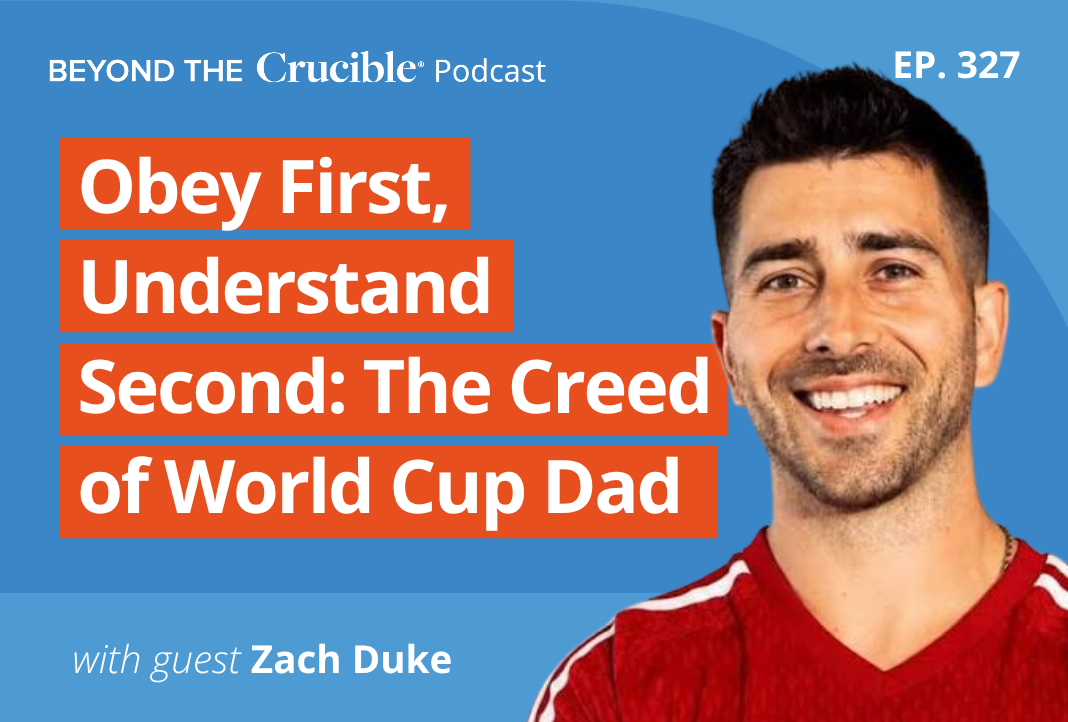
Obey First, Understand Second: The Creed of World Cup Dad
What if your crucible didn’t happen to you — but for you?
In this episode, we sit down with Zach Duke, whose life has taken one of the most unexpected and faith-filled paths we’ve ever featured on Beyond the Crucible. An eighth-generation Indiana farm kid, college football player, and missionary, Zach thought he knew his calling — until years of chronic illness left him convinced his best days were behind him. Then came an audacious act of faith: pursuing soccer, a game he had never even played, with the goal of competing in the World Cup. What followed is a remarkable story of obedience, discipline, and the discovery that the seasons we most want to escape are often the ones quietly preparing us for our greatest purpose.
Have a question or comment? Drop us a line at info@beyondthecrucible.com
—
👉 Don’t forget to subscribe for more leadership and personal growth insights: https://www.youtube.com/@beyondthecrucible
👉 Follow Beyond the Crucible on Facebook: https://www.facebook.com/beyondthecrucible
👉 Follow Warwick on LinkedIn: https://www.linkedin.com/in/warwickfairfax/
👉 Follow Beyond the Crucible on Instagram: https://www.instagram.com/beyondthecrucible
👉 Take the free Trials-to-Triumphs Self-Assessment to discover where you are on your journey of moving beyond your crucible and how to chart your personal course to a life of significance: https://beyondthecrucible.com/assessment/



Transcript
Warwick Fairfax:
Welcome to Beyond the Crucible. I'm Warwick Fairfax, the founder of Beyond the Crucible.

Zach Duke:
If I'm going to push myself to the limits, I need to find what my soccer limit will be. So if I could think to the farthest degree of what the limit could be, it would be the World Cup. And so naturally or unnaturally or supernaturally, I think, I'm going to try to make it to the World Cup in four years or break my body trying because I'm going to find what my limit and my edge is.

Gary Schneeberger:
Our guest this week, Zach Duke, has done just that. From an eighth generation Indiana farm kid to a college football player and missionary, Duke thought he knew his calling, until years of chronic illness left him believing his best days were behind him. Then his audacious act of faith, pursuing soccer, a game he had never even played, gave him his purpose back. His pursuit of playing in the World Cup is a remarkable story of faith, discipline, and discovering his crucible didn't happen to him, but for him.

Warwick Fairfax:
So Zach, welcome. Thanks so much for being on the podcast. And I'll just read a brief bio to let people know who Zach Duke is. So Zach is an American athlete and father known as World Cup Dad, who famously began a quest in late 2022 to become a professional soccer player. And this is despite having absolutely no previous experience, he aimed to compete in the FIFA World Cup in 2026.
Now he's documented his entire journey on social media and uses a digital platform to inspire others, including fellow fathers and families to chase their dreams. Now, before embarking on a soccer journey, Zach was a former collegiate American football player at Liberty University. And from there he went on to church planting, missionary work, family life. Traveled over 40 countries around the world. He was first inspired to begin pursuing his goal by a podcast he heard, that dared its listeners to stop accepting the status quo.
He began training in soccer for the first time when he was 34 years old. A remarkable story. His athletic journey included losing over 30 pounds and changing his entire body composition and skillset. In the Major Arena Soccer League, the indoor league, in 2024, he was selected 24th in the draft by the Empire Strykers, and that's in a roster which included much younger and more experienced players.
He met his wife, Megan, while attending Liberty, and together they have five children. And as Zach just mentioned to me off-air and one on the way. So Zach, thanks so much for coming and thanks so much for being here. So I understand that you are from Indiana and believe it or not, I have some understanding of Indiana because even though I'm from Maryland, my three kids all went to Taylor University, which is not far from where you first went to university before going to Liberty, so I'm sure you know where it is.

Zach Duke:
I know right where that is. Ivanhoe's.

Warwick Fairfax:
Exactly. In the middle of the cornfields. Ivanhoe's is an ice cream place and the goal, I think by the time you finished at Taylor is to have all ... I don't know, 101 flavors or whatever it is, some massive amount, which is quite a lofty goal. But Zach, tell us about growing up in Indiana, what was life like for young Zach? What was your hopes and dreams? What was just your family all about? So just tell us about what life was like for you growing up.

Zach Duke:
Yeah, absolutely. And Warwick and Gary, thank you so much for having me on this podcast. I'm just looking forward to this conversation. I'm so grateful, when I look back on my childhood, incredible parents that love Jesus so much. They weren't just in the church, but really wanting to hear and obey Jesus from their hearts. My grandparents the same. Our family has lived in the same area in Indiana, since the Revolutionary War. So we've been farmers in that same area for essentially as old as the country is, which is pretty remarkable.
And in fact, just last week we got our entire Duke family together around the original tombstone of our ancestor that fought in the Revolutionary War and took a giant Duke family picture. So just really special small town community farmers in Indiana and grew up in a very loving, incredible home. And as I look back on that ... I definitely took it for granted growing up because I didn't know any better. But looking back, it's more than I deserve. I'm very, very grateful for that.
And I was always taught to be a hard worker, blue collar mindset, very gritty, and my dad just instilled those values into me. And so I was always a very high driven, high performance type of a guy, but that also ended up being part of my underbelly in my relationship with the Lord because I always wanted to prove myself. I was always questioning, "God, am I good enough? Is what I've done good enough for you?" And a big part of my story is no, that's not how the gospel works. So I can get into more of that story later, but God really used those areas of my life to push me, to grow me, to mold me, but also at the same time to break me and to build me.

Warwick Fairfax:
That's fascinating, even though I imagine ... As you say, you grew up in the church and you probably heard lots of messages that were saved by grace, not by works. You probably heard that message a 1,000 times. I'm sure your parents were all about it, but yet it can be a challenge because we tend to think, "Yeah, but really ..." Intellectually we hear that, but emotionally or spiritually, it's like, "You have to work hard and you got to get good grades and do well if you're an athlete." And it's a subtle thing. That is not an easy message to believe to your core.
My thought about beliefs are, you know you believe something, if it changes the way you behave and act and live your life. So at the extreme, if you say, "Gee, I love Jesus." And then lie, cheat, steal and mistreat everybody, maybe you don't. People would question. I'm not seeing the match between your life and your faith. That's probably a fascinating story. Does that kind of make sense that it's ... You heard that message, but yet there was a subtle shift in the message from what the truth was, which is ... I won't say inevitable, but common.

Zach Duke:
Yeah. No, you're exactly right on that. It took years, even into being a missions pastor, youth pastor, college pastor, still struggling with that performanceism. It wasn't until I was working at a church in Dallas, Texas, and I felt like a total fraud. I felt unlovable. I felt unforgivable. I felt unredeemable. I'll never forget, I was in my apartment and I felt like the enemy had possession of my soul, legitimately, not exaggerating. And I felt like I was completely deserting Jesus.
I wasn't even living in sin, that performanceism ... That lack of peace grew so deep from my projected reputation to the depth of my depravity that I knew what I was, that I though there was no way that God could ever receive me and give me salvation. And I just cried out desperately. I didn't think God would answer me. I didn't think I had any faith. I just said, "Jesus, help." That's all I said. I said, "Jesus, help." And to this day, this is the only time this has ever happened, but I had this picture come into my mind immediately. Without thinking about it, of a lion jumping inside of my chest, eating the darkness. And I physically felt the weight leave. And I started jumping up and spinning in my room.
I knew in that moment I was free. This was in 2012. And when that kind of calmed down, I heard the voice of the Holy Spirit speak to me in a still, small voice. And he said, "Zach, I never want you to try to be good again." And that just was going against everything I'd always thought and been taught of, "We need to give our best, we need to do our best." And yes, absolutely it's true, but there's an underlying as what ... Aslan in Narnia would say, "There's a deeper truth or the deeper magic."
And this is what the Holy Spirit said next. He said, "I never want you to try to be good again. I need you to trust in my goodness." And it just wrecked me. For the first time I realized that there does need to be performance. There does need to be goodness. There does need to be all of that. It's just not mine. It's Jesus'. Jesus performed for me perfectly and then died on the cross with the perfect blood.
I still wrestle with that because that's my fleshly tendency to go into performance, but the gospel has profoundly transformed my life as I've just seen Jesus was my performance.

Warwick Fairfax:
So let's talk about your love of athletics. You started off your career at Anderson University, which is not that far from where my kids went at Taylor University. Was it I-69 or something from Indianapolis up through Anderson and then on to Taylor? So talk about that and your love of athletics and football and your love of competing. So that's clearly a theme throughout your life.

Zach Duke:
Yeah, totally. My time at Anderson was amazing. I played football there as well. Actually, my first game was against Taylor. So my first ever collegiate game was Anderson versus Taylor. It was the best. I met some incredible godly friends there. I have an identical twin brother, so we both were receivers on that team. My brother and I and a few close teammates, we started a Bible study on the team called Gridiron, and that ended up being one of the most powerful things that we've ever done, just seeing teammates come to Christ, seeing coaches come to Christ.
I look back on those days of just incredible fondness of college students that don't have strategy, but have willingness. Willingness to trust God and to say yes. And I think willingness is such an underrated ... I don't want to call it a skill, but a value of just being willing to obey no matter the cost. And so I really enjoyed my time there, played two seasons and then God spoke and he told me to transfer to Liberty. And I'll put it this way, Liberty wasn't on my mind. I didn't want to go. I was loving Anderson, everything about it. And it terrified me to even think about going to Liberty, leaving my family.
I've never spent more than two days away from my brother ever, my identical twin. I didn't really know anybody there. I wasn't enrolled to Liberty. I knew if I didn't do this, I was disobeying. So in one day I withdrew from Anderson, drove down to Liberty, wasn't even enrolled. They didn't know I was coming, showed up in the Liberty parking lot with tears on my face. This woman saw me and she asked me what was wrong and I told her what I just did and she's like, "Oh, you need to come with me." I'm like, "I've got nothing to lose. I'll follow you."
So I follow this lady. We go into the registrar office. I'm like, "Okay, this is the right spot." Then we go past the desk. I'm like, "Now where are we going?" She takes me to the dean of the registrar and then she sits down in the chair because she was the dean. The very first person I met accidentally was the dean of the registrar. She's like, "All right, I'm going to enroll you in the university." I had my transcripts with me. I gave it to her. Literally, that's how it happened. She enrolled me in the school, signed me up my classes, got me dormitories, emailed all my professors, saying I was two weeks late to school and to not give me two weeks past homework.
It was a miracle. And so from that moment, I knew God has planted me at Liberty and I'm going to give my heart and soul for the purpose he has me there. So even that story itself was a journey of the impossible, trusting God. And it was all these little seeds from these little yeses growing up that continued, I don't want to say give me faith like it's mine, but gave me confidence in God that he will always fulfill what he asks us to do, whether it's a failure or a success. His purposes will be fulfilled. And I just have really come to trust that. And that's one of the beautiful stories of how he did that.

Warwick Fairfax:
I mean, that's an amazing story because just to let listeners and viewers know, Liberty University in Virginia is probably the largest Christian university I think in the country, where I live in Maryland. My kids all went to a Christian K through 12 school. And so a lot of kids would go to Liberty and just various other places. But it's a remarkable story because sometimes you make a shift in life because you feel like things are going wrong. But as you write, things weren't going wrong. You loved Anderson. You're there with your twin brother. It's not like you had this sense of discontent, this sort of, "Gosh, is there more to life than this?" It's very rare that somebody makes a change when things are going well. That is so unusual.
And to hear that voice say "You need to go to Liberty." It's like, "Well, why? My family's in Indiana. It makes no sense." But the odds of meeting the dean of the registrar is like a billion to one. Did people say, "What are you doing, Zach? I mean, this makes no sense."

Zach Duke:
One hundred percent.

Warwick Fairfax:
I mean, how did you answer that? Things are going well. You love Anderson. Why in the world move to the other side of the country where you know nobody? This makes no sense. Probably so many said that. How did you respond to them?

Zach Duke:
They did. I remember those sit down meetings very well. And to be completely honest, I don't fault them at all for their thoughts and their opinions because genuinely they were right. It wasn't a moral right or wrong decision. It was a decision based on, God would be with me if I stayed and God would be with me if I went. And so I had really close friends sit down and say, "You're sinning, you're leaving work unfinished. This isn't of the Lord." And coaches, my high school coaches call me saying, "You'll never play at Liberty. This isn't a good decision."
There were very few people in my corner in this decision, but because I heard the Lord, I never wavered. And so what I would tell these people ... And I wouldn't be upset, I genuinely understood their feedback, but I would tell them, "I think God's telling me to leave something I love for something that he loves and to leave something good for something of God." Those are the conversations that I had. And what's really cool is all of those people that sat me down are still some of my closest friends to this day. Our relationship is better even after I've left. And that decision, some of them came back and said, "I'm glad you did that. That gave me confidence to step out in faith too."
I don't know if that's encouraging to anybody, but trust God even if it might cause temporary conflict because that could be the key for their life too, for faith and obedience.

Warwick Fairfax:
Another confirmation in addition to meeting the registrar, when you just got out of the car was how you came to actually play football at Liberty. So talk about that because that again makes no sense. It never happens the way it did. It just doesn't.

Zach Duke:
No. No. When I showed up at Liberty, I had zero desire to keep playing football. In my mind, I was thinking, "I've already just committed such a big transition. I just want to be here as a student. I want to be a missions major. I just want to follow Jesus. I want to grow in the word." And I was fully ready to just do that. But then my roommate who I had never known before that I got put with, when he heard my story. He's like, "You need to play football." I'm like, "I don't want to." He's like, "I think you're really supposed to do it. You should email the coach."
And so a couple of weeks into school, I'm like, "Okay, I'll just email him and see what happens." They had already had walk-on tryouts. Like, "There's no way he's going to say yes." I emailed him at 11 at night. His name was Coach Rocco. I don't remember the exact email, but I know I sent him, "Here are my stats from Anderson. I just transferred here, would love a chance to try out." And he responded back seven minutes later at 11:07. Again, what head coach would that? He had to have been on his email when I did that, just God's profound timing.
And he just said, "We already had tryouts, but I'll connect you with our receiver's coach, Charlie Skalaski, and come out Friday at such and such a time and we'll take a look at you." I'm like, "I got to at least try." So I show up Friday, and this coach is still a dear friend and mentor of mine today. We just connected at a personal level right away. I went out there. I ran 40-yard dash. I ran routes. We talked football plays and IQ and he found out real quick that I might not be the best athlete on the team, but he knew that I knew what I was doing and he knew that I was coachable and I was athletic and I would provide value to the team, at very minimum.
And so a day later got a message back saying, "I'm on the team. Show up and we'll get you all the compliance, everything set up." And I couldn't believe it. I was a Division 1 football player, which was a lifelong dream, and I didn't even go there to play football. God just opened up that door. The two years I played there ended up being some of the most fun, free, incredible times of playing football. I grew so much as a person, as an athlete with the incredible coaches and chaplains that ... Our coaching staff love Jesus so much. Our strength coach loved Jesus so much.
And so it was an incredible environment, even though a lot of our teammates weren't believers. I was in this Christian bubble of Liberty, but the football team was not a Christian bubble. So I got to live that out in the locker room every day. And God really used that time in me and in my teammates to draw us closer to Jesus while having fun smacking people around.

Warwick Fairfax:
So you met your wife, Megan, there at Liberty and it seemed at the time things are going great. I mean, you felt like, "Gosh, I've tried to obey the Lord. I've maybe found the Lord's favor in some sense." But yet it's hard to understand why bad things happen, why God doesn't cause things, but he allows things to happen. And you started having some stomach issues that went on for years. It didn't just affect you physically. It seems like it affected you emotionally, spiritually. It wasn't just ...
So talk about that journey. What I'm fascinated about is it didn't happen overnight. It's not like you woke up one day and it's like the sky's falling, at least not spiritual and emotionally. This is sort of a cautionary journey. It can happen to anybody, but just talk about the stomach issues, what it did to you physically, but also what it did to you emotionally and spiritually.

Zach Duke:
Yeah. It feels like another lifetime ago. It's crazy how quickly you can forget pain and forget where you were in that season, but it was really, really bad. And I don't even like putting my mind back into it. It was around 2014 and I just started getting very, very sick. The first thing I remember is going to the ER, and just being so nauseous, not knowing why. And then it just started every single day without exception. I would be sick.
No joke, I couldn't brush my teeth without getting sick. I couldn't drink water without getting sick. I couldn't eat food. I could barely stomach rice, but yet at the same time, I started gaining weight. Why? I don't know. Maybe cortisol, maybe stress, maybe spiritual. I don't know, but I couldn't eat or drink anything and when I did, I would just get sick. Then I started having insomnia and panic attacks while at the same time ... This is when I'm working for a global ministry, where I'm one of the main guys traveling internationally. And so I'm sick in the Congo, sick in Oman, sick in Qatar, Nairobi, Kenya, South Africa. Hugging toilets in the international airports, traveling alone, begging God to take my life because I was in so much agony. It was miserable. It was a miserable existence.
And I started getting super depressed, despairing of life. And the despair really came through thinking, "I'm never going to get to play with my kids. I'm never going to have a normal adult life. I'm never going to get to teach my kids to play sports or to play catch in the backyard." Or, "I won't be able to fulfill ministry, continuing to travel because the sickness is just taking hold of my body."
And at the same time, doctors couldn't diagnose it. I went to all sorts of functional medicine, got my stomach scoped in the hospital and it's swollen from the inside, but they don't know why. We tried to treat it from over the counter medicine and prescribed medicine. And just nothing worked, nothing for six years. And every single night I'd go to bed and I would just tell my wife to pray for me because I didn't think I would wake up in the morning. I wasn't being dramatic. I wasn't exaggerating. I felt every night like I was having a heart attack and I couldn't breathe and I had to stand up and I'm having terrible chest pain and terrible stomach pain and I'm crying and I'm hyperventilating, night after night after night. It was miserable.
So I would be scared to wake up because I'd be sick and I would also be scared to go to bed because I knew I wouldn't sleep. And so this cycle just got worse and worse and worse. Mentally, physically, emotionally affecting relationships, while trying to hold it together, help run and steward this global work in ministry. Be a father, be a husband. I was breaking. I reached an absolute breaking point. And there was one moment, I don't know the day or even the year, it was like 2019 or 2020. And I'm in the middle of a panic attack. It was in the afternoon and I just put worship music on and I was like, "I'm just going to worship and I'm just going to not care about this even though I felt like I was having a heart attack, I couldn't breathe."
Like, "I'm going to rebel against what I'm feeling and I'm going to praise God." The moment I just started singing to Jesus, the spirit spoke. And I've said this several times on the podcast. I don't want to say he's speaking all the time, but these are significant moments in my life where he did. And he said, "You're not going to die. I'm with you. You're going to be okay." And I believed him. I did. I just fully believed him, lifted my hands, and the panic attack did not go away in that moment. However, I never had one sense and I just felt his love come over me in that moment and my stomach was completely healed and haven't had those issues since. I've been sleeping great for the last six years as well. God totally, miraculously healed my body from ... I don't even know what it was, probably something spiritual and just completely brought me back from the abyss.

Warwick Fairfax:
That is a miracle.

Zach Duke:
It's miracle.

Warwick Fairfax:
I mean, how else could you explain it other than that? But just to dwell a bit on some of those challenging times, you write that it wasn't like discouragement happened immediately, but it wore you down. You weren't rebellious, you were resigned and resignation is dangerous and obviously it can affect every area of your life and your habits deteriorated, your confidence, purpose. You said when purpose fades, discipline follows. Discipline becomes difficult. So all of these habits that you had over a lifetime that was ingrained in everything that Zach Duke is, it began to erode. Purpose, discipline, vision, self-confidence.
I mean, just talk a bit about ... The physical pain must have been tough, but I'm sure your wife, Megan and others probably looked at you and just said, "The sickness is awful, but the person we know and love has changed. Where's the purpose? Where's the passion?" That must have been hard for you, but really hard for others.

Zach Duke:
Yeah. It was especially tough for my wife, Megan. The word I've heard her use the most is the word hopelessness. She saw the hopelessness in my eyes. She saw that my fire was gone. She saw that I was literally a walking corpse with no hope. She's an incredible woman and leader and would stick to me through thicker thin. She meant her vows with her whole heart. She's such a godly woman, but she felt hopeless and helpless because she didn't know what to do or how to help me. I mean, she prayed for me every day. She tried to encourage me. She never ever left my sight. She never criticized me or condemned me for ... Whether she thought I was acting or exaggerating. She just stood right by me and never left my side.
Now looking back, that really was beautiful and so often joy and sorrow are intermingled together. And God has a way of when you look back on things in your life that you think are sorrowful, ended up being joyful and the things that you look back that you really enjoyed, you look back and see that was actually not good. And so as I look back, as painful as that was, pain has a purpose and Jesus wastes nothing in our life. It's that Genesis 50, everything the enemy used for good, the Lord used, or the enemy used for evil, the Lord has turned for good. It's just true. It's just true.

Warwick Fairfax:
So this is where there's a profound shift in your, I suppose, vocational life and you began to be interested in soccer, which is crazy because from the sound of things, you didn't play soccer growing up. I mean, kids play soccer everywhere, but not necessarily a number of years ago. I mean, you've had a number of dramatic calls from the Lord to go from Anderson to Liberty and not having been enrolled, but then the whole soccer thing. It's like, "What?" And I think you were what, like 34 or something? I mean, you weren't like 17. That points you towards the journey that you're on now. How in the world did that happen, this whole soccer journey?

Zach Duke:
Yeah. I never grew up playing soccer. I played basketball, football, track. The only time I did soccer was when I was in preschool. When you're sitting, you're running amoeba and you're picking the grass. My dad, he's a big football guy, doesn't like soccer. So one year of that, he's like, "No more." So that was the extent of my soccer was preschool grass pickers. And so never trained, never played. And so the Lord heals my body, the story I just shared. Then a couple of years go by and I'm still very overweight, haven't got my habits back. Even though he healed me physically, mentally, emotionally from a leader and servant standpoint, I'm just not there. And so much so that I just begin to regret the man that I'm becoming.
Every man feels this. Every man thinks about, "Here's the standard God's called me to, and when I think 50 years in advance and who I am, I don't like it. I don't like the husband I'm becoming, the man I'm becoming." And so I was in Virginia at my in-laws and I'm like, "I just need to get away, go to a coffee shop, spend time with Jesus and just pray he speaks to me. Just beg as I'm listening to him to get me out of this depression and this rock bottom of my soul."
And so I go there and I listen to the podcast that you referenced in the beginning called DadWork. I love the tagline from my friend Curt Storring. It says, "Equipped to lead, easy to love, hard to kill." Every man wants that. We all want to be equipped to lead, to be hard to kill, to be easy to love. And so they had a guest on the podcast, this amazing Christian dad podcast. And he's just challenging men like me. Why have we accepted the status quo? Why do we accept the dad bod? Why do we accept the societal norms in America and not question them and challenge them according to scripture and what God has for us? Where are the few men, the warriors who trust God to the nth degree? Men of God, do you even know what your limits are? Do you even know what your edge is? Have you ever even been close to it before to know what pushing yourself looks like mentally, physically, spiritually, emotionally to the edge?
And I'm sitting there thinking, "I don't have a clue because I've never tried. I just gave up." I'm coasting and just getting through life. And that burdened me. I realized in that moment that I did not like the man that I was becoming. And so I prayed a dangerous prayer and I just prayed, "God, don't let me move from this chair until you bring the fire and resolve back." Fortunately he answered that immediately or I might still be sitting there.
But the only way I can describe it is I just felt like electricity just started going through my body that I instantaneously knew that God was answering my prayer, immediately, without question. And I get out my journal, I get my pen. I'm like, "All right, whatever you tell me to do, God. I'm going to do it." And he said, "Soccer." And I'm thinking, "All right, God. Whatever you want me to do, tell me."

Gary Schneeberger:
Because I'm not hearing so good right now.

Zach Duke:
There's no way that you actually mean that. And he said soccer. I'm like, "I don't understand." And the first thing that popped to my mind was my days at Liberty, when that's when I had the best habits and disciplines and time management, abiding in Jesus. Ministry that was going on with my friends and just enjoyment of walking with God according to his purpose. I'm like, "Okay, I get that from that standpoint, but why soccer? Why not football?" And he then reminded me I was going to Southeast Asia to be with one of the big directors of football soccer for the area. And he was using soccer to plant underground churches in India, Bangladesh, Sri Lanka, Bhutan, and Nepal.
The lights just started going on. "Okay, this is the lowest hanging fruit, every country on Earth. It's the global language. You can get into persecuted nations. The World Cup's coming to my country, the Club World Cup, Copa America. So it's going to hockey stick as far as popularity and people really engaging with soccer in our own nation. If there's ever a window and a time to use soccer and to use this gift of gain that God has given us for the sake of the gospel, it's right now."
And so that just clicked to me. I'm like, "All right, if that's why we want to do it ..." It's kind of like that Liberty moment. If you put me on the team, I don't know why, I might not ever play, but if you do, I want to use it for your glory. It was that same mindset. I don't understand any of this, but I'll do it if this is why you want me to do it. And then the other part came to me like, "Okay, but if I'm going to push myself ..." Because the conversation was around the limits and getting to the edge. If I'm going to push myself to the limits, I need to find what my soccer limit will be. So if I could think to the farthest degree of what the limit could be, it would be the World Cup.
And so naturally or unnaturally or supernaturally, I think I'm going to try to make it to the World Cup in four years or break my body trying because I'm going to find what my limit and my edge is. I wrote it all down. I still have that original note on my phone of that commitment down and went home and told my wife. I'm convinced I could have told her I wanted to be a professional basket weaver and she would have been all in because she saw that her husband was back.

Gary Schneeberger:
Yeah. You said something earlier that you don't have to have a strategy if you have willingness. And what you've just described is almost like willingness became your strategy. The willingness to go far beyond. I mean, you compared it to Liberty. What you did to yourself when you said, "Okay, let's just go for the World Cup," is like ... Take you back to football. Let's just go to Alabama. Let's walk out of Alabama and see how that happens, the University of Alabama. I mean, you really went far. Would you agree that willingness became a bit of a strategy for you as you move forward?

Zach Duke:
I think that's a great way to put it and I would say absolutely. I've never though of it that way. Might have to steal that, but yeah, willingness-

Gary Schneeberger:
All yours.

Zach Duke:
Willingness, it is the strategy because that's what the Lord is looking for is anyone who is thirsty may come. And that's his heart. Anyone who wants to come to me, 2 Chronicles 16:9 comes to my mind. Says that the Lord wants to give strong support to the heart that's fully committed to him. So the way to get strong support from the creator of the universe is your full heart abandoned yes, which is willingness.

Warwick Fairfax:
Well, that's such a good point. I mean, you're showing throughout your life that when God says, "You need to go to Liberty." When God says, "You need to do soccer." It's like, "Okay, I don't think I understand the whole plan. In fact, I know I don't, but yes. And I trust that you'll show me the path and the next step." I mean, that is to me a practical definition of faith. It's just amazing. And it seems like ... You write that this whole journey started with hope and some of those habits came back, the discipline, the vision, you had a goal. It almost seemed like goals are important, but it wasn't as much about the goal as what can I achieve? What can God do through me? How can God use this for his glory, the journey as much, if not more than the destination?
So talk about how that journey, the whole World Cup Dad meme, where that journey went and how it began to help you physically, emotionally, spiritually. I don't know if you could say the old Zach was back, but to a degree the trajectory of your life started changing in a positive way.

Zach Duke:
Yeah. No, what you just described is exactly it. It is not about the goals. It's not about reaching some achievement. And if more people were to get that, not in my story, but in their own life. Man, that really is what the Lord is after in all of us is shaping us more into the image of Christ. And so the whole journey of what World Cup Dad is and is becoming, it's been a miracle after miracle the entire step of the way.
From day number one, I knew I had to burn the ships. I had to make this public or else I would quit in private. I had to face very quickly that people were going to make fun of it, that I would be humiliated, that I would face rejection and everything in between. And I knew I had to walk through that fire because that reputation management is something I could no longer hold onto and God wanted to burn that out of me and is still burning that out of me. And so I just started posting my training as often as I could, almost every day. And I literally told nobody. I didn't tell friends. I didn't tell family. I just started doing it and they just found out when they found out.
And then four months into it, after I started regaining my daily disciplines, my time with the Lord. After four months, I lost about 15 pounds. I started getting stronger, back in shape. I started playing soccer. I was very bad, very bad, and playing rec league soccer. But then I had my first Instagram reel go viral. And I've gotten a lot of flack over the last four years of like, "Oh, your journey only happened because of social media." I think that's silly on so many fronts because one, I would encourage everybody to use every tool possible that they have. I am convinced Paul would've used social media and Zoom to share the gospel if he lived in our days. He wouldn't say, "You should only use the roads. How dare you use these other things that have been invented?" And for any other athlete, why would you not use social media, instead of just emailing coaches?
Use everything at your disposal to maximize what God has given you. That's called stewardship. And so my reel started doing really well. My story started to inspire a lot of people, so much so that a professional mid-level team out of Brazil found out about the story and invited me to come and train and play with them in Brazil, in Sao Paulo. And to which I told them, "That's a really bad idea. I don't think you know how bad I am." And they said, "No, we know how bad you are and we want to help you." Like, "This sounds like we're on the same accord here." And so they paid for the whole trip and went down there, trained with the professional team, was scared out of my mind. We ended up leading one of the coaches to Christ there. And that was probably my highlight was that.
Come home, I get invited after that to play for the Indiana University alumni team for a seven on seven world championship. And we ended up making it to the final four, playing on ESPN, so much fun. It's these in between seasons that people don't really see or know that we get to express more on these type of podcasts. But there was three months of nothing. No one's calling, no one's reaching out. And I'm thinking, "This journey's over. This is ridiculous. What am I doing? Did I hear God correctly?"
These are the seasons when our flesh wants to force something. We want to create an Ishmael out of Abraham and Hagar, instead of waiting for God's promise through Sarah. And so every time I thought about, "Should I reach out to anybody, what should I do?" The Lord said, "Do nothing or you will take credit." And so I just waited and I just prayed and I fasted. And God told me three months later when I was fasting, it was like a three-day fast, "Call your friend Reggie." And I call Reggie and Reggie's like, "No way. I just started fasting today and I asked God, what do you want me to do? And then you called me." I'm like, "Of course. Of course that's how it happened."
And so long story short, I go out to California to where Reggie lives and he just so happens to know the general manager of the USA indoor team. And we go out to lunch, he falls in love with my story and wants me to be part of the team and puts me and rosters me on the USA pro indoor team. It makes no sense. I'm not saying I deserve to be on that team. I tried out and they thought, "Man, Zach's really good and he should be on that team." No, it happened through fasting and prayer, connecting with Reggie. Reggie knew that guy. This GM was really moved by my story and God put me on the team. I didn't force my way on it. I didn't try to strategize my way on it. God just did it. So in my shoes, should I say yes to that? Absolutely, 100% I should do that.
They ended up playing me in the game Verse Mexico, which shocked me. I've never played pro indoor in my life and you're going to play me versus Mexico. And I didn't do good, but I didn't do bad. I just kind of existed out there and that was good enough for me to not look like an idiot. But before the game, I got to pray for the team because I had been sharing my testimony with a few of them the day before. So when it came time to pray before we went out, they all pointed to me and said, "Zach will pray for us." And so I'm thinking, "This is my one opportunity. I'm just going to pray individually over each one of them and speak life, identity, the blood of Jesus over them."
And they were visibly moved by the Holy Spirit touching their lives. So much so that they came up to me after the game saying, "That was the most incredible prayer ever." And again, no credit to me, my praying, I think that's silly, but I say that to say that it impacted them so much that when I went to the combine that next month, when I ended up getting drafted 24th by the Empire Strykers, that coach was in the locker room that day at the USA game. And he said, "I remember when you prayed for the team and the respect that they had for you and the way that everyone looked at you as a leader in that room and I knew that we needed that on our team."
So again, the reason I got drafted, was it because I was good? I don't think so. I think it was genuinely because I prayed for people and it moved people and they wanted that on the team. Why did I get put on Liberty? I don't know. Why did I get put on the USA team? I don't know. Why did I get drafted to the Empire Strykers? I think all of it is more than what I deserve, but it's a testimony of the strategy of willingness, of just keep saying yes to Jesus.
Since that time ... I'll make the rest of this brief, but I got asked by the LA Galaxy to play in their Adidas tournament for their three on three national tournament, which was so fun just to get to represent the Galaxy. I signed a contract to play in the 6V6 World Cup with Brazil in September. Some of that stuff is still in flux because coaches and presidents, but the contract is signed. Nevertheless, we'll see how that plays out. But God has just blown the doors off of expectations.
I still don't know how the story's going to finish, but as I look back, I just think God uses the weak things of this life to bring honor and glory to him. He really does use mustard seeds of faith in all of us. And my prayer is that God is using this to give Joshua and Caleb like courage to obey Jesus and to take the land and to obey the promises of what he's given instead of making excuses of, "There's giants in the land, they're too big, we're too afraid." Fill in the blank of whatever the excuse is, but to have courage again to fully trust Jesus and to go for it.
I'll finish this long thought with some wisdom that my brothers from Pakistan told me. They said, "You guys in America, you feel like you have to understand before you obey, but over here in Central Asia, we obey and then we understand." I think that's what Jesus is after from us. Let's stop hesitating until we know every little dot and tittle and obey Jesus first and understand second.

Warwick Fairfax:
That's so profound because part of the definition of faith is not understanding everything. And for those of us who like to plan, and I do, just learning to, "Okay, what's the next step, Lord? I may not understand why or where this is going, but yes, you show me the path." And really you've showed just so many elements of faith and the reason why you did things and why you did what you did is everything, not so much the result, as you say. So some people could say, "Well, look at Zach Duke." I don't know how many folks you have on Instagram. Is it like 160,000? Well, that's massive. And you could say, "Well, it's all about being a social media influencer." And it's like, "Well, no. It was about being faithful to God's call. It was about burning the ships and making public what your declaration was about soccer and the whole World Cup Dad goal." That was it.
Your goal wasn't to be this social media influencer. And people may believe you or not, but that's up to them. It's their problem. You were just being faithful and when you were fasting and praying and you call Reggie and it's like, "Wow, I was just thinking about you." And you get to play with the US indoor soccer team and then later with the Empire Strykers, the indoor soccer team. I mean, that's just God and the influence you had for him praying. I mean, there's so many times when you were faithful and God showed up.

Zach Duke:
Yeah. God is incredibly faithful. He really is faithful to the end as well. Earlier on the podcast, we talked about the schemes of the enemy a little bit. And anyone who is listening would understand this, it's not often the big things that will take us out, but Satan's strategy for all of us is the wearying of the saints. Just the slow grinding down to when we just say, "You know what? This isn't worth it anymore." And I pray that I would never get to the point where I could say, "You know what? Jesus no longer is the treasure in the field that in my joy I can sell everything for." I pray I never get there. I pray that I never stop risking for Jesus no matter how old I am, because I know that this life is only a grain of sand compared to the beaches of eternity.
I pray I'm like Caleb, if I get to live to my 80s, 90s, 100s, bright-eyed and full of faith to the end. And that's only possible through Jesus, only. Not by our disciplines, not by my habits. Those things are good, but that's not it. What is it? It's the spirit of God in us as we yield to him and everything else sits on that foundation.

Gary Schneeberger:
I have no idea why I do this sometimes on the show, Zach. Sometimes people will be talking about certain phrases and words and I'm like, "I wonder what the anagram for that would be." So while you and Warwick were talking, I grabbed my phone and typed in on an anagram server what World Cup soccer ... What anagram you can build out of World Cup soccer. Here's what you can build out of World Cup soccer. Lord escrow, God's escrow. When you buy a house, escrow is where they hold funds and they hold property and they hold places. And then when it's completed, those funds are released. It seems like the Lord has held all of this in escrow for you as you've continued the journey.

Zach Duke:
That's really good. Yeah. I'm going to sit on that for a while because I think that's better than just a 10 second of, Hey, that's good." That's really, really deep and good. Thank you for sharing that.

Warwick Fairfax:
So your story is just a remarkable story of faithfulness and I'd love to ask you what you feel like you've learned through the course of your life. What God has taught you, but it just seems, at least to me ... There's so many times when you said, "Yes, Lord," and not knowing the answer, not knowing the why, having people ridicule you. I mean, you've probably been ridiculed to a degree throughout a lot of your life from different people, sometimes well-meaning people. Going to Liberty and leaving Anderson makes no sense. You're playing wide receiver with your brother. Why would you do that?
Somehow you get this notion you'll play soccer and World Cup and it's like, "Well, that's not going to happen." And it's easy to say, "Well, it's 2026 and yes, you're not on the US team." But it's not the point, that people miss that. And it's like, "Oh, you're a social media influencer. That's what it's all about." No, that's not the point. It's about the journey and how God is using me. So do you feel like maybe some of the tools of the enemy is so many people misunderstand you or question your motives or question whatever, and yet you just keep saying, "Yes, Lord. I'm not here for popularity. People may love me, condemn me, but that's not the issue." There's probably a lot of thoughts in there, but what do you feel like God has taught you through all of this?

Zach Duke:
Transparently, he taught me that I cared way too much about what people thought and that when they would say those things, that it would really bother me and it would hurt. And so that was revealing. That was revealing that I had a long way to go for the Lord to refine that out of me. And so I've been growing and getting to the place where I don't need for others to understand. I don't need to convince them. If people have opinions, I can live with them having those opinions. That's really, really hard for me.
But what he does want me to do is to keep my eyes on him, like Peter on Jesus in the waves. There's all these waves constantly coming, but my eyes are on him. And the more I focus on the vitriol or even the well-meaning opinions, they're all distractions if they're not from the Lord. Now, that doesn't mean that I should dismiss what people are saying. And that's what's hard for me, is I want to hear people. I want to know it. I don't want to come off as off-putting or I don't care what people say. I don't think to swing the pendulum that far, but I think the top filter is what is the Lord saying? That's the priority. And then everything else is filtered through that.
And so fighting bitterness when you wish people would support and they don't. Is God's support enough? It has to be. For me and for us, his look of pleasure and love, if it's not everything, then I have idols and I had idols. And furthermore, it doesn't matter how many times I've said yes to Jesus up to this point. If tomorrow I give him a resounding no, it doesn't matter. I can't think, "Oh, I'm someone who says yes to Jesus." Well, that might be historically true, but is that true today? Is that true tomorrow? I don't know. I'll have to find out when I get there.
So I think that endurance, that long obedience in the same direction is what he's after in us. I think it's harder now in this journey than it was at the beginning. The stakes are higher. The responsibility is higher. The story is more profound. The light is more on me. So how will I respond? It's harder now. So I don't know what's necessarily next, and I think it's even harder now to maintain those habits and disciplines because now more is required. And so at every part of our journey, we could get to the edge and say, "I've come far enough." And so I'm at that point right now, where I need to continue to say, "I'm going to keep going." Not just for soccer, you could change the goal. I don't care. That's not an idol to me, but I've got to keep going and saying yes to Jesus or else everything in the past really didn't mean a whole lot.

Gary Schneeberger:
That sounds you just heard, folks, is the captain has turned on the fastened seatbelt sign indicating it is time for us to begin our dissent on this conversation. But before we get there, I would be remiss, Zach, if I didn't give you the opportunity, especially since you're not sure how the story's going to end. If I didn't give you the opportunity to tell folks how they could find you on all those social media platforms that you talked about earlier.

Zach Duke:
Yeah. The best one that I'm on the most is Instagram. So it's just @worldcupdad. Yeah, shoot me a message. Would love to engage with anyone on there and how this podcast encouraged them, inspired them. It's getting harder nowadays with more messages, but I want everyone to know that their journey and story is just as significant to God as anybody's. Follow me on Instagram, engage with me. Any way that I can be of a help and service, I just want to be.

Gary Schneeberger:
Warwick, as always, before we close, the prerogative of the last question or questions is yours.

Warwick Fairfax:
So Zach, there might be somebody that is listening and watching this and maybe they feel like today's their worst day. It might be a crippling physical ailment as you had, or it could be a loss of a loved one, loss of a business, of a job, a divorce. It could be all sorts of things in which today might feel like there is no hope. They have this grim sense of resignation, time to give up on life, give up on what I believe. What would a word of hope be for that person who they might feel like there is no hope, there is no point, I'm giving up. What would a word of hope be for that person?

Zach Duke:
If there's breath in your lungs, then there's hope. And the most profound revelation is that Jesus loves you. And I know we sing the songs, we have the nursery rhymes, but when we just sit long enough and believe that Jesus loves me, specifically me. Two verses are coming to my mind that I want to encourage people with, specifically if we're in that place of despair or giving up or tragedy or stuck. The first one is in Psalm 18, where it says that, "He delivered me because he delighted in me." And I think a lot of us have forgotten the delight of Jesus, that his love was so profound that he literally gave his life to buy back his family, to fight for us, to destroy what's destroying us.
And we so often think of kind, loving Jesus, but when it comes to the things against us, Jesus is a warrior king and he wants to destroy what's destroying us. So Psalm 18, read that, be encouraged by it. And then the second one is Isaiah 61, I believe, verse 11. And it says, "Instead of shame and dishonor, I will give you a double portion of honor." It blows my mind because we deserve, and those listening, you actually do deserve shame and dishonor. We can agree that that is true, but it's the half-truth.
The full truth is because of Jesus and his performance for us, we get a double portion of honor. We get a double portion of inheritance. We get a double portion ... It finishes in that verse saying that he will give us everlasting joy. That's our God. The only way that we can get through this is to look to Jesus, to see that he loves you, to see that he delights in you, to see that he's not against you. The moment we turn and we trust in him and believe in him, that's when he shines that light in our darkness again.
And so get up one more day, trust in him one more time. Do what I did in the middle of my panic attack. Turn on worship and start praising Jesus like your life depends on it and let worship be your warfare. So that would be just what comes to my spirit immediately to encourage others with.

Gary Schneeberger:
Friends, I've been in the communications business long enough to know when the last word on a subject's been spoken and our guest today, Zach Duke has just spoken it. In fact, if we go by the metaphor of what we've been talking about, he just kicked the winning goal on our conversation. If you're not watching it on YouTube, he just pumped his fist when I said that, so that's awesome.
Warwick, we just had a very interesting, inspiring and enlightening conversation with our guest, Zach Duke. You may know him folks as World Cup Dad. That's what he is all over social media. What's the one takeaway? And there were a lot of them, so I hate to do this to you. What's the one takeaway from our conversation with Zach that you'd like to leave our friends with today, Warwick?

Warwick Fairfax:
Zach Duke is a remarkable person. His is a story of faith and continually saying yes to God when it made no sense. Here he is, he's from Indiana. His family's lived in Indiana since ... Gosh, before the Revolutionary War, like a long time. He even had an ancestor that fought for the US in the Revolutionary War. And he goes to Anderson University in Indiana, which is not that far from Indianapolis. And he's playing wide receiver on the football team with his twin brother. And he feels like the Lord's saying, "I want you to leave Anderson and go to Liberty University," which is in Virginia. It's one of the largest Christian universities in the country, but it's all the way over the other side of the country. "I want you to go." And so here he arrives at Liberty and he's not even enrolled and he's two weeks late for the beginning of the year. It just makes no sense.

Gary Schneeberger:
It's not an auspicious beginning, for sure.

Warwick Fairfax:
No. And then somehow a woman in the parking lot says," Can I help you?" And she was like the dean of admissions or something, the registrar. And what are the odds of that? I mean, Liberty University, it's a very big place. And he gets enrolled and then he sends an email to the coach at 11:00 and within eight minutes or something, he gets a reply saying, "Sure, why don't you try out?" And he gets to be a wide receiver on the Liberty team.
I mean, as people know in college sports, you get scholarships, there's walk-ons, but not a whole lot of people get walk-ons. But after the team is selected and the semester has begun, your chance of making it is close to zero at that point. It just doesn't work that way in college sports, certainly not college football. It makes no sense.
And then he goes through this debilitating ... Gosh, it must have been six years or so of his stomach illness and the doctors can't figure out what it is. To this day, I don't think they know what it is. And he's showing up, he works for some global missions organization, he's traveling all over the world and he's spending his life in airport toilets. It's just debilitating. He can't sleep, he's depressed, it hurts his esteem, his ability, the drive and discipline, it all goes.
And then one day he says, "Lord, I just need a sense of direction." And Lord says soccer and somehow miraculously the panic attacks stop and his stomach is healed. It makes no sense. And here he is 34 years old and this whole notion of playing soccer, which he never played in his life.

Gary Schneeberger:
Well, no. That's not true. He played as a peewee, he said.

Warwick Fairfax:
That's true.

Gary Schneeberger:
He was in preschool or something, he said.

Warwick Fairfax:
Exactly. As he puts it, when you kind of pick up dandelions or grass off the field. Having had kids who played soccer, I'm familiar with that. And he has this whole idea of playing in the World Cup in 2026. Now we're in 2026. The World Cup is here in this hemisphere, US and Canada, Mexico. And no, he's not on the US team, but it's not the point. The point is he has been faithful to God his whole life. And so one of the biggest takeaways, whether you're a person of faith or not, is when you have that still, small voice, that inner voice saying, "You need to do this." As they say, you know when you know, and nobody else might think it makes any sense, you feel like this is the next direction, this is the next place I need to live, this is the next job, this is the next step in my journey. You sort of just obey that call. You listen to that voice.
And he's done that time and time again. And God has used him at Anderson, at Liberty, to lead Bible studies with players. Here he is at one point, he plays with a Brazilian soccer team. I think it's an indoor soccer team. He plays at one point for the US indoor soccer team and then gets drafted to play for the Empire Strykers. And why does he get drafted? Because the coach heard him pray at the US indoor men's soccer team. It's not his ability. I mean, he's athletic, but he hasn't played soccer his whole life. So his whole journey is a journey of saying yes to that still, small voice, yes to the Lord.
And even in the dark times, just clinging to that belief that somehow the Lord will find a way. Certainly he's a testament to, it didn't happen to him, it happened for him. His story is amazing. Yes, you could say, "Well, he hasn't made the US team and it's 2026." But it's not the point. It's about being faithful to the journey. And yes, he's got 160,000 followers on Instagram and people can say it's all about being a social media influencer. No, it was about publicly declaring the goal that he had and being faithful to the Lord.
He has really not got his identity in what he does or even his goal. He's just trying to be faithful. It's about the journey. When you have the sense of vision, it gives you a sense of perseverance, a sense of purpose, a reason to get up in the morning, having that vision more than ... It's not so much whether every aspect comes true or maybe the vision doesn't come true in the way you thought, but just focusing on the day-to-day, on the journey and the people that you'll impact more than what you achieve. So many powerful lessons, whether you're a person of faith or not, so many powerful lessons from Zach Duke.

Gary Schneeberger:
So until the next time we're together, folks, please remember this. We know that your crucible experiences are difficult. Warwick and I have talked about it on this show many times. Zach talked about the just terrible physical and spiritual, emotional crucible he went through. But here's the hope that we all have out of this conversation and out of all the ones that have come before, and that's this. Your crucible experiences aren't the end of your story. In fact, if you learn the lessons from them, you apply those lessons moving forward, you can find yourself heading toward what can be the greatest destination of your life, and that is a life of significance.
Welcome to a journey of transformation with the Beyond the Crucible Assessment. Unlike any other, this tool is designed to guide you from adversity to achievement. As you answer a few insightful questions, you won't just find a label like the helper or the individualist. Instead, you'll uncover your unique position in the journey of resilience. This assessment reveals where you stand today, the direction you should aim for, and crucially the steps to get there. It's more than an assessment. It's a roadmap to a life of significance. Ready? Visit beyondthecrucible.com. Take the free assessment and start charting your course to a life of significance today.