
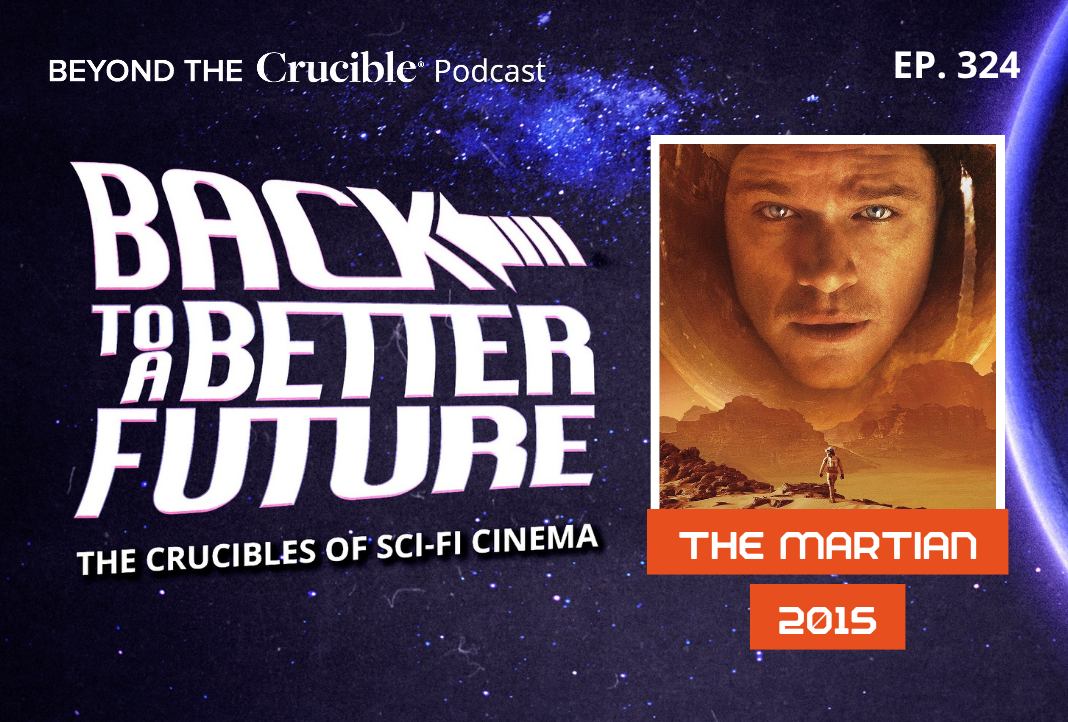
Back to a Better Future: The Crucibles of Sci-Fi Cinema VIII The Martian
What do you do when you’re stranded on Mars with almost no chance of survival — and no one is coming to save you anytime soon?
In this episode, we wrap up our special summer series Back to a Better Future: The Crucibles of Sci-Fi Cinema with The Martian — and the remarkable story of astronaut Mark Watney. Left behind on the Red Planet after a mission gone wrong, Watney faces not just his worst days, but his worst months and years, with little more than his ingenuity, determination, and an impressive sense of humor to carry him through. His story is one of the most compelling portraits of resilience we’ve explored in this entire series — a masterclass in what it looks like to science your way out of a crucible and refuse to let impossible odds have the final word.
Want to explore our three prior summer series about the lessons we can learn about overcoming crucibles from film?
Check out these playlists featuring every episode of each one:
LIGHTS, CAMERA, CRUCIBLES (2022): • Beyond the Crucible: Lights, Camera, Cruci…
CLASSIC FILMS, CLASSIC CRUCIBLE LESSONS (2024): • Classic Films, Classic Crucible Lessons: A…
BIG SCREEN, BIG CRUCIBLES (2025): • Back To A Better Future 2026
Have a question or comment? Drop us a line at info@beyondthecrucible.com
—
👉 Don’t forget to subscribe for more leadership and personal growth insights: https://www.youtube.com/@beyondthecrucible
👉 Follow Beyond the Crucible on Facebook: https://www.facebook.com/beyondthecrucible
👉 Follow Warwick on LinkedIn: https://www.linkedin.com/in/warwickfairfax/
👉 Follow Beyond the Crucible on Instagram: https://www.instagram.com/beyondthecrucible
👉 Take the free Trials-to-Triumphs Self-Assessment to discover where you are on your journey of moving beyond your crucible and how to chart your personal course to a life of significance: https://beyondthecrucible.com/assessment/



Transcript
Warwick Fairfax:
Welcome to Beyond the Crucible. I'm Warwick Fairfax, the founder of Beyond the Crucible. He could have given up saying, "Well, how do I grow food on Mars?" I mean, that's impossible, surely. But fortunately, Watney then says, "Luckily he's a botanist," and then says these words, "Mars will come to fear my botany powers."

Gary Schneeberger:
The red planet may not wind up fearing astronaut Mark Watney's botanical skills, but his science skills and his creative ways of applying them to overcoming being stranded on Mars impresses NASA and a watching world when a mission crucible leaves him stuck there with little chance of getting back to earth or even surviving. This week in the eighth and final episode of our special summer series, Back to a Better Future, The Crucibles of Sci-Fi Cinema, we look at the ingenuity, determination, and sense of humor that propel Watney through and past not just his worst days, but his worst months and years too. How can understanding how he overcomes these challenges help you overcome your own? Stay tuned.
Welcome friends to this episode of Beyond the Crucible. You have joined us for, sadly, the final episode of our summer series, which we are calling Back to a Better Future: The Crucibles of Sci-Fi Cinema. And it is the fourth year that we have focused our special summer series on what films can teach us about confronting crucibles, moving beyond our crucibles, and then launching ourselves into a life of significance. And we had so much fun doing it the first three times we did it that we though we'd do it again this year. And that's indeed what we have done.
Just to rewind a little bit, the first one we did in 2022 was spotlighting heroes, sports heroes, military heroes, historical heroes, any kind of hero you can think of, we covered that in 2022. We then skipped a year and did something else in our summer series. In 2024, we did classic films from the American Film Institute that they'd spotlighted as really, really excellent films. And they were really, really excellent and they were really, really excellent in helping you learn how to move beyond your crucible. And then last year we did movies. I've said it before, not in all episodes, but in some of these episodes, you've heard of the brand Chock full o'Nuts Coffee.
Our summer series last year was chock-full of crucibles films, films that really had a lot of crucibles that really showed how to tackle multiple setbacks and failures and move forward toward a life of significance. And this year, as I said, we're focusing on sci-fi movies and Warwick, I will ask you this question. I've asked you the first seven episodes, I'll ask you here for the eighth episode. We're going back to the cinema again. We're walking through buying our tickets and going in. Why movies again? What is it about films that fit Beyond the Crucible and what are you hoping our listeners and viewers have gotten from what we've done so far? And we'll get from this. What is your hope for this series?

Warwick Fairfax:
Yeah. We both love movies, but it's different looking at movies from the Beyond the Crucible perspective. Suddenly-

Gary Schneeberger:
Ain't that the truth?

Warwick Fairfax:
... this movie, which we'll get into, I really enjoyed it, but there's so much we can learn from this movie, which you'll talk about in a bit. There's so many lessons from Beyond the Crucible perspective. So, it's really hopefully educational for the listeners and viewers. It certainly is for both Gary and me. We really enjoy doing this. And part of the thing with movies is they typically portray a protagonist who is facing huge challenges, huge crucibles. It's really sort of technicolor level of challenges rather than just black and white or just pastel. I mean, it's just bright colors. And as you've mentioned, we've covered superheroes, sports heroes, the American Film Institute's top 100 movies.
And it's really a lot of fun and a great learning experience just to see how these central characters overcame just massive crucibles and found a way in most cases to not let those crucibles define them. In some cases, I can think of a couple, The Godfather and Citizen Kane. Unfortunately, those crucibles did define them and the arc of the movie, basically their lives get worse. So, it is possible to go downhill after a crucible, and certainly that happened in those movies. But in general, with the movies we have here portrayed over the last several years, you have characters that learn from their crucibles and find a way to focus on albums.

Gary Schneeberger:
Yeah. And whether they learn from their crucibles, the characters in the films, or like The Godfather and Citizen King, they didn't. They did let their worst day define them. There's plenty of help for all of us who go through crucibles from both the stories we should follow and the cautionary tales, right?

Warwick Fairfax:
Absolutely.

Gary Schneeberger:
And you said that it was fun just to kind of go through movies that we both like movies. As we've said before, when we do it for the series, we wear, I've coined the phrase Beyond the Crucible Goggles. But this particular series this year, right? Back to a Better Future, The Crucibles of Sci-Fi Cinema, particularly exciting for you, this now eighth week of this series has been. What is it? Explain to folks here, what is it about science fiction that you love so much and that you think is so resonant for discussing the kinds of things we're discussing, moving past your worst day and going toward a life of significance?

Warwick Fairfax:
Yeah. I've always loved science fiction ever since I was very small. I read books, watched movies, TV shows, the focus on science fiction. And I think of one of the most influential science fiction movies ever made was 2001: A Space Odyssey. It came out in 1968. And in this movie, you saw future technologies such as space shuttles with video screens on the seat in front of you. That's common now when we fly. But back in 1968, that technology didn't exist. You had talking computers, video conferencing. And what they did so well in 2001 is Space Odyssey is they use brands such as Precursor to AT&T, the Bell Company, and you have a scientist calling his daughter back on a birthday on earth.
He's in some space station circling the earth and he's using Bell telephone video conferencing. So, it's pretty cool the way they did all that. I think the space shuttle might be a Pan-Am space shuttle, which doesn't exist now, but today it might be American Airlines or United. So, really impressive. Of all the science fiction shows that exist, my favorite was Star Trek. And that aired from 1966 to 1969, we actually discussed a Star Trek movie last week. And that was from the Star Trek Next Generation, Star Trek First Contact. And as I mentioned last week, Star Trek: Next Generation is probably my favorite of the different series within the Star Trek universe.

Gary Schneeberger:
And you've seen all of them. You made that point last week. You've seen every episode of pretty much every series that they've done on Star Trek. So, it's bravo.

Warwick Fairfax:
Absolutely. Absolutely. Yeah. So, huge fan. And I'm also a fan of some of the great science fiction writers, Arthur C. Clarke and Isaac Asimov. Arthur C. Clarke actually wrote the screenplay to 2001, The Space Odyssey. And what I love about science fiction is yes, it explores future technology, but at its best, and certainly Star Trek does it very well, which is one of the reasons why I love Star Trek, is it explores deep societal issues such as the future of the human race, conflict between people who are different, how we'll interact with other forms of life, what's the role of technology? We obviously think a lot about AI today and is it good? Is it bad? What will AI do? Will it take people's jobs?
If AI gets too intelligent, will it be like in the Terminator where you've got robots that are taking over the world? Science fiction portrays things in some cases that we have some degree of reason to be concerned about. So, in science fiction, we see very significant crucibles portrayed. Can the human race survive? What will happen as humans explore the galaxy? Will it be beneficial or not? And will technology get to a point where it will control humans? So, that's why a lot of science fiction is yes, there's the technology, but the deep societal issues that science fiction can explore is really amazing because it's said in the future.
It's in societies that don't exist now or in context that don't exist. So, it's not threatening to anybody per se. So, you can really fully explore some deep issues.

Gary Schneeberger:
I've not said this in any of the episodes in this series, but the one thing that's interesting to me as we talk about all the advances and things that they show is the one thing that these movies did not necessarily get right, and how could they, is what computers look like. Because every computer that they show still looks like a dot matrix thing that's running by. Even Alien, which is set in this future. It's one of those things that you look at and you go, okay, this feels a little dated. Even The Terminator does that.

Warwick Fairfax:
Yeah, it's so true. They can't get everything right. But I do remember in the original Star Trek, they do have these communication devices that they're not quite smartphones, but they're kind of pretty nifty and talking computers that talk back. So, they don't get everything right. But that's the beauty of science fiction is the movies we make today about the future, I'm sure in 30 years' time to look back and say, "Come on, how could we have got that so wrong?" So, it's sort of inevitable.

Gary Schneeberger:
Okay. Here we are in episode eight and we're looking at the final film on our list this summer, and it's 2015's The Martian. It's the second movie, interestingly enough, in this summer series that we're doing, directed by Ridley Scott. And the first was Alien, which we just sort of hinted at a little bit, all the way back in week two. Sorry. It feels like season two sometimes, doesn't it? But it was back in week two. That was Alien. And here's the summary of the movie that we're talking about here, The Martian, which is in the film industry, this summary is known as the log line. It's the most compact way to express a film.
And I'm going to be sad that until next summer, I'm done talking log lines on Beyond the Crucible after this week. But here is the log line, and it's the shortest film we've had so far. It's this. An astronaut stranded on Mars must rely on his ingenuity to survive and arrange a potential rescue. Now that's a very succinct way of saying something that as you'll hear, we talk about it here. It's not very succinct. There's a lot of stuff that goes on and a lot of ingenuity indeed, as the logline says, it has to happen.
But Warwick, before we get into the movie, I thought it would be interesting since this is the last one of the series, to have a little look back at all four years, four years that we've done a summer series. So, I did a little research, Warwick, into the four years that we've done this. And in those four years, we've done 32 films counting this one. 32 films over four years. There are three films that one actor appears in all three films. Three different actors appear in all three films.
Do you have any wild guess as what, going back to 2022, what one actor might appear in all three series, not films, sorry. In all three series, appears in one film in three series. There's three actors. I won't keep you on the hook long because there's a lot of actors in 32 movies.

Warwick Fairfax:
Well, I know we had Charlton Heston in Planet of the Apes. I'm not sure if he was in any of the other series, but including this series, hmm, I don't know.

Gary Schneeberger:
I'll give you a hint. One of them's the star of the movie we're talking about this week.

Warwick Fairfax:
Oh, Matt Damon.

Gary Schneeberger:
Matt Damon. So, Matt Damon is one of the three. Matt Damon was in, well, he's in The Martian. He was in The Monuments Men, which we did last year. And he was in Invictus, which we also did last year.

Warwick Fairfax:
Right. Yeah.

Gary Schneeberger:
Matt Damon was one. Here are the other two really quickly. Cate Blanchett has been in three of the films we talked about in our summer series. Lord of the Rings, Fellowship of the Ring, that was 2024. In 2022, she was Marion in Robin Hood way back in 2022.

Warwick Fairfax:
Wow.

Gary Schneeberger:
And in 2025 last year, she was in The Monuments Men.

Warwick Fairfax:
Okay. Yeah. Yeah.

Gary Schneeberger:
And this one surprised me when I was looking it up because you don't think of him as doing this. Robert Duvall was in three. Robert Duvall was in The Natural in 2022. He played the sports writer that was kind of out to get Roy Hobbs. He was in The Godfather very famously as Tom Hagen, the consigliere of the Corleone family. And then he had a very small part, the pivotal part in To Kill a Mockingbird, which came from 2024.

Warwick Fairfax:
Right. Yeah. I think that might've been his first role in To Kill a Mockingbird.

Gary Schneeberger:
It was one of his first roles for sure. So, I have a modest proposal that we should call these series from now on, the Blanchett, Duvall, and Damon Summer Movie Series, right?

Warwick Fairfax:
There you go.

Gary Schneeberger:
Blanchett, Duvall, and Damon summer miniseries in honor of our most visited stars in the films that we've covered.

Warwick Fairfax:
That's so funny. That's great.

Gary Schneeberger:
And one other little fact that I just thought was kind of interesting here is that, where'd it go? One film has the most actors, three actors. One particular film of the 32 that we've covered has three actors who appear in other films that we have. And that's the Fellowship of the Ring. The Lord of the Ring is the Fellowship of the Ring. That's Cate Blanchett, isn't it? Ian Holm, who was also in Alien, isn't it? And Hugo Weaving, who was also the Red Skull and Captain America, the First Avenger. There's some summer movie series trivia from Beyond the Crucible. All right. Let's move on from trivia to what's going on in this film.
It's 2035, Warwick. And the crew of the Aries three, Mission to Mars, is exploring a planet on Martian Solar Day 18 of their 31 sol expedition. You'll explain probably better than I can what sols are when we get there. Sol, not souls like soul work that we talk about. A severe dust storm threatens their Mars ascent vehicle, known as a MAV. We'll call it a MAV throughout. And in the ensuing evacuation, astronaut Mark Watney is struck by flying debris. This kicks off the plot and it's a major crucible right away for the star of our film and for this film, right?

Warwick Fairfax:
Absolutely. So, in this opening scene of the movie, we see Watney and then another astronaut, Rick Martinez. They're outside the MAV. And it seems like out of no way, the severe dust storm hits. And all of the crew head towards the MAV. The dust storm is so severe, it begins tilting the MAV dangerously. And if it tilts too much, it's going to keel over and they're not going to be able to take off. And so, time is against them. And amidst this dust storm, the crew loses contact with Watney. All they see is that Watney gets hit with debris and they don't see him again and they assume that he's killed.
And one of the things that certainly makes them think that is they lose all contact with him and there are no vital signs. All of the spacesuits have technology that you can see the biosigns in each crew member. So, they see him being struck by debris and there are no vial signs, no bio signs. So, they assume that he's dead. And Commander Melissa Lewis, who is the lead person of the crew, she's faced with a difficult, almost impossible decision, is that if they wait, then they might all be killed because the MAV is going to be on its side or tilted over and nobody's going to be able to escape. So, they're really faced with a choice where they have no choice and they take off.

Gary Schneeberger:
Right.

Warwick Fairfax:
And obviously, they assume that Watney's dead and that there's nothing they can do.

Gary Schneeberger:
But Watney is not dead. Watney awakens after the storm we see in a subsequent scene, having narrowly survived his injuries. As he recovers within the crew's surface habitat, he begins a video diary to document his thoughts on survival. Watney realizes he's alone, injured and stranded millions of miles from earth. One of the most powerful moments in the film comes when Watney makes a decision. Simple decision, but not a simple decision. He's going to survive. So, let me ask you this, Warwick. Why is mindset the most important choice we can make when we're at the beginning of our own crucibles?

Warwick Fairfax:
We see in these early scenes that after the dust storm is over, as you say, Watney is actually alive. His has been punctured by this flying metal spike, which we later learned is connected to the antenna array, and his oxygen level is critical. So, he wakes up, he's injured, and he begins to walk slowly back to the base camp before the oxygen level dissipates. And once inside, he takes his suit off, pulls out the metal spike, which is punctured his side and staples the wound with sutures. And he's all alone. The crew have left him and the MAV. And so, what he begins a video log.
It's a very useful way in the movie that we know what he's thinking because he wants to record his thoughts, which makes sense. So, he says that this metal spike was part of the antenna and it sealed the blood in his suit, but it also destroyed his biomonitor. And he says it will be four years before anyone can reach him. He talks about everything that could go wrong, including the water reclamation machinery, or if the lab is breached, or if he runs out of food. So, he's very aware of how a dire his situation is. He's not kind of saying everything's great. He is very sober and sane in terms of how challenging his position is. But then he makes this bold statement.
He says, "I'm not going to die here." He just puts that line in the sand, "I realize how dire things are, but it's not happening. I will not die." Basically throughout the movie, he finds a way to keep moving forward. It's just remarkable. And Watney obviously had every reason to give up. He could have felt that his crew abandoned him and that there is no way he'll have enough water or food to survive four years when the next mission may come. I mean, that was not what this whole space camp was designed for. Not to mention all the disasters that could happen to him on Mars. So, there's every reason for him to feel like this is impossible. I may as well just give up.
And it would be very understandable if he felt sorry for himself and as I mentioned, gave up. But yet he makes a decision that he will not die on Mars. That is his mindset. And that shifts his thinking from despondency and negativity to one of hope. And it shifts his thinking to one of where he's saying to himself, "What do I need to do to come up with a plan to keep myself alive for four years? What's the plan?" And rather than saying, "This is all too hard," he has an attitude. "This will be challenging, but let's begin the journey. What's the first step? Let's come up with a plan and begin the first step towards survival.
So, really what this says more broadly is when you try to come back from your worst day, you're crucible, your mindset is everything. It's the difference between staying mired in the pit of despair and being angry at the world, angry at yourself, or having this sense of hope that, yeah, things are challenging, but I'm going to come up with a plan. I'm going to figure out a way. We're going to move forward step by step. We'll figure it out. We'll get it done. So, the difference between despair and hope is huge. Hope offers the promise of life. Despair almost guarantees that there is no hope. Despair can be and often is a fulfilling prophecy.
So, you want to move forward from your deepest, darkest day, have a sense of optimism, a sense of hope, not anchored in some complete lack of reality, but it's like, okay, it's going to be challenging, but we'll figure out a way, one step at a time. It's remarkable throughout this whole movie, Watney's sense of optimism and his mindset. It's just incredible.

Gary Schneeberger:
Yeah. I mean, he's got confidence and sometimes, he's even got defiance. And I think that's one of the things, folks, that you'll see in this clip that we're going to play. Let's take a look and listen to how Watney lays out his situation and his plans. His confidence, as I said, that he will survive.

Video Clip:
Right. Let's do the math. Our service mission here was supposed to last 31 sols. For redundancy, they sent 68 sols worth of food. That's for six people. So, for just me, that's going to last 300 sols, which I figure I can stretch to 400 if I ration. So, I got to figure out a way to grow three years worth of food here on a planet where nothing grows. Luckily, I'm the botanist. Mars will come to fear my botany powers.

Gary Schneeberger:
So, Warwick, there's skill obviously in that clip, but also a lot of humor. What will show a lot of both throughout this film, The Martian. Why is humor an indispensable asset to pair with our skill in our crucibles? Because I think those two go hand in glove in this movie and in our lives.

Warwick Fairfax:
Absolutely. So, in this clip, Watney calmly lays out what he needs to do to survive. He figures out that given that there is just one person and not the full crew, there is enough food for him for 300 or maybe 400 days. But he has to get three years worth of food when nothing grows. In other words, maybe this will cover the first year or so, but what about the rest of the four years? And he realizes that he does not have enough rations to get through four years. So, he could have given up saying, "Well, how do I grow food on Mars?" I mean, that's impossible, surely. But fortunately, Watney then says, luckily he's a botanist, and then says these words, "Mars will come to fear my botany powers."
I mean, you're right. It's an in your face, very humorous remark. But it's true the fact that he's a botanist does save his life. So, Watney calmly assesses a challenge about what will happen after his rations run out. And he has to find some way of growing food in order to survive. So, rather than being despondent, he sees this as a challenge and he's willing to face this with almost in your face humor. So, one of the things that this shows is sometimes amidst to crucible humor, even death defying gallows humor, which we see a lot from Mark Watney in this movie can be helpful. You recognize the problem, but you will not be defeated by it.
So, humor almost sort of diffuses any sense of despondency and actually help propel you towards moving forward. At least it does in this movie. Watney then begins to bring dirt from outside and he lays it all in a room and plants seeds in the dirt. So, he sees these potatoes and he finds a way to kind of get the seeds in the potatoes to kind of plant in the earth. And one of the other things you see is he's got two things sort of blocking his nose. So, he finds a way to use the manure from the waste disposal system because plants, as we know, they need some kind of fertilizer. So, he's creative, but not a fun job.

Gary Schneeberger:
No.

Warwick Fairfax:
And so, okay, so he's got the potatoes, he's got earth, he's got some kind of fertilizer, but you also need water. And this is Mars. There's not water on Mars, at least not anymore. Scientists speculate they may have been billions of years ago, but not now. So, how's he make water? Well, he's a scientist. So, he combines hydrogen and oxygen and burns it in some way that will produce water. Well, his first attempt doesn't work and it kind of blows up and is thrust backwards. But it's like, "Okay, yep, that didn't work out." And he figures out what he did wrong and figures out a new way to combine hydrogen and oxygen. And he indeed makes water and you see moisture in the room with the soil.
And eventually, he sees a small green sprout and then later potatoes. I mean, to have enough ingenuity, okay, he's a botanist, but enough ingenuity, creativity and sticktoitiveness to grow potatoes inside in this base camp in Mars. I mean, that's mind-blowing and creativity. And I'm sure the people back in NASA, if you said, "Yeah, I'm sure there's a way to grow potatoes inside a base camp," everybody would've said, "Nah, that's impossible. There's not one person at NASA that would say this could in any way, shape or form be possible." But Watney finds a way. It's truly remarkable.

Gary Schneeberger:
And Mars does indeed witness his botany powers as they play out in this scene. But as he's beginning this process of staying alive, back on earth, NASA has no idea that he is indeed alive, do they?

Warwick Fairfax:
They do not. So, the first we see of NASA on earth is we see Teddy Sanders, the administrator of NASA, and he's actually conducting a memorial service for Watney. They assume that he's dead. And then we see Vincent Kapoor, who is NASA's director of Mars missions. He comes and talks to Sanders and says that he wants to have satellite coverage of Mars to see what's left. And he wants to know what's happened. And Sanders worries about the PR of seeing a dead astronaut. Now, throughout this movie, Sanders doesn't always make the right call and doesn't even make the right PR call. He doesn't always approach it that well. But Kapoor advocates for satellite coverage to try to see what's happened.
And if Watney is indeed dead, let's fight out, let's bring his body home. Now's the time when everybody is focused on NASA and Mars and what's happened Let's do it now. Kapoor actually tries to push back on Sanders' PR view saying there's another way of looking at it. So, finally, Sanders does authorize satellite coverage of Mars so that they can see what happened and what's left of base camp and where things are. So, finally, Sanders authorizes it.

Gary Schneeberger:
And they don't just see what's left of base camp from those images. On earth, NASA satellite planner, Mindy Park notices Watney's activity from the recorded satellite images and suspects that he must be alive. How does NASA react to this news, Warwick? Because it is a bit of a seismic shift in what they understand to be true about what has happened on Mars.

Warwick Fairfax:
It is indeed. So, the satellite photos show that there's been movement at base camp on Mars. The solar panels are being put back. Obviously, they were kind of turned over and scattered with the storm. And they see that a rover, which is a Mars vehicle, has been moved. So, they conclude that Watney must be alive. I mean, how do those solar panels get put back in place? How does the rover sort of move from one place to the other? It's not being knocked over by a storm. It's right side up. I mean, how does all that happen? So, one of the other things that's apparent is that Sanders does not want the crew of the Aries, which is Watney's fellow crew that are heading back to earth on their spaceship.
Sanders doesn't want them to know that Watney is alive because he believes they'll be devastated to think that they've left him behind. So, Sanders makes the call, "Do not tell the crew of the Aries that Watney's alive."

Gary Schneeberger:
Watney then explores the surrounding terrain and studies his maps and he quickly journeys out to retrieve the Pathfinder probe, hoping to restore its communications. Kapoor realizes this strategy and quickly visits Jet Propulsion Laboratory. We're going to call that JPL throughout the rest of this episode, folks. The director of JPL, Bruce Ng, to use their replica of the probe. What plan is hatched next, Warwick?

Warwick Fairfax:
So, this again shows Watney's remarkable creativity and his ability to think outside the box. So, he remembers the Pathfinder probe from 1997 and he takes the rover out to find it, thinking that maybe he can use this to communicate with NASA. Because remember that whatever communications array they had back at base camp was destroyed in the storm. So, while he's found a way to grow food and create water to survive, he knows that ultimately to live, to continue to be alive, he needs to find a way to restore communications with NASA. He wants them to know that he's alive and he obviously needs their help.
And so, what's interesting is at NASA on earth, they're looking at these images of base camp and they notice that the rover is headed out of base camp. Well then they draw a line from base camp to the rover and Kapoor is a smart guy and he figures out, "I know what Watney's doing. He's headed to where the Pathfinder probe was." And so, at that point, as you say, Kapoor heads out to JPL in Pasadena, California, and there they have a replica of the Pathfinder. And so, it's like, okay, he's going to find Pathfinder on Mars. We'll find the one we have here. And this is old technology, but the Mars Pathfinder in a sense will find a way to hopefully communicate with the Pathfinder on earth.
So, Watney brings his Pathfinder back to base camp. He turns the machine on and there's a camera that takes still photos. So, that's the technology. It's not video. There's no sound, but it does take still photos. So, again, Watney is the ultimate for thinking outside the box. So, he gets these trays from inside the base camp and he starts writing on them. And then he erects two sides saying yes or no. And so, when the camera spins towards yes, he knows that they're seeing him at NASA on earth and it means yes. And so, it's pretty rudimentary forms of communication, but at least he can get a yes or no answer to these questions that he's written on these trays. It's really remarkable. But Watney's not satisfied.
That's the first step in communication, but yes or no is a pretty crude way of communicating. It's a fairly elementary. It'll take forever to have any kind of communication. Well, he knows he needs to find a way to have an alphabet, but because of the turning radius of the camera, a regular 26-letter alphabet won't work. So, being a scientist, he said of something that I certainly haven't heard of, which is the hexadecimal alphabet.

Gary Schneeberger:
Oh yes, that.

Warwick Fairfax:
So, that was a new one to me. So, somehow the hexadecimal alphabet must be less than 26 letters and can fit within the turning radius of this camera on the Pathfinder. Well, somehow as he's working on that, the smart people at JPL in Pasadena figure out what he's trying to do is it's a hexadecimal alphabet. I mean, talk about great minds thinking alike. I mean, this is crazy, but I guess he must have given them clues or maybe he's written it on a tray. Somehow they've figured it out and now they can communicate with the full alphabet. So, they ask him how he is alive. And so, this is the message that Watney sends. Impaled by antenna, biomonitor destroyed. Crew had reason to think me dead, not their fault.
Very concise, very to the point. Really a remarkable message. So, this shows Watney's incredible ingenuity and thinking of using the Pathfinder's communication device and thinking of using the hexadecimal alphabet to communicate. But it also shows Watney's state of mind. He is not blaming NASA or the Aries crew for leaving him behind. He gets it. He understands that the MAV was about to keel over, that they had to escape. He realizes his biomonitor was damaged. And so, they had no reason to believe he was alive. He doesn't at all fault them for leaving him. There's no anger. He gets it. It just shows a remarkable presence of mind.
And it's not even forgiveness because it's like, well, there's nothing to forgive. They did what they had to do. So, he's not weighed by the past. He's not wallowing in the pivot of space. He's not angry at others. He's not angry at himself or anything or anybody. It's like, here we are, what's the next step? So, his creativity and his mindset as just jaw dropping. It's really incredible.

Gary Schneeberger:
The agency makes contact with Watney and instructs him to link Pathfinder to the Rover where he can now communicate by text. Totally going to change the way that they exchange information and make it much, much better. With this breakthrough, Mitch Henderson, who is a flight director for NASA, Mitch Henderson is finally allowed to inform Watney's crew mates. This is his team of fellow travelers. And how do they react to this unexpected, truly breathtaking news?

Warwick Fairfax:
So, now that Watney can communicate with NASA, really the first huge breakthrough is when NASA says, "Okay, there's a way that we can link up Pathfinder to the rover so we can have more complex conversations by text. That's not something Watney had figured out, but the bright minds at NASA did. Again, it shows the importance of having fellow travelers. As smart as Watney is, having a whole bunch of other minds can certainly help. And you're right, it was a game changer. So, now he's able to text NASA and they can text him back. I mean, it's huge. Certainly a lot more efficient than the original system of yes or no signs in the earth of Mars, so to speak.
And so, Kapoor tells Watney that they're working on a supply mission to keep him fed and working on a rescue mission. Watney is understandably relieved and in classic Watney in your face, humorous fashion says, "Glad to hear it. Really looking forward to not dying." And they all laugh back at NASAs, including Sanders. I mean, it's just classic Watney. Yeah, really looking forward to not dying. Just this optimistic gala's humor is incredible. So, Watney asks how the Aries crew is feeling now that they know that he's alive. Well, they tell him that the crew doesn't know that he's alive. And Watney's incredulous and says, "What's wrong with you at NASA that the crew doesn't know he's alive?"
He's just dumbstruck by that. At that point, Henderson tells Sanders that the crew of the Aries need to be told that Watney is alive. And so, at this point, Sanders authorizes communications. So, Henderson sends a video message to the Aries crew and he tells them that Watney's alive and healthy and that they found this out two months ago and they decided not to tell them. But then Watney says they have communications with Watney and a rescue plan. So, Lewis' reaction is, "I left him behind." And she says it more than once. "It's understandable the commander of a mission, when things go wrong, they tend to say, it's my fault. I should have thought of something."
And she does. Now the crew says we all left together and it wasn't her fault, but that's a tough thing. I mean, how could she possibly know? She saw this debris take Watney away. There's no biosigns on his spacesuit. They had to take off because the MAV was about to tilt over. She had no choice. Logically, she made the right call. She has the safety of the rest of the crew. But emotionally, understandably, she's thinking, it's my fault. He's stranded there and it's my fault. It's very understandable that she would think that way.

Gary Schneeberger:
So, as Watney enters the camp one evening, a leak in the airlock causes an explosion that injures him and destroys that potato garden that he works so hard and ingeniously to create. And just as the audience, you're kind of lulled into this, things are going smoothly. These guys are all so smart. It's going to work out great. Here come crucibles. Something that we all know, right? Just because you've been through one and it's gone smoothly a bit for you or you figured it out does not mean that another one's not going to come. And although he repairs the airlock, he is again threatened by starvation. Warwick, what impact does that scene have on Watney?

Warwick Fairfax:
Yeah. So, Watney's outside trying to strengthen the outside wall of base camp. And he's in an interlock, which is between the two doors. So, basically you go through one door and pressurize that sort of tunnel, if you will, and then open the next door and get into base camp. So, as he's in the interlock between these two doors, somehow there's a tear in the tube and oxygen blows out and knocks Watney around. His soon has been punctured. His oxygen is at 5% before he can find tape to tape over the puncture. So, he gets that taped.
Well, then he heads into base camp and he sees that the whole explosion, if you will, with oxygen escaping. He sees that the whole crop has been exposed to the outside atmosphere and it's all being killed. And then he goes to the rover and tells Sanders Henderson and Annie Montrose, who's the director of media relations for NASA, he tells them all that the crops are dead and the water supply's an issue. So, this makes the rescue mission that much more challenging. The whole food supply has been radically diminished because he's lost all his potato crops. And NASA is now allowing the Aries crew the ability to communicate directly with Watney.
And so, there's this conversation that ensues and it's classic in your face banter as comrades and arms do. And it's just incredibly priceless conversation. So, Martinez on the Aries crew says to Watney, "Sorry we left you behind, but we just don't like you." And then he says, "It's a lot roomy on the Aries crew without you. We had to take up your job, but it's only botany. It's not real science. It's classic smack talk in your face." And Watney eats it up. He realizes it's all in fun. And so, Watney smiles at this batter and Martinez asks how things are going. And Watney says he just blew up the hatch and explained what happened.
But unfortunately, all of Lewis's disco music survived. Now throughout the movie to this point, the only music in base camp is Commander Lewis's disco music. And for whatever reason, Watney cannot stand his disco music. It's just driving him insane. But when it's you alone, it's disco music or nothing. Well, he decides disco music is better than nothing because he's hearing something as he's going about his day. So, in this banter between Watney and the Aries crew, it's clear that Watney has not given up no matter how bad things look at times, and still tries to have some sense of optimism despite the fact that he's lost his, well, at least a lot of his food supply and some of his water.
And so, this is just this recurring theme of optimism. And as I mentioned, hating Lewis's disco music. It's also clear from the batter how much the Aries crew thinks of Watney. And the smack talk is said in love. You only have that kind of conversation if there's a real sense of love and camaraderie between the Aries crew and Watney.

Gary Schneeberger:
Right. Last, another big crucible happens to NASA. And then the China National Space Administration becomes an unexpected fellow traveler to all of this that's going on. And it decides to offer a launch vehicle originally intended for the Tai Yang Shen Space Probe out of China to resupply Watney. NASA astrophysicist Rich Purnell devises an alternative plan though. What is that new plan, Warwick?

Warwick Fairfax:
So, NASA is trying to send a supply vehicle up, but unfortunately the supply vehicle they send up. It blows up shortly after liftoff. So, now what are they going to do? They don't have lots of vehicles, supply vehicles are waiting. It could take months to be able to get another one up and running. So, they'd shortened the schedule to get that supply vehicle up and had not done all the final checks because they just knew that Watney didn't have time. You have to take desperate measures when it's a desperate situation. So, at this point, Watney realizes that things are not looking good. And so, we asked Lewis to pass on a message to his family in case the worst happens.
And this message is very telling about Watney's mindset, but also the legacy that he wants to leave. And this is a message he asks Lewis to pass on to his family. He says that if he dies to tell his parents, and he says, "It is a lot to ask, but he's not giving up, but he's preparing for every outcome." And he said to tell him he loves what he does and he's really good at it. Dying for something big and beautiful and greater than me. Tell him he said that he can live with that. And thank you for being my mom and dad. So, basically, he's hopeful that he'll live, but if he doesn't, he can live with the facts, so to speak, that he's dying for a cause greater than himself. That is pure life of significance. A life on purpose, dedicated to serving others.

Gary Schneeberger:
Yeah, for sure.

Warwick Fairfax:
It's really remarkable. So, this legacy message shows that Watney realizes he is living for life of significance. In fact, he's willing to die for his life of significance. And he says that he can live with that. It's just remarkable. So, meanwhile, the China Space Agency is watching. And unbeknownst to NASA, China has come up with booster technology that can help. So, the head of this China Space Agency reaches out to Sanders at NASA and tells them that China's willing to help. So, NASA can get a supply vehicle launched fairly quickly after all. So, meanwhile, Purnell at JPL Pasadena has come up with a plan. So, he's this sort of uber scientist, almost a little bit nerdy and he's kind of a genius.
And this involves the Aries spaceship, which is headed back to Earth, getting gravity assist from looping around the Earth and picking up supplies from the Chinese rocket and then accelerating back to Mars. Then it's going to loop around the Earth, pick up the supplies from the Chinese rocket and head back to Mars. So, Watney, on the other hand, he would use another MAV on another part of Mars to then intercept Aries while it's orbiting Mars. So, that's the plan. It's not an easy plan, but it's doable. So, Sanders does not want the Aries crew to know of this option.
I guess Sanders is probably skeptical, plus it would mean the Aries crew having to go all the way back to Mars after they're actually orbiting the Earth. And while Henderson, on the other hand, says he believes it should be the crew's decision. Well, Sanders makes a call. No, Aries crew are not going to hear about this option from Purnell. Well, then Henderson, he goes behind Sanders' back and sends a coded message to the Aries crew. Lewis and the rest of the crew realize that they're being kept in the dark by NASA and that they could force NASA's hand. I mean, they could make a decision on their own that Sanders can't do really anything about. But Lewis says that if it was up to her, she'd do it.
She'd return and rescue Watney. But she fully realizes this is mutiny and they're going against what NASA wants. And so, she says that the crew has to be in this together. She says, "This will add 533 days to the mission before we see our families." And she says that NASA will never send us back in space again because they're defying orders, it's mutiny. And she says, "Any of the crew who are in the military will be caught marshaled." So, Lewis says, "This decision must be unanimous." They all vote yes and they're excited. They're eager to rescue their friend and colleague Watney, and they fully realize the consequences of their decision.
So, the crew somewhat cryptically tells NASA that Purnell is a steely-eyed missile man. So, basically at that point, Sanders and NASA realizes word is out. They know about Purnell's plan. So, Sanders realizes what's going on and he also realizes how it happened. It must be Henderson. He's the one that wanted to tell the Aries crew. He obviously did tell the Aries crew of Purnell's plan. But Sanders then asked for Henderson's resignation. There are consequences for doing what Henderson did. And I'm sure Henderson realized there could be consequences. And Sanders basically said, "I need your resignation." Nonetheless, Sanders reluctantly blesses Purnell's plan, which the Aries crew are emblematic.
He might think, "What choice do I have?" But he basically blesses Purnell's plan. So, a couple remarkable things happen here. Lewis and the Aries crew are willing to add 533 days to their mission before seeing their families again, and they're willing to risk their future careers with NASA. Henderson sacrifices his career for the sake of rescuing Watney. So, it's a lot of incredibly selfless behavior on the part of the Aries crew and Henderson of doing what they feel is right, even though it will be a great cost to themselves to help Watney. It's truly remarkable their attitudes and what they did.

Gary Schneeberger:
So, after waiting several months, Watney embarks on a long journey to the areas for MAV. He plans to use it to rendezvous with the Hermes, but needs to do something pretty extreme to make it work, doesn't he?

Warwick Fairfax:
He really does. So, Watney has to make a long journey to get to the MAV on the other side of Mars. He travels during the day or at night, and then he has to stop and get out the solar panel to charge the rover. And then off he goes again. It's just a long journey. So, his goal is to reach this other MAV that will then take off from the planet Mars from the surface and then link up with the airy ship once it's in orbit. And so, he leaves this following message as he leaves base camp, I believe. Everywhere I go, I'm the first. Climb that hill, first guy to do that. Four and a half billion years than me. First person to be alone on an entire planet. So, again, it's a never say die attitude from Watney.
His human optimistic personality are incredible. So, Watney then finally gets to this MAV, and he's told by NASA that to get to the right intercept velocity, he needs to make the MAV wire a lot lighter. So, Watney at NASA's direction begins to start throwing out a lot of equipment from the MAV. He throws out the controls. He unscrews everything. He even, I think sort of removes some of the outside windows to this MAV and he puts a top over the nose, which he comically calls making this MAV like a convertible without a top. And it's just incredible. Wat needs to this process before he leaves in the MAV, he cleans up his appearance, cuts his hair, shaves. He wants to look presentable.
And earlier as he was heading to the MAV, he thought of himself as a pirate since nobody really owns Mars. And then he starts thinking about when you're in International Waters, nobody owns International Waters. He kind of riffs on this whole way of thinking. And he thinks of himself as a pirate because again, he's in the middle of Mars, nobody owns that. And he asked to be called a Captain Blondebeard. The sort of captain Blackbeard in the pirate days way back when. So, he wants to be called Captain Blondebeard. It just cracks you up his sense of humor. And meanwhile, while all this is happening and he's about to take off in the MAV, the whole world is watching.
We see scenes from NASA, the Chinese Space Agency headquarters, even people in Trafalgar Square in London, they're all watching. And the MAV takes off and the G-forces are so strong and so great that Watney passes out.

Gary Schneeberger:
The daring rescue mission that follows sort of caps the film off. And remember on the Aries going through some kind of crucible experiences. It's also the film's biggest rollercoaster ride. It's truly an action packed way to bring this film in for a landing. What happens?

Warwick Fairfax:
So, the Aries crew in Watney really have to think outside the box. So, the intercept velocity between the Aries ship and the MAV is too fast. Somehow they've got to slow down, otherwise they're not going to be able to make contact. So, Lewis incredibly tells a crew member to make a bomb. That's a solution, make a bomb. And so, they're going to put this bomb in part of the ship. And when the bomb explodes, it will reduce the ship's speed. It will reduce the ship's velocity. So, meanwhile, Lewis puts on the spacesuit, which is attached to a long tether line as she seeks to grab Watney. And she tells Watney that he has to leave the ship, which is not a problem after all, it is convertible.
And the ship's windows out there, he's got a space suit on, he just needs to crawl through the open window, so to speak, and off he goes. And so, she's trying to grab Watney as he's leaving the MAV, and she's on this long tether line in her spacesuit, but this still's too far away. And so, Watney creatively thinks of cutting a hole in his suit and uses the escaping air pressure to thrust him forward. He'd mentioned it earlier to Lewis and the crew of the Aries is an option. And Lewis grabs Watney and says, "Way to go, Iron Man."
Now, this is another comment that Watney comes up with when he was earlier pitching his idea saying, "Hey, I know there's a way I could leave a MAV and reach the airy spaceship. I can be like Iron Man and puncture my suit. They turned it down initially. Now what choice do they have?" It's so funny. And so, finally they reunite and we see Lewis grab Watney. The tether line is pulled back and Lewis and Watney are pulled back onto the ship. And everybody's smiling. And one of the first things that Watney says when he's able to talk to Lewis face to face, he says, "You have terrible taste of music." Again, this whole rift about how much he hates disco music.
They all laugh and mission control at NASA yells enjoy. And the whole world is watching this and everybody around the world is also rejoicing. Watney has been successfully rescued.

Gary Schneeberger:
And that's not exactly the last scene of the film because after returning to earth, Watney becomes a survival instructor for astronaut candidates. His speech to the class could be a talk to a group of graduates if we ever created a Beyond the Crucible university, couldn't it?

Warwick Fairfax:
That is so true. So, we see Watney walking into a classroom of future potential astronauts. And it's just classic in your face Watney humor. He says this, "Welcome to the astronaut candidate program. Pay attention. This could save your life. Trust me, I know what I'm talking about." And the class of course laughs. "Yes, I did survive on a deserted planet by using my own S expletive. In other words, dung, excrement, manure. You get the picture. And did I think I was going to die? Yes. At some point, everything is going to go south. You can either accept that or get to work. You just begin. You do the math. You solve one problem and then the next. And if you solve enough problems, you get to go home."
I mean, this is classic Mark Watney. He shows a remarkable sense of humor, optimism, and a willingness to never give up. When he's flying through space using a punctured hole in his suit to let the air escape, to try to reach Lewis and the Aries crew, he refers to himself as Iron Man. Perhaps he should have called himself Captain America. I think of that movie that we did a few years ago. And in fact, you mentioned this in a recent blog, Gary, that you wrote in a podcast we did a little bit ago. And there's a line in Captain America with Steve Rogers as Captain America says, "I can do this all day." He says that throughout the movie.
Well, I feel like Watney could also use those phrases because he could say, "I can do this all day." No matter what happens to him, he always thinks of a way forward. He never gives up. And it's just incredible. As Watney tells the class when things go wrong, you have to accept that and get to work and solve the problem, solve the next problem. And eventually if you solve enough problems, you get to go home. This is resilience persists It's a creativity and instead of a never say die humor at a Mount Olympus level.
It's just no matter what happens, he shrugs it off, has a smart Alec remark and says, "Okay, that sucks. That's not good. But now what? Now what do we do? What's the next plan? What's the next step?" He never gives up. He just keeps going. It's just his mindset is truly remarkable.

Gary Schneeberger:
So, Warwick, we've finished the film proper. Let me ask you what I've asked you for all seven episodes prior to this. Frankly, what I've asked you for... oh, I'm going to have to do math. All the ones that came before these last seven episodes, I'm not going to do the math. How do the crucibles of the characters in the martian, particularly Mark Watney, how do they offer us insight into how to overcome, how to walk through, how to move beyond our own crucibles?

Warwick Fairfax:
One of the major themes of this movie is humor. I'm not sure that we've talked about humor as often as we have in this movie and in this podcast of how valuable a tool it can be to really helping you come back from your crucible and not be defined by your worst day. But it's certainly one of the biggest themes in this movie. And even when things are looking dire, Watney always has a wise crack, calling himself Iron Man, Captain Blondebeard. He jokingly calls himself the greatest botanist on the planet of Mars. Well, he's the only botanist. He's the only human. But of course, it's classic. I'm the greatest botanist and planet of Mars.
And then he says, he colonized Mars and then says, "In your face, Neil Armstrong." So, he's referring to Neil Armstrong back in 1969, he was the first human to set foot on the moon. But he says, "Huh, Moon? This is Mars in your face, Neil Armstrong." It's just so funny. It's all so impressive. So, when we're in our darkest moments, humor can often lighten the mood so we can clear our head and think what we need to do next. It basically flushes out the negative thoughts. It's like, "Okay, that sucked." You make a smart-aleck remark. And then what do I do next? It's such an important tool for survival and getting beyond a crucible. But Watney also shows how important it is not to dwell in the past.
He is not angry that he's been left behind on Mars. He could have said, or maybe he could have tried harder and why'd you leave me? I mean, not the best necessarily logical in this case, they had no choice. But when you've been left behind on the planet Mars with little hope for survival, most people would dwell on the negative. Most people will get angry at others. But he gets it. He would've assumed that he was dead too, especially after the biomonitor on his suit stopped working. He does not get down. He solves the problems one by one. He gets the solar panels up and running. He figures out a way to grow potatoes and produce water. He figures out a way to communicate with NASA using Pathfinder.
It's just amazing. So, after we've cleared our minds with humor and not dwelled on the past, letting go of any resentment of others, we can begin to work the plan one step at a time. Don't focus too far ahead. Think about what you need to do today. And then when you string enough action steps together, one today and then another today, you'll find these steps take you to where you want to go. Your vision will have come to pass and you'll be leading a life of significance, a life on purpose, dedicated in serving others. So, humor sort of clears the system, helps you focus, and come up with a plan. And what's the next right step I need to do today?
And when obstacles come, you always say, okay, this was awful. This wasn't fun. Crack a joke, whatever it takes to relieve the tension, and then get back on tracks and go, okay, what's the plan? What do I do now? Maybe I need a new plan. If you keep moving forward, have the sense of optimism. Don't look back. What's the next right step? And eventually, those steps will string together your journey that will lead to a life-affirming vision. It's just such a powerful mindset that Mark Watney has. It's truly incredible.

Gary Schneeberger:
Warwick, folks, that is a wrap on our 2026 summer series, Back to a Better Future: The Crucibles of Sci-Fi Cinema. Or as I called it before, the Blanchett, Duvall, and Damon Summertime Series. Is that right? It's the Blanchett, Duvall, and Damon summer movie series. We've just ended our 2026 version, but guess what? As we've said from the time we started this eight episode arc, we have three other series that came before this, and we've created a way for you to find them and enjoy them really quickly. So, as we're wrapping, just keep this in mind. You can go to Beyond the Crucible on YouTube. All right? Find Beyond the Crucible's website on YouTube and look up our three previous series to this fourth one. There's 2022s.
All the episodes are listed right there for you in a playlist. Lights, camera, crucibles. That one focuses on heroes, movies that feature heroes. You can also find 2024's summer movie series called Classic Films, Classic Crucible Lessons. Those are film classic movies that are rated as some of the best movies ever made by the American Film Institute. And then you can also find last year's summer movie series, Big Screen Big Crucibles, which as I have said several times in this series, you've heard of Chock-Full of Nuts Coffee. This is Chock-Full of Crucibles films. Go to our YouTube channel, search for the playlists. They're all there.
And you can enjoy an afternoon and an entire day really watching through all of these series. 32 and all, as I said, that is the Blanchett, Duvall, and Damon summer movie series. And we are done with the latest version of it here in 2026. We will be back, folks, to regular programming, as you might say, next week here at Beyond the Crucible. Until then, please remember that we know and understand this truth. Your crucible experiences are tough. They're hard. The people who've been through Crucibles and all these movies that we've just discussed experience that, but they're not the end of your story.
In fact, if you learn the lessons, like we unpack the lessons from these films in this series, if you learn those lessons and apply them as you move forward, it's not just not the end of your story. It's the start of a new story that can lead you to a phenomenal new destination. And that new destination, as Warwick has talked about since the onset of Beyond the Crucible, but also a lot of times in this series, that new destination is the most wonderful destination you can reach because it is a life of significance.
Welcome to a journey of transformation with the Beyond the Crucible assessment. Unlike any other, this tool is designed to guide you from adversity to achievement. As you answer a few insightful questions, you won't just find a label like the helper or the individualist. Instead, you'll uncover your unique position in the journey of resilience. This assessment reveals where you stand today, the direction you should aim for, and crucially the steps to get there. It's more than an assessment. It's a roadmap to a life of significance. Ready? Visit beyondthecrucible.com. Take the free assessment and start charting your course to a life of significance today.