5 Ways Jurassic Park Will Help You Conquer Your Hardest Days
Steven Spielberg’s Jurassic Park is remembered for groundbreaking special effects, unforgettable dinosaurs and edge-of-your-seat suspense. But beneath the thrills lies something even more enduring: a masterclass in how people respond when everything falls apart.
On the fifth episode of Beyond the Crucible‘s summer series, Back to a Better Future: The Crucibles of Sci-Fi Cinema, Warwick and I explore how the film’s characters either rise above, or are consumed by, their greatest challenges. While the dinosaurs create the danger, the human responses to that danger offer the deepest lessons for our own lives.
Here are the five biggest takeaways from our discussion.
Lesson 1: Don’t minimize your crucible.
One of Jurassic Park‘s greatest tragedies isn’t the escaped dinosaurs. It’s John Hammond’s refusal to recognize the seriousness of the crisis until it’s almost too late.
Even after a worker is killed before the park opens, Hammond treats the incident as little more than a speed bump. His answer isn’t reflection; it’s acceleration. Bring in a few experts. Get their approval. Stay on schedule. Keep moving.
It’s a temptation many of us face when crucibles hit. When our careers falter, our marriages struggle, our health declines or our finances unravel, we often convince ourselves that everything is “basically fine.” We push harder instead of asking harder questions. We hit the gas when we should be stopping the car and recalculating the route we’re on.
Warwick noted during the podcast that this is almost the opposite of making a mountain out of a molehill. Hammond makes a molehill out of a mountain, believing determination alone can solve a problem that actually demands humility, change and reflection.
Real growth begins when we stop pretending our crucible isn’t as serious as it really is.
Lesson 2: Humility is often the first step toward wisdom.
Ian Malcolm delivers what may be the film’s most famous line: “Your scientists were so preoccupied with whether they could, they didn’t stop to think if they should.”
His point isn’t just wisdom tied to genetic engineering. It’s that success, intelligence and innovation can become dangerous when they aren’t balanced by humility. Throughout the film, Malcolm, Ellie Sattler and Alan Grant repeatedly ask questions others refuse to consider. What could go wrong? What don’t we understand?
What assumptions are we making?
Hammond and the investors, meanwhile, are captivated by profits, prestige and possibility. Our own crucibles often expose the same blind spots.
Sometimes our greatest setbacks come not because we lacked talent, but because we believed we had everything under control. Because we lacked control. Humility doesn’t weaken leadership, it strengthens it by making us teachable before circumstances force us to become so.
Lesson 3: Control is often an illusion.
As the park descends into chaos, Sattler confronts Hammond with one of the film’s most profound truths. When the billionaire industrialist insists he can regain control, Ellie replies that control itself is the illusion.
Few lessons are more relevant when we’re in the midst of a painful crucible.
Many of us spend enormous amounts of energy trying to manage every outcome, every relationship and every future possibility. But crucibles remind us that life rarely unfolds according to our plans.
Instead of clinging to the illusion of complete control, resilient people learn adaptability.
That’s precisely what Alan Grant does. Rather than wishing circumstances were different, he accepts reality and begins solving the problems immediately in front of him.
Moving beyond a crucible often begins with replacing the question, “How do I get control back?” with, “How do I faithfully and forthrightly respond to what’s happening now?” That’s how, as we say often, we take our trial from happening to us to happening for us.
Lesson 4: In crisis, people come first.
One of the most beautiful transformations in Jurassic Park has nothing to do with dinosaurs.
At the beginning of the movie, Grant clearly isn’t comfortable around children. By the middle of the film, he has become the protector, encourager and source of calm for Hammond’s grandchildren, Tim and Lex.
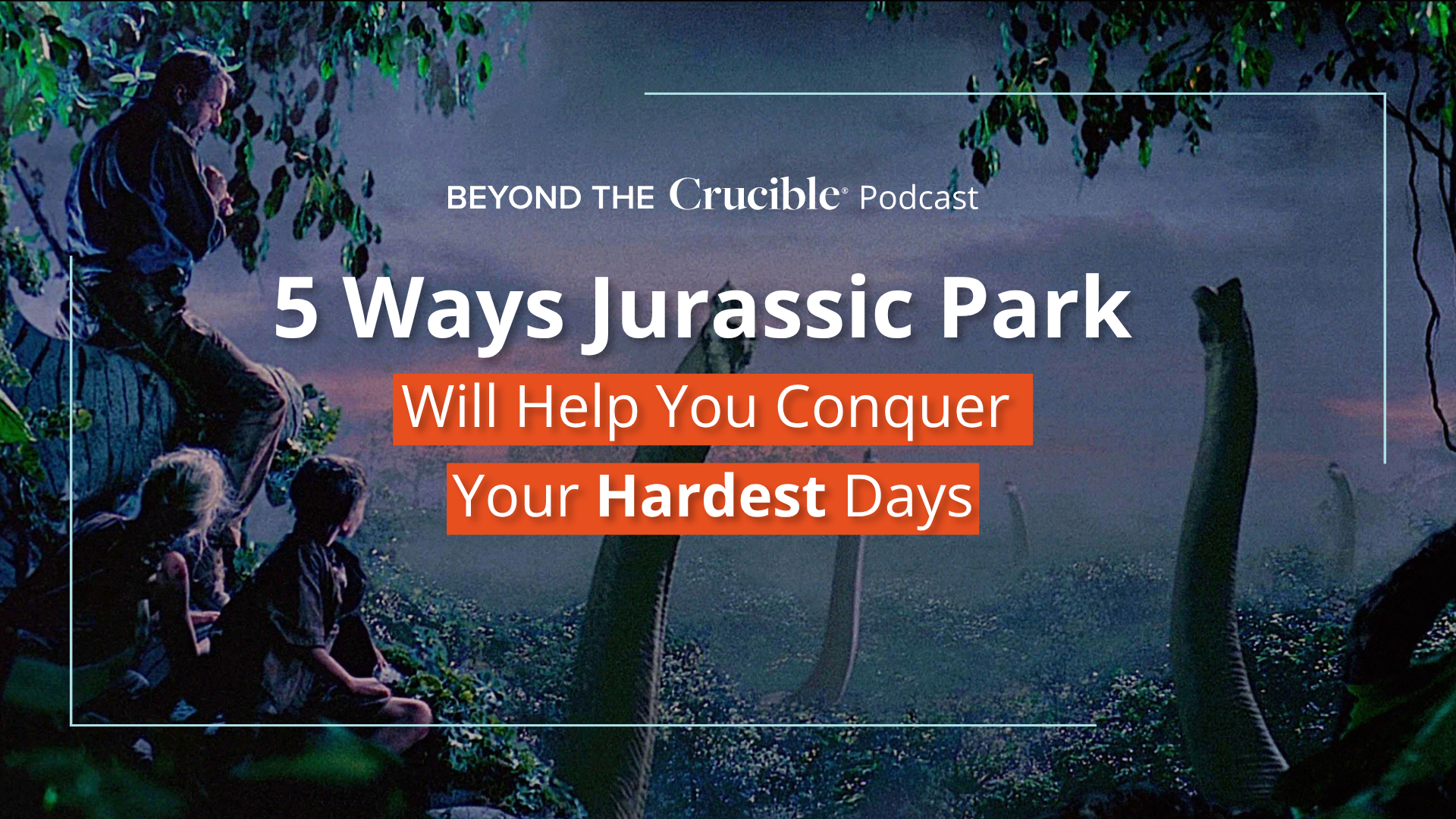
One quiet scene captures this perfectly. Safe for the moment in a tree while a peaceful brachiosaurus feeds nearby, Grant comforts the frightened children instead of focusing only on his own fears.
Crucibles reveal what truly matters. When life falls apart, accomplishments, titles and ambitions fade into the background. Relationships move to the foreground.
Warwick points out in the episode that one of the healthiest responses to hardship is to intentionally care for those around us, especially the people on our team, in our family or under our leadership.
Compassion doesn’t distract us from overcoming a crucible. It often becomes the best path through it.
Lesson 5: Growth means learning the lesson.
By the film’s conclusion, Hammond finally abandons not just the dream, but the reality, of Jurassic Park. Grant has grown into someone willing to embrace responsibility beyond himself. Sattler has accepted that humility must replace illusion.
No, not everyone changes. But those who do emerge wiser because they allow the crucible to reshape them.
Warwick reminds us in our discussion that painful experiences should never simply be endured. They should be examined. Sometimes they require us not merely to recover but to change direction entirely. Blind optimism, pride and denial only deepen our suffering. Honest reflection creates the possibility of transformation.
That’s ultimately the message of Jurassic Park. The dinosaurs may provide the spectacle, but the real story is about human character. Everyone who appears onscreen faces the same external crisis, yet their internal responses determine whether they grow, stagnate or perish.
The same is true for us. We can’t always prevent the unexpected from crashing into our lives. But like the survivors who finally escape Isla Nublar, we have a choice. We can deny reality, cling to control and let pride deepen the crisis—or we can embrace humility, care for others, adapt to changing circumstances and allow our crucibles to become the very experiences that shape us into wiser, stronger and more compassionate people.
That’s a lesson worth remembering long after the dinosaurs have disappeared from the screen.Reflection
- Have you ever struggled with minimizing a crucible? Why?
- Think of a time you faced a crucible and tried to exert control to get out of it. How did that work out for you?
- Think of a crucible you successfully navigated your way through. What lessons did you learn from it?
To explore Beyond the Crucible resources, including our free Trials-to-Triumphs Self-Assessment, visit beyondthecrucible.com.
Enjoy the show? Leave a review on your favorite podcast app and leave a comment at our YouTube channel and be sure subscribe and tell your friends and family about us.
Have a question or comment? Drop us a line at info@beyondthecrucible.com
—

Don’t forget to subscribe for more leadership and personal growth insights: https://www.youtube.com/@beyondthecrucible
Follow Beyond the Crucible on Facebook: https://www.facebook.com/beyondthecrucible
Follow Warwick on LinkedIn: https://www.linkedin.com/in/warwickfairfax/
Follow Beyond the Crucible on Instagram: https://www.instagram.com/beyondthecrucible
Take the free Trials-to-Triumphs Self-Assessment to discover where you are on your journey of moving beyond your crucible and how to chart your personal course to a life of significance: https://beyondthecrucible.com/assessment/