
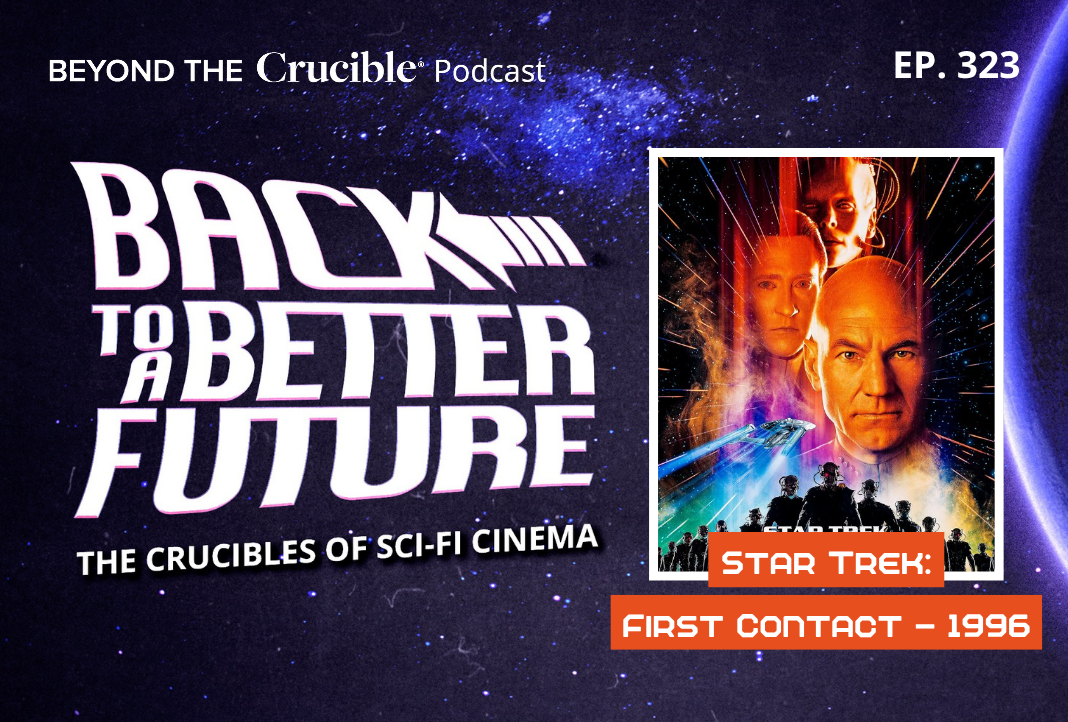
Back to a Better Future: The Crucibles of Sci-Fi Cinema VII Star Trek: First Contact
Heroes versus villains. The latter looking to rule the galaxy, the former looking to save it.
What happens when the leader who must save everyone is still carrying the wounds of his own trauma?
In this episode, we dive into Star Trek: First Contact as part of the seventh installment of our special summer series, Back to a Better Future: The Crucibles of Sci-Fi Cinema. Captain Jean-Luc Picard of the Starship Enterprise must lead his crew against the Borg. This very enemy once assimilated him, while fighting through the trauma that experience left behind. The stakes couldn’t be higher: the fate of the entire galaxy and the birth of warp drive hang in the balance. Picard’s journey is one of the most compelling crucible stories in all of sci-fi cinema, and the lessons it holds for anyone leading through unresolved pain are as relevant on Earth as they are in the final frontier.
Want to explore our three prior summer series about the lessons we can learn about overcoming crucibles from film?
Check out these playlists featuring every episode of each one:
LIGHTS, CAMERA, CRUCIBLES (2022): • Beyond the Crucible: Lights, Camera, Cruci…
CLASSIC FILMS, CLASSIC CRUCIBLE LESSONS (2024): • Classic Films, Classic Crucible Lessons: A…
BIG SCREEN, BIG CRUCIBLES (2025): • Back To A Better Future 2026
Have a question or comment? Drop us a line at info@beyondthecrucible.com
—
👉 Don’t forget to subscribe for more leadership and personal growth insights: https://www.youtube.com/@beyondthecrucible
👉 Follow Beyond the Crucible on Facebook: https://www.facebook.com/beyondthecrucible
👉 Follow Warwick on LinkedIn: https://www.linkedin.com/in/warwickfairfax/
👉 Follow Beyond the Crucible on Instagram: https://www.instagram.com/beyondthecrucible
👉 Take the free Trials-to-Triumphs Self-Assessment to discover where you are on your journey of moving beyond your crucible and how to chart your personal course to a life of significance: https://beyondthecrucible.com/assessment/



Transcript
Warwick Fairfax:
Welcome to Beyond the Crucible. I'm Warwick Fairfax, the founder of Beyond the Crucible.
One of the things that Picard and the Enterprise realize is it is critical that Zefram Cochrane launched this ship called The Phoenix, go and achieve warp drive, and make contact with the Vulcans. And it's also pretty clear that the Borg don't want this to happen. They're all about defeating the Federation and really anybody in their path.

Gary Schneeberger:
Heroes versus villains, the latter looking to rule the galaxy, the former looking to save it. This week in the seventh episode of our special summer series, Back to a Better Future: The Crucibles of Sci-Fi Cinema, we look at Star Trek first contact in which Jean-Luc Picard, the captain of the Starship Enterprise, must fight through the trauma of having been assimilated by the Borg, as he leads his team to a life of significance for the whole galaxy, ensuring the birth of Warp Drive.
How can understanding how Picard and his crew turn their trials with the Borg into triumph for all, on the side of the Federation, help us through our own crucibles? Stay tuned.
Welcome, friends, to another episode of Beyond the Crucible. You are dropping in toward the end now of our summer series. We do one every year, or at least we have for the last four or five years. And you've dropped into the latest episode of our summer series this year, which once again, you won't be surprised if you've been with other summer series for us. It's on movies. And the reason why it's on movies is we had so much fun when we focused our summer series on movies, Warwick and I have, over three of the last four years, that we want to do it again. Not only because it's fun, that's a big reason, but also because from movies, we can learn a lot about how to overcome, how to move beyond crucibles, and how to then to point yourself toward a life of significance.
And so, after spotlighting our first one of these series, we just did some hero movies, superhero movies, military hero movies, historical hero movies. Then we flipped to some of the best movies ever made, according to the American Film Institute. We talked about how the characters in those movies either overcame or didn't overcome their crucibles. And if you haven't heard that, go back, because in a couple cases, you can learn just as much about how to move beyond your crucible from those characters that don't do that in films.
And then, last year we did what I have called on a couple of occasions during this series, you've heard of Chock Full of Nuts Coffee. This was Chock Full of Crucibles. We did movies with lots of crucibles in them. And as those crucibles sort of barraged you, you could continue to learn from them and move on.
So Warwick, this year we're calling our series Back to a Better Future: The Crucibles of Sci-Fi Cinema. And I'm going to ask you this question, just first about movies, and then I'll ask you why this particular focus on movies.
But why are we back in theaters, this time around, to examine movies again for our summer series?

Warwick Fairfax:
Well, both you, Gary, and I, we love movies and it's very different looking at movies from Beyond the Crucible perspective. Typically, when you watch a movie, you got your popcorn and you're there to have fun and enjoy. And I'm thinking, gee, what can I learn from this movie to help me lead a better life? Life is significant to life on purpose, dedicated to serving others. Typically, movies portray a protagonist who is facing significant crucibles that they're seeking to overcome.
And as you mentioned, we've covered superheroes, sports heroes, and some of the movies from the American Film Institute's top 100 movies. And it's just fascinating, when you're looking at these movies, it's really crucibles in technicolor. They're enormous challenges, challenges often of character. And how are they going to overcome these challenges and become often a better version of themselves?
So it's really rich territory to look at how do you overcome the pit of despair and get beyond it and live a life of significance? And so, really movies are often a great way to learn some powerful lessons.

Gary Schneeberger:
Yeah. And one of the things that we've said as we've been doing this, and in fact, an episode before the series started, we talked about watching movies with Beyond the Crucible goggles on, because it's a whole different experience, as you said, than just watching movies with a bucket of popcorn in front of you. It's more than just entertainment. It's also encouragement and tips and action steps you can take to get beyond crucibles. That's why we're doing it this time.
And Warwick, you're doubling down on stuff you love here on this summer series, because as I said, it's called Back to a Better Future: The Crucibles of Sci-Fi Cinema. And you're particularly excited about that, because that is, science fiction movies are indeed a major love of yours. Why do you love science fiction films so much? And what about them is particularly resonant about this discussion that we're having about looking at movies through Beyond the Crucible goggles?
What happens generally in science fiction films that goes to the topic we're discussing?

Warwick Fairfax:
So since I was very young, I have always loved science fiction in books, movies, TV shows. I think one of my earliest memories was going to see one of the most influential science fiction films ever made, 2001: A Space Odyssey. It came out in 1968. What I really loved about this movie was just the way you saw future technology. You saw space shuttles with screens on the seats in front of them where you could watch a movie, which of course you can now, not necessarily on space shuttles, I'm afraid, which they don't have anymore, but you can on planes. But it didn't exist back then. There was video conferencing.
And what they did so well is they put brand names. So at the time, AT&T was Bell. And so you had Bell Teleconferencing from whatever, I think it was a space station that the hero was in. He was just talking to his family. I think his young daughter had a birthday. So they just made it seem so real with future technology, with brands that everybody was familiar with.
And I was also a fan of a lot of science fiction shows, including the original Star Trek. And maybe we'll talk about that.

Gary Schneeberger:
Good foreshadowing as always work. Good foreshadowing.

Warwick Fairfax:
And I was also a great fan of some of the classic science fiction novels, Arthur C. Clark and Isaac Asimov. In fact, Arthur C. Clark wrote the screenplay for 2001: A Space Odyssey.
And so, what I loved a lot about science fiction is yes, it explores future technology, but at its best, great science fiction, whether books written by Arthur C. Clark or Isaac Asimov, or indeed in the Star Trek TV series, they explored deep societal issues about, what is the future of the human race and how will it interact with other forms of life? And what's the role of AI?
One of the things about the original Star Trek series, it provided a medium in which issues that were really forbidden to be discussed in the '60s could be discussed. You had a white man, Captain Kirk kissing a Black woman, Uhura, who is a communications specialist. That is not something, in '66, '67, whenever that episode came out, it was pretty controversial. A lot of parts of America, unfortunately. And you even had a classic episode in which you had a race that was on an alien planet that was half white and half black on their faces. And, the only difference between the two races was which half was white and which was black.
And so, when Captain Cook said to the leaders of one of the races, "You folks, they're so similar."
He said, "What do you mean? We're totally different? It depends on which side of the face is white or black."
It was making a mockery of racism in a very clever way. So science fiction at its best takes on issues, sometimes before we're really willing to face it. So that's some of the reasons why I love science fiction.
And science fiction, certainly you see very significant crucibles. Often we're talking about the future of the galaxy, the future of the human race. Can humans survive? Will humans, as they expand across the galaxy, be a force for good or not? Will technology get to the point where it will control humans? That is prevalent throughout a lot in science fiction, including Terminator, which we talked about earlier this summer.
So, that issue of technology, which now we have AI and people are wondering what are the ethics of AI, and will AI get too powerful? So a lot of the issues that we face are covered by science fiction.

Gary Schneeberger:
Yeah. And this week, in episode seven of the series, we're looking at a movie... It's kind of like having kids. I wouldn't dare say that this movie is your favorite among the ones we've talked about, because all of them are your favorites. You like them all. But this one, let's say this, and you'll unpack this in a bit. You understand you're truly a student of this universe. And that is the movie that we're talking about. 1996's Star Trek: First Contact.
The second big screen movie to feature the cast of the TV series, Star Trek: The Next Generation. That's the second TV series that came after the original Star Trek that Warwick was talking about. And here's the summary of the movie. One of my favorite parts of the show. I'm going to miss it when after next week I can't do it again for another several months.
But this is what the Hollywood film industry calls the log line of a film. It's the most concise recitation of what the plot is about. Here's the log line for Star Trek: First Contact. When the cybermetric Borg traveled back in time to 2063 to prevent Earth's first contact with an alien species, Captain Picard and the crew of the Enterprise must follow them to the past, fighting to save both the timeline and the future of the Federation.
Oh my goodness, there's so much stuff in here. There's time travel. There's bad guys and there's bad space guys. There's lots of good stuff in here. So let me ask you this question as we start off, Warwick. But, before we get into this movie though, you're a big fan of Star Trek as I intimated, and particularly Star Trek: The Next Generation. Talk a little bit about why that is, because I think it'll help people understand why you're going to be able to pluck so many lessons out of this for moving beyond your crucible.

Warwick Fairfax:
Yeah. As we've discussed, I am a big fan of science fiction, but of all the science fiction genres and series that there've been, I've always been a huge fan of Star Trek. That may be one of, if not my most favorite genre of all the different iterations that we have in science fiction.
And Star Trek, the original series, it began with the vision that Gene Roddenberry had and the series ran from 1966 to '69. Kind of fun fact is, pretty much every studio in Hollywood turned it down. But it turned out that Lucille Ball, of I Love Lucy Fame, she had a studio called Desilu Studios after, I guess, her and her husband, Desi Arnaz.
And so, every studio out there turned it down, but Lucille Ball saw something in this. And despite some of her organization saying, "I'm not really seeing it," she kept saying, "Yes, yes, yes. We are going to fund this. We're going to make it."
And so, obviously without Jude Roddenberry's vision, there wouldn't be Star Trek, but without Lucille Ball, we wouldn't have Star Trek, because nobody would provide the funding or produce it. Gene Roddenberry created this world where there was a benevolent organization called the Federation. And their mission was to explore new worlds. As they say in their opening of Star Trek, to bravely go where no one has gone before.
And so, this mission of exploration in this world, there wasn't money, there wasn't poverty. There was a sense of altruism in which people were working together to benefit all of mankind, and indeed other alien races.
Now, yes, there were malevolent cultures that really didn't have the same vision. And in various iterations of Star Trek, we had the Klingon, the Romulans, and especially the Borg, which we'll get into here. So yes, there's conflict, because their mission is to protect the Federation and all of the planets that aligned with them against evildoers that want to destroy their way of life. So yes, even benevolent organizations do have to defend themselves. The Federation obviously does.
For a science fiction fan like me, who loves thinking about future technology, but also a better world, a better society where people are honored, treasured, where excellence is rewarded, where really you can achieve your dreams with work and vision, Star Trek was certainly enticing. And just to give you an idea of what a Star Trek fan I am, other than some animated series, which I've not really watched, but all the live action series, I have pretty much watched every episode of every series dating back to when it first came out in the '60s and then reran in Australia where I'm from in the '70s.
So that means I've watched the original Star Trek, which as we mentioned, went from like 66 to 69. Star Trek: The Next Generation that went from 1987 to 1994. Deep Space Nine, Voyager, Enterprise, Discovery, Picard, Strange New Worlds, and Starfleet Academy. That's a lot of Star Trek.
And in fact, there were also six films made with the original cast and four with Star Trek: Next Generation. I've seen all of those.
Now, one of the interesting things is that, of all the Star Trek iterations, probably my favorite, I'd say definitely my favorite is Star Trek: Next Generation. And you might wonder why, because they all have the same vision. It's the Federation. It's an altruistic organization. The central meme of all of them is the same. But in Star Trek: Next Generation, you have this Shakespearean trained English actor, Patrick Stewart, playing Captain Jean-Luc Picard.
Now, Captain Picard is actually meant to be French, although it's played by Patrick Stewart in a very English way. He doesn't even pretend to put on a French accent.

Gary Schneeberger:
Right. Exactly.

Warwick Fairfax:
Exactly. But you see in earlier episodes of the series that his family have a vineyard somewhere in France and all that. But what I like about Captain Picard is, in some ways, he reminds me of my father because you see in earlier parts of the series that he is an amateur archeologist, extremely well-read in history and philosophy. And he's a very intellectual, very erudite man, but also a man of action. He is very considered, he's loyal, he listens to input from his crew. Most of the time, he's a very rational, caring, thoughtful person.
And as a part of that, sort of intellectual person that he was, he was open to input and open to understanding different perspectives that reminds me of my father was also some intellectual, but loved to learn, and love to dialogue with people who had different political or even theological views than himself.
There's an element of Patrick Stewart and Captain Jean-Luc Picard that reminds me of my father. Obviously, my father wasn't a starship captain or a man of action. He was very much the philosopher type. But that being said, I've always felt some sort of a kinship with Captain Jean-Luc Picard. So all that's to say is, I'm definitely a huge fan of Star Trek, in particular Star Trek Next Generation.

Gary Schneeberger:
I've known since we've worked together, Warwick, that you are a graduate with an MBA of Harvard Business School. I did not know until right now that you also have an MSFA, a Master of Science Fiction Arts from Starfleet Academy. I did not know that till just now.

Warwick Fairfax:
Absolutely. And in fact, I have that piece of paper in a frame in my office, Starfleet Academy.

Gary Schneeberger:
We'll have to catch a glimpse of that at some other time, but we have a full agenda here, because there's lots of good tips and action steps about overcoming crucibles that we can get to here in Star Trek: First Contact. So let's start out here.
One reason that this film resonates so deeply is that, beneath its action in science fiction and all those things that you talked about, right? It's really a story about people facing crucibles, trauma, loss, fear, obsession, questions about identity. And we'll touch on all of this as we get through the film, but let's start at the beginning, which is a good place to start, right? That's why it's called the start, because you begin there.
Captain Jean-Luc Picard awakens from a nightmare in which he relives the assimilation of the cybernetic Borg six years earlier. What is that nightmare about Warwick, and how does it affect the captain?

Warwick Fairfax:
So as the movie opens, we see Captain Jean-Luc Picard, he's reliving a nightmare in which he was assimilated by the Borg six years earlier. And this is arguably the toughest time of Picard's life, the most searing crucible. So, in the TV series, Star Trek: Next Generation, Picard was captured by the Borg and was made into one of them. Now the Borg are this half human, half machine creature, and the Borg operates as a collective. So that means you lose all individuality.
It's sort of like a hive mind, almost like bees. And you have no self-control. You're almost like this drone in which you're all operating as one unit with one will. And he was renamed Locutis of Borg. And of all the things that could happen to you in science fiction, this is one of, if not the scariest, because not only do you have no individuality, and no control over what you did, in the case of Captain Picard, he was one of the premier Starfleet captains of Starfleet. That means his collective knowledge of the weaknesses and strengths of Starfleet was prodigious. And the Borg used all his intelligence and all his experience to great effect, meaning that Captain Picard ended up killing enormous numbers of humans on behalf of the Borg. I mean, enormous numbers and caused huge damage to the Federation and different planets.
And so, somehow there are a few worse crucibles that you can have, is losing all sense of self and being forced to do despicable things against your will. So somehow you hope others will forgive you. And then somehow you have to forgive yourself. And you could say, "Well, I had no control," but somehow that doesn't hold a whole lot of water. It's like, "Yeah, but I still did it." Surely there was a way I could have broken free, which in the case of the book, there really is not. There's nothing you can do. There's no way out.
So, just emotionally feeling that there's something I could have done. Somehow it is my fault. It was searing. He ended up being rescued by his crew, but without being rescued, he would never have escaped. Despite him being a courageous, very strong person, you can't escape the technology and what they do to you. So it was just a horrific experience that was absolutely traumatic and was searing.

Gary Schneeberger:
It's very interesting that you talked about Picard's collective knowledge of things. And you talked then, right before that, you talked about the Borg as a collective. It's interesting, they have a guy who has a lot of... They want to capture him because he's got a lot of varied information, and they want to absorb him into this place where everybody's sort of got the same kind of information. Is that a sort of a decent assessment of what's going on here?

Warwick Fairfax:
Absolutely. We'll see later that the Borg talk about, resistance is futile. You will assimilate your culture, your intelligence into our own, so that we can better achieve perfection. It's this twisted ideology that sounds almost attractive. Who's against striving for perfection? Who's against assimilating other cultures to better our own?
Now, you could do it in an altruistic sense, in the time we live in, of learning a new language, living in a different culture so that you can better improve your own culture and your own way of thinking. That's not wrong, but the way the Borg do it is, it's not voluntary. They compel people, they force people. But they believe what they're doing is right. We're just achieving perfection. And the cost of perfection is, we assimilate you. We make you a higher evolved self than you were before. We're doing you a favor by assimilating. They're this weird ideology that they actually believe in. It's just scary.

Gary Schneeberger:
Well, and that's what makes what happens next in the film scary. Picard is contacted by Starfleet, which informs him of a new Borg threat against Earth. But they don't want him to combat that threat. Starfleet does not.
Warwick, many people who've experienced a crucible struggle with how others view them afterward. What can we learn from Picard's reaction to being sidelined because of his past? Because that's really the reason why Starfleet doesn't want to send him into battle, right?

Warwick Fairfax:
Absolutely. So given Picard's history with the Borg and having been assimilated and causing a lot of damage to Starfleet when he was one of them, in a sense, it's understandable why they didn't want to send Picard in. But it must have been very frustrating because Captain Picard is thinking, "I know the Borg better than any human. I know their weaknesses. I know their tactics. I, of all people, should be sent in and my crew of the Enterprise to combat the Borg. And the Borg are heading towards Earth. And Starfleet is sending many ships to fight the Borg. And it must have been so frustrating because the Enterprise is one of the top ships and technology and crew in all the Starfleet. How can you not send your best ship or arguably your best ship and your best crew? But Picard, while he deeply resented it and was frustrated, he did understand it.
Doesn't mean he agreed with it because Starfleet, from his perspective, did not have confidence in Picard's ability to tackle the Borg because he'd been assimilated by them, which he said introduced an unstable element that was not predictable. So he could coldly analyze and say, "I understand why. I don't agree, but I get it." But clearly he disagreed and obviously would feel put down by this, would feel like, okay, they don't have confidence in me. Surely I've proven in the six years since my ability to tackle the Borg and be a top-notch staffly captain, but it was frustrating. So I think the broader point here is sometimes we've gone through crucibles. Others may doubt our ability to face similar challenges again. I've seen what he or she has been through and I don't think they can tackle that again. I think they'd probably knockle under, they'd lose.
So I'm not going to put them in that situation again because I don't think they can hack it. And that may be right or wrong, but if you are that person where somebody in authority says, "I'm not sending you in because I don't think you can take it. I don't think you just cry uncle." You're not going to feel like, "Oh, of course I understand." You'll be thinking like, "No, no, no. I'm beyond that. Put me in, coach. Let
Me get in there. I can take this thing on. I'm not going to buckle." And when they don't listen to you, it's like, well, they don't have confidence in me. They don't trust me. I'm forever defined by my worst day because people don't have confidence in me not to fail again or buckle under again. It's humiliating, frustrating, and it certainly makes you feel put down and less than. It may be understandable, but it doesn't feel understandable to you. You feel like they don't trust me. Am I going to have to live my whole life based on that crucible? Won't anybody ever give me a chance again? To give me a break, give me a chance. That's what Captain Picard is thinking.

Gary Schneeberger:
Yeah. Well, and he gets a chance. He kind of seizes a chance because plans change when the Enterprise learns that the fleet, Starfleet, is losing the battle against the Borg. So, what do Picard and his crew then do to change what Starfleet has said they should do?

Warwick Fairfax:
Yeah. So Picard finds out that the fleet, they're not doing well, and the Borg is winning. Picard has specific instructions, don't enter the fray, don't enter the battle. But his sense of duty and obligation to fight the Borg is so paramount that, look, I can't let them win. The fleet is losing. They need the Enterprise. And he's thinking, "I know more than anybody how to fight the Borg and their weaknesses." And that proves to be, certainly in some ways, true.
So then being a smart man, a man of honor, he asks the crew whether they're willing to come with him because he's asking the crew to violate orders. That is not a small thing that could affect all of their careers. And the crew is of course united and says, "Let's go. We're with you." Which is very heartwarming. So, Picard enters the fray. He feels like Judy calls him to battle and he heads towards the Borg that are near Earth.

Gary Schneeberger:
Yeah. And then the Borg cube launches a smaller spherical ship towards Earth before being destroyed. That leads to a major crucible for the crew with major implications for the future, doesn't it?

Warwick Fairfax:
Absolutely. So here we have the Borg cube, which is very common. The Borg ships are in this cube shape. Now, Picard, he has extensive knowledge of the Borg and their weaknesses. So he finds a way to destroy the cube. He says, "Okay, target this particular sector of the cube."
And the crew was saying, "But that seems like it's a non-essential, non-critical part of the ship."
Well, somehow Picard, obviously, because of experience, he knows their weaknesses, and it proves to be by firing at that particular spot on the cube, it destroys them and destroys the Borg cube. But as you mentioned, not before this spherical ship leaves the cube and it hurdles towards Earth, but then this spherical ship, it may And it is to create a temporal vortex, which enables time travel. You see, the Enterprise is caught in this vortex wake and it has the ability to follow, but before it enters this temporal vortex, we can see that this Borg spherical ship, it has changed time. It has changed history. And we see that the present Earth is now being assimilated and is all Borg. There are no humans on the planet, only Borg.
And so, Picard realizes what has happened. They've gone to the path to change the future, and they have changed the future. So Picard and the Enterprise followed the Borg through this temporal vortex. And they're now in the past, they end up around Earth of 2063, and their time is the 24th century. And so in 2063, as we're told, this is 10 years after the Third World War where 600 million people died on Earth and major cities were destroyed.
So, we happen to see a colony in the woods of central Montana. And Picard and the Enterprise's mission is clear that they're in the past to stop the Borg changing the future and turning Earth into a Borg colony.

Gary Schneeberger:
Yeah. And the crew does a good job at figuring out the Borg plan. What is that plan, and what critical historical figure in the Star Trek universe does it involve?

Warwick Fairfax:
Yeah. So, obviously part of the plan is to change the future and ensure that Earth is a Borg colony. But there's another part of that Borg plan, and that is to stop a man by the name of Zefram Cochrane. And he, back in 2063, is about to launch a ship called the Phoenix and achieve warp drive. Now, warp drive in the Star Trek universe is faster than the speed of light travel. So you'll hear in various iterations, you'll say, okay, let's warp seven, warp 9.9, you can't go faster than warp 10. So that means multiples of the speed of light.
So, one of the interesting things in the Star Trek universe, there's a thing called the prime directive, which means that Federation cultures and planets, and certainly Starfleet, should not interfere with civilizations that are of pre-warp technology. So they might have steam engines, they might have cars, radios. It depends on the level of progression of their culture. But if they don't have warp drive, they're not meant to interfere with their culture and they're meant to just let it evolve on its own. That's one of the hallmarks of the Starfleet belief system.
So, in history, when the ship called The Phoenix is launched by Zefram Cochrane and achieves warp drive, a species known as the Vulcans, which it is very logical culture, they're flying by in their spaceship. When they see a ship with warp drive, now it's okay for them to make contact, because now this is a post-warp culture, post-warp civilization.
And so, in history, they do make contact, and that contact with Earth back in 2063 completely changes the trajectory of Earth culture. And so, one of the things that Picard and the Enterprise realize is it is critical that Zefram Cochrane launched this ship called The Phoenix, go and achieve warp drive and make contact with the Vulcans. And it's also pretty clear that the Borg don't want this to happen. They're all about defeating the Federation and really anybody in their path.
Not only do they want to assimilate Earth, they want to make sure the Federation never exists. It's hard to believe the Federation staff would exist without Earth of 2063 making contact with the Vulcans. So it's really twin objectives from the Borg. Assimilate Earth, and making sure that Zefram Cochran's flight that achieves warp travel never happens.

Gary Schneeberger:
Yeah. And it's common in time travel movies, and we saw it when we did Back to the Future. Marty McFly leaves 1985, goes back to 1955, and his mom is not the same as she was in 1985. So, when you time travel, it's not uncommon to run into people who aren't exactly who your timeline tells you they are. And the Zefram Cochrane that the crew meets is not the hero that they studied in school. Here's a clip from the film that spotlights the differences in who he really is and who they know him as. Let's take a look and listen to that clip now.

VIDEO CLIP:
Only got an hour to go, doc. How you feeling?
I got a four alarm hangover, either from the whiskey or your laser beam, or both. But I'm ready to make history.
Joint Commander Riker.
Riker here.
We're ready to open the launch door.
Go ahead.
Oh, look at that. What, you don't have a moon in the 24th century?
Sure we do. This looks a lot different. There are 50 million people living on the moon in my time. You see Tyco City, New Berlin, even a Lake Armstrong in a day like this. And you know, doctor, Zefram-
Please, don't tell me it's all thanks to me. I've heard enough about the great Zefram Cochrane. I don't know who writes your history books or where you get your information from, but you people got some pretty funny ideas about me. You all look at me as if I'm some kind of saint or visionary or something.
I don't think you're a saint, doc. If you did have a vision. And now we're sitting in it.
You want to know what my vision is? Dollar signs. Money. I didn't build this ship to usher in a new era for humanity. You think I want to go to the stars? I don't even like to fly. I take trains. I built this ship so that I could retire to some tropical island filled with naked women. That's Zefram Cochrane. That's his vision. This other guy you keep talking about, this historical figure, I never met him. I can't imagine I ever will.
Someone once said, "Don't try to be a great man, just be a man, and let history make its own judgments."
It's rhetorical nonsense. Who said that?
You did, 10 years from now.

Gary Schneeberger:
So Warwick, what impact does that scene have on Cochrane moving forward? Because it shakes him up a bit, and puts him on a different trajectory.

Warwick Fairfax:
Yeah. Well said. It's interesting that sometimes our heroes don't measure up to the image we have of them. If we could go back in time, sometimes we'd say, "Huh, that's not what I read about." Well, maybe it depends when you saw them.
I'm reminded of young Washington and we spoke to one of the screenwriters, Dietrich Hogestratten. And if you went back in time to a young Washington in the 1740s, 1750s, I think one of the things you would see is somebody that had character, but was really not the great man that Washington became. He'd suffered defeats, humiliation. Nobody had a whole lot of confidence in Washington, be it the British army that he was at least attached to, being in the Virginia militia, or indeed his fellow soldiers in the Virginia militia.
But by the end of the movie, he's a different person. He has achieved some success. He has courage. So it depends.
At one point we sort of go back and see and make contact with our heroes. So in the case of Zefram Cochrane, yes, in the future he was considered a hero. There's a big statue of him erected on the spot in Montana where the action takes place when we're on the planet Earth. And one of the crew members on Starfleet Enterprise mentions that his high school was Zefram Cochrane High School.
And so, this all kind of weirds out Cochrane. And in an earlier scene, we see him just run off. He just doesn't want to be any part of this hero worship. And in this clip, we see him talking to William Riker, who's the first officer of the Enterprise. And he says, he's just tired of hearing about the great Zefram Cochrane. He says, "You all think I'm the saint or visionary. You got it all wrong. I mean, it's all about money for me. It's not about humanity. I don't even like to fly. I want to get rich so I can retire on some beautiful island with a whole bunch of women." That's the vision. Okay. That's it.
And, in this last part of the clip, Riker quotes somebody and the quote says this: "Don't try to be a great man. Just be a man and let history make his judgment."
And Cochrane says, "That's rhetorical nonsense. Who said that?"
And Riker says, "You, 10 years from now. It's your words." And so, I think Zefram Cochrane is being a bit harsh with himself. He says, "Look, I'm not a visionary. It's all about money." And while there's truth to that, I bet deep down there is at least a grain of a greater man in there, a grain of somebody that does have this great vision. I mean, achieving warp drive is an amazing thing that will benefit humanity. You can explore other planets in a way that's just not possible with pre-warp power.
So, I have to believe there were some good motives, even if there were just a few. And so, sometimes we undersell ourselves and say, "I'm not that great. It's all about me. There's nothing virtuous, nothing good about me."
And maybe that could be largely true, but maybe there's a grain of humanity, a grain of a desire for life of significance, a life on purpose dedicated to serving others. Sometimes we undersell ourselves, as we'll see. Sometimes it requires help from others to help us see our true selves, but sometimes we're actually better than we think we are. We're not as bad as we really think we are. So that's one of the interesting elements of looking at Zefram Cochrane here in this clip.

Gary Schneeberger:
Yeah. One of the things about his backstory I thought is interesting in light of what you just said, is that he likes to drink a little. Oh, okay. He likes to drink a lot. And with my background of having been an alcoholic, I learned the lesson that, why do you drink? Well, it's not how much you drink that makes you an alcoholic. It's why you drink.
And one of the reasons that I drank, main reason was to change the way I felt. And I wonder if Zefram Cochrane doesn't have some of that in him too, that this sort of devil may care, drinking too much guy, is trying to make up for something that he feels is missing from him. Maybe that's bad psychoanalysis. I don't know, but it seems like it might fit.

Warwick Fairfax:
Yeah, it's so well said. So we see in early scenes where he's drinking, and he's got his favorite cheer on the jukebox, and sort of this basic kind of nightclub out in the woods in the wilds of Montana. And he might be trying to escape from himself thinking like, "I'm not that great," and this whole thing won't work. We lived in this post apocalypse Earth in which civilization has been largely destroyed. The cities are being destroyed. And there are factions that we hear that are all around the place attacking each other. It's not a particularly fun or pleasant place.
So, he's got to live in a world which is a shred of what it used to be where there could be factions all over the place, and his vision may come to nothing. So there are reasons why he might kind of dislike himself, dislike the world, and wants to drink to escape all of these thoughts about the dangers of the world, the destruction of much of humanity and him feeling like, "I'm just not good enough. What me? I'm a loser. I'll never amount to anything."
So yes, it's understandable in some ways why he takes to drink. It's very sad, but yes, we can guess about some of the motives behind it.

Gary Schneeberger:
Yeah. All right. Let's go back into the film. Back on the Enterprise. A group of Borg invade the ship's lower decks, assimilating some of the crew and modifying the ship. So these guys don't just assimilate and modify people. They assimilate and modify things. They're modifying the ship. What did Picard and his crew do next, and what happens to them?

Warwick Fairfax:
So, soon after the Enterprise travels back in time, they're following this Borg spherical ship. And the Enterprise destroys the Borg ship. So you think like, okay, danger over, the Borg have been defeated. We've still got to make sure that Zefram Cochrane takes off in a Phoenix and achieves warp travel, but at least one out of two parts of this mission accomplished.
Well, not so fast. So it seems that somehow the Borg had managed to sneak into the Enterprise and take over part of the crew and part of the ship. And one of the early clues to this is, when one of Picard's senior crew, Warf, tells Picard that the humidity and temperature have risen on the ship. And he quotes him exact numbers. Well, Picard is an expert on the Borg, obviously. And he knows that the humidity and the temperature that have changed on parts of the ship is exactly what the Borg like. That's what they need to flourish in.
So at that point, Picard realizes something is instantly wrong. He happened to be on Earth in the colony in Montana, because he's trying to make contact with Zefram Cochrane. So at that point, he instantly comes back to the Enterprise, and he knows that the Borg is somewhere on the ship.
So the Borg, we learn, have assimilated much of the Enterprise, including up to half the crew. And they've occupied a number of decks, including engineering. Meanwhile, the Borg is assembling a communications array on the outer hull of the ship. So Picard realizes that what they're trying to do is they're trying in the past to communicate with the Borg that then live at the time. And they're trying to summon their fellow Borg to help them conquer Earth.
Now we learned that the Borg are in the Delta Quadrant, which we know from other Star Trek series is, I don't know if it's a hundred light years away, it's a lot of light years away. Basically it would require, I don't know if it's 50, 100 years, generations to come to Earth, but the Borg, they don't really think about time the way we do. So it may take a while for the Borg in the Delta Quadrant to come, but what will happen is humanity will face the Borg hundreds of years earlier than they were ever meant to. And before they could even be remotely prepared to take on the Borg.
So clearly this is an enormous threat. And so we have Picard, Warf, and another crew member, they've done spacesuits and they're on the outer haul of the ship, and they attempt to stop the Borg assembly the communications array and then communicating with their fellow Borg all the way in the Delta quadrant.
So fortunately they do manage to destroy the communications array. And so that's one part of the mission solved. But meanwhile, we see that Commander Data, who's one of the key members of the crew, has been captured by the Borg. And somebody that we see is the Borg queen, somebody who's in charge, in one sense, of this collective. It's a bit strange because the Borg, they don't have any leader because they're a collective, but yet the Borg queen seems to be in charge. That's a bit of a hard to understand.

Gary Schneeberger:
Well, think of Russia in World War II. They were a commune, right? And they had Stalin. So I think that's not unheard of.

Warwick Fairfax:
Yeah. Well, we're all equal except when we're not.

Gary Schneeberger:
Exactly. Exactly.

Warwick Fairfax:
So one of the interesting things about Data, which we know from Star Trek Next Generation series, is he's an android. He is a machine. Now he's a highly evolved machine. And in most cases, he doesn't have emotion much like Spock in the original series, Star Trek series who is Vulcan and doesn't have emotion. But Data is a machine and Data has always wanted to be human. He's always wanted to understand what it is to have emotion and empathy. And that's in his own way, he's tried to become more human.
So Data is captured by the Borg queen. So the Borg queen, she's trying to get Data to give over the encrypted computer codes of the ship, which will then allow her to have total control. And she does everything to tempt him, seduce him. I mean, she's a very clever enemy. She knows that Data wants to be human. So she kind of finds a way to graft human skin onto part of Data's arm so that he can feel like her breath over the hairs of his skin. It's just a weird thing. She's doing whatever it takes to seduce him, to control him, to get from him these computer codes. She's very evil, but she's very smart. So it's a scary, scary situation that Data finds himself in.

Gary Schneeberger:
Yeah. And it starts to get scarier for everybody else too, because the Borg assimilate more decks of the Enterprise. As they do so, Warf suggests destroying the ship. And Picard angrily calls him a coward.
Picard is still rendered wobbly by his earlier encounter with the Borg, isn't he? It seems like he's triggered by his previous encounter with the Borg when the stakes for the Borg continue to get higher. And he calls out someone who's been a loyal crew member to him as a coward. Talk about that a little bit.

Warwick Fairfax:
Yeah. So here we have the Borg that keep assimilating parts of the ship, including many crew members. And, it seems that there is no way that they can stop the Borg. And so, at this point, the smart play is to abandon the ship, escape in escape pods, and destroy the ship so that the Borg can't get hold of the Enterprise because then they don't have their own ship anymore. The spherical ship has been destroyed. But if they get control of the Enterprise, then they can more easily take control of and conquer Earth. If they destroy the Enterprise, then they'll destroy the Borg. It seemed like that's a logical play, is to destroy the ship.
But Picard, he does not want to be defeated by the Borg. He sees in some sense destroying the ship as admitting defeat. And he remembers how, in a sense, they defeated him six years earlier when they assimilated him.
And so, he starts acting angrily, irrationally, and in a very mean, cruel way that's completely unlike the Captain Picard that we've known and loved throughout the movies and the TV series. And so, when he says that Warf is afraid and calls him a coward, that is a searing thing to say because those who know the original TV series, of The Next Generation, they'll know that Warf is a Klingon. And that is a warrior culture, that prides itself on courage and honor, and sacrificing yourself and your comrades. To be called a coward is the worst possible thing you can call a Klingon.
And so, when Picard calls this elite warrior a coward, it's like saying to a Navy SEAL, or some other elite warrior about times that they're a coward. Now they'll probably just laugh and think you're an idiot. A Klingon is going to kill you for that without even thinking, such is the pride they have in being a warrior.
And so what's really unfortunate to hear is Picard knows how damaging what he's saying is. And in that moment, he doesn't care. So he's thinking, "What's the most hurtful thing I can possibly say to my friend?" And he picks a good one. It was a very hurtful thing to say.
And Warf says he will kill any other man for saying this, but such is Warf's loyalty, and frankly love, of Captain Picard, that he doesn't do what he would do to any other living being. He would kill him on the spot, but not Captain Picard.
All that's to say is Picard is not acting rationally. All his senior crew know that the right decision is to destroy the ship and stop the board getting control of it. But in his rage, Picard cannot see straight. He cannot think straight. He's acting completely irrationally against the interest of his crew and against the interest of the very mission that he's there for, which is to destroy the Borg. He's acting irrationally in every possible way.

Gary Schneeberger:
Yeah. And he's also, in a very real sense, he's crossing a line from courage to obsession. And that's an interesting point to sort of broaden out to our listeners and viewers. How can people recognize when determination has become something destructive? What are the warning signs that our crucible as starting to control us instead of strengthening us? What finally snaps Picard back out of it when he finds himself in this situation?

Warwick Fairfax:
Picard is obsessed with not letting the Borg win. He can't stomach the thought of the bog getting control of his ship. And he somehow sees destroying the ship as letting the Borg win, which it's really not. Destroying the ship means the bog lose because they get destroyed, but he can't think straight. And so he just doesn't see it.
And so, his way of thinking makes no sense, but it's all fueled by rage and anger. I think what that says more broadly is, when we're filled with rage and anger. There is pretty much zero chance that we're going to make good and rational decisions. And we're also very likely to hurt those that we love and those that we work with, friends and family, everybody.
And so, we see Picard, he goes to his office just on the side of the bridge called his ready room. And someone from the colony, Lily, who happens to be on the Enterprise at this point, she enters Picard's ready room and she takes Picard on.
I mean, everybody else is just like, when Jean-Luc Picard is like this, there's no talking to him. They just realize, he's our boss, he's the captain. He's spoken. It is what it is. But not Lily.
So Lily says that everyone is saying to you that fighting the Borg is suicide. And Picard tells her of his assimilation six years ago, and says that he knows how to fight the Borg. And Lily says, "I get it. The Borg hurt you and you're going to hurt them back, almost like a kid. That guy hurt me. I'm going to hurt him back." Just this almost childish reaction that she's really calling him out on.
And Picard says in his century, they are beyond revenge. And Lily calls him on this and says, "I mean, that's rubbish." She says in effect, it's about revenge. She doesn't buy it for a second. She doesn't know Picard, but she knows somebody that's just not being honest with themselves.
And so, then she really uses an image, which she has no way of knowing is brilliant with Picard because he's a very well-read person. And she says that Captain Ahab has to go hunt his whale. And Picard knows exactly what she means. This is all from the book Moby Dick. And he says, "It's not about revenge," which is of course what Captain Ahab is all about, "It's about saving the future of humanity."
And Lily yells at him and says, "Liar." She calls him out on it in the strongest possible way. You are lying to yourself, basically. And Lily tells him to blow up the ship.
This really gets to Picard and he just smashes the glass panel near him where he's got all the models of model ships. And he says, "We've made too many compromises. Not again, the line must be drawn here." He'll make them pay for what they've done.
And Lily begins to leave and says, "See you around, Ahab. Again, a very neatly timed barb, calling him Captain Ahab. And Picard begins to recite lines from Moby Dick, realizing that what Lily says is very true. And so he says that Ahab spent years hunting the white whale that crippled him, but in the end, it destroyed him and his ship. Lily said that Ahab did not know when to quit.
The message has got to Picard. He understands the image. And so Picard then goes to the bridge, and he says to his senior crew that they'll evacuate the Enterprise, and they're going to start the 15-minute order destruct sequence for the ship. And then Picard goes to Warf and apologizes, and says that Warf is the bravest man he's ever known. Clearly Picard deeply regrets what he said to Warf. And because Warf has a deep admiration, and indeed love, for Picard, he accepts the apology. Not an easy thing for Klingon to do when you've been called a cow. That's not something you kind of move on from, pretty much ever, but such is the depth of their relationship.
So I think what this shows is sometimes we can act irrationally, because we are triggered by a painful memory of a past crucible. And in those circumstances, it is not easy to think clearly and to think rationally.
And it's certainly not easy to make good decisions. Sometimes in the midst of being triggered by a past crucible, it may be impossible to make a good decision. And, you might think, "I'm a resilient, evolved human. I can pull myself out." Sometimes you may not be able to. And in the case of Picard, he's one of the strongest, most rational leaders you could ever meet. And even Captain Picard in that instance, he can't see it. If Captain Picard can't see it, I mean, that's something to think about.
So this is where a team of fellow travelers is so critical. Having an advisor, like Lily in this sense, will speak truth to power is so important. And Picard hardly knows Lily and they've just met in a sense. But she ends up being the one who goes to the mat to try to save Picard and the crew, in a sense.
And so, it's ironically not one of his longtime friends, but she goes at it. She calls him out on his lies to himself and he says, "Oh, we're beyond revenge." And she just says, "Liar." She knows exactly what it's about. It's about revenge and uses this very neat story of Captain Ahab.
So what this says is, when you go through your darkest times and you're triggered by a crucible, that is where having fellow travelers is so critical. And having a fellow traveler like Lily, who was really only just his fellow traveler, hadn't been there for very long at all, is just so critical.

Gary Schneeberger:
We talk a lot, we have talked a lot in more than 300 episodes of this show, about the importance of fellow travelers. But something else that you hit on here as you were describing what happened, is something else we talk about. I mean, there's power in fellow travelers, yes, but there's also power in apology. Fellow travelers speak truth to power, but the power sometimes needs to speak apology to those who they lead, who they may have judged wrongly. That's a big part of this as well. And it's a big part of how you move beyond a crucible sometimes, isn't it?

Warwick Fairfax:
It's such a good point. Sometimes when we're triggered by a crucible, or maybe in the throes of a crucible itself, we can say very hurtful and damaging things to those we love, those we know, and those we work with, very often, when we're at our lowest point and feel hurt the most, our prime target for our anger is those we love. Makes no sense, but such is human psychology, unfortunately.
And so, when that happens, because it's more when than if, and we say things that are hurtful and devastating to those we love and know and work with, because we're in the midst of a crucible or being triggered by something that happened in the past, We need to go to those people and say, "What I said was uncalled-for. I should never have said that to you. I was wrong. I was so hurt. No excuse. Please forgive me."
That's what you do, because it's inevitable over the course of our lives that we'll say hurtful things to those we know and love. And it's nice to try and avoid it happening, and we should do whatever we can to stop it from happening. But when it does happen, because it's when, not if, we've got to clean up after ourselves. We've got to apologize and hope and pray that that person will forgive us. If they don't, well, that makes it tough, but we're not responsible for their actions, but we are responsible for ours, which is to apologize.

Gary Schneeberger:
Good bonus content here at Beyond the Crucible. All right, so let's get back to the movie. As Cochrane, Riker, and engineer Geordi La Forge prepared to activate the warp drive on The Phoenix, Picard discovers the plan the Borg queen has set into motion. And Data doesn't let that crucible get the better of him, does he?

Warwick Fairfax:
Yeah. So Picard, as we've mentioned, he's ordered the evacuation of the Enterprise, they're escaping their escape pods, and he's initiated the self-destruct sequence for the ship.
But he learns that Data has been captured by the Borg and in particular the Borg Queen. And Picard tells Lily, as she and the others are about to escape from the ship, that one of the crew members, Data, has been captured, and he wants to save Data. And Picard said that years earlier, six years earlier, that his crew risked everything to save him. And now, Picard is willing to risk his life to save his friend and fellow crew member Data. It's a very noble thing to do. The ship is being evacuated. The order destruct sequence is on, but Picard wants to find a way, before the ship blows up, of saving his friend Data. It's a very noble and self-sacrificial act that Picard is willing to take.
So meanwhile, Cochrane, Riker, and La Forge, they're about to activate the warp drive on the Phoenix. They're out in space. They've left the Earth atmosphere.
But the Borg queen, of course, she wants to stop this and destroy the Phoenix, because she does not want the Phoenix to achieve warp drive and then to make first contact with the Vulcans, which will of course change history for the better for the Earth, which of course is not good for the Borg, because they want to subjugate the people of the Earth and every other civilization they can get their hands on.
So, Picard confronts the Borg queen in his efforts to save Data. And he does an incredibly noble thing. He asks the Borg queen to let Data go in return for him freely offering himself to the Borg. Now remember, that trauma he went through six years earlier, it's Picard's worst nightmare. He's saying, the agony and the trauma that I went through, I will need to go through it again. It's one thing not to know what's going to happen. It's another to know exactly how much pain, and how terrible it's going to be. And you do it anyway to save the life of your friend. That is about as noble as he can possibly be.
And his Borg name is Locutis. Locutis the Borg. And he knows there's something about the Borg queen in which he has so many special gifts and knowledge that it's the Borg queen's advantage for him to willingly offer himself rather than just him being forcibly becoming a Borg. So, he says that you can have Locutis, and Locutis will be with you. Picard will be with you.
And the Borg queen says in this malevolent tone, "Welcome home, Locutis." It's this evil, evil tone. But it appears that Data is now with the Borg, and has given the Borg the encryption code. It appears that Data is now with the Borg and has given the encryption code to the computer, to the Borg queen, which means that the Borg will now be able to control the ship and do whatever they want to with the ship and the civilization of Earth.
So Data then sends quantum torpedoes to destroy the Phoenix, which is what obviously the Borg wants. And the Borg queen, because they don't want the Phoenix to achieve warp drive and get in contact with the Vulcans. But it turns out that those torpedoes, they miss the mark. And the Borg queen yells at Data because Data's an Android, doesn't make mistakes. Clearly it's on purpose. And so, Data says in a sort of a deadpan, low-key voice, resistance is futile, which is what the Borg always say to their victims as they're about to assimilate them.
And so, Data then shatters a pipe that has plasma in it. And Data knows that plasma will destroy all flesh. Remember the Borg, they're part human and part machine, but they need flesh. They need the human part to function. And so, Data knows it will destroy all the Borg, including the Borg queen.
Now, Picard understands what's happening. So he climbs up the conduit to try to get above where the plasma is, instead of this green gaseous substance that's all over engineering, where they're at. And the Borg queen is trying to save herself by grabbing at the feet of Picard. But Data pulls the Borg queen down, and she is killed along with the other Borg. The plasma is then vented, and Data then admits to Picard that he was tempted for a time by the Borg queen's offer of being with the Borg and being part of their collective.
And Picard asks, "Well, how long were you tempted?"
And Data says, "0.68 seconds." Doesn't seem like much, but Data says, "For an android, that's an eternity." So he might say to himself, "Man, I was tempered for 0.68 seconds." Maybe for us that might mean months. I don't know. But yeah, so Data will have to try and find a way to forgive himself for being tempted for such a long period of time, 0.68 seconds. So there we go.

Gary Schneeberger:
That's a lifetime. My goodness. So the Borg's now neutralized. And with the Borg neutralized, all that's up in the air, literally, is whether Cochrane completes his warp flight. How does that turn out?

Warwick Fairfax:
So back on the Phoenix, we know that those quantum torpedoes have missed their mark. So Cochrane initiates warp drive, and he's indeed detected by the Vulcan ship that happened to be passing nearby. And so the ship, having seen that this population of Earth has achieved warp drive technology, they then make first contact, hence the name of the movie. And the Vulcan ship lands at this colony in Montana, and they come out of their ship and they greet Cochrane.
And of course, the Vulcans say what they always do, "Live long and prosper." That's what Spock says in the original Star Trek series. That's just the natural greeting to each other. Live long and prosper, which yeah, not a bad greeting. And so, the Borg have now been destroyed. Cochrane and the Phoenix have achieved warp drive, and first contact with the Vulcans has happened. History is being preserved, and the future will be as it should be.
So the movie ends with the Enterprise then heading back to the 24th century, using the temporal vortex.

Gary Schneeberger:
And that lands the plane on the plot of Star Trek First Contact, but there's still a question to ask you. And that's the one that we always ask at the end of these summer series episodes, and that's this. How do the crucibles that the characters in this film go through, the folks in Star Trek First Contact, how do their crucibles and what they do to overcome them, move beyond them? How can they help us move beyond our own crucibles?

Warwick Fairfax:
Yeah. One of the biggest lessons we learned in this movie, Star Trek: First Contact, is from Captain Jean-Luc Picard. We can see even a man as sane and balanced and caring and empathetic, and as great a leader as he is, can be affected by past trauma and crucibles. And, he was about to continue to fight the Borg on his ship when the rational, sane choice for the crew, for himself, for the future of humanity. I mean, this is not a small decision, would be to blow up the ship, and have everybody evacuate and initiate the self-destruct sequence.
But Picard was so filled with rage with what they did to him by assimilating him six years earlier and robbing him of his individuality and forcing him to kill enormous numbers of people and living beings, just throughout the galaxy, that he could not get over that. He could not obviously forgive them. And so, it just was not possible for him to think straight.
So I think what this shows, it's possible for past trauma and crucibles to affect us in the present, and stop us from making sane, rational decisions. It's easy to say, "I'm in this evolved being and I've gotten past my crucibles and I'm good." Well, with Captain Picard, as sane a leader as you ever come across, can be affected by past crucibles, it means all of us can. None of us should say, we're so evolved. We're so progressed in our psyche and self-knowledge that yes, we're bulletproof. Given a certain set of circumstances, any of us, I think, can face a situation where we're triggered by a past crucible, and it makes it hard, if not impossible, to make sane, rational decisions.
And so yes, maybe sometimes we can sap out of it by ourselves, but sometimes we can't. And that's where having fellow travelers, or an advisor like Lily, is so critical. I mean, she was willing to speak truth to power and go to the mat. And she hardly knew the guy. It's just amazing. And sometimes when somebody speaks truth to us, we did not want to hear it.
And a true advisor, a true fellow traveler, is willing to risk the relationship for the sake of getting through to us, because they care so deeply. So in that sense, that is the ultimate fellow traveler.
I think of really an example that we've talked about earlier, in Louis Howe, who was the key advisor to Franklin Roosevelt. As we described in that recent podcast, in 1921, Franklin Roosevelt got polio. He was paralyzed from the waist down. And in that time, if you got polio, it was considered a political death sentence. You were meant to stay home. And that was just the culture at the time, hard to understand. But in the world of the '20s and '30s, if not beyond, that was the culture.
Well, Louis Howe was Roosevelt's political advisor, helped in campaigns in the early '20s and 1920 presidential campaign, when Roosevelt was a Democratic candidate for vice president. And he wouldn't let Roosevelt give up. He just encouraged his wife, Eleanor Roosevelt and Franklin, just not to give up. We can get you back in the political limelight. Your career's not over.
It's unclear exactly how much Roosevelt pushed back. It's clear that Louis Howe was willing to do whatever it took to help Franklin Roosevelt not give up and achieve Franklin Roosevelt's dreams, which led to, of course, him being president and also being president during World War II. So, such is the value of an advisor.
So, we also see other characters in their growth. Zefram Cochrane, he was a cynical, hard-drinking guy who claimed his vision for this warp-capable ship was purely for money so he could live a good life. It seemed like there were not too many redeeming qualities with Zefram Cochran, but in reality, there was some altruism in his vision. He just wasn't willing to admit it.
And there again, we see a fellow traveler. We see William Riker, the first officer of the Enterprise. And he quotes a future Cochrane, 10 years from then, saying that we should not try to be a great man or a great person, just a man, a human being, and let history make his judgment. He basically called out to the better angels and Zefram Cochran, and Cochrane would grow into being a better version of himself and less cynical. We see a number of examples of people willing to give their lives for their fellow crew members, their fellow humans. And they were all about living lives of significance.
Self-sacrifice is a common theme in this movie. The crew of the Enterprise is willing to go back in time to save the Earth from being a Borg colony, that they were willing to do whatever it took to stop the Borg winning.
Picard is willing to sacrifice his own life and freedom for Data. That is no small sacrifice, to be captured by the Borg again and forced to do what they want him to do, and potentially hurt other people. He's willing to do whatever it took to save his friend Data. So, one of the themes in this movie is, to move beyond our worst out crucible. We need friends, we need help from fellow travelers. There's no question that Captain Jean-Luc Picard needed help from Lily, a fellow traveler he'd only just met. We can see that Zefram Cochrane needed help from William Riker.
We need fellow travelers who are willing to help us. In a sense, Picard was also fellow traveler to Data. He was willing to do whatever it took to help Data be freed from the Borg and the Borg queen.
So, sometimes we might be where Captain Picard was and this sort of doom loop of anger and self-incrimination. And we might feel like there's no escape. And maybe we've tried everything we could, but maybe we need help. And that's where having friends and fellow travelers is absolutely critical.
Another lesson from this movie is sometimes we can spend our lives endlessly ruminating about the past, being angry at ourselves, angry at others. I can't believe I did that, like Picard. I can't believe that I hurt so many people and let the Borg capture my intelligence and my knowledge. It wasn't his fault, but it doesn't stop ourselves from endlessly beating ourselves up, or being angry at the things that we did have control over and the way we hurt other people.
We need to forgive ourselves. We need to give others. Yes, that doesn't mean condoning, but we have to move on. If we don't move on, how are we going to continue with the vision that's going to uplift ourself and others? We won't be able to, because we're in this endless doom loop of self-recrimination and self-loathing. That helps nobody. It doesn't help our friends, our family. It helps nobody. So we've got to find a way to forgive ourselves and move on, so that we can lead a life of significance, a life on purpose, dedicated to serving others.

Gary Schneeberger:
Folks, take a look. The house lights are coming up. The house lights are coming up. That ends the feature, as it were, on this episode of Back to a Better Future: the Crucibles of Sci-Fi Cinema. This was week seven, folks. We've got one week left.
And I'm going to call on you, Scott, because this is going to be the last time that you'll have a chance to do what I'm about to ask you to do for, if my math is right, probably 50 weeks, right? 52 weeks in a year. And we do this for... No, wait, we do this for eight weeks. My goodness. It's going to take you like 40-some weeks. I can't do the math on the fly here. It's going to be a while, Scott. So here's what I need. I need a drum roll right now so we can talk about the last episode.
Excellent. We will be back next week, folks, with our eighth and final episode of our summer movie series, Back to a Better Future: The Crucibles of Sci-Fi Cinema. And that is on the movie. I know the drum roll's probably still going. This is good. I'm dragging the moment out. The movie is The Martian, another sort of space flight film.
So, as you leave the theater, please take your popcorn boxes and your sodas with you, and we will see you next week. We'll save you an aisle seat.
Welcome to a journey of transformation with the Beyond the Crucible assessment. Unlike any other, this tool is designed to guide you from adversity to achievement.
As you answer a few insightful questions, you won't just find a label like the helper, or the individualist. Instead, you'll uncover your unique position in the journey of resilience. This assessment reveals where you stand today, the direction you should aim for, and crucially, the steps to get there. It's more than an assessment. It's a roadmap to a life of significance.
Ready? Visit beyondthecrucible.com. Take the free assessment and start charting your course to a life of significance today.