
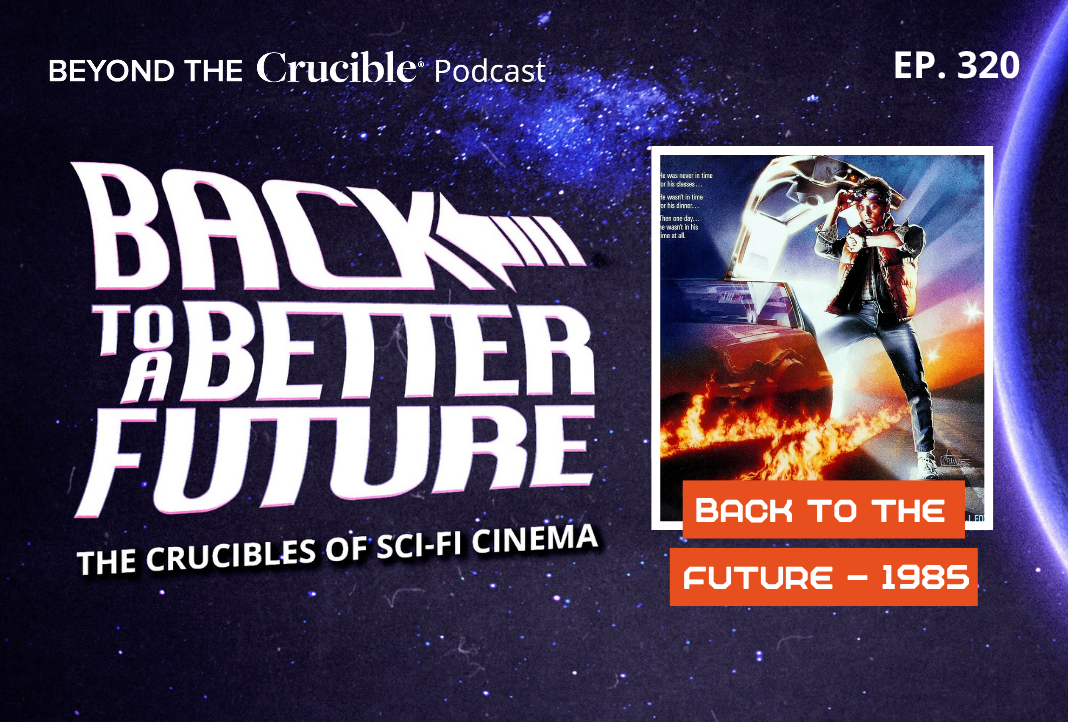
Back to a Better Future: The Crucibles of Sci-Fi Cinema IV Back to the Future
What if the only thing standing between you and triumph is the belief that your crucible can’t be overcome?
In this episode, we dive into Back to the Future as part of the fourth installment of our special summer series, Back to a Better Future: The Crucibles of Sci-Fi Cinema. The McFly family has a generational problem — not just Biff Tannen, but the deeper pattern of self-doubt and resignation that leaves them stuck in their trials rather than pushing through them. It takes a souped-up DeLorean, a little time travel, and one son willing to believe things can be different to break the cycle. Their story raises a question worth sitting with: what crucibles in your own life have you quietly decided can’t be overcome?
Want to explore our three prior summer series about the lessons we can learn about overcoming crucibles from film?
Check out these playlists featuring every episode of each one:
LIGHTS, CAMERA, CRUCIBLES (2022): • Beyond the Crucible: Lights, Camera, Cruci…
CLASSIC FILMS, CLASSIC CRUCIBLE LESSONS (2024): • Classic Films, Classic Crucible Lessons: A…
BIG SCREEN, BIG CRUCIBLES (2025): • Back To A Better Future 2026
Have a question or comment? Drop us a line at info@beyondthecrucible.com
—
👉 Don’t forget to subscribe for more leadership and personal growth insights: https://www.youtube.com/@beyondthecrucible
👉 Follow Beyond the Crucible on Facebook: https://www.facebook.com/beyondthecrucible
👉 Follow Warwick on LinkedIn: https://www.linkedin.com/in/warwickfairfax/
👉 Follow Beyond the Crucible on Instagram: https://www.instagram.com/beyondthecrucible
👉 Take the free Trials-to-Triumphs Self-Assessment to discover where you are on your journey of moving beyond your crucible and how to chart your personal course to a life of significance: https://beyondthecrucible.com/assessment/



Transcript
Warwick Fairfax:
Welcome to Beyond the Crucible. I'm Warwick Fairfax, the founder of Beyond the Crucible.
It seems like when setbacks happen, like Marty losing his audition, the collective response is, "Well, it's all for the best." Defeats are not motivating for this family. It's not like, "okay, when you get defeated, you get back up, you try again, you never give up." It's like, "Well, if at first you don't succeed, give up and never try again."

Gary Schneeberger:
That's hardly a recipe for overcoming the crucibles life throws at us, but it's exactly how the McFly family of Back to the Future responds when they encounter setbacks, at least until their son Marty starts doing some time traveling in a souped-up DeLorean.
This week, in the fourth episode of our special summer series, Back to a Better Future: The Crucibles of Sci-Fi Cinema, we look at the challenges the McFlys faced, from being bullied by Biff Tannen across two generations to not believing in themselves enough to muster their resilience to turn their trials into triumph. How can understanding how they master these challenges help you overcome your own? Stay tuned.
Welcome, friends, to this episode of Beyond the Crucible. You have joined us during our summer series, which we are calling Back to a Better Future: The Crucibles of Sci-Fi Cinema. That's right, it's another series where we focus on what movies can teach us about crucibles. And we did it because we had so much fun in the last three years that we did this, that we're doing it again this summer. And after doing movies that spotlighted heroes, all kinds of heroes, sports heroes and superheroes and historical heroes, classic movies celebrated by the American Film Institute and then movies that really featured a lot of crucibles. You've heard of the coffee brand Chock Full o'Nuts. This was Chock-Full of Crucibles. That was the series that we did last year. But this year we're doing, as I said, Back to a Better Future: The Crucibles of Sci-Fi Cinema.
So Warwick, as we dive into this, let me ask you what I asked you at the beginning of all of these episodes. Why movies again? This is the fourth time now, three in a row, plus one before that, that we've gone into the cinema for our summer series. What are you hoping our listeners and viewers get from our discussion of these films that we're talking about?

Warwick Fairfax:
So we both love movies and have enjoyed looking at movies from a Beyond the Crucible perspective, which is very different than when you're watching a movie for fun and you're watching it with a Beyond the Crucible lens. I mean, just in this movie that we're about to discuss, there's so much I didn't see the first time. But movies typically portray protagonists that face significant obstacles that they seek to overcome. Sometimes they overcome them and a few times, like in Citizen Kane and in some other movies like The Godfather, they're actually defined unfortunately by the crucibles. And we've covered superheroes, sports heroes, historical movies, as you mentioned, the American Film Institute's top 100 movies and lastly, we focused on films with significant crucibles. So we love movies and seeing what we can learn from them.

Gary Schneeberger:
Yeah. And one of the things, and I've not said it yet in this year's series, I love because every week I get to hear you say the excellent Australian pronunciation of protagonist as protagonist. So I love that. Truly, that's a high point of the series for me. But I also know, Warwick, you're particularly excited about what we're doing this year because you are very much a fan of the science fiction film genre. What do you love about science fiction movies so much and what about them in particular is resonant as we talk about the subject of crucibles and how you move beyond them?

Warwick Fairfax:
Yeah. I've always loved science fiction since I was very small, books, movies, TV. I think of that classic science fiction movie, 2001: A Space Odyssey that came out in 1968 and that was an incredible movie. You'd see future technology like space shuttles and that'd have screens on the front of seats in front of you, which exists now but didn't in 1968. You'd have talking computers, almost sentient computers, which it got a little scary in that movie, video conferencing. And they did such a good job. You had video conferencing with Bell telephone, which became AT&T. And then I was also a big fan of some science fiction shows like Star Trek, [inaudible 00:04:51] from 1968 to 1969. And I read some of the classic novels written by Arthur C. Clarke and Isaac Asimov, giants of the science fiction genre.
So what I loved about science fiction and still do is not only does it explore future technology, but at its best it explores deep societal issues, what's the future of the human race. How will humans interact with technology as well as other species out there in the universe? Will the human race be a force for good or not? And many of the issues that we face today such as AI really is something that comes up in science fiction. As I mentioned in 2001: A Space Odyssey, we have a computer that ends up being malevolent and puts the astronauts in great danger because it basically becomes sentient. So it's something we talk about today. So science fiction, we see significant crucibles portrayed. Can the human race survive? Will there be expansion of humans throughout the galaxy? Will technology get to a point where it controls humans? So science fiction, not only does it have crucibles, but explores some very deep societal issues.

Gary Schneeberger:
Right. And just hearing you talk about computers becoming sentient, I'm reminded of our last week's episode on Terminator 2: Judgment Day because Skynet did become self-aware and that sentience did turn out to be bad. So that was an actual very bad computer, just like in 2001: A Space Odyssey.

Warwick Fairfax:
Absolutely. So bad things potentially happen when computers become sentient. So something we'll have to watch out for in the years to come.

Gary Schneeberger:
Indeed. So here we are in episode four and we're looking at the 1985 movie that inspired our series title. This is kind of fun. And that was Back to the Future, the top grossing film of that year, just like T2, which we talked about last week was the top grossing film of 1991. This Back to the Future was the top grossing film of 1985. Here's the summary of the movie known in the film industry as the logline. And I read these every episode that we do because I just think as a writer, I'm like, this is so perfectly compactly explained that I'm jealous. I didn't think of it, but here we go.
Marty McFly, a 17-year-old high school student is accidentally sent 30 years into the past in a time-traveling DeLorean invented by his close friend, the maverick scientist Doc Brown. The first piece of the film, Warwick, introduced the two main characters mentioned in the logline, Marty and Doc. And both of them, from what we glean in the film's first minutes, are no strangers to crucibles. In fact, it seems their lives are kind of a boneyard full of crucibles when we first meet them. So what setbacks and challenges are these two characters dealing with when we encounter them?

Warwick Fairfax:
So in this opening scene, we see Doc's house and there's every conceivable kind of clock ticking. I mean, everything from grandfather clocks with cookers and you name it, there's every kind of clock. And we see a framed article that Doc had to sell his family's mansion, so he's obviously suffered a setback there. And then there's this kind of hair-brained automatic breakfast machine that really doesn't seem to work too well, there's burnt toast, there's coffee that's getting poured on the ground, there's pet food that falls in a massive pile in the dog bowl, I mean, I could have sworn I saw the movie that it said cat food, maybe it wasn't, but I mean, everything seems to be going wrong with piles of dog food on the ground. So it seemed that Doc is having challenges. He's not a very successful inventor. He's lost his family home. So it's really not an auspicious beginning.
And so then we see Marty at Doc's house and his calling for Doc is not there. So Marty then turns on a very powerful amp and he plugs his guitar into this amp and starts plucking the strings and the amp basically blows up. I mean, of course, Marty being Marty turns every dial up to the max that he could possibly do. Is there a red zone on the dial? Well, what does that mean? Well, you just go way past that red zone, you just kind of dial it up, see what happens. And he's just blown backwards with his guitar. And so soon after that, there's a phone call that Marty gets at Doc's house. And Doc says, "You have to go to the local mall, Twin Pines Mall, and you got to be there at 1:15 AM." Now somehow Doc has set the clocks back, so that they're slow, 25 minutes slow. So it's like Marty looks at the clock and he's like, it's really 8:25, he's late for school. And so he dashes off.

Gary Schneeberger:
And also in that scene where he's talking to Doc, Doc says to him, "Oh yeah, you might want to watch out about the amp. Be careful because I don't think it's working right." Doc's timing is not good there on that advice.

Warwick Fairfax:
And Marty thinks, "Okay. Yeah. Thanks, Doc. I'll watch out for that," or something like that.

Gary Schneeberger:
Right. Yeah. Yeah. So two scenes then come back to back in this film that spotlight the big themes of the movie. And the first one, Warwick, involves Marty's confrontation with his principal. What does he say to Marty and how does Marty respond? And it's important to really pull this out because this will become sort of a common refrain that gets thrown at Marty throughout the movie.

Warwick Fairfax:
Yeah, it's so true. So here's Marty, he's sneaking into Hill Valley High School and he sees his girlfriend, Jennifer Parker. But Principal Strickland, he catches them and gives him tardies, which for Marty is four in a row. That's a very common thing.

Gary Schneeberger:
The ultimate black mark. Yeah.

Warwick Fairfax:
Oh yeah, very common thing for Marty. And so Principal Strickland, he reminds Marty that Doc is his almost mentor, Marty's mentor is a nut job. And Marty is a slacker who reminds him of Marty's dad who is also a slacker. The principal notices that Marty's band is on the roster for an audition for the high school. And the principal says he does not have a chance. He, Marty has no chance because he's too much like his old man. And then he says this, the principal, "No McFly never amounted to anything in the history of Hill Valley." The principal is in Marty's face, like inches away. And Marty fights back, at least verbally, and says, "Well, history is going to change."
So you see in this opening scene rather than a fellow traveler, he's one of the people that we most know, somebody that says, in not so many words, "You're nothing. Your family's nothing. They've never amounted to anything. Give it up. Why even bother trying to audition with your band? It won't work. You'll fail." I mean, that's just this negative message that Principal Strickland gives him.

Gary Schneeberger:
And he's been dropping that kind of negativity on the McFly men for 30 years because as the movie travels back later on, we find out he knows Marty's dad because he had Marty's dad in school too.

Warwick Fairfax:
Oh yeah, exactly. This is his lifelong, the McFlys are hopeless, they'll never amount to anything, waste of space. So Marty auditions with his band, which are interestingly called The Pinheads. And they actually play The Power of Love by Huey Lewis and the News. And the teachers evaluating Marty's audition are not impressed and say that the music is too loud.

Gary Schneeberger:
And the teacher who actually tells him it's too loud, it's a cameo by Huey Lewis himself playing the teacher who is kind of very bland and he's like, "Oh no, that's way too loud." And it's his song that's playing, which is kind of a funny little Easter egg that Bob Zemeckis, the director, threw in the film.

Warwick Fairfax:
It's pretty funny. Huey Lewis doesn't like his own song, so who knew? But anyway, so Marty's crestfallen, as is Jenifer.

Gary Schneeberger:
Right. But Jennifer does try to cheer him up by quoting to him something that she says Doc Brown always says. And folks, you want to listen to what Warwick's going to explain that is because it will not be the last time you hear these words. So what is it, Warwick, that Jennifer tells Marty, quoting Doc, about how he should think about this crucible that he finds himself in?

Warwick Fairfax:
So Jennifer is really the first fellow traveler that we see in the movie that is speaking into Marty. And Jennifer tells Marty that he's really good, that she likes his music and she says that he should send in his audition tape to a record company. She believes in him. And then Jennifer starts to say, "It's like Doc says," and then Marty finishes what Jennifer was about to say. And so Marty says, "If you put your mind to it, you can accomplish anything." And Jenifer says, "That's good advice." So Marty says that if they say he's no good, he can't take that kind of rejection. So he's about to go down that negative line, listening to the siren songs of Principal Strickland who says McFlys can't amount to anything. But then he stops and he catches himself and says, "Hang on, I'm sounding like my old man. I'm sounding like my dad."
So he realizes this is not helpful to go down this line that McFlys can't accomplish anything and just give up. He's thinking that, he's beginning to go down that line, but he stops himself before he gets too far down there. So it's a fascinating moment.

Gary Schneeberger:
Yeah. And it's a fascinating moment when taking the whole movie into context. We'll talk more about that later folks. We then meet Marty's parents and siblings. They too seem to be living in a crucible existence, especially the dad, George, who is bullied by his boss Biff. These scenes show, Warwick, that the whole family's living in crucibles, don't they?

Warwick Fairfax:
So here we see Marty at his home and Biff Tannen comes in. Now Biff has wrecked George's car, but Biff, of course, won't pay for the damages. Somehow he finds a way to say, "Well, George, it's all your fault that I crashed your car," instead of, Biff logic, and not only that, but he blames George for the fact that he spilled his drink on his lap and it stained his jacket. And so he wants George to pay for the cleaning bill for his jacket. So it's George's fault, George has to fix the car that he wasn't driving, which is George's car, and also to pay for the dry cleaning for the jacket. So then Biff asks George for the reports that George was meant to work on. Now it's clear that these are reports that Biff should be working on. It should be Biff's reports. And he says, "Look, I need a bit of time because I'm going to need to copy them so that it makes it look like it's my work."
And so when George seems a bit slow on the uptake or slow to respond, Biff grabs George by the tie and says sarcastically, "Hello, anyone home?" He then marks George again by saying to him that his shoe is untied. Of course, George looks down and Biff kind of hits him on the chin. So George laughs kind of nervously and Biff looks at Marty and Marty stares. Marty's just looking at what is happening here. Marty's just incredulous just to see the way that Biff is treating his dad and how his dad is just taking it.

Gary Schneeberger:
And to hear you talk about Biff, this just popped in my head, he's kind of like in old Western movies, the villain that twirls his mustache. And what's funny about this movie or about that is that there were three Back to the Futures made. And in the third movie, Back to the Future Part III, where they go back into the 1870s or something, I believe Biff is actually played with one of those big handlebar mustaches. So that was intentional, I guess, for the character when he's first introduced here.

Warwick Fairfax:
I'm not sure, but I can't remember, but maybe it was one of Biff's ancestors in the 1800s or something. So the genes of being obnoxious and the bully go back generations.

Gary Schneeberger:
Yes, indeed they do.

Warwick Fairfax:
Yeah. So once Biff leaves, then George says he knows what Marty will say because he can tell, there's this expression on Marty that's just like, "What are you doing? What's happening here?" And so George says, "Well, Biff is his supervisor." And George says, "Well, he's just not good at confrontations." Marty says, "But Biff wrecked the car." And Marty says he needed the car. And his dad says, "Well, he's sorry." So George says, "Well, Marty is better off not playing at the dance because George hears that Marty didn't do well on the audition." And Marty's brother Dave agrees. Everybody's supporting this negative give up at the first moment of failure, at the first setback, and nobody seems to be doing that well. We've seen how George is completely under Biff's thumb. We see Dave is in a McDonald's uniform, obviously working at McDonald's. Marty's sister doesn't seem to be doing that well.
And then we see Marty's mother who's overweight and is drinking a lot. And then, we see that Lorraine throws a cake down on the table for Uncle Joey who basically says he's not going to need it because he didn't make parole again. I think there was icing on there saying, "Welcome home" or "Welcome out Uncle Joey." And yeah, Uncle Joey's still behind bars. And so then Lorraine says, "Well, we all make mistakes in life." And this looks at it very, I don't know, matter-of-factly, if you will.
So it seems like none of the family seems to be doing well, including Marty's mother who drinks too much and his brother's working at McDonald's. It seems like when setbacks happen, like Marty losing his audition, their collective response is, "Well, it's all for the best." Defeats are not motivating for this family. It's not like, "Okay, when you get defeated, you get back up, you try again, you never give up." It's like, "Well, if at first you don't succeed, give up and never try again." That seems to be the family motto, which is very destructive and very discouraging for Marty and the rest of the family.

Gary Schneeberger:
It flips on its head, what we say in Beyond the Crucible all the time. The way the McFlys are living is that their crucibles did not happen for them, their crucibles happened to them. That's how they're living their lives.

Warwick Fairfax:
Yeah. And it's almost like you are not only defined by your worst day, you were defined by the smallest speed bump. No matter how small the speed bump is, give up, you were defined by that. I mean, it's just a crushing, depressing life that they're leading based on their choices basically.

Gary Schneeberger:
Correct. But here's the good news. The norm is about to be upset. Doc Brown shows up on the scene to reveal what he calls his greatest experiment. "The big one I've been dreaming of all my life," he says. He has Marty meet him at the local mall to show him what the experiment is. It's something that has the power to change the trajectory of Doc's life and winds up changing the trajectory of Marty's life and his whole family's life too.
Warwick, what is this invention and how does it come to be?

Warwick Fairfax:
So we see Marty with Doc at the mall and Doc opens up a truck to reveal a DeLorean car, but it's not any ordinary DeLorean, this is actually a time machine. So we see Doc has a white coat with interestingly enough, a radioactive symbol on it, which doesn't look good.

Gary Schneeberger:
No.

Warwick Fairfax:
And Doc opens the car and he puts in the dashboard the date of November 5th, 1955. And he says that was the date that Doc invented time travel. So Doc had this vision of the flux capacitor back then. This is 30 years ago and it took that length of time, 30 years and his family fortune to build it.

Gary Schneeberger:
I want to play show-and-tell for a second because you mentioned a DeLorean, right? The time machine is made out of a DeLorean. For folks who don't know about DeLoreans, look them up. You can find them on YouTube. They're very interesting-looking cars. But my watch today happens to be made with the logo of the DeLorean Motor Company. See right there? DRC. No, sorry. DMC, the DeLorean Motor Company. That's my watch today. But you also mentioned Warwick, the flux capacitor. I've got to do this.

Warwick Fairfax:
You have a flux capacitor. I

Gary Schneeberger:
I have a flux capacitor right here. It's actually a Yahtzee cup. It's Back to the Future Yahtzee. There's my show-and-tell for the day. Sorry to interrupt, but I had to show that.

Warwick Fairfax:
No, that's all good. And you don't need to show us the plutonium. I'm sure that's back in the lead line vault that you have in the basement.

Gary Schneeberger:
Yes. Yes. That is not, right, handy right now.

Warwick Fairfax:
Not indeed.
So this flux capacitor, the DeLorean, it runs on plutonium and it needs 121 gigawatts of power to make it run. So Doc said obviously it needs plutonium. And he said that he took the plutonium from some Libyan terrorists who wanted him to build them a bomb. So basically, where do you find plutonium? Well, I guess these handy Libyan terrorists-

Gary Schneeberger:
Terrorists that are [inaudible 00:24:08].

Warwick Fairfax:
... who wanted him to build a bomb. And he said, "Sure, I'll build a bomb," not really intending to do that. So I think we'll see that Doc didn't quite think through this plan very well. But anyway, he says he's going 25 years into the future and he needs one flask of plutonium per trip. He was almost about to take off without another flask of plutonium, which means he would've got stuck. So just then as Doc's about to take off, we see this VW van hurtling through the mall, the tops open, and there's Libyan terrorists just shooting at them with machine guns.

Gary Schneeberger:
Right.

Warwick Fairfax:
And at one point it appears that Doc is being killed, fire all over him. So then Marty jumps in the DeLorean and accelerates. And we've already learned, just before then, that the key benchmark is 88 miles per hour because once you hit 88, time travel happens. So you see the dial get close to 88 and then it happens and then the DeLorean disappears. You see these flaming tire tracks and it's disappeared. The VW van crashes and yeah, somehow Marty is gone, he's gone somewhere.

Gary Schneeberger:
He's gone somewhere ta-da-da-ta. You don't have to wait too long folks. He's gone and he shows up pretty quickly and he shows up in 1955, 30 years earlier. He hides behind the signs, some signs in town, and he walks into the town. And when he enters the town, Warwick, he sees a much different Hill Valley than the one he was living in 1985, doesn't he?

Warwick Fairfax:
He surely does. So Hill Valley in 1985, it's a dilapidated rundown town center. It has X-rated movies showing on the movie theater. But now in 1955, Hill Valley town center, it looks pristine. And there's a movie playing with Ronald Reagan in it. Now for folks, this movie was made in 1985 and in that year, Ronald Reagan was President. So the audience are going, "Whoa, what? Ronald Reagan is playing in a movie back then." And so then we see a Texaco gas station and it has a whole bunch of people helping this one car. So there's somebody filling it up. There are other people washing the car and they've all got their Texaco uniforms and something-

Gary Schneeberger:
It looks like a pit crew. It looks like a pit crew in car race, right?

Warwick Fairfax:
Absolutely. But that doesn't happen here, at least not in our time, nor did it in 1985, but in 1955 it did. And we also see a record shop playing the song, The Legend of Davy Crockett. And that was from a great 1950s black-and-white TV show, David Crockett. And then we see the clock tower in the main square is actually working because in 1985, and this will be important later on, it's been broken for 30 years. But in 1955, it's actually working.

Gary Schneeberger:
Yeah. And then Marty meets his dad, a 30 years younger George McFly, first person he meets when he gets back in 1955, when he gets into 1955. And he discovers that George's crucibles back then are a pattern that continued, doesn't he? In other words, the guy that he meets in 1955 has a lot in common with his father in 1985, doesn't he?

Warwick Fairfax:
Yeah, he surely does, unfortunately. So Marty enters a diner and he's looking for a payphone to try to get a hold of Doc. He knows that Doc was around in Hill Valley back then in 1955. So he's trying to find a payphone and a phone book and find the address and number. So then a young Biff enters and he says, "Hey, McFly." And so Marty turns around, but there's another guy that turns around too at the same time. And that other guy is a young George, Marty's dad. And so Biff asked George if George has done Biff's homework. It's the same line as 1985-

Gary Schneeberger:
Exactly.

Warwick Fairfax:
... when Biff says, "Hey, have you done my reports?" So in this case it's, "Have you done my homework?" And George says, "Well, it's not due till Monday." Well, Biff knocks George on the head saying, "Hello, is anybody home?" Biff says he needs basically the weekend to copy it because if he doesn't copy it in his own hand, Biff will get kicked out of school. And so it looks like nothing has changed for George. George is still getting picked on by Biff and George is also not standing up for himself and just shrinks from Biff teasing and him using him. So it seems like George has gone through a lifetime of being picked on and being used by Biff and doing nothing about it.

Gary Schneeberger:
Yeah. Then, George also leads Marty to his mom, Lorraine, to Marty's mom, Lorraine. And unlike Marty's dad, who's pretty much the same as Marty knows him to be in 1985, Marty's mom, 30 years earlier in 1955, she's nothing like the woman. She's a girl at this point. She's nothing like who Marty knows to be his mom in 1985, is she? She's a different young lady.

Warwick Fairfax:
It's so true. So George takes off on his bike and Marty follows him. So then Marty sees George in a tree and George has binoculars and he's staring across the road at a young woman in her bedroom on the second floor who's undressing.

Gary Schneeberger:
Clearly up to something really good, George.

Warwick Fairfax:
And so Marty is thinking, "My dad is a peeping Tom. I mean, what is my dad doing?" So then George falls out of the tree and falls right in front of the car that's driving by. So Marty, in an act of heroism, pushes his dad out of the way and gets hit by the car. Now George rushes off while the driver of the car gets out to see if Marty's okay. Now it turns out we'll find out the driver of this car is a young Lorraine's dad. So what ends up happening is Lorraine's dad, the driver of the car, brings George, who is unconscious, back to his house. So then Marty wakes up and at first he thinks, okay, I had this nightmare and I'm waking up and what happened? And there's a girl by there and as Marty's waking up, he says, "Mom, is that you?"

Gary Schneeberger:
Right.

Warwick Fairfax:
... and kind of, but as Marty's waking up, this girl puts an ice pack on his head and says that Marty has been asleep for nine hours. And the light goes on and it turns out the girl is his mother. Now this is a young Lorraine. She's a teenager. She looks wonderful, very different than the more overweight mother that he knows who drinks too much. This is a completely different Lorraine, a completely different person. So Lorraine keeps calling Marty Calvin because Marty wears Calvin Klein underwear. And so throughout the movie, it shifts between Lorraine calling him Calvin or Marty. It's a bit confusing because obviously she'd never heard of Calvin Klein underwear. And so Lorraine sits next to Marty and is going to touch him, like putting a hand on his knee or something and Marty falls off the bed and really doesn't want to be sort of romantic-

Gary Schneeberger:
Can't get away fast enough, right?

Warwick Fairfax:
Yeah. He doesn't want to be in a romantic relationship with his mother. So Marty goes downstairs and he meets Lorraine's parents and family. And one funny scene, he sees that there's baby Joey who's in the playpen and Marty says, "You better get used to this." Because remember in 1985 when he's at his home, his mom puts down this cake for his uncle Joey who's in prison. So it's like foreshadowing of little baby Joey is behind bars. So anyway, so Lorraine in 1955 is nothing like Marty's mother in 1985. She's young and good-looking with a whole life ahead of her. So everything seems very different now in 1955.

Gary Schneeberger:
Yeah. So Marty's perspective, his world is rocked and he tries to find something that's going to help him un-rock it. And that's when he goes looking for 1955's version of Doc Brown. He finds him, but initially has trouble convincing him that he's from the future, he, Marty, is from the future. It's only after he shares the story of how Doc was prompted to create the time machine that Doc offers to help him. Warwick, let's take a look and a listen to.
The clip that drives the action in the second act of the movie. Here it is.

Doc Brown:
It's truly amazing. A portable television studio. No wonder your President has to be an actor. He's gotta look good on television.

Marty McFly:
Whoa, this is it. This is the part coming up, Doc.

Doc Brown:
No, no, no, no. This sucker's electrical, but I need a nuclear reaction to generate the 1.21 gigawatts of electrical.
What did I just say?
The flux capacitor stores...
This sucker's electrical, but I need a nuclear reaction to generate the 1.21 gigawatts of electricity.

Marty McFly:
1.21 gigawatts. 1.21 gigawatts.

Doc Brown:
Please stop. What the hell is a gigawatt? How could I have been so careless? 1.21 gigawatts? Tom, how am I going to generate that kind of power? It can't be done. Can it?

Marty McFly:
Doc, all we need is a little plutonium.

Doc Brown:
I'm sure that in 1985, plutonium was available in every corner drug store, but in 1955, it's a little hard to come by.
Marty, I'm sorry, but I'm afraid you're stuck here.

Marty McFly:
Whoa, whoa, Doc. Stuck here? I can't be stuck here. I got a wife in 1985. I got a girl.

Doc Brown:
Is she pretty?

Marty McFly:
She's beautiful. She's crazy about me. Look at this. Look what you wrote here, Doc. That says it all. Doc, my only home.

Doc Brown:
Marty, I'm sorry. But the only power source capable of generating 1.21 gigawatts of electricity is a bolt of lightning.

Marty McFly:
What'd you say?

Doc Brown:
A bolt of lightning. Unfortunately, you never know when or where it's ever going to strike.

Marty McFly:
We do now.

Doc Brown:
This is it. This is the answer. It says here that a bolt of lightning is going to strike the clock tower precisely 10:04 PM next Saturday night. If we could somehow harness this light, channel it into the flux capacitor, it just might work. Next Saturday night, we're sending you back to the future.

Gary Schneeberger:
So Warwick, talk about what leads up to this clip and the importance about what's about to take place after this clip plays out.

Warwick Fairfax:
So yeah, Gary, as you mentioned, Marty has trouble convincing Doc that he's from the future in the time machine that Doc created. It seemed pretty farfetched in 1955. So Marty says that he knows how Doc got the bruise on his head, that he fell off the toilet and somehow came up with the idea for the flux capacitor. So they go off and get the DeLorean, which is hidden behind the sign outside of town, and they bring the car back to Doc's garage. So after Doc shows Marty his drawing of the flux capacitor, they open the DeLorean to see the real flux capacitor. And Doc is amazed because he's dreamt of this flux capacitor and here it is, it's actually working. And Doc is just jubilant and says, "Finally, I've invented something that works." Because as we'll see, a lot of his inventions don't work like the automated breakfast thing that doesn't work too well.
So in this clip, we see Marty showing Doc the video because he has the video camera that he was actually shooting Doc before the Libyan terrorists came on in the mall in 1985. And so he's showing Doc, an old Doc, talking about that to make this DeLorean work and to be a time machine, you need a nuclear reaction to generate 121 gigawatts and you need plutonium. Well, Doc says in one of the funnier moments of the movie, and there's a lot of funny moments, "I don't know what it's like in 1985, maybe getting plutonium is like going to the corner drugstore, the corner grocery store, but it's a little hard to get plutonium in 1955." So Doc says, as you can see in the clip, "We need a bolt of lightning to generate that kind of power."
Now, it just so happens that Marty has a flyer with him from 1985. Now, earlier in the movie when Marty and Jennifer in the town square, a woman hands him a flyer saying to try to raise money to fix the clock tower. In that flyer, it has the precise date of when a lightning bolt hit that clock tower in 1955. So at this point, Doc's like, "Well, that's it. We're going to need a bolt of lightning. Well, now I know exactly when a bolt of lightning is going to hit and where." And so then he says in that immortal line that we're going to send you back to the future, pointing his hand out. Marty now has hope that he won't be stuck in 1955 and he can get back to 1985, his family and his girlfriend, Jennifer.

Gary Schneeberger:
Right. And there are crucibles involving time travel. There are other crucibles involving time travel. Doc warns Marty of the catastrophe that can happen if Marty interacts with anybody he knows in 1985, now that he's in 1955.
Warwick, how does Doc convince him, this is more than a life-altering crucible, it's a life-preventing crucible possibly?

Warwick Fairfax:
When Doc asks him if he's interacted with anybody, Marty says, well, he's met his parents and Doc is horrified, "What?" And so Marty has a photo of his family with him. When Doc looks at that photo, Marty's head is gone like it's being erased. And so basically Doc says, "If we don't stop this process, your whole family will be erased." So one of the things you see in time travel movies and shows, including Star Trek, is if you go back in time and you influence yourself back then, it can alter the future timeline. That's a standard fare in science fiction. So Robert Zemeckis, the director of the movie, obviously knows this standard science fiction logic. Yeah, so that is a crucible. And really Marty's challenge is he's got to find a way to prevent this crucible of altering his family's history, which if he doesn't, not only will he have trouble perhaps getting back to the future, but he may not exist in the future.

Gary Schneeberger:
Right. And his parents, in the 1985 segments, his parents talk about how they fell in love. So that's what prompts Marty to go, "Wait, okay, they're in high school. I met them both. My mom now thinks I'm attractive, so that's kind of weird and also dangerous." So he comes up with the idea that he has to find a way to make his mom and dad as high schoolers meet and fall in love in 1955, so the family can exist in 1985. His efforts start with George. He discovers something about his dad he never knew.
And really, Warwick, and beyond the crucible parlance, Marty dives in to act as a fellow traveler to his father at this point, doesn't he?

Warwick Fairfax:
Yeah, it's so true. So we see Marty now going to high school and he sees George who's in high school getting kicked on the backside because of a sign on him saying, "Kick me." It's like a middle school thing, except for George it keeps going on, he's in high school. And so Doc and Marty look at this and Doc says, "Well, maybe you're adopted." I mean, Doc's thinking, how in the world is he going to get together with Lorraine and have kids? The sad thing is nothing much has changed with George. So now we see Principal Strickland, he was principal in 1985, well, he's principal in 1955, very long tenure, staggering.
And so then we see Principal Strickland, he comes up to George and asks him if he wants to be a slacker the rest of his life. So just like the future principal, this principal is the same kind of person. He keeps really getting in the face of McFlys and discouraging them. And Doc wonders what Marty's mother ever saw in George. I mean, there's not a lot to think of who could see anything worthwhile in George. That's really basically what Doc is thinking. And Doc and Marty realize that George and Lorraine connected because originally George was the one who was meant to be hit by Lorraine's father's car. But in this version of events, it was Marty and not George. And that's what really alters the timeline, which is a bit of a disaster for the time continuum, so to speak.
So Doc says it's the Florence Nightingale effect when nurses become attached to their patients. And that's what happened in the original timeline. Now, Lorraine only has eyes for Marty and calls him a dreamboat. Doc says that we have to get George and Lorraine to go to the Enchantment Under The Sea dance and that George has to take Lorraine to the dance. If that doesn't happen, then Marty won't exist, his siblings won't exist. So we see George is in the cafeteria writing science fiction stories and George says that he never lets anyone read his stories because what if people thought they were no good. George often says, "I don't think I could take that." And Marty finds a way of encouraging him and saying, "Well, maybe they'll get published." There's something that just by Marty's presence, I think George maybe feels like, "Well, that's probably silly." And Marty doesn't think it's silly. Anyway-

Gary Schneeberger:
And it's also for Marty, because Marty back in 1985 when he gets not in the band, he's trying out for the concert, he gets rejected. He says the same thing to Jennifer. So they oddly, interestingly, get strength from each other over the course of time I think here.

Warwick Fairfax:
Yeah, so true, so true. So Marty says that Lorraine wants George to ask her to the dance. And George says, "Well, if she said no, he could not take that kind of rejection." And George says that Lorraine would rather go with Biff, which is amazing how clueless George is because-

Gary Schneeberger:
Correct.

Warwick Fairfax:
... that is not the case, who would want to go with Biff, he's just a bully. So George says there is nothing on the planet that will make him change his mind and ask Lorraine to the dance. Now those are auspicious, actually triggering words in a good sense of the word because then Marty gets creative and he puts on his radiation suit because to go in the DeLorean time travel machine because it's got plutonium, they have a radioactive suit. So he has this yellow radioactive suit on and he goes into George's bedroom at night and he puts these Sony Walkman headphones on George and he sort of cranks up the music and it is playing Van Halen. And George wakes up and Marty pretends to be an alien. And he says that he is Darth Vader from the planet Vulcan, which as science fiction aficionados would know, that's mixing Star Wars with Star Trek, but George doesn't know. Neither of those things existed in 1955.
So the next day, George tells Marty that he will take Lorraine out to the dance because if he doesn't, Darth Vader told him that he would melt his brain. So Darth Vader really deserves some credit in this particular movie for helping give George some courage or maybe it's the fear that prompts him to do something. So really what we see in these scenes is that Marty goes all out to help George and be a fellow traveler. He seems to encourage George in writing his science fiction stories. He encourages George to take Lorraine to the darts, albeit through this way over the top creative device of pretending to be an alien Darth Vader. Really, Marty is a kind of fellow traveler that will do whatever it takes to help George. Yes, there's some self-interest because Marty doesn't want to disappear, he wants to exist.
But I think more than that, he wants his dad George to be different. He wants to encourage his dad to follow a different path. I mean, clearly the part of it is not just a self-serving, "Hey, I want to live and exist." But part of it too is he wants his dad to be something different than the person that he's grown up with.

Gary Schneeberger:
Right. And then for a science fiction movie, something that happens in pretty much any dramatic movie, happens next. And that's the Biff of 1955 shows up to wreak his bullying behavior on George and to sexually harass Lorraine. The evil, right, the bad guy always shows up just as you're about to make progress in your plan. Marty unravels his own plan before he's even really started moving when he punches out Biff and Lorraine goes all lovesick on him even more than she had before. And she raises the stakes here, doesn't she, Warwick?

Warwick Fairfax:
Yeah, absolutely. So George goes to the diner and is about to ask Lorraine to the dance. Now Marty, ever the loyal fellow traveler who never gives up, he's even basically written a script for George to say. He says, "George, this is what you say. Destiny has brought us together and you are the most beautiful girl in the world." It's not a bad, in certainly 1955, not a bad line. It should hopefully be effective.

Gary Schneeberger:
If you say it right, he says density.

Warwick Fairfax:
Oh, he does. He completely-

Gary Schneeberger:
Yeah.

Warwick Fairfax:
Yes. Right. I guess dense people say density, I don't know, but he doesn't get it right.
So just as George is in the middle of trying to get this out and Lorraine is looking at him saying, "Huh, what's going on here," because it's a different George, Biff comes up. Worst possible moment. Now Marty is trying to keep Biff out of it. So Marty sticks his foot out and trips Biff. And so then Biff stands up, gets in his face, and then Marty punches him out, punches Biff. Well, Marty flees while Lorraine looks at Marty, who she calls Calvin, and says it's a dream. So the plan spectacularly backfires here. And rather than helping George, it actually makes her be even more attracted to Marty. So yeah, she's getting even more infatuated with Marty and not George.
So then what happens is that Lorraine actually follows Marty to Doc's house where Marty's staying. And Lorraine wants Marty to ask her to the dance, which is the exact opposite of the plan. So Marty asks, "What about George?" Lorraine says, "Well, George is cute, but a man should be strong and stand up for himself and protect the woman he loves," key words, as we'll see later in the movie, she wants somebody that will stand up for himself and protect the woman he loves. This George in 1955 does not seem the kind of guy that would do either of those things.

Gary Schneeberger:
So it's after this scene, Warwick, that Marty truly shows his fellow traveler colors. He gives George a pep talk that echoes what Jennifer told Marty in 1985. What does he say and how does that help George?

Warwick Fairfax:
Yeah, it's a great point. So Marty says to Doc that we need to show Lorraine that George will stand up for himself and protect Lorraine, echoes the words that Lorraine has just mentioned to him a short while earlier. So Marty lays out this whole plan for George. Marty will take Lorraine to the dance at around 8:55 PM. Lorraine will get angry when Marty pretends to take advantage of her. George will then walk up and say, "Hey, you, get your damn hands off her." Marty tells George that George will then punch him in the stomach. And so basically Marty's trying to set this whole thing up, so that George would be the hero and Lorraine would then admire and be attracted to George.

Gary Schneeberger:
Right.

Warwick Fairfax:
So while George is scared, Marty says, "Hey, there's nothing to be scared about." And then Marty mentions these words that originally came from Doc and says to George, "If you put your mind to it, you're going to accomplish anything." This is probably the first time anybody has ever told a young George that in his life and that will end up being life altering. So George has just had people that have just given up on him and don't believe in him, certainly the principal at the school. For the first time, here's somebody like Marty, just this fellow traveler that's constantly in his face, in the best sense of that word, who believes in him and tries to give him hope in the future that you can accomplish anything if you put your mind to it. It's just incredibly powerful words.

Gary Schneeberger:
But alas, the plan doesn't go exactly as scripted on the night of the dance, does it? How does it go south and then how does it get redirected to go the right direction again? There's some fancy footwork that has to happen here to get this turned around.

Warwick Fairfax:
So true.
While George is at the dance sort of dancing by himself awkwardly, we see Marty and Lorraine pull up in a car. Now Marty asked Lorraine if she would mind parking for a while. So instead of language from days gone by, parking, and Lorraine says, sure, but she's almost 18 years old and it's not like she's never parked before. So Marty is shocked and nervous. My mom has parked, which basically means in some sort of romantic interlude, if you will. So Lorraine has found some alcohol from her mother's liquor cabinet and has it there. So Marty tells her not to do that because she might regret it later in life when she drinks too much and then she starts smoking. And Marty is shocked. This is almost foreshadowing of direction that won't be helpful in Lorraine's life, drinking and smoking. So then Lorraine kisses Marty, but is shocked. Lorraine says, "It's sort of like kissing my brother." Obviously, she's kissing her son in some weird-

Gary Schneeberger:
Time travel way. Yeah.

Warwick Fairfax:
Exactly right.

Gary Schneeberger:
But then once again, I think in this movie we could say maybe seven times, but then Biff shows up and that's never a good thing. Then Biff shows up and his boorishness sets the plan back in motion. It causes a problem in the moment, but it does indeed set the plan to get Lorraine and George together back in motion, doesn't it?

Warwick Fairfax:
Indeed. So Biff holds Marty out of the car and Biff's gang ends up locking Marty in the trunk of the car of the band that's playing at the dance. So Marty's out of the picture at this point. He's locked in the trunk of the car. Now Biff gets in the car with Lorraine and starts manhandling her. George comes up on the scene and he doesn't realize that it's Biff in the car with Lorraine, he thinks it's Marty. So he thinks this is all part of the act and he leans in and says he's his lines, "Hey you, get your damn hands off," and before he could finish his sentence, he sees its Biff. So it's like, "Uh-oh, Biff." And Biff tells George that he has the wrong car and to turn around and walk away, basically George, just be a coward, leave, none of your business, go away. And Lorraine pleas with George to please help her.
Biff says to George, "Close the door and beat it." Now, George then says something that's very uncharacteristic for him. He says, "No, Biff, you leave her alone." We haven't seen any degree of courage or backbone in the whole movie until this point. So Biff gets out of the car while Lorraine is trying to help, but he pushes her back into the car and starts laughing. George gets mad and he punches Biff, knocking him out cold. I mean, incredible thing for George to do. Lorraine turns to George and looks at him in a new way, this is a George she has never seen before. George can't believe that he's done it. And Lorraine looks at George dreamily. The arc of their lives is beginning to change. It's an incredible moment. It's really a life-defining moment.

Gary Schneeberger:
Yeah. And she forgets Calvin Klein, right? Immediately, Calvin Klein, we'll be friends, Calvin, but Calvin is now out of her romantic sights.
But again, great thing about this movie, things are going well, two steps forward, one step back. It almost unravels again only to be saved by George finally embracing fully his inner strength. Right, Warwick? He finally embraces that courage, that backbone that you were talking about, right?

Warwick Fairfax:
Absolutely. So George is dancing with Lorraine and Lorraine asks George if he's going to kiss her. So just at that point, somebody butts in and dances with Lorraine saying to George, "Scram McFly," basically get lost. Now George starts to walk away, but then he turns, he comes back. Again, this is not the same George McFly that we're used to. And George pushes the other guy away and kisses Lorraine, an incredibly bold thing to do for somebody that's so scared and meek and mild. But again, this is a new George.
So at this point, Marty's actually playing in the band. One of the band members actually got injured and Marty's image had been almost completely lost. It almost completely disappeared from the photo. And he's not doing that well. He's in the process of effectively disappearing himself. But as soon as that kiss happens between George and Lorraine, he bounces back and he feels better. All his siblings reappear on the photo because they pretty much were all gone. So it's an incredible moment when George comes back, pushes that other guy away and kisses Lorraine and the future at this point seems to be cemented.

Gary Schneeberger:
Yeah. I mean, truly the future of the McFly clan has been secured and all that's left, right? All that's left, he says ironically, all that's left, all that's left is for Doc and Marty to head back to the future. But that's not always easy. That's not all that easy, is it Warwick? Because there's some things that happen that have to fall into place for them to get back to the future. Talk about that a little bit.

Warwick Fairfax:
While all that's happening, meanwhile in the town square, Doc is trying to set things up so that Marty can indeed get back to the future, so the DeLorean is there, set up this big long cable from the clock tower, the clock face where the lightning bolt is going to hit. He's got that connected to another wire that when the DeLorean goes past, it's got this metal hook that will then touch the horizontal wire that's near the road and it will get the whole 121 gigawatts and will go back to the future. So this is not easy. It's a stormy night. And then you can see at one point a tree falls on the cable and it's disconnected. So there's poor Doc high up in the clock tower almost about to fall off with his hands on the hands of the clock itself and he's got one hand trying to put the wire on one of the arms of the clock face, another one with the cable that's fallen onto his pant leg and he's trying to connect the two and then come down.
And meanwhile, Marty races from the dance to the car. He gets back to where he needs to go, gun it to get to 88 and of course, the car won't start. He finally gets it to start and accelerates. The cable's connected somehow by Doc to the clock face. The lightning strikes, the clock face goes right down into the DeLorean as it hits the cable and we see the fiery tire tracks and Marty has indeed gone back to the future.

Gary Schneeberger:
Yeah. And when he gets back to the future, he discovers that the McFly family still exists, but its fortunes have turned around from what they first were since we met them in 1985.
And Warwick, this is for me the most fascinating part of this movie from a Beyond the Crucible context, is that this is a very Beyond the Crucible ending, isn't it? The characters have been through setbacks and failures, they've done some things wrong but learned the lessons from those mistakes. And it sure seems that by the time the credits roll, the McFlys are living lives of significance, doesn't it?

Warwick Fairfax:
It really does. So you've got Marty entering his house, the home he grew up in, and it's like it's this completely new world that's an alternate universe. It literally is an alternate universe, a better universe. So he sees his brother, he is wearing a suit, not a McDonald's outfit. And his sister's looking nice and Marty is surprised at what Dave is wearing, his brother. And his brother Dave says, "Well, that's what I always wear to the office, a suit." And so Dave has a better job than what he had before.
So his parents walk in, looking like they've just come back from some tennis match at the club and they're nicely dressed, sophisticated and looking very confident and at ease and these completely different parents than he's grown up with. Now, Marty falls off his chair in shock and says they look great. And as did his mother looks so thin. She now looks good, is healthy, is thin. And then his mother says that she really likes his girlfriend Jennifer and asks Marty if he's going to go up to the lake with Jennifer. Well, Marty says, "Well, I can't because the car's wrecked." Because remember in his timeline, Biff wrecked the car and of course blames his dad George.
So it turns out that it's actually a BMW in the driveway, which wasn't a BMW there before, it was another car, not as nice. And now we see an older Biff and he's waxing it. Now this is a very different Biff. Biff is almost, I don't want to say lost some confidence, but kind of. He's certainly not that bully anymore.

Gary Schneeberger:
No.

Warwick Fairfax:
And what's interesting is the very different George tells Biff, "Now Biff, make sure there are two coats on that car" because he knows that Biff will try to con him and get away with stuff. And George knows that and is onto him and will not let that happen. And so then in walks Biff with a box of George's new book. It is George's first novel, a science fiction novel, which is amazing because if you remember in 1955, George talked about writing a science fiction novel, but never seemed to think he was going to do it, but Marty sort of encouraged him. And so then George offers this classic line, "If you put your mind to it, you can accomplish anything." And George says that, as he always says, well, obviously you heard that from Marty, you heard it from Doc, Jennifer encouraged him in sort of a line throughout the movie, but it's incredible.
So then Jennifer appears, Marty's girlfriend and asks if everything is all right. And Marty says, "Oh yeah, everything is great." I mean, everything is a whole lot better than it was before. This version of Marty's life is so much better than before. And so then Marty notices a sleek black Toyota 4x4 pickup truck. I think Biff had just been waxing it and Biff hands Marty the keys. Now, before Marty went back to 1955 earlier in the movie, we see that Marty had always dreamed of having this 4x4 Toyota pickup truck and now he hasn't, he actually owns it.
So now we see George returns in the DeLorean, he's been off to the future and he wants to tell them about the future adventures or about the next adventure that they're going to go on. So it looks like the McFlys are doing very well. George is confident and successful and is no longer bullied by Biff. In fact, Biff now works for George, which is very different than the earlier version of life. Lorraine doesn't drink too much anymore and looks great. Marty's brother is professional. Marty's sister is doing great. So George has changed the direction of his family's life. It's really Marty that changed George's life and now George is changing his whole family's life. Before, he was a timid person who would just give up at the first sign of trouble. Now, he lives by that family motto, that's become his family's motto, even though it was originally from Doc, "If you put your mind to it, you can accomplish anything."
So that motto, as he mentioned, started with Doc. Jennifer and Marty started quoting it. And now that motto is really the way of thinking, rather than giving up, anything's possible if you put your mind to it. It's transformed George's life and his family's life. It's incredible.

Gary Schneeberger:
And it's interesting, right Back to the Future at its basic level is a time travel film. But really when you get into these issues, when we come at it from this perspective, it's really a legacy building film. It talks about, it shows how to build a legacy in a family, which I think is what we try to do here at Beyond the Crucible.

Warwick Fairfax:
Yeah. It's such a good point. You can have a legacy of despondency, of giving up. Nothing's impossible. At the first sign of a setback or failure, give up. You're not worth it. Everybody's out to get you. When they say that you're hopeless, everybody's right. You should cower when people pick on you. Don't defend your family, just maybe commiserate with them, but yeah, McFlys are slackers and will never amount to anything, so just why bother.
And now we have a different legacy in which McFlys are a family that don't give up, that anything's possible. They defend those they love, they stand up for what's right. They don't let people like Biff take advantage of them. It's a complete 180. It's a completely different legacy, a completely different life. One is of just despondency and hopelessness and despair and the others of confidence and optimism and anything's possible. It's just two completely different legacies that we're seeing in this movie.

Gary Schneeberger:
Right. The McFlys at the end are living a 121 gigawatt life of significance, I think.

Warwick Fairfax:
Indeed.

Gary Schneeberger:
So Warwick, let's pull out of the movie and talk to our listeners and viewers. How do the crucibles of the characters in Back to the Future offer us insight into how to move beyond our own crucibles?

Warwick Fairfax:
So we see in Back to the Future lives change. George McFly goes from this caring man who is continually bullied by Biff and basically gives up on life to a confident man who's in charge and as well is optimistic, is influencing his whole family with this can-do, nothing is impossible mindset. His wife, Lorraine, is also confident and healthy, which is different from the person before who is overweight and drank too much. And Marty's siblings are also transformed, they're doing better. Now, Doc also is different. He shifts from being an inventor who historically has failed at everything and he lost his family's house and fortune. Now, he's a successful inventor who has traveled to the future and back.
Now, Marty has also changed. He changed from somebody who almost believes he's a loser like his dad and can't be successful at anything, including not making the audition for the band at high school. He hears the voices of people like Principal Strickland who calls him a slacker and believes that McFlys will never amount to anything. He doesn't completely buy it, but he's certainly not confident that he, Marty can achieve anything. It requires people like Jennifer kind of believing in him, but he certainly doesn't come out of the gate as some confident person where success and confidence is assured.
So Marty changes the direction of his family's life. He is the one who encourages his father to publish science fiction novels and to pursue a relationship with Lorraine. Marty, in some sense, is responsible for giving George courage, which ends up leading George to no longer being bullied by Biff. I mean, Marty is really an incredible fellow traveler to George, to his dad. He helps him believe that he can get his book published. He helps him believe that he can have courage and stand up to people like Biff and do what's right to pursue the woman that he's attracted to.
So really what this shows is we have a choice in life. We can listen to the bullies like Biff or the naysayers like Principal Strickland that tell us we're losers and we'll never amount to much. But we can listen to people like Doc, Jennifer and Marty who believe in us. So having fellow travelers that come alongside us like this in this movie, it can have generational impact that fundamentally transforms our lives for good.

Gary Schneeberger:
Folks, you just saw it. The house lights are back up, curtains closed. So pick up your popcorn boxes, your hotdog wrappers, and if you brought a flux capacitor, take that with you as well. Because we are done for this week's episode of our summer series, Back to a Better Future: The Crucibles of Sci-Fi Cinema. But next week, we will be back with another episode. And here we go, I'm going to tell you what it's going to be. And Scott, I'm going to need you to give me a drum roll right here. There you go, the drum roll is here and we are going to talk next week about Jurassic Park, the first Jurassic Park. Fascinating. That'll be a fascinating discussion. So until next week, folks, remember, we'll save you a seat. We'll see you then.
Welcome to a journey of transformation with Beyond the Crucible Assessment. Unlike any other, this tool is designed to guide you from adversity to achievement. As you answer a few insightful questions, you won't just find a label like the helper or the individualist. Instead, you'll uncover your unique position in the journey of resilience. This assessment reveals where you stand today, the direction you should aim for and crucially, the steps to get there. It's more than an assessment. It's a roadmap to a life of significance. Ready? Visit beyondthecrucible.com. Take the free assessment and start charting your course to a life of significance today.