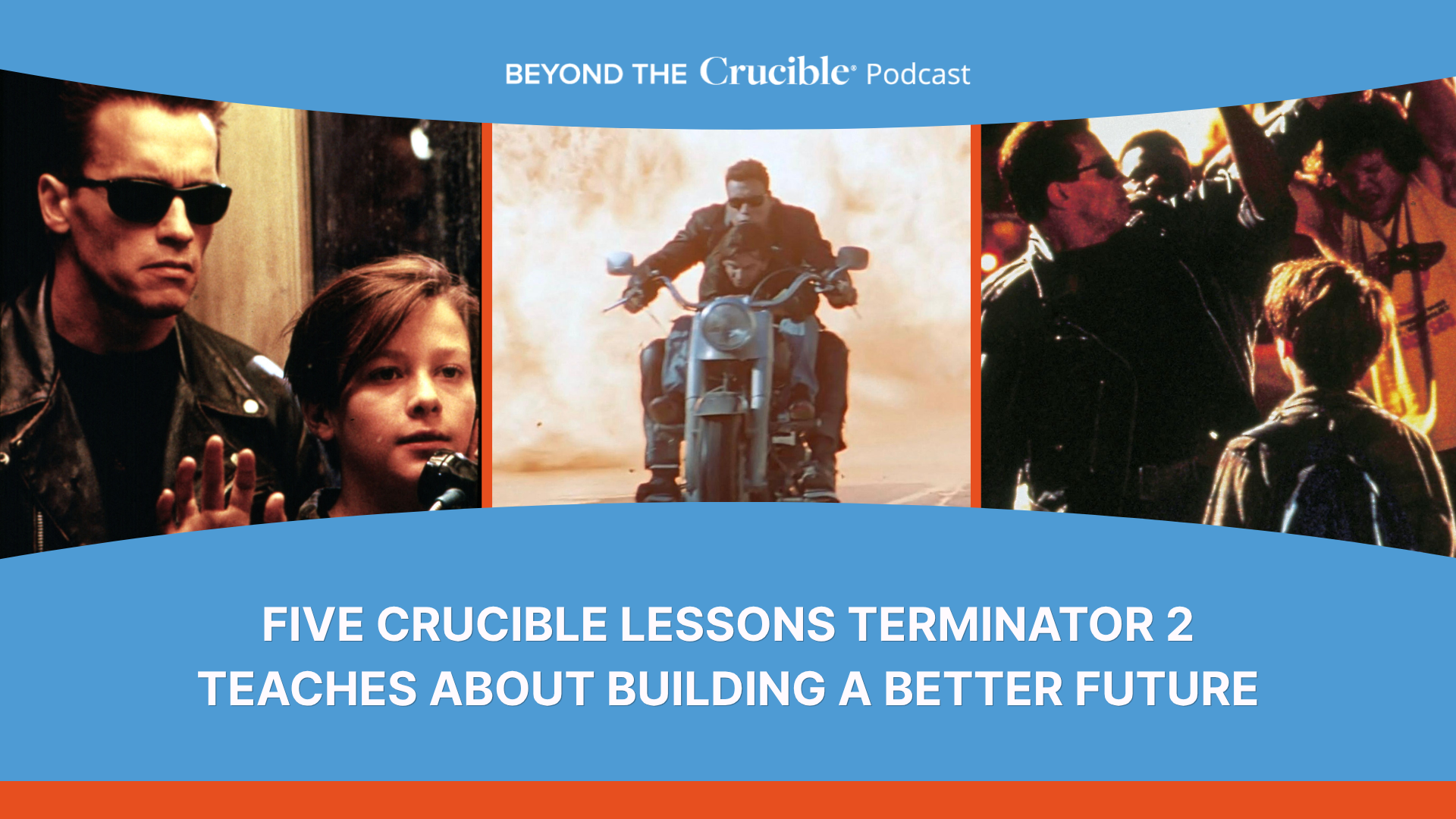
Five Crucible Lessons Terminator 2 Teaches About Building a Better Future
James Cameron’s Terminator 2: Judgment Day (1991) is remembered for its groundbreaking visual effects, unforgettable action sequences and one of the greatest plot twists in movie history.
But beneath the explosions, motorcycle chases and liquid-metal villain lies something even more enduring: a compelling story about transformation.
In the third episode of our summer podcast series, Back to a Better Future: The Crucibles of Sci-Fi Cinema, Warwick and I explore how Terminator 2 offers resonant insight into what it takes to overcome life’s greatest setbacks. The film’s characters aren’t simply fighting machines from the future, they’re wrestling with fear, trauma, regret and the question every person facing adversity eventually asks:
Can the future really be different? The answer, surprisingly, is yes.
Here are the five biggest lessons the film teaches about moving beyond our crucibles.
Lesson 1: Your past doesn’t have to determine your future.
The most powerful, resonant line in the entire movie isn’t spoken during an action scene. It’s the message Sarah Connor carves into a picnic table:
“The future is not set. There is no fate but what we make for ourselves.”
That’s also one of the foundational truths we explore at Beyond the Crucible.
After experiencing failure, loss or trauma, it’s easy to believe your story has already been written — that your mistakes, your pain or someone else’s decisions have permanently defined you.
The movie rejects that idea.
Sarah refuses to accept humanity’s destruction as inevitable. John refuses to believe his mother is crazy once he learns the truth. Even the Terminator, programmed to kill Sarah in 1984’s The Terminator, evolves beyond the role he was originally designed to play.
None of them are trapped by yesterday. And neither are we. The future isn’t something that simply happens to us. It’s something we help create through the choices we make today.
Lesson 2: The people who overcome crucibles become protectors instead of victims.
At the beginning of the film, Sarah is consumed by anger. Years of being institutionalized, dismissed and isolated have hardened her. She has every reason to become bitter. No one believes her warnings about Judgment Day.
But as the story unfolds, something changes. Her focus shifts away from her own suffering and toward protecting her son—and ultimately, protecting all of humanity.
That’s a profound transition. Many people who face setback and failure understandably remain stuck in asking, “Why did this happen to me?”
Healing often begins when we start asking a different question: “How can what happened to me help someone else?”
People who move beyond crucibles don’t deny their pain. They redirect it. Instead of becoming prisoners of what happened, they become protectors of others who may one day face similar challenges.
Lesson 3: Real strength is measured by sacrificial service.
One of the film’s greatest ironies is that the most human character isn’t actually human.
The Terminator begins as a machine carrying out a mission – albeit a different one than he had in the original film. By the end, Sarah realizes something astonishing: this machine never abandons John, never abuses him, never stops protecting him—even if it costs it its own existence. She concludes that, compared to every failed father figure John has known, this machine is the one that truly embodies unwavering commitment.
That observation points to one of Beyond the Crucible’s central ideas: Lives of significance aren’t built on power, status or accomplishment. They’re built on service.
Throughout the movie, the Terminator repeatedly chooses protection over self-preservation as it keeps John safe from the liquid-metal T-1000 that has been programmed to kill the boy. Eventually, The Terminator sacrifices itself completely so humanity can have a future.
The greatest leaders — and the healthiest families, organizations and communities—are built by people willing to place others ahead of themselves.
Strength isn’t domination. Strength is sacrificial love in action.
Lesson 4: Transformation happens when we choose growth over programming.
Every major character changes. Sarah moves from rage to hope John transforms from a rebellious teenager committing petty crimes into someone willing to risk everything for others. Even the Terminator appears to move beyond its original programming, learning the value of human life and acting with compassion rather than simple obedience.
That progression mirrors real life.
We all have “programming.” Some of it comes from childhood. Some from trauma. Some from painful experiences that taught us unhealthy ways of thinking or reacting. But our programming doesn’t have to become our permanent identity. Growth begins when we intentionally replace destructive habits with healthier ones. When we rewire our code.
The movie reminds us that change is possible — even when it seems impossible. If a machine can symbolically learn compassion, surely human beings can learn forgiveness, resilience and hope.
Lesson 5: Lives of significance are built one choice at a time.
By the film’s conclusion, every major character stands at a crossroads.
The T-1000 never changes. It remains committed to destruction until the very end. And it dies a horrific death.
The other characters, though, choose a different path.
Myles Dyson, whose work with artificial intelligence causes the Judgment Day of the title and the annihilation of much of civilization, decides to destroy the technology he spent years creating once he understands its consequences. Sarah chooses hope over vengeance. John chooses compassion. The Terminator chooses sacrifice.
Those decisions reflect one of Beyond the Crucible’s platinum principles: When we learn the lessons from our crucibles—and apply them—we move toward lives of significance.
Significance isn’t achieved through one dramatic moment. It’s built through myriad daily decisions. Will I choose bitterness or grace? Fear or courage? Self-protection or service? Hope or despair?
Our future is shaped by those choices.
Terminator 2 may tell the story of robots, time travel and artificial intelligence, but its lasting appeal comes from something much more personal: Every one of us faces moments when the future appears dark.
We experience betrayal, failure, illness, grief or disappointment. Sometimes our own “Judgment Day” seems unavoidable. But the movie reminds us that crucibles don’t have to become destinies.
We always have a choice. We can become like the T-1000, rigidly committed to destruction, anger and fear. Or we can become more like Sarah, John and even the unlikely cyborg hero at the story’s center — learning, growing, serving others and choosing hope.
Because, as Sarah Connor ultimately realizes, if even a machine can learn the value of human life, perhaps we can learn to overcome what has held us back, too.
Reflection
- How have you moved beyond believing your past automatically determines your future?
- Think of a time when you have sacrificed to serve someone else. How did it make you feel?
- What are you doing today, right now, to get you a step closer to the life of significance you’re pursuing?
To explore Beyond the Crucible resources, including our free Trials-to-Triumphs Self-Assessment, visit beyondthecrucible.com.
Enjoy the show? Leave a review on your favorite podcast app and leave a comment at our YouTube channel and be sure subscribe and tell your friends and family about us.
Have a question or comment? Drop us a line at info@beyondthecrucible.com
—

Don’t forget to subscribe for more leadership and personal growth insights: https://www.youtube.com/@beyondthecrucible
Follow Beyond the Crucible on Facebook: https://www.facebook.com/beyondthecrucible
Follow Warwick on LinkedIn: https://www.linkedin.com/in/warwickfairfax/
Follow Beyond the Crucible on Instagram: https://www.instagram.com/beyondthecrucible
Take the free Trials-to-Triumphs Self-Assessment to discover where you are on your journey of moving beyond your crucible and how to chart your personal course to a life of significance: https://beyondthecrucible.com/assessment/