
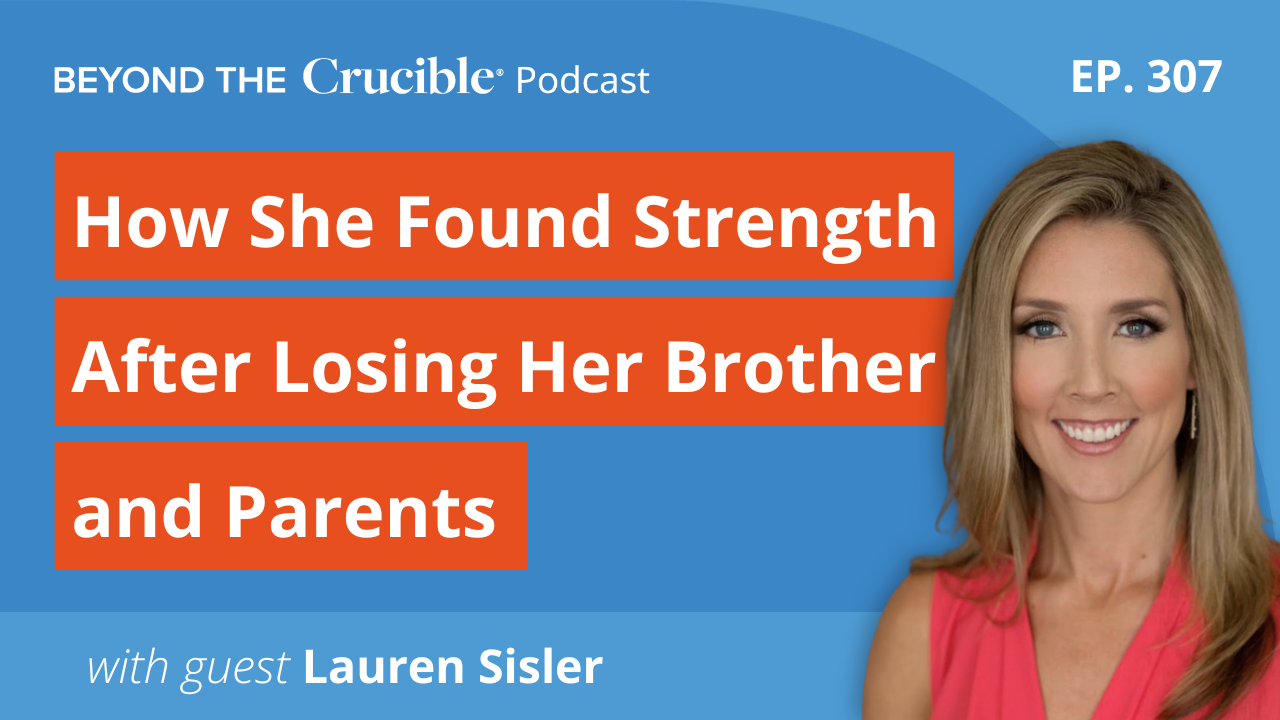
How She Found Strength After Losing Her Brother and Parents: Lauren Sisler
Content note: This episode includes discussion of loss and grief that may be difficult for some viewers. Lauren Sisler lost her brother, Allen, while on a speaking tour promoting her book SHATTERPROOF, in which she tells the story of how their parents died just hours apart of hidden opioid addictions. How has she kept moving forward after such a devastating pair of emotional body blows? She has moved beyond dwelling on the what-ifs that threatened to derail her recovery to embracing the what-is of her life today, which includes appearing in a documentary celebrating her brother’s life and shining a spotlight on the mental health of military veterans. To learn more about Lauren Sisler, visit www.larensisler.com To learn more about the documentary Dear Allen, visit www.116films.com
Enjoy the show? Leave a review on your favorite podcast app and leave a comment at our YouTube channel. And be sure subscribe and tell your friends and family about us.
Have a question or comment? Drop us a line at info@beyondthecrucible.com
—
👉 Don’t forget to subscribe for more leadership and personal growth insights: https://www.youtube.com/@beyondthecrucible
👉 Follow Beyond the Crucible on Facebook: https://www.facebook.com/beyondthecrucible
👉 Follow Warwick on LinkedIn: https://www.linkedin.com/in/warwickfairfax/
👉 Follow Beyond the Crucible on Instagram: https://www.instagram.com/beyondthecrucible
👉 Take the free Trials-to-Triumphs Self-Assessment to discover where you are on your journey of moving beyond your crucible and how to chart your personal course to a life of significance: https://beyondthecrucible.com/assessment/



Transcript
Warwick Fairfax:
Welcome to Beyond the Crucible. I'm Warwick Fairfax, the founder of Beyond the Crucible.
Lauren Sisler:
His life in the military was the thing that got him up in the morning, kept him going, kept that structure around his life, in probably many ways protected him from the pain and the heartache that he could be feeling on the other side with my mom and dad, and the loss of that, that tremendous loss that we faced in our lives, and when the military went away, I think he just lost himself. I think he lost himself and couldn't find his way.
Gary Schneeberger:
That's our guest this week, Lauren Sisler, talking about the trauma of losing her brother, Allen. What made it surrealistically more tragic was that he passed away while she was on a speaking tour promoting her book Shatterproof, in which she tells the story of how their parents died just hours apart of hidden opioid addictions. How has she kept moving forward after such a devastating pair of emotional body blows? She has moved beyond dwelling on the what-ifs of life that threatened to derail her recovery to embracing the what-is of her life today, which includes a documentary celebrating her brother's life and shining a spotlight on the mental health struggles of military veterans.
Warwick Fairfax:
Well, Lauren, it's so good to have you. We had you on a previous episode. Let me try and remember what it was. It was episode 163, more than two years ago, believe it or not. We're going to talk a bit about your book, Shatterproof, which we'll get to in a moment, and then more particularly about your brother, Allen. But before we get started, I'm going to let folks know a little bit about Lauren Sisler. Lauren is an Emmy award-winning sports broadcaster who joined ESPN and the SEC Network in 2016 as a sideline reporter for college football and gymnastics. She's highly sought-after speaker dedicated to helping audiences refuse to be defined by shame, inspiring them to fall in love with their own stories. It says Sisler and her husband, John Willard, live in Birmingham, Alabama. On July 4th, 2023, they welcome their son, John Mason Willard, otherwise known as Mason, into their family.
It is really exciting to have you, and we want to focus on Allen, but just we want to talk a bit about your backstory and your book Shatterproof. I actually have it here, if I can figure out how to hold it up on the screen.
Gary Schneeberger:
There you go. There you go.
Warwick Fairfax:
Something like that. Not used to doing this, so I apologize. There you go. What I love about this book, in the inscription, which you kindly wrote you have fallen in love with your story. Profound wisdom with that, which we'll get into a bit, but talk a bit about Shatterproof. I know you grew up in Southwestern Virginia, in Roanoke, so talk a bit about growing up, and in particular the crucible you faced with your parents. It provides a bit of a backdrop as we then shift to Allen.
Lauren Sisler:
Well, I really appreciate this opportunity. And I have to be quite honest with you, I'm a little smitten right now because I get to be on this podcast with you guys again, Warwick and Gary both. I consider you guys great friends and just so grateful for the opportunity to share my voice.
We talk about Shatterproof specifically. Shatterproof, whoo, let me tell you, labor of love. I started that journey a few years ago. It's actually probably been about four, five years ago when I actually started putting pen to paper, and here we are now just on this journey. Gary was a dear friend through the process helping me navigate just understanding how the book world worked, how the PR side of things worked, and ultimately, and I got to tell you guys, and I got to underscore this, I get the question a lot, why Shatterproof? Where did that title come from?
And the very amazing thing, because people said when you get to the title part of the book, writing the book is hard enough, and then you get to the title and it was like, wait a sec, you weren't kidding. This thing is hard. Wow. Trying to figure out the perfect title for the book. Really, Gary put it in perfect terms. He said, "It's like someone takes a baseball back to your life and shatters it into a million pieces, but through the human spirit, we have the ability to pick up those pieces and create a life of joy and of purpose with resilience." So it was perfect, and I'm like, "Wow, Shatterproof." And it really has stuck because I think about constructing this life where you have all these cracks, but those cracks are not weakness. They're really a symbol that you've lived, that you fought, that you continue fighting, and I think that's what's so beautiful about it, especially because in this life, we all face adversity, and adversity is something that we will carry with us in every single chapter
For me, that adversity really reared its head when I was a freshman at Rutgers, was on a gymnastics scholarship there, living my dream, and not only just my dream, but my parents' dream as well, because I grew up, it was me, my mom, and my dad, and my brother, Allen. My parents were super supportive of my gymnastics career. It was something I was so devoted to, so dedicated to. I knew that a college scholarship was the hope and the goal and the dream, and that was it, and so I was chasing after that for years and years and years. Finally, after 14 years of that gymnastics career, I signed that letter of intent, I'm off to Rutgers, life is good, life is going as scripted, until I get the phone call from my dad in the middle of the night, my second semester, my freshman year, to let me know that my mom had died.
It came as a complete shock as I sat there in the middle of the night in my bed taking that phone call because I had just talked to my parents on the phone. I always talked to my parents every single day. We were super close. They were my best friends. I had just talked to mom, just talked to dad. She's 45 years old. It's the middle of the night. None of this makes sense. He said, "Lauren, get on the next plane you can. I'll be at the airport to pick you up." Unfortunately, he never showed up that day. He, too, passed away. I just remember sitting in the backseat of that car when my uncle and my cousin came to the airport to pick me up instead to inform me that both my mom and dad were dead.
It turned my world upside down. It changed the trajectory of my entire life of what I knew, what I understood, and just the love that I had for my parents and the family and the close-knit part of our family, all of that was just gone. In those moments, I did feel hopeless. I felt broken, I felt shattered, and that's where the journey really began to picking up those pieces and constructing a life that truly is shatterproof.
Warwick Fairfax:
The circumstances surrounding that was, I think, very challenging. I think you write in the book that they'd had injuries. Back then, I guess more than they do now, they prescribed opioids to help with the pain management, and that led to something that it almost feels like is not their fault or unfair or just people didn't know. Explain that and then the challenge you had to accept what happened and the toxicology report and years going by before you look at it. Just help folks understand, because that's part of the challenge you had of accepting what happened, why it happened, and then not wanting to deal with it. Just talk to folks about that whole cycle that you went through.
Lauren Sisler:
Yeah. There is so much to unpack here, Warwick, so much to unpack, which is of course why I decided to write a book, because I had to unpack all of that. As you mentioned in my bio, my introduction that you did so great, I am a sports reporter, not an investigative journalist, but this really tested me in the sense that I had to dig. I had to dig deeper. I had to figure out and answer a lot of the questions that I didn't have answers to for years and years and years, because you get a phone call, my mom died, five hours later, my dad's gone. What in the world happened? It would really be months and even years before I would come to grips with that because I was so ashamed.
You talk about shame, that being the biggest thing that really took me under for years because I carried this shame of the nature of my parents' death, how they died, why they died, because my parents died of prescription drug overdoses. They died of fentanyl overdoses. I couldn't wrap my mind around this thought that my parents were both addicts. It just didn't make sense to me because we're living this life. We wake up every day, my dad goes to work, my mom takes me to gymnastics practice. They're involved heavily in all of our activities. They're always there supporting me and my brother, giving us all the love that we need, all the support that we need, and sometimes the discipline that we needed as kids.
But I just couldn't understand how all of this could have been going on behind closed doors, and nobody had any idea. My parents were going to a pain management doctor in Roanoke, Virginia. They were going there to get help. My mom had degenerative disc disease, multiple surgeries over the course of time, and then my father, he had chronic back pain as well as PTSD from his service in the Navy. They were going to this pain management doctor to cope with the pain that they were experiencing, but eventually that prescription, it started with Oxycontin and eventually just built its way up, and my mom eventually prescribed fentanyl because she couldn't manage the pain anymore. It just escalated. The hardest part of it for me is to put the label of addiction on their passing and then the shame that I carry, but reflecting on that, I recognize now that my parents fought this battle in silence because they, too, were carrying that shame.
That really has become my mission and this idea of falling in love with your story. It's something that's been a total work in progress. It continues to be a work in progress, learning to fall in love with my story over and over and over again, and as we'll get to some of that here in just a minute, as we talk about my brother Allen, it has been a journey. It has not been a linear path, but this idea that we live life and we have this picture-perfect idea of what life's supposed to look like, it just doesn't exist. That is where we have to find that resilience to keep picking ourselves back up and recognize that we can be sharpened and strengthened through that adversity, and that belongs to not only just our resilience, but our faith in the good Lord above and that God can guide us on that path and help us to pick up those pieces, and that He ultimately helped me to see that, no, I'm not broken. I'm not broken, I am human, and that through faith and determination and hard work, I can pick up those pieces and create a life of resilience and use it to glorify Him and to help other people along the way.
Gary Schneeberger:
Lauren talks a lot about falling in love with your story. I have to share, let me take my watch off so you can see it, but I'm wearing, Fall in Love With Your Story jewelry from your collection right there.
Lauren Sisler:
Yes.
Gary Schneeberger:
I'm also wearing right here in your honor, that's a Wonder Woman pin-
Lauren Sisler:
Whoo!
Gary Schneeberger:
... because that's who you are. The third thing that occurred to me, before we move on, is that both of you are people I came to know and work for because of one line in your story where for you it was you lost $2.25 billion. I'm like, yes, I'll sign up for that because there's pain behind that and there's a story behind that that people need to know. And Lauren, when I heard of your story about your parents, it was the same thing. It was, "Oh, my gosh, that is just heartrendingly unbelievable. I need to work with this person." So it's an honor, and then I'll be quiet, it's an honor to be here right now with one line. I got to become really dear friends with both of you, and I'm very grateful for that. I'm sorry, Warwick, you can ask more questions.
Warwick Fairfax:
No, no, no, no. It's so well said.
Lauren Sisler:
Thank you, Gary. I so appreciate that. Hey, nothing's on accident, and we know that, and you and I have talked about that. How many tears have I shed? How many phone calls... Literally, I would hit up Gary and text him, "Hey, do you have a minute?" and a minute would turn into an hour that we'd be on the phone just unpacking things and just walking through the challenges, and that's life, but that's why we lean into the people that we love and that have that wisdom that can help carry us through maybe some of the challenges that we face and the storms that life is going to throw our way.
Warwick Fairfax:
Let's talk about Allen. What was Allen like? What was he like growing up? It was just the two of you, and you had these sort of cute nicknames for each other. Just talk about who he was and just as a little kid, that fun-loving little Allen running around.
Lauren Sisler:
Little Allen. Oh, yes. It's funny because our last name is Sisler, and so growing up, we always ran together. It was my friends, his friends, and he was always known as Big Sis and I was Little Sis, but then we referred to each other as Elsis and Asis. So Sis has been it. The Sisler name condensed to Sis has been in the bloodline now for many years, and so we always had those little nicknames for each other, but we grew up, Allen was just... I smile about this because he was one of those that... I don't know, I don't want to say that I'm like a rule follower, but I would say I'm probably a bit more of a rule follower. My brother, on the other hand, pushed the limits on everything he did.
I always say this, he was the guy that went out and sought out adventure, and he would gauge how much risk was involved in that adventure or the decisions and the things. If risk was not attached to it, he wanted no business with it. There had to be some sort of risk. That's just how he lived life. I joke about it, but I talk to my family and I was the little tattletale. I was the one that'd be like, "Eh, Allen did this, Allen did that." That was just who I was and how I was with him. It's just funny because we would obviously pick at each other and argue and we were always competitive and always all the things, but then also we had our moments where we just got along and we loved on each other, and I looked up to him. Allen was two and a half years older than me. I was born in '84, he was born in '82, so of course I say '80s babies, born in the 80s, raised in the 90s, good times to be had by all.
We were very close and I was always supporting him in his sports and all that he was doing. He was an athlete doing football, baseball, basketball, also a big NASCAR guy, worked for a local pit crew at the New River Valley Speedway where we grew up in Roanoke, Virginia, then of course moved to Giles County out in the country. We used to go to the NRV Speedway, the New River Valley Speedway, and he was on a pit crew and I would watch him down there doing his job and just the excitement and all of that. There was always a lot of love and support, but we grew up in that kind of era where it was literally 10 bikes sitting on the front lawn. Everybody would ride their bikes around the neighborhood. We'd play flashlight tag. We always had so much fun playing flashlight tag as kids.
The days that we would ride up to the local pool, and my brother had one heck of a cannonball, a jackknife, whatever you call it, that was him. He just did things and I always was like, "Oh, look at my brother. He's so cool." I admired that and I definitely hung my hat on that. As we got older, he got his license when he was 16 and I was the little sister getting a ride to school with my big brother and felt cool in the jacked up F-150, Big Blue, they called it. My brother was just, he was a personality and, people will tell you, a character for sure, very much charisma. People say I have a lot of charisma. I think my brother had a lot of charisma, a lot of energy, so we were very much the same in that sense. My brother didn't know a stranger. That was, I think for him, he had a love for life. He just did life really hard. Like I said, if there wasn't risk involved, he wasn't interested. Peace.
Warwick Fairfax:
You obviously did gymnastics and then became an ESPN sideline reporter. Talk a bit about his journey. What did he do in life? What was his passion?
Lauren Sisler:
Well, and I have to tell you, when I made that journey into sports broadcasting, it was always so fun to just... I always would get those text messages from him on game day, like, "Kick butt out there," and "You're going to do great." He'd be tuning in. That was something that was really special to me, and I'll say that because there were times where it was a challenge when I would reflect and think, "Wow, my mom and dad aren't here to share in that moment." I can only imagine what my mom and dad would be saying right now with the DVR on or tuning into a live college football game, my mom commenting on maybe my outfit or my hair and my makeup and giving me pointers and complimenting me like she always did. But for my brother, his journey looked a lot different than mine.
I mentioned to you my dad struggled with PTSD, and it was something that was from his service in the military. I was actually born in Guantanamo Bay, Cuba, so I was born on the naval base there, which is pretty cool. Always have said I'd love to go back there. Of course, now is not a good time, but at some point my dad had always said going back to Cuba would be really cool. He was stationed there. That's where I was born. My brother obviously was born on the Naval base, was born just outside of Millington, Tennessee when my dad was also stationed there. So military was always like in the blood. My brother knew from a very young age he wanted to pursue a military career. That was it for him. He had all these dreams of going in the Navy, following in my dad's footsteps.
I think ultimately my brother would've loved to become a Navy SEAL, but we all know that is the elite of the elite of the elite of the elite, and only a small percentage of people make it. Unfortunately, my brother had some injuries, some baseball injuries. He had a chip in his elbow from when he played baseball, and he just really struggled with some of the testing that required the physical testing, that those injuries would percolate and be a little bit of a setback for him. But for my brother, it really was about serving his country. That's all he wanted, to serve his country and serve it with great pride. That's what he did. He was a parachute rigger in the Navy. He was stationed in Norfolk, Virginia for pretty much his entire military career and then of course did three deployments, Operation Enduring Freedom as well as Operation Iraqi Freedom.
That was a big deal to me, that was a big deal to my parents. I'll never forget the day, man, this is crazy, reflecting on this moment back when 9/11, when the plane struck the towers, and he had actually been home on leave. He was actually staying at a friend's house. I remember that happening. My mom was supposed to fly out that morning. She was flying to Charlotte. She was going on a trip with my aunt and uncle. Of course, I panicked because I'm like, "Well, my mom was supposed to fly. My mom never flies." So she happens to be on a plane this morning. SI remember using my gym teacher's cellphone, because y'all, this was back before we all had cellphones. So I'm panicking. She lets me go in her office. I use her cellphone. I call, I can't get in touch. I had to page my dad, page, pager, that was back in the pager days, page my dad at the VA, the Salem VA where he worked, the Veterans Administration.
Then I immediately called my brother because I knew the friend's house he was staying at. I called and he was still asleep, because it was early in the morning and he was still asleep. I'm sure he was enjoying sleeping in, considering he got to be on vacation, so to speak. I woke him up and I said, "Allen, turn on the TV. You're not going to believe this." It was just a moment in time that I'll never forget because he quickly came home. We went home and then basically his commander said, "Hey, you've got to get back to base. It's time to pack up. We're going to deploy." Within a matter of just a couple days, he had to pack his bags, he had to get back. I'll never forget, we ate at the Red Lobster. That was the place, Red Lobster. I love me some Cheddar Bay Biscuits, y'all. Some Cheddar Bay Biscuits.
We ate dinner and we said our love yous and goodbye, and my dad hugged my brother and he said, "I love you, son. God speed." I just remember that being such a prolific moment because my brother gets in his truck and he goes back to Virginia Beach where he would do his first deployment. I know that obviously it was probably an anxious time, but also an exciting time for him because he's like, "I'm about to go fight for my country. I'm about to put my boots on the ground." Of course he was in the Navy, so he was on the aircraft carrier for much of his deployments, but spent different time doing some different operations and obviously on the ground at times. But that was his moment to show up for his country. I remember they were deployed for... Actually, the Theodore Roosevelt was the ship that they were on and they were deployed for the longest length of time. They set a record for longest time out to sea without porting, and so that was a big deal.
I remember we would hear from him maybe every once a week, maybe once every other week via email, maybe get a phone call once a month. It was a big deal to hear from my brother. I remember when his ship was coming home and just the excitement, we were all just so excited. I laugh about this, but my mom and I would be driving to gymnastics practice and the Green Day song Time of Your Life would come on. We would just sit there sobbing, waiting for my brother to come back home, just so anxious for that moment. Finally it happened, and we come back home and all the TV stations are standing around and they want to interview him, and of course my brother gets off that ship.
I remember the ship coming into port and the guys all lined up around the outside of the ship, the men and women on the outside of that ship. It said, "The boys are back in town." That was the song that was playing. I can remember I, The Boys are Back in Town. I just remember, so anytime I hear that song, I just get so emotional and I'm like, "Ah, they're back, they're back. They're home, they're home." I just remember that moment because he's home and I just see the pride. My mom and dad were just so prideful, just so happy their son was home, their little boy was home. I was so proud, the proud sister that got to see my brother go and fight for his country in a time of desperation and of war when our country was ultimately shattered by this terrible terrorist act. I was just so proud of him. Unfortunately, a year to the day that his ship came back home was when my parents passed away. I think that is where his journey began to take a turn for both of us. We both experienced something very different.
When my parents died, I was at Rutgers. I went home for 10 days. We buried both of my parents. I went back to Rutgers where I had all the love and support of my teammates and my coaches and everyone just cheering me on and saying, "You got this, Lauren. You're going to get through this." My brother, he strapped on the boots and he went back to war. I think in some ways that's maybe how he coped with the devastation of losing our parents, whom he also considered his very, very best friends in the whole wide world. I think in a lot of ways he struggled with that, but buried a lot of that pain and that grief because that's what he was trained to do. That's what he was conditioned to do. You're in the military, you're strong, you don't show weakness, you battle, you go to war.
I remember at times I would call him just crying like, "I miss mom and dad. I miss mom and dad," and he's like, "Lauren, you got to quit crying. You got to strap on the boots and go to war." That was like mindset, but I think deep inside, he was hurting so badly and he wanted to acknowledge that pain, and he just couldn't.
Warwick Fairfax:
Amidst all this, it seemed like there was another turning point in Allen's life in 2012, when there were budget cuts. Talk about that because I have a feeling that was an incredibly difficult moment for Allen. So talk about what happened.
Lauren Sisler:
Yeah. My brother, as I mentioned, he served three deployments, 12 years in the Navy. 2012 rolls around, and this was a moment in time, much like his deployment that I also remember very vividly. I am a reporter at a local CBS affiliate here in Birmingham, Alabama, living my dream, doing this whole sports broadcasting thing. I'm about to cover an Alabama football game and we're about to walk into the stadium. My brother calls me on my cellphone and I answer. He told me, he said, "Lauren, I'm getting discharged from the Navy." I was just like, "What?" He said, "Lauren, we've done everything we've can. We've done everything we can. We've appealed it. We've done everything we can, but I'm getting kicked out." I couldn't understand it, but I remembered hearing in his voice the devastation, the disappointment, maybe the fear of failure that he had failed.
That was the first time, really, that I felt the weight of his grief. We were grieving mom and dad together, and I think we shared that grief, but then suddenly in this moment, I felt the weight of his grief that his entire career, his 12 years of military career, his dedication to our country was being yanked away from him, and not by choice. I think that was the biggest challenge because he didn't want to leave the Navy. He didn't want to get out of the Navy. He wanted to serve his full 20 years and retire, whatever that looked like for him, but because of budget cuts during that timeframe, they came in, and the government essentially cut a third of all military forces.
What happened to my brother, and I didn't quite understand it, but it's some things that I've pieced together now after talking to his commanders who I've been in touch with, who I've spent time on the phone talking to, was that because my brother actually had a break in service, he basically went in the reserves for a brief period of time when my parents passed away, trying to figure out what he was going to do, taking care of his little sister, all the things that therefore puts him in a pile of, "Hey, you got to go." I think because of that, the metrics and the database and however they crunch numbers, they determined that he was one that was expendable. He's one that we can let go. To me, that is just devastating because I do think in many ways the military failed him. I think that he gave his life to the military and didn't want to want to leave the military, and unfortunately that's ultimately what happened to him.
Warwick, I think a lot of his identity was tied to his military service. I think that is what he saw himself as. I think that idea of him being a brave soldier, a courageous soldier, his life in the military was the thing that got him up in the morning, kept him going, kept that structure around his life, in probably many ways protected him from the pain and the heartache that he could be feeling on the other side with my mom and dad, and the loss of that, that tremendous loss that we faced in our lives. When the military went away, I think he just lost himself. I think he lost himself and couldn't find his way.
Warwick Fairfax:
Talk about that, because after he left the Navy, what happened? What was his journey from that point?
Lauren Sisler:
Yeah. It was a challenging journey because as he got out of the military, he went back home to Virginia, went back home to stay and live in my parents' home. Just to outline that piece of the story, when my parents died, there was nothing left. There was no will. The cars were repossessed, the house went into foreclosure. We were left with nothing. I'm talking nothing. We were stripped of everything. Thankfully, one of our teachers at our school actually helped fundraise some money to go back to that auction and buy back a few of the items that we felt were meaningful and mementos of my parents.
But then also, the house went into a foreclosure and my brother did everything he could to keep that house. Because that was my parents' dream home. My parents built that house. They wanted to be out in the country and enjoy the countryside. My brother thankfully was able to work with the bank to buy it out of foreclosure and they had to jump through some hula-hoops to make it happen, but thankfully, by the grace of God, he was able to keep the home. So when he got out of the military, he went back to Virginia, back to God's country, as he called it, back home, but I sometimes think that that might've also been a bit of a detriment to him because that was the home that we grew up in. That's the home where I say we grew up in from middle school, high school and beyond is where we spent our time.
My brother, every time he had a break from the military, every time he got a day off or a weekend off, it was him and his Navy buddies all coming to Giles County, to Newport, Virginia, to spend the weekend where my mom and dad would just love on them and mom would cook them meals and biscuits and gravy and all the things. So there were so many memories in that home, andy brother went back to that home where I think there was a bit of emptiness, and it was never going to be the same. Home was never going to be the same. Yeah, and I think that when he went back home, he just lost himself in that journey. For him, I think trying to cope with the loss, finally maybe the realities of my parents' death and him not dealing with it and him not working through the tragedy and the trauma and all of that, I think that was all just... he was confronted with it, and confronted with it in probably the worst kind of way.
So for him, I think his coping mechanism really became alcohol. For him, it was, maybe this will ease the pain, maybe this will get me through to the next day. I do want to mention, too, my dad struggled with alcoholism at a younger age. Prior to my dad and mom struggling with prescription drug addiction, my dad did struggle with alcoholism. It was something that he had to go to meetings and see counselors and really work on it. It was something my dad did work on. It was something that he could maintain sobriety for several months and then he would have a relapse here and there, but for the most part, my dad was managing it and he was functioning in this process.
I think that there is a hereditary, we know a hereditary component to it, and so I think that alcohol was something that really became the coping mechanism for my brother, and because of maybe that genetic predisposition to it, it really just became a part of his life and something that he turned to to help him navigate this new life while he was trying to find his new identity.
Warwick Fairfax:
Talk about November 8th, 2024.
Lauren Sisler:
Yeah. November 8th of 2024, I will say that at this point I am coasting on a high because, and Gary will speak to this, October 1st of 2024, we released Shatterproof, and it was this exciting time, the, "Wow, we did it! We're here!" I got to be honest with you, my brother was one of my biggest cheerleaders. Here's the thing: my brother, he held the keys to the car in the sense that I wrote the book, but if he would have come to me and said, "Lauren, I'm not okay with you releasing this. This literally bears everything about our family, the history, the addiction, the loss. Everything." He could have easily said, "Lauren, I'm not okay with this." But he didn't, and he supported me in it, and he provided a lot of color commentary throughout this journey, filling in a lot of the gaps, the holes, the black spaces of the timeline of things that happen, better understanding things.
He gave me his blessing. To me, that was so, so, so important. So we're riding this wave, riding this high, every single news appearance I did, article, whatever it was, my brother was calling me, texting me, letting me know how proud he was and how excited he was. Of course he keeps saying like, "New York Times bestseller, here we come!" I said, "Well, we can limit our expectations here, buddy." But hey, you know what? In his mind, it was a bestseller, I'll take it. Just amazing.
So I'm doing this whole media circuit. Life is good. We're doing it. I did it. I'm exhausted. I'm tired. It's football season. I'm doing all these media things. I remember I'm traveling to Arizona for my... it was Arizona State game, and I travel out to Tempe, Arizona. I turned in for the night. I talked to my husband. We were texting, and then I fell asleep. I always put my phone on Do Not Disturb. I call it moon mode. Just because I have so many alerts going off, I wouldn't get any sleep if I kept it on. My husband tried to call me on my cellphone in the middle of the night multiple times. I did not answer because I was fast asleep.
So then I suddenly hear my hotel phone ringing and I sit up, and of course it's the middle of the night once again. I just, like, "Why is my hotel phone ringing?" and my heart just stops. I immediately think about my son Mason, our son Mason, who's two and a half years old, like, "What's going on?" I suddenly think the worst and I pick up the phone, "Hello, hello, hello?" That's when John said, "Lauren, Allen's dead." I just sat in that hotel room just a million miles away from home, a million miles away from anybody, just struck by that pain of hearing those words, something I feared for a long time, honestly.
But also, I unfortunately have spent a lot of my life and it's something I've had to work through, but let me tell you, getting a call in the middle of the night, I did it before with my parents and it's like, "Here we go again." I couldn't believe that my brother was gone. It was me and him. We were in this thing together. It was me and him, and I'm like, "Why?" I just couldn't understand it. My brother's 42 years old. He still had so much life left to live, just like both of my parents.
The whole thing is just such a tragedy and I feel like so much of it was a domino effect, that one thing spiraled into the other and I just, for my brother to be one of the strongest people I know, hardheaded in so many ways, I'm like, "Allen, why couldn't you have fought this thing?" It's just hard for me to understand one of the strongest people I know and that ultimately he was dragged down and consumed by the demons and the pain and all those things, and ultimately that he couldn't survive. Alcohol ultimately was the thing that took his life, the thing that eventually put his body into a tailspin and that's ultimately what took his life.
Warwick Fairfax:
Recovering from what happened to your parents was unthinkable, but then with your brother, it must have been like, "I don't know that I can do this again." And as you said, it feels like one domino related to another. I'm sure you were thinking, if my dad had been around, he suffered from alcoholism, maybe my dad could have helped Allen. Maybe, "Hey, buddy, I know where you are. I'll go with you to meetings." You're not there. Not that you were with him, but having somebody that's been there, I'm sure all those thoughts probably flooded through. It's like, why God? It's so unfair. I can't take one more. Not Allen, not Allen. Not him. Please not Allen.
How in the world did you even begin to think about trying to cope? Because you've got a husband, you've got a son. How in the world did you even begin to try and deal with... tragedy doesn't even capture the right word. It's just unspeakable, horrendous pain. How in the world did you find a way to even begin to not move on, but move with, cope, wake up another day?
Lauren Sisler:
Yeah. I think that's such a great way to put it because you don't move on. It's been coming up in March, it'll be 23, March 24th of 2003, so we're coming up on the 23-year mark when my parents passed away. The pain doesn't get easier, and there are chapters. I think one of the hardest things, you mentioned my husband and my son, my husband never did meet my parents. We met after my parents passed many years after. Mason will never know his grandparents other than the stories and the memories I share, much like my brother.
I just think, when I look at Mason, there's certain things that he does that he'll just have this little grin and his little nostrils will flare out, I'm like, "That is my brother." Oh, my gosh, Allen, you are there. That is you. There's that moment of happiness, I'm struck with joy reflecting on those memories, but then I'm also struck with a sadness because I think, man, I want my brother to experience this joy, the laughter. My son loves monster trucks, and that was something my brother loved, monster trucks. I don't know, I just see things that he does and I'm like, "I wish Allen could be here for this. Maybe it could have brought him joy amidst his pain and his suffering." I just want to fix. I want to fix it. I want to fix it. I wanted to fix my brother. I wanted to fix it. I wanted to save him.
For years and years, I tried so hard. I tried so hard to save him. I walked on that journey with his struggles and things... He would get better and he would be fighting and he would be standing tall and he would find his confidence again and he'd be working a great job and life would be good, and he would take 10 steps forward and 20 steps backwards. It just felt like this tug of war for so many years. But I remember sitting on the floor of my bedroom after my brother had passed away and I just felt this brokenness that I was like, "I'm not going to recover from this. I'm not going to recover from this."
I thought that when I lost my parents, I had this suit of armor on, this suit of armor that would protect me from any grief and any pain and I can get through anything. Well, who am I to think that that was even possible, to not feel the weight of my brother's death and the way that I did? As I'm sitting there on the floor, I had my book, I was sitting on the floor, I had my book, which held a whole different meaning after his passing, and in some ways a lot of pain. I didn't even want to open the cover of that book. I didn't even want to look at it. I was just like, "I'm done." the bracelet that Gary mentioned, that I'm in Love With My Story bracelet that he's wearing, I had one of those bracelets sitting there next to me as well, and I just remember being like, "How am I supposed to love my story when this is my story? How am I supposed to follow in the footsteps of my own words that I share with people every day when this is my story?"
But I also go back to my pastor, Pastor Chris Hodges at Church of the Highlands. He called me that day when I got home off the plane from Arizona and I remember just being just sad and broken and devastated and still processing, and almost numb in some ways, just feeling every emotion you can think of. I was ready to light it all on fire. I'm done with it. I'm done. I'm done. I'm not talking about it. My story, light the books on fire. Shatterproof, go. I don't want to look at you ever again. He said to me, he said, "Lauren," he said, "We're not going to let you be silenced. We're not going to let your voice fade away."
I just remember that and how profoundly... and he said it probably a little bit more eloquently than that, but I just remember him telling me that, "We're not going to let you quit." And I'll be darned because I was ready to light it all on fire and literally turn the page to 2026, or 2025, I should say. I ended up doing 73 speaking events. Mind you, I had no desire to get up on stage again, no desire to share an ounce of my story. I got to tell you, I think it's all God. He just gives us the strength to keep going.
Gary Schneeberger:
There's a letter, and we'll talk about it later when Warwick pivots into what you're doing in Allen's memory, but there's a letter that you wrote him, and I've been looking at it as we've been talking and something that I didn't see the first time I read it, I think it's a God thing that just came in my mind. This is what you wrote, and this is where we talked about the bounce-back of someone's crucible. This is the first part of our bounce-back section. This is you writing this open letter to Allen: "Unfortunately, we can't remain trapped by the what-ifs in life, because then there will never be a path forward."
When I saw that phrase, the what-ifs in life, I realized, knowing you, what you've done, how you've asked the question, how do you bounce back when the second tragedy hits, and I think what you did about the what-ifs is you said to the what-ifs, "Get the F out," and by that I mean, get rid of the if, and it becomes a live in the what-is. That's what you've done, Lauren. You've lived in the what-is. The F is out of the what-ifs. I hadn't thought about that until I sat down-
Lauren Sisler:
Wow.
Gary Schneeberger:
... and we started recording this episode.
Lauren Sisler:
Wow. See, Gary, that's why you're so good. I told y'all, he's got the PR prowess over there, my boy Gary. It means a lot to me. Just for those of you listening, I wrote this letter to my brother. We're working on a project, and I know we'll talk about this more with Alabama Veteran, an organization that my brother volunteered with here in Alabama that helps with veterans and just their health and getting them back on their feet and giving them resources and really just helping them to restore hope in their lives, and as I was working on this project, I had written this letter. I'd already shot the video, so we've already done it. At this point, I am literally just sending it to Gary because I just want him to read it and to just be in it with me.
It's interesting how there's certain people in our lives that we feel called, because really, there was nobody else other than my husband that really read that letter. I just felt called to send it to Gary and to just maybe get his words of encouragement in that. It just means a lot to me that you took the time to read it and sit with it and be with it. You didn't know Allen. You learned some things about him during this journey as we were working on the book and publishing the book and getting it out there, but for you to be able to see that and pull from that, that's so, so, so powerful. Just to come full circle on that, being trapped in the what-ifs, it's so easy to get trapped in it. You literally just articulated what I was trying to articulate there. That's incredible. It's amazing.
Warwick Fairfax:
Yeah, that is so profound. Yeah, the what-ifs can be a trap. I'm not a big spiritual warfare person, but yet I realize it does exist. I like to think about it, to be honest, but I feel like in that moment when you were on the floor and you had your book, you were probably thinking at least, most would, Shatterproof, I'm shattered into a million pieces. Love my story, I hate my story, I loathe my story. Okay? I'm shattered, and I hate my story. Most humans would be feeling that, but yet through the Lord, through your past, a husband, I'm sure other friends, you were able to maybe not pick up the pieces, but maybe have the Lord help you pick up the pieces.
Says, "Okay, I do feel shattered. I do feel like I'm in a million pieces. I do feel this is so unfair. It's one crucible too many. One last too many. I can't take this one. I'm done. I'm done." But yet I feel like, I don't want to put words in your mouth, but somehow that God gave you strength where you had none left. You were a strong person, but who can withstand that kind of... Obviously it must have been the Lord saying, "Lauren, you've got a message that needs to be heard and need you to speak." Then it seems like, I'm sure it must have been the Lord, too, you need to speak for Allen, because his voice needs to be preserved and there's a mission to help others like Allen.
So just talk about that, because I'm sure you had a lot of conversations between you and the Lord that... You talk about the pit of despair. I just can't even begin to think how horrendous those first few days and weeks. So talk about what you do now to honor Allen's memory, and as time would assume, how the Lord helped you get out of that pit, not that you're still not grieving, but to be able to function because you have this little boy that needs you there every day, and a husband. Just how did the Lord help you out of it, and tthen how did that pivot to this mission you have with Alabama Veteran and the documentary you're doing? How did that all happen to get from the lowest of the low to doing what you're doing now to honor Allen and his memory?
Lauren Sisler:
Yeah. Oh, that's so good. You're right. The message piece of it, because this message, I feel like in a lot of ways, as I've been on stages and been in rooms and just one-on-one meetings with people that have come into my life, I've been speaking on behalf of my story and my journey and losing Mom and Dad, but in many ways I was carrying Allen's voice, too. It might have just been a little bit more in the background, because my brother wasn't someone... he didn't shy away from sharing it, but he definitely was a little bit more private about it and would share with people and friends, but a little bit more in closed settings.
But again, he was proud that I was out there sharing the message with the world and that I was public about it, and he was okay with that and he supported me in that, but taking that next step, you said it there, Warwick, that this is an opportunity for me to continue his journey, the one that I feel was cut short, that I can be a voice for him through the hard and the struggle and the pain, just as I've been for my parents for so many years. I now can take that, and instead of looking at it as a sad thing, it's, wow, what an honor. What an honor that I get to carry on his memory and his legacy. I take pride in that I might be the last one standing in the Sisler family right here, right now, but I'm telling you right now, I'm going to give it everything I've got and make sure that my parents and my brother's memory continues to be served well.
That's a lot of what we're doing. I'm actually working on putting together the Sisler Family Foundation, a place where we can gather funds to support organizations that are doing great work, ministries that are doing great work, veteran organizations, addiction, prevention, recovery, all the things that I believe in and that I believe can do great work in restoration and redemption, because we all need hope. We all need hope in this world. Really that's how I got tied in with Alabama Veteran specifically because my brother was actually doing some work with them. He moved to Alabama here in 2016. It was something Little Sis here was like, "Hey, get your butt down here. I'm tired of you being a million miles away. You're out of the military."
Really I knew that it was time because he was back at the house, at my parents' house, and the upkeep on it was a challenge of just him and his dog Scout. Also, too, I just felt like he was fighting off a lot of the demons that lived there that were part of that chapter of his life. So I said, "Let's get to Alabama." He came here in 2016. I have to show you guys my shirt real quick. I know this is going to be edited, but my mellow yellow shirt, Cole Trickle, is from Days of Thunder.
Gary Schneeberger:
We're going to leave that in there. We're not going to edit that out. We're going to leave that in there.
Lauren Sisler:
Oh, I know, but you have to make sure you get me on full screen there. Days of Thunder. I mentioned NASCAR. Talladega, biggest track on the circuit here in Alabama. I got to finally take my brother out to Talladega, and what an experience. We ordered these shirts and were twinsies obviously showing up to the race, and that became our tradition. We would go out to the race wearing our Days of Thunder shirt. It was just cool to get him here to Alabama, but I think for him, what was important is trying to establish his own life, his own friends, his own community. I think that was a challenge for him at times because when things were going well, he'd be out in the community, he was doing small groups, he was going to church. He was trying to make his way in this community, but then of course, when he would have setbacks with the alcohol and the drinking, that pulled him back and retreated into his own isolation, and a lot of those relationships would fall to the wayside.
He was connected with Alabama Veteran I think a year or two before, I guess about two years before he passed away. It was really cool just to hear his passion for it. He was volunteering at these retreats, helping other veterans walk through their journey, walking through their crisis, walking through their tragedies, walking through their stuff, and just hearing his passion for helping others was just so amazing. Then he was attending the retreats as well, getting his own help and walking through the things that he was experiencing internally. It was such a beautiful thing. This project that we're working on called Dear Allen, one of the guys that works with Alabama Veteran, who's also a veteran himself, his name's Will, approached me and said, "Hey..."
He and I have gotten to know each other over the course of the last year or so and said like, "Hey, We loved your brother. We love Allen. We want to honor him the best way that we can." I think really this project for Dear Allen, it will be somewhat of a documentary to share in Allen's life and his legacy. It's not necessarily just to focus on the spiral, so to speak, and the pain, but also the focus on the grief, right? Because we all experience grief. It's this idea of that empty chair. When you sit around the dining room table, there's now that empty chair that that person is no longer sitting in and it's now vacant. How do you hold space for that grief and help others along in that? Then also, too, focusing on veteran health and the importance of just helping our veterans who come home from their military experiences, how to acclimate to life.
In my brother's case, I think acclimating to life when the military is no more, when that identity is gone, where you feel like your identity is fighting for our country, and that is no more. What does that life now look like? How can I find purpose in my life that isn't tied to carrying the American flag on my back and being a soldier?
Warwick Fairfax:
I guess a couple of thoughts in my mind is just, what you're trying to do is preserve the legacy of who Allen was through this documentary and through the work you do with Alabama veterans, but I was sort of struck by just some of the fun things about Allen. His legacy is helping people obviously try to get help when they need help, but just preserving the memory of the fun-loving person he was. I love the nickname that he gave your son, who was born on a special day. That is so cute. Then in the trailer I think for the documentary, it is putting a number of special things in a glass container. One I think said Virginia Tech, I don't know, I think it was... Then it threw me for a second, it was Chevy Chase, Christmas Vacation?
Lauren Sisler:
Yes.
Warwick Fairfax:
Which I guess, yeah, we want that at Christmas, too.
Lauren Sisler:
That was a movie that he quoted all the time.
Warwick Fairfax:
Well, it's such a wonderful, fun movie, but it just gave a bit of a window. Just so the listeners and viewers would understand, what was the nickname that he gave your son, and why? Because it's such a cool nickname.
Lauren Sisler:
It was America Mason. If there's somebody that is more proud, it was my brother, that he was born on July 4th. He's like, "America's birthday. Heck yeah." Incredible. It was always America Mason. He loved that so, so, so, so much. He just always said, "What's America doing right now?" I just think it's so sweet. I think about the last interaction that he and America had. My brother had actually, him and his girlfriend had put together this cute box that had his name on it, Mason, and it was red, white and blue in his very 4th of July theme. It was for his birthday. It was some clothes and some toys and some different things. There was a lot of camo in there and American flag stuff and books. It was actually cool. My brother had given him this Navy book for kids that outlines all the different positions in the Navy, the little sailor. It was cool to get that out and read that to Mason.
That day he came downstairs from his apartment and had brought that box down. He had opened the door. Mason was napping and had just woken up from his nap and he leaned into the car. He kissed Mason on the forehead and he said, "Your Uncle Allen loves you." That was the last thing he said to Mason. It just sucks so bad that Mason won't remember that because he was just over a year old. But I just, when you talk about preserving legacies, I look forward to the day that I can share those memories with Mason and that he will understand those memories and that he can look at a picture.
This was my brother's military picture here that you can see. One day he'll see that and be like, "Who was that?" and being able to share that with him and to understand the significance of the folded flag. Just I hope that even though Mason never met my parents and very briefly met my brother, that he will carry so much pride in his heart for the Sisler legacy and the people that came before him and laid and paved the way, especially for his mama, and helped to direct that path. That's important to me. I am hopeful and I am faithful that he will share that same love for my parents and for my brother Allen.
Warwick Fairfax:
Just as we begin to wrap, just really talk about your heart for this documentary and the work you do with Alabama Veteran. Obviously there's the work you do with Shatterproof and then there's this other mission, the mission you never wanted to have, but you have now, so just talk about what's on your heart for that mission and that legacy as you move forward.
Lauren Sisler:
Yeah. It's certainly not a mission that I ever wanted to have, but I will say serving veterans has always been on my heart and certainly has been magnified in the wake of my brother's passing. I think a lot of it is because so many people wear scars that are always unseen. We all do. Some might look at my journey and say, "Well, wow, she got to the finish line." Oh, let's be honest. I ain't even got close to the finish line. If I'm being honest, my brother made it to the finish line in heaven with the good Lord above and he is up there just dancing and having a time with my parents. So if there's someone that's met the finish line, it's definitely him and probably on the better side of things as we know the struggles that we all face as humans down here on earth, but our journeys look very different, even through the same experiences.
I think everybody walks through tragedy, disappointments, failures very differently, and I think that everybody's journey is different, but that's what makes this life beautiful, that we're able to take our stories and connect one another in various ways, learn from one another. I think that's what I'm hopeful in this journey with Dear Allen as Alabama Veteran and Will, the producer and director of this, as we work closely together to continue pulling together the pieces for that and telling Allen's journey, his story, acknowledging the grief and the loss, but also really highlighting the legacy that my brother left, because that's what the hope is in the work that we do with Alabama Veteran is giving not only just the veterans, but even their families an opportunity to find hope and healing, because it's a family affair.
When a military man or woman deploys, they go overseas. A lot of times the other, the man or woman, the husband or wife is left to care for the family and the children on their own. Oftentimes they send their significant other off to war and they come back totally different people. The challenges that come from that can be so significant.
One thing we have to acknowledge is that grief isn't just the loss of an individual. Grief continues and is with us every single day. I grieved my brother losing his opportunity in the military, being discharged, honorable discharge, but against his own will. I grieved that for him, but then I grieved the remaining time that he was here on earth. I grieved his sadness. I grieved what could have been. I grieved the days that he would struggle mightily, the days that I wouldn't hear from him for weeks on end because he was in isolation. I experienced that grief, and I think that so many people feel much of the same thing, that even though their loved ones are here with them, we grieve the things that could have been. We grieve the what-ifs, right? So then that's where, as Gary mentioned, you remove the F, get the F out of here and now you focus on the what-is.
Dude, that needs to be a T-shirt, okay? I'm on it. You have no idea. You just literally built my next keynote, okay? Gurl.
Gary Schneeberger:
Thanks.
Lauren Sisler:
It just keeps going. But to close on that thought, I think that grief is such a powerful thing, something that can really get its grip on us and life, and it's helping veterans and their families deal with the grief of not just loss in life, but loss of a journey, loss of a chapter, a moment, the things that we're grieving when those things are no longer with us. I think that's what we're hoping to do with this documentary focusing in on veteran health and grief and sharing in that together, and then also focusing on legacy and how we all can do our part and carrying the legacy of our loved ones, even when they're no longer here with us.
Gary Schneeberger:
This is normally the point in the show where I say something that I think is clever, like the captain just turned on the "Fasten your seatbelt" sign, we're going to land the plane on this conversation soon, but come on. I've got the ESPN sideline reporter, who's also a YouTube viral video person for her sideline shimmy, so I should say, there we go, let's get a little sideline shimmy. We've reached the sideline shimmy portion.
Lauren Sisler:
Only if Warwick does it with me. Come on here. Come on. Wave your hand in the air, like you don't care.
Warwick Fairfax:
Like I could even.
Gary Schneeberger:
There we go. Look at that. I love it.
Lauren Sisler:
All right, Gary, come on. Come on. Let's go. Yeah, yeah. Oh, oh, oh, oh, oh.
Gary Schneeberger:
Hey, that's awesome. I'm glad it's a video podcast. This is great.
Lauren Sisler:
Same.
Gary Schneeberger:
But I would be remiss, Lauren, if I didn't give you the opportunity to let people know how they can find out more about you, but also find out more about the film Dear Allen. Where can they go on the web to find those things?
Lauren Sisler:
Well, I so appreciate it. I will drop the link to you all so that you guys have that, of course on my social media as well, but I'm going to pull this up because it's right here. It's easy to remember. If you go to 116, the number 116films.com, we'll give more information about the vision behind this film. We're still working to raise some funds, because people don't realize the production costs to produce a film can be so challenging. Even an independent film such as this, where we're hoping to be able to enter this into some independent film festivals and things like that, but there's a hefty cost to it. So we are still raising some funds, because we do feel like this message will be so important for so many people to hear, and I'm really excited about that. So 116films.com.
Then just connecting with me, I'd love to hear from you. Just reach out, if you've listened to the podcast and dear friends of Warwick and Gary, dear friends of mine, and I'd love for you to just reach out, so of course on social media, but if you go to laurensisler.com, it is a one-stop shop. It's all there. You can find my social media channels. You can find a place where you can get Shatterproof. For those of you who'd love to read, it's a quick read. You can get through it pretty quick. But also if you're a audiobook person, I did narrate it as well. So if you are an audio person, the audiobook is also there and available for you.
All that stuff is there. Again, I'd love to connect. Thank you guys so much for this opportunity of reflection. I have so many things that I've even taken away from this that I can't wait to take back to the drawing board because like, oh, I'm on fire.
Gary Schneeberger:
Well, we've got one more question at least from Mr. Fairfax who we always give the last... he has the right of final activity here.
Lauren Sisler:
Closure.
Gary Schneeberger:
Is there one final question that you'd like to ask our guest, Ms. Sisler?
Warwick Fairfax:
Yeah. There could be somebody and today might feel like their worst day, they might feel like they're on the bottom of the pit of despair. Maybe they're a veteran struggling to find their way in the world. Maybe there might be somebody that has lost loved ones and they're struggling to find a way forward, a way through, just some way to have, I don't know, some positive thought. What would a word of hope be for that person who today might feel like just the weight of the world and what they've been through and what they've seen and what they've lost just might be so overwhelming, they just don't know how to move forward?
Lauren Sisler:
I would say this: when there is breath in your lungs, there is still hope. You are here, you are standing. I mentioned this a little bit earlier, but I think about the cracks in your life and I think about, and this is the message that I've really been sharing with a lot of folks lately, those cracks in your life are not weakness. They're proof, proof that you are living, proof that you have battled, proof that you have fought, and that to me is such a beautiful thing. So while a lot of times we feel that we are defined by our hardest chapter, no, my friends, we are defined by the courage it takes to keep writing the next one.
Gary Schneeberger:
Friends, I have been in the communications business long enough to know when the last word on the subject's been spoken and our guest today, and my dear friend, Lauren Sisler, has just spoken it.
Warwick, we just had something that doesn't happen a lot at Beyond the Crucible, a guest we've had on for the second time, Lauren Sisler. Well, what is, and this is going to be hard for you to do, how can you nail down what she had to say in one or even two takeaways? What do you hope that listeners and viewers take away from this conversation with Lauren?
Warwick Fairfax:
I guess the concepts that come to me is, how do you move forward, move with, when you've suffered unspeakable tragedy on top of unspeakable tragedy? It's just hard to fathom what Lauren Sisler has gone through. As we heard, Lauren, when she was in college at Rutgers on a gymnastics scholarship, she lost both her parents to opioid overdoses, fentanyl. They were both suffering physical injuries and challenges and they took that for pain management, and then they got addicted and you have to keep taking more to get the same amount of pain relief. She lost them within hours of each other, and it's just staggering.
And then, she's dealing with this. She wrote a book, Shatterproof, that we mentioned earlier, really talking about how she found her way back from that, which took years of feeling shame and the sense of losing parents to drug overdoses. That's just unusual, and how do you explain that? So she came to terms with that. She has been very successful as a sideline reporter for ESPN, but then she has a brother that serves in the military like her dad did. In 2012, just through budget cuts, he was downsized and just could never really deal with that. His whole identity was being in the military. He suffered addiction through alcohol and had his good days, but eventually in 2024, he took his own life.
Here's Lauren Sister who wrote this book Shatterproof, I'm sure in that moment she felt like she was probably in a million pieces. How do you overcome... This is the last member of her immediate family. She loses her parents, and then she loses her beloved brother. She has a small little child, Mason, who will never remember his uncle.
It's just hard to describe, but I think we referred to J.S. Park, a chaplain who we had on a little bit ago who talks about grief moving with, not moving on, and really Lauren's story is one of resilience, one of... yes, her grief is still probably unspeakable, how bad it is, it would be for anybody, and she's going to preserve his memory, both for Alabama Veteran as well as this documentary that they're working on, Dear Allen, to help other veterans to help them get help, as well as to help with the grief of those who've lost loved ones in the military. She continues to speak about Shatterproof of just giving people hope. I love the phrase that she has of helping people love their story, because it's not easy to love a story in one sense like Lauren's. It's a story of tragedy, but yet I think she, I suppose from the faith, would see how God can redeem that story.
She's going to preserve Allen's memory, both the fun-loving guy that he was. He would call her son Mason America Mason, because her son was born on July 4th, so that's just so cool. There's that special bond. So she will tell her son many stories of the fun-loving person that Allen was, and then try to help veterans and those who've lost loved ones.
It's hard to describe how sad Lauren's story is, but yet she's a person who is a person of hope. I love what you focused on, Gary, in which in that letter that she wrote Allen after he died, talked about being trapped in the what-ifs, and you talked about removing the F, so living in the what-is, you've got to let go of the what-ifs. I've had a lot of what-ifs. What if I hadn't done the 2.25 billion, take care of my family's 150-year-old family business in Australia? What if my dad hadn't died a year before I married my wife Gail? What if he'd actually seen his grandkids, at least my kids?
I can think of a ton of what-ifs. The faith in my family, which was very strong with my great-great-grandfather, seemed to become a little less strong for the generations. I have, like everybody, a long list of what-ifs, but it's not helpful to dwell on the what-ifs. Understand them. Yes, there's some grief there, but don't camp on them, don't dwell on them. You've got to find a way to move with grief, but don't dwell on the what-ifs. Find a way to preserve the memories of those you've lost. Find a way to find, what is the gift amidst the pain? We talk a lot about it beyond the crucible. How can I shift from it didn't happen to me, it happened for me? How can I honor that person's memory?
There's so much to learn from Lauren in her work on Shatterproof and now her story with her brother Allen. She's a very resilient, courageous person who is clearly still grieving. How could you not? But she is not letting her life or Allen's life be defined by those tragedies.
Gary Schneeberger:
Until the next time we're together, please remember this. We know crucibles are hard. My goodness, you heard Lauren talk about the two devastating crucibles that she's been through. You've heard Warwick talk about his before. You even heard me talk about mine. But here's what you also have heard from each of those stories is it's not the end of your story. In fact, if you learn the lessons of them, if you lean into what, that it didn't happen to you completely, it happened for you. If you lean into that, it can send you on a journey to a destination that will be the most rewarding destination you can get to, and that is a life of significance.
Welcome to a journey of transformation with the Beyond the Crucible Assessment. Unlike any other, this tool is designed to guide you from adversity to achievement. As you answer a few insightful questions, you won't just find a label like the helper or the individualist. Instead, you'll uncover your unique position in the journey of resilience. This assessment reveals where you stand today, the direction you should aim for, and crucially, the steps to get there. It's more than an assessment. It's a roadmap to a life of significance. Ready? Visit beyondthecrucible.com. Take the free assessment and start charting your course to a life of significance today.