For many of us, our self-worth is tied to our job and career. If we are doing well at our job, we feel good about ourselves. But if we are not performing well at work, life might not look so good. This may seem normal, so what’s the problem? Isn’t this just life?
The problem is that seeing your self-worth — your identity — bound up with the outcome of how you perform won’t just affect you, it will hurt those around you. It will affect those that work for you, your co-workers, your friends, and your family.
While it is all too common to see your self-worth tied to your career, life does not have to be this way. There is a better way — a way that includes separating your self-worth and your identity from how you perform.
What is Self-Worth?
Life is rarely smooth. So, inevitably, we will fail at times. Our life and indeed our careers are full of ebbs and flows. We might get promoted and advance, or we might get passed over or even fired. We can be held back by a boss that does not appreciate us, or we might be laid off because of the economy.
Webster’s Dictionary defines self-worth as “one’s own value as a human being.” It is closely related to self-esteem (meaning confidence in your own worth and abilities) and self-respect. It all boils down to how we feel about ourselves. Do we feel we are worthwhile, that we are valuable?
Feeling good about ourselves, whether in our career, our appearance, or other areas in our life, is critical to our ability to be happy. Feeling bad about ourselves and having little respect for who we are can lead to bad choices in our career and in our relationships.
Having a healthy self-worth, which sadly does not seem that common in our society, means we value who we are. We don’t accept behavior at work or at home that devalues us. We accept jobs that are in line with our abilities and do not settle for less.
We need to feel we are worth something because of who we are, not what we do. In a sense, we need to appreciate ourselves; our gifts, talents and abilities; backgrounds, heritage, everything. When we anchor our identity not in our performance, but rather in our own inherent value as human beings, we free ourselves from the natural ups and downs of our careers.
Finding Your Self-Worth Outside Your Career
My faith says that God loves us because of who we are, and that we are made in his image. Psalm 139 says that God created “my inmost being” and that we are “wonderfully made.” To me, this means our self-worth comes from who we are, not how much or little we accomplish — not our careers, not how much money we have in the bank, but of the person we choose to be, day in and day out.
So how do we begin to separate our self-worth from our career? A word of caution: this is not easy. But with some perseverance and belief, it is possible. Below are some initial steps you can start taking today:
Strengthen your innermost beliefs and values. Have a daily routine that reinforces and reminds you of your beliefs. This could be through prayer, meditation, or journaling.
Take inventory of the people you surround yourself with. It’s important that your innermost circle also carries the same beliefs and values as you. When we are feeling down, they can remind us of our beliefs.
Look outside your job. Examine who you are and what you care about outside of your career. What brings you joy and fulfillment? Look for outlets for your passions and beliefs outside of your job. Volunteering is a great way to express what matters most to you.
Examine your current circumstances. Take some time to evaluate whether or not your job and the people you work with are in alignment with your beliefs and values. If not, consider a change in direction.
Finding our self-worth outside of our career and performance will make us more resilient to life’s inevitable ups and downs. Life is not easy. We will face trials and challenges. When we separate our self-worth from our career and value ourselves for who we are, we will help strengthen our self-esteem and our self-worth.
Reflection
Do you feel that you have worth, that you have value?
How much is your self-worth tied to your career?
For what activities could you volunteer that would be outlets for your passions and beliefs?
To explore Beyond the Crucible resources, including our free Trials-to-Triumphs Self-Assessment, visit beyondthecrucible.com.
Enjoy the show? Leave a review on your favorite podcast app and leave a comment at our YouTube channel and be sure subscribe and tell your friends and family about us.
Take the free Trials-to-Triumphs Self-Assessment to discover where you are on your journey of moving beyond your crucible and how to chart your personal course to a life of significance: https://beyondthecrucible.com/assessment/
Leadership is hard. We may have a vision that we are trying to pursue, but for some reason it’s not happening. We feel stuck. We feel despondent. We don’t want to give up, but what else are we going to do? We might even think it’s time to quit.
Great leaders don’t give up. George Washington and the American colonies fought an eight-year-long war for independence. Winston Churchill spent most of the 1930s as a lonely voice railing against the threat of Nazi Germany, eventually becoming prime minister during the six year-long Second World War. These leaders had huge, almost insurmountable, goals they were trying to achieve with the fate of a nation depending on them. Your goal might not feel as hard as winning independence for the American colonies or ensuring freedom for your country during the Second World War, but it still may feel extremely difficult.
What is perseverance?
Perseverance is the ability to keep going no matter what. Giving up is not an option. The obstacles may be large, but you are going to press on. The kind of tenacity that is required to keep going in the face of seemingly impossible barriers requires a high degree of commitment and a strong belief in the vision or cause you are pursuing.
How do you persevere?
Before you take more practical steps, you first need to both understand the nature of why you feel stuck and then what to do about it. In order to do this, it’s helpful to do an internal review as well as an external review of why you have hit a roadblock in accomplishing your vision.
Internal Review:
Why is this vision so important? Life is hard. So is leadership. Your vision should be important to you or it will have no staying power. You need to be able to articulate why it’s important to make your vision become a reality. And, by the way, this needs to be your vision, not your friends’ or your parents’ vision. As I have often said, you cannot inherit a vision.
Do you have the skills to accomplish the vision? You might feel like it would be great if your vision happened — someone should do it — but should that someone be you? Do you have the inherent wiring and the skills to make your vision a reality? A key part of accomplishing your vision needs to be related to your skills. Walt Disney was an animator. He was able to work alongside his fellow animators in the early days, guiding them to make such classic movies as Snow White.
Are you passionate about your vision? Your vision might relate to a crucible experience you have gone through. For those that have suffered abuse, you might want to help others who have gone through abuse. Ideally your vision would be fueled by your belief system. If your vision is anchored by your most cherished beliefs, that will give it a lot more staying power.
External Review:
Do you have the resources to accomplish your vision? You might not have sufficient financial resources to take your vision to the next step.
What are the external threats? Perhaps the economy is challenging, or you have significant competitive threats.
Do you have the right people? You might not have the right people on your team. Ideally you would have a team with skills and abilities that are complementary to yours. They should be totally committed to — and passionate about — the vision.
Creating an Action Plan
You might have a number of issues from the above lists or you might have only one. Identify the issue, reflect, and then consult with relevant advisers and/or your team to help you figure out the next steps.
Internal
For the internal side, often a group of people that really know you can help. They could be friends or fellow team members of yours. Ask them to ask you tough questions, questions such as:
Is this your vision or someone else’s?
How passionate are you about the vision?
Are your skills and aptitudes a key part of accomplishing the vision?
Is your vision related to and fueled by your core beliefs?
Between your own reflection and the input from your team and those close to you, you might have to face some tough decisions. If you are pursuing a vision that is not yours, that you are not passionate about, that you don’t have the key skills for, and that is not anchored and fueled by your fundamental beliefs, you are in a difficult position. You would be right in asking yourself some serious questions about the viability of pursuing your vision.
External
For the external side, in a similar vein, you need to reflect and consult the relevant people.
If there are financial issues, consult with people with financial expertise on what your options are.
If the issue is the economy or competitive threats, you might consider getting input from your core team and potentially outside experts.
If you don’t have the right people, first make sure you understand your own skills and aptitudes, and then determine the complementary skills that you need to hire. It might even be worth asking your team what, if any, skills and aptitudes are missing from the team.
The Bottom Line
The internal and external analysis of what is holding your vision back is valuable and can be very helpful. At the end of the day, however, the two questions you have to ask yourself are:
How passionate are you about the vision?
How much is the core of your vision tied to your innermost strongly held beliefs?
Passion and perseverance break through many walls. If the answer to these questions is a resounding absolutely, then you will have a much greater chance of making your vision a reality.
To explore Beyond the Crucible resources, including our free Trials-to-Triumphs Self-Assessment, visit beyondthecrucible.com.
Enjoy the show? Leave a review on your favorite podcast app and leave a comment at our YouTube channel and be sure subscribe and tell your friends and family about us.
Take the free Trials-to-Triumphs Self-Assessment to discover where you are on your journey of moving beyond your crucible and how to chart your personal course to a life of significance: https://beyondthecrucible.com/assessment/
One of the great stories of perseverance is the American Revolutionary War and George Washington’s dogged determination to not give in. It was in large part Washington’s commitment to the American cause of independence and his refusal to give up amidst overwhelming odds that was the key to the birth of the United States.
Washington, the commanding general of the Continental Army of the American Colonies, was not a brilliant strategist or tactician. He was not particularly well-educated either. He was up against British generals with far more significant command experience and he lost more battles than he won. Thomas Jefferson later said that Washington often “failed in the field.” He was sometimes guilty of gross military blunders, such as when he placed his army on Long Island, New York, in 1776, exposing his entire army to capture. So why is Washington revered as the Father of the Nation and considered such a great leader?
The Greatness of Washington
The greatness of Washington lies in his character and in his capacity to learn. These were the two areas that led to the preservation of the Continental Army, the American cause and, ultimately, led to our country’s independence. One historian called the American Revolution “almost a miracle,” saying that “the war came much closer to ending short of a great American victory than many now realize.”
Washington was a wealthy man who did not take a salary and risked all he had for the cause. Through it all, he showed unrelenting courage and perseverance, never losing sight of “the goodness of our cause.” He truly believed difficulties were not insurmountable, saying “perseverance and spirit have done wonders in all ages.” This inspired great loyalty among his troops.
Self-Awareness and Humility
Washington was also self-aware. He knew his limitations and his lack of experience as a military commander. In his formal acceptance of the command of the Continental Army in 1775, Washington said, “I am truly sensible of the high honor done me by this appointment, yet I feel great distress from a consciousness that my abilities and military experience may not be equal to the extensive and important trust.”
Leaning in as a Learner
In addition to his self-awareness and humility, Washington’s great strength was his capacity to learn. Washington realized that trying to fight open-field battles against the might of the British Army was not wise. He turned to hit and run tactics — guerrilla tactics — that he had seen Native Americans use so effectively in the French and Indian War, a decade or so before the American Revolution.
Washington realized the key to victory was survival — survival of the Continental Army and the American cause. Eventually, this survival led to the French entering the war. This culminated in the combined American and French forces, aided by the French navy, defeating the British at the Battle of Yorktown in 1781, which effectively ended the war.
What can we learn from Washington?
Never Give Up. Never giving up and being able to survive can be the key to ultimate victory.
Keep Your Ego in Check. Have an accurate appraisal of yourself. Arrogance will only hold you back and may end up depriving you of victory.
Surround Yourself with a Good Team.Surround yourself with a team that has complementary skills to yourself, even to the point of hiring people who you may feel are better than you in many respects.
Key Takeaways
Believe in Your Cause. Your passion has to be bigger than the obstacles you might face along the way. This will keep you going and focused on the vision you’ve set out to achieve.
The Strength of Your Character can Lead to Victory. Being humble and self aware can enable you to take advice you don’t want to hear and surround yourself with a great team with complementary skills.
Character and humility, combined with a fierce belief in the cause and the determination to never surrender, will inspire many passionate followers. These are the kind of qualities that will help a leader persevere and prevail amid the toughest trials and challenges. This was the key to American independence. The American Colonies were led by a man of great character and humility — who passionately believed in the righteousness of their cause.
To explore Beyond the Crucible resources, including our free Trials-to-Triumphs Self-Assessment, visit beyondthecrucible.com.
Enjoy the show? Leave a review on your favorite podcast app and leave a comment at our YouTube channel and be sure subscribe and tell your friends and family about us.
Take the free Trials-to-Triumphs Self-Assessment to discover where you are on your journey of moving beyond your crucible and how to chart your personal course to a life of significance: https://beyondthecrucible.com/assessment/
We have spoken of how inspiring a group of people with a shared vision is one of the hardest challenges in leadership. Growing your vision is not easy. Having your vision impact the world for generations is perhaps the ultimate goal for a visionary, but such a goal can feel like climbing Mount Everest. Impossible! However, Jesus did it. The key is to create a growing wave of ambassadors for your vision across continents and generations.
One of the greatest success stories in spreading a shared vision is through the approach and method Jesus used. We may think of Jesus as a good man or the Son of God, but a visionary leader?
The reach of the Christian faith grew dramatically from Jesus’ death to a few hundred years later. In 40 A.D., a few years after Jesus’ death, there were around 1,000 Christians. By 350 A.D., just over half of the 60 million people in the Roman Empire were Christians. That is a growth rate of the Christian population of 40% per decade. Sociologist Rodney Stark outlines this in his fascinating book, “The Rise of Christianity.”
The Jesus Approach
Jesus was truly authentic to the vision he shared. In the Sermon on the Mount, Jesus says the poor in spirit (i.e., the humble), the meek, and the merciful are blessed — Jesus was all these things. Aside from authentically living his vision, there were a number of factors that accounted for the dramatic growth in the shared vision of the Christian faith.
1) Jesus Consistently Shared His Vision
Jesus shared his vision with his team, his disciples, and with others. He embodied love and preached the good news of the forgiveness of sins and challenged the hypocrisy of the religious leaders of his day. He did not share his speech just once to a big crowd, but shared it often with small numbers of people, as well as with larger groups of people.
2) Jesus Entrusted His Message to a Faithful Few
The organizational model that Jesus used to spread his vision is worthy of study. There were three levels in his leadership model: The Three (Peter, James, and John), The Twelve (Jesus’ twelve disciples) and The Seventy-Two (a wider group of disciples). Jesus knew that his vision wouldn’t spread as well with just a big speech, but with faithful followers who would embody the vision and preach the vision. This is the theory of multiplication that is so critical for the exponential growth of any vision — the kind of exponential growth that the Christian faith had.
3) The Next Generations Lived and Spread the Vision
Two great epidemics illustrate the extent to which early Christians lived their vision and the power of people who live what they preach. The first epidemic occurred in 165 A.D. It lasted fifteen years and led to the death of approximately a quarter to a third of the population of the Roman Empire. The second epidemic was in 251 A.D. and was equally devastating. Caring for those with the disease was very risky, but the early Christians embodied the values of love and charity. Many Christians died caring for the sick. A contemporary observer stated that caring for the sick was very counter cultural at the time.
4) Early Christians Were Committed to the Vision
Early Christians were so committed to the vision that they were willing to die for it. While the number of Christians who were martyred for their faith was not great, their example had a powerful effect.
5) The Vision Was Different
In spreading a vision or a message, it helps if it stands out. The central message of Jesus’ vision was one of love, forgiveness, and mercy. In a time when the culture taught that humility and mercy were not rational, the early Christians’ message of forgiveness and mercy was striking.
Creating an Impactful Vision
While the growth of Jesus’ vision across continents and generations might seem daunting for us as leaders, there are some practical tips that Jesus’ approach can teach us about creating a vision that has impact.
Embody Your Vision: Let the way you live be as bold a message as the words you speak.
Consistently Share Your Vision: Sharing your vision does not happen in one big speech. Share it often in different places, with different people consistently and constantly.
Give Ownership of Your Vision to a Team:More than the big speech, having a core team that lives and preaches the vision is key. They will help spread the vision, ideally even after you.
The key to rapid exponential growth globally of your vision is multiplication. Spread the vision to a faithful few who will preach and embody the vision, who will in turn find others who will preach and embody the vision. Significant growth in your vision depends on this multiplication. Start small, with a faithful few, to grow big.
Reflection
How are you authentically living your vision?
Who are you giving ownership of your vision to that can carry the vision to future generations?
To explore Beyond the Crucible resources, including our free Trials-to-Triumphs Self-Assessment, visit beyondthecrucible.com.
Enjoy the show? Leave a review on your favorite podcast app and leave a comment at our YouTube channel and be sure subscribe and tell your friends and family about us.
Take the free Trials-to-Triumphs Self-Assessment to discover where you are on your journey of moving beyond your crucible and how to chart your personal course to a life of significance: https://beyondthecrucible.com/assessment/
One of the hardest areas of leadership is to inspire a group of people with a common vision, a shared vision. Why is this?
Typically, leaders are in love with their vision. They have a hard time letting anyone touch their vision. More often than not, their vision is years in the making and a culmination of all their hopes and dreams. It summarizes everything they are and everything they value. They would rather fail than have anyone desecrate a vision that they have come to believe in. At least, this is what a visionary often thinks.
The statue of David, by Michelangelo, comes to mind when I think of a leader’s attachment to their vision. They see their vision as perfection, a masterpiece. They almost worship it. How could you let anyone mess with such a wondrous vision? The problem with this way of thinking is that, while you may perceive your vision to be at the same level as the statue of David, it likely needs more work and polish from a team of people who can add value.
Empower Your Team with A Shared Vision
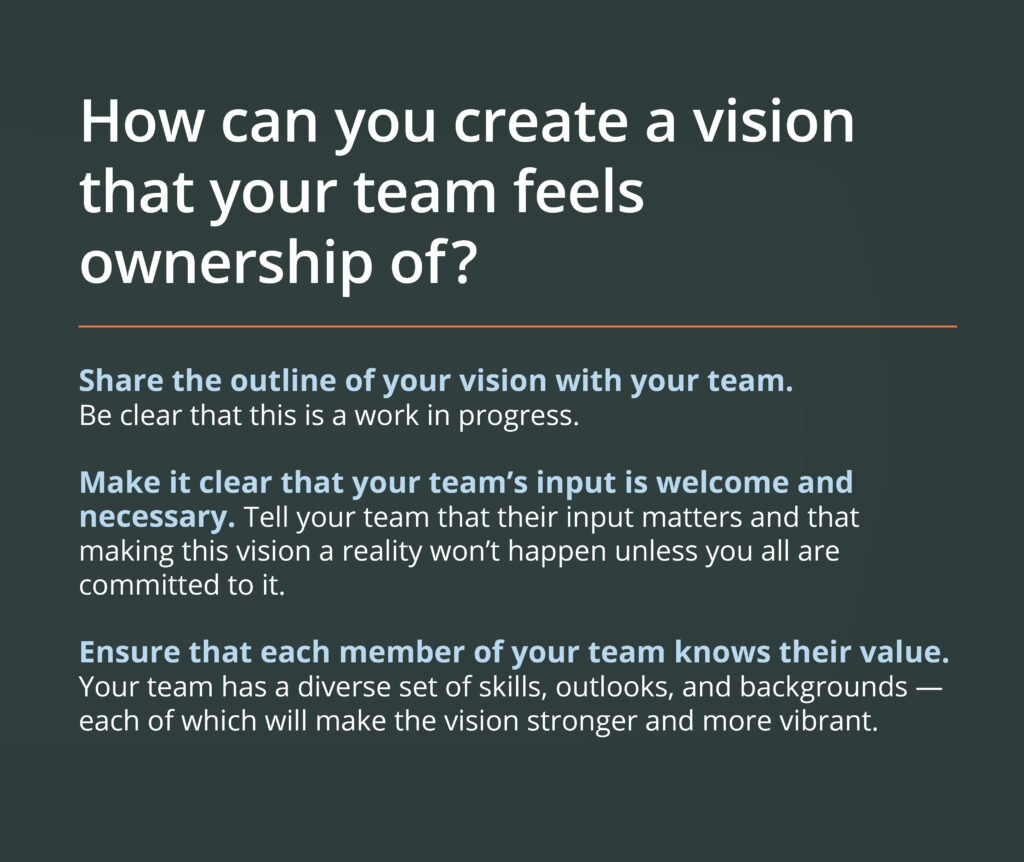
Great leaders have learned to give others on their team the hammer and chisel and let them contribute. They encourage their team to take this hammer and chisel and go chip away. They allow their team to have ownership.
“The price of success, of a vibrant, breathing vision, is partnership. The willingness to share your vision, to give the keys of the kingdom to your team, is one of the most powerful things you can do as a leader.”
It can be tough for a leader to ask for input from their team, but which is better: 100% buy-in from your team to 80% of your vision, or 0% buy-in to 100% of your vision? For most leaders, if the final vision is 80% of your vision, that’s a win. What’s the point of having 100% of your vision when your team does not buy into it? What’s the chance that your vision will succeed, that your vision will get implemented? The answer is it won’t.
This is where it gets really hard, because you have to mean it. Your team needs to believe that you actually want their input. When they hesitantly offer some thoughts, it’s important to thank them, especially if this is a shift for you and how you do things. It won’t be easy, but giving a little ownership goes a long way in creating a team who is committed to your dream.
Those on your team who implement the vision must buy into it, it is that simple. Without the buy-in of your team, the vision will go nowhere. It is sheer pragmatism. Your team will get that.
Evolve Your Vision for Success
Armed with the philosophy of why it is important to get the input of the team, you now need to put it into practice.
1. Depending on the size of your team, share your vision and have a brainstorming session.
If your team is large, consider having several groups meet separately to gather feedback. Then have the team leaders of these groups gather with you to discuss the feedback they have received.
2. Go back and redraft your vision using the input you’ve received.
You might consider having someone else redraft the vision, but since it is your vision and you are the team leader, you might want to do the redrafting. Input is good, but you are still the team leader and you still have to buy into the vision.
3. Share the redrafted vision with your team. What is good about this new version of the vision? What could be improved?
Gather their input again and redraft the vision. After a few rounds of this, you need to declare victory and make the vision final — at least final for now.
By this point, you should have a group of people who have passionately bought into the vision. They are ready to take any hill or go through any obstacle. After all, it is not just your vision, but it is now also their vision. Isn’t that what you want, a group of people passionate about the vision, locking arms together to do whatever it takes to make the vision become reality?
Reflection
What ways can you be more proactive in sharing your vision with your team?
Have you gathered your team’s input and included them in the process of setting the vision?
How are you giving your team ownership of the vision?
To explore Beyond the Crucible resources, including our free Trials-to-Triumphs Self-Assessment, visit beyondthecrucible.com.
Enjoy the show? Leave a review on your favorite podcast app and leave a comment at our YouTube channel. And be sure subscribe and tell your friends and family about us.
👉 Take the free Trials-to-Triumphs Self-Assessment to discover where you are on your journey of moving beyond your crucible and how to chart your personal course to a life of significance: https://beyondthecrucible.com/assessment/
On Saturday, June 8, 23-year-old Ashleigh Barty won the French Open Tennis Championship. She is the first Australian to win the French Open in more than 45 years.
What is amazing about Barty is that she is only 5’5” in an era where many of the great women tennis players are closer to 5’10”. Despite the height disadvantage, she has one of the stronger serves on tour. She wins matches with a combination of her serve, her groundstrokes, her variety, and her never say die attitude. But it is also her character and the backstory that make her Championship win at the French Open so compelling.
Barty is of Aboriginal heritage, the first Aboriginal tennis player since the great Evonne Goolagong. Barty has said that it would be “amazing to get more kids enjoying tennis across Australia within indigenous communities.”
Barty was one of the top junior players when she took a break after winning junior Wimbledon in 2011. She was burnt out and had lost her passion for the game. She took a three-year break and when she came back to tennis, it was on her terms. As one writer put it, “The bravest decision Ash Barty ever took was to walk away from the thing she did the best.”
Ben Crowe, a professional mentor and leadership coach to sports stars and corporate leaders who has worked with Barty, says, “For me, her humility, her gratitude, her respect, and her acceptance are her greatest attributes. Her goal is to be a good person and, with that foundation, go after her dreams. That is 100% authentic. She will always have that humility and respect, rather than getting caught up in ego and pride.”
Not only is Barty authentic and grounded, she has no fear. Earlier this year, before her recent success, Barty told a press conference that she fears nobody in women’s professional tennis. When asked about this, she paused, and with an intensity in her eyes, she replied forcefully, slowly, and quietly, “Fear won’t get you anywhere, mate.”
Ash Barty embodies the ideal of the great Australian cricketer, Sir Donald Bradman – a person who is a decent individual and competitor. He said, “When considering the stature of an athlete or for that matter any person, I set great store in certain qualities which I believe to be essential in addition to skill. They are that the person conducts his or her life with dignity, with integrity, with courage, and perhaps most of all, modesty. These virtues are totally compatible with pride, ambition, and competitiveness.”
Lessons from Ashleigh Barty
Stay Courageous: When Barty says she fears nothing, it does not seem arrogant. The key is to have your identity in something more transcendent — something other than the pursuit of your goal or vision — while at the same time giving it your all.
Have Strong Character: Character is everything. Having a mixture of humility, gratitude, and respect is important, as is being authentic. As you are fearlessly pursuing your dreams, keep them in perspective — be grounded and know who you are.
Ash Barty is a great role model, not only for young aspiring tennis players, but for all of us. Pursue your dreams without fear, but know who you are and stay grounded. After all, it is this that has proved a winning combination for Ash Barty.
To explore Beyond the Crucible resources, including our free Trials-to-Triumphs Self-Assessment, visit beyondthecrucible.com.
Enjoy the show? Leave a review on your favorite podcast app and leave a comment at our YouTube channel. And be sure subscribe and tell your friends and family about us.
👉 Take the free Trials-to-Triumphs Self-Assessment to discover where you are on your journey of moving beyond your crucible and how to chart your personal course to a life of significance: https://beyondthecrucible.com/assessment/
A miracle happened over the weekend in Australia. Australian Prime Minister Scott Morrison won what was called an unwinnable election. All the indications from the polls and the experts was that Scott Morrison was going to lose. Morrison is the leader of the Liberal Party (actually a center-right party). He was up against Bill Shorten, the leader of the Labor Party (the center-left party). So sure was Shorten of victory that he laid out detailed progressive policies on taxes and climate change. Morrison, on the other hand, has been Prime Minister for under a year. The Liberal Party had removed two sitting Prime Ministers in the last several years. Many people were tired of all the Liberal Party internal politics. In most cases, when one party keeps shooting itself in the foot, the other party wins.
So how did Scott Morrison win this unwinnable election? Morrison campaigned on more of a steady-as-you-go platform that did not overpromise. But Scott Morrison’s real key to victory was his authenticity. “ScoMo,” as he is affectionately called, grew up in a fairly ordinary middle-class background. His dad started off life as a policeman. Morrison is active in his church, a Pentecostal church he has been a part of for years. Australia is a pretty secular country, so being a person of faith is not always helpful politically. He is also a huge football fan of the Australian Rugby League team the Cronulla Sharks. So on the Sunday after it looked like he was going to be re-elected Prime Minister, he went to church and then went to a Cronulla football game as normal. He was mobbed by cheering crowds at the Cronulla football game. The fans knew he was one of them, a passionate Cronulla supporter.
Morrison’s message is aspirational. He says, “I believe in the promise of Australia.” He uses folksy slogans like, “If you have a go, you’ll get a go,” basically saying that if you take a chance, Australia will let you do pretty well. On the night of his victory, he said, “God bless Australia,” and that he felt Australia was the best country in the world to live in. Such language might be common place in the US, but it is not in Australia.
People could relate to this guy. He was one of them. He has been called the “daggy dad,” which in layman’s terms means your typical boring dad, without a whole lot of fashion sense. He is married with two young children.
We can learn a lot from Scott Morrison. The lessons are not so much about his party or his political philosophy. It is that people crave authenticity. Not everyone in Australia is a Pentecostal Christian or a Cronulla Sharks football fan. But people admire a man who is authentic. A family man, raising two children, with a message of hope.
To explore Beyond the Crucible resources, including our free Trials-to-Triumphs Self-Assessment, visit beyondthecrucible.com.
Enjoy the show? Leave a review on your favorite podcast app and leave a comment at our YouTube channel. And be sure subscribe and tell your friends and family about us.
👉 Take the free Trials-to-Triumphs Self-Assessment to discover where you are on your journey of moving beyond your crucible and how to chart your personal course to a life of significance: https://beyondthecrucible.com/assessment/
Who would argue that the abolition of the slave trade was not one of the most impactful events of the nineteenth century? British historian, G.M. Trevelyan said this was “one of the turning points in the history of the world.” William Wilberforce was the driving force behind this.
Who is William Wilberforce?
In his later years he was regarded as “the conscience of his nation,” but his early life did not give any indication that he would become a man so respected and revered. Born in 1759 in Northern England to wealthy parents, he went on to study at Cambridge University. He was never a serious student, but he was known to be witty, charming, and eloquent. With the charisma of a natural leader, Wilberforce was elected to Parliament at 21 — the youngest age you could be elected — along with William Pitt, who became Prime Minister just three years later.
The Turning Point
In 1785, Wilberforce had an “intense religious experience” while traveling, prompting him to consider leaving Parliament and going into the ministry. At this juncture, his life could have taken a very different course had his friend and mentor John Newton not intervened. This former captain of slave ships had his own religious conversion, becoming an Anglican minister and abolitionist — and went on to write the hymn “Amazing Grace.” Newton urged Wilberforce to continue his political path and to live out his faith in the place where he could have the most impact.
The Abolition
From that point forward, Wilberforce devoted his whole being to the abolition of the slave trade and of slavery itself. At this time, the slave trade was dominated by the British, and was entrenched in political and monetary interests. The abolition of the slave trade would be a difficult battle.
In 1789, Wilberforce introduced resolutions against the slave trade to parliament for the first time. They did not pass. For 18 years he continued to propose these bills, but again and again, they were defeated. Finally, in 1807 the tide began to turn. In speech after speech, members of Parliament spoke in favor of the abolition of the slave trade in the British Empire. Prime Minister William Grenville called the bill “a measure which will diffuse happiness among millions now in existence, and for which [Wilberforce’s] memory will be blessed by millions yet unborn.”
Three days before Wilberforce died in 1833, he learned that Parliament was passing a law that would free all slaves in the British Empire.
How One Man Lived Out His Beliefs
We can learn a lot from Wilberforce. Showing humility and empathy with those opposed to him, and by demonstrating an understanding of the financial impact of the abolition of the slave trade, he won people over. He appealed to their sense of morality and pressed on, asserting that the abolition of the slave trade was the right thing to do.
With his natural charisma and charm, it was said that “with all his talents he would probably have been Pitt’s successor as Prime Minister if he had preferred the party to mankind.” Instead, he believed strongly that pursuing the abolition of the slave trade and slavery was his purpose in life. This was how he was going to lead a life of significance. Consistent through this battle was the anchor in his life: his faith.
How to Make a Difference in Your Own Life
There are lessons we can learn from William Wilberforce for our own lives, as we seek a life of purpose and significance:
The anchors in our life should guide our actions. For Wilberforce, it was his strong faith.
Making a difference happens when we match our beliefs with our passions and our skills. Wilberforce matched his faith with the passion he had for abolition. He lived his vision out in Parliament, an arena he was particularly gifted in. He was one of the most skilled speakers of his day.
We all need a good mentor. Wilberforce had a great mentor in John Newton, who urged him to stay in Parliament and live out the anchor of his faith.
A strong support network can be the key to our vision becoming reality. Wilberforce had a support network who shared his vision. This group of friends, “the Clapham sect” were devout people who were influential in government and business.
The strength of Wilberforce’s faith and the passion he had for his vision of the abolition of the slave trade and slavery helped him overcome many obstacles. How can that translate to your own life?
Find out what you believe in, such that you believe in it to the depths of your soul, and live it out.
Discern what cause or vision your beliefs are calling you to.
Ensure that this cause or vision is in line with your skills and natural aptitudes.
Talk to a mentor to seek counsel and to friends who will support you along the way.
Be committed to your path and grounded in the anchor of your beliefs. There will inevitably be obstacles. Perseverance comes from the determination that what you are devoting your life to really matters.
Few of us may feel that we can have the impact that William Wilberforce did. Even he, at a younger age, had no idea what he was capable of, but we all want in some way to lead a life of significance. Our own impact may not be as well-known as that of Wilberforce, but the impact of many people leading lives of significance can add up to a world-changing difference.
To explore Beyond the Crucible resources, including our free Trials-to-Triumphs Self-Assessment, visit beyondthecrucible.com.
Enjoy the show? Leave a review on your favorite podcast app and leave a comment at our YouTube channel. And be sure subscribe and tell your friends and family about us.
👉 Take the free Trials-to-Triumphs Self-Assessment to discover where you are on your journey of moving beyond your crucible and how to chart your personal course to a life of significance: https://beyondthecrucible.com/assessment/
Our beliefs form the very core of who we are. They are the essence of our true selves. Living and leading our life in harmony with our most deeply held beliefs is a major step toward leading a life of significance – a life that is not about us but about serving others and making a difference in the world.
As we pursue our vision and lead our lives, our deeply held beliefs help ensure that we are on course. They provide anchors for our lives. If we feel that we have led a life that betrays everything that we believe in, that is soul crushing. It is a place you do not want to be.
Where Beliefs Come From
What are these beliefs that can form anchors for our lives? They are typically a set of principles, a moral philosophy, if you will. They may be rooted in a major religion, such as Christianity, Judaism, Hinduism, Buddhism, or Islam. They could also be based on a philosophical way of thought, such as the writings of Confucius, Plato, Aristotle, or John Stuart Mill.
That there are documented writings that address the purpose of life and where we find that purpose is an advantage of a religious way of thought. There are also teachers that can provide guidance and help us live in accordance to our purpose.
Discovering Your Own Beliefs
It’s important that you spend some time examining your beliefs. What do you believe? Is every area of your life in alignment with your belief system? If not, why not? For anchors to be really effective in our lives, we must really think through and believe in our belief system. Having halfhearted beliefs does not provide a strong anchor.
Below are a few things you can get started on today that will take you one step closer to discovering the anchors in your life:
Write out and describe the principles that you lead your life by. It might be humility, integrity, and self-sacrifice. Or perhaps, kindness, generosity, and compassion.
Then, think about why you believe in these principles. Why are you so passionate about them? Spoiler alert: If you are not passionate about your beliefs, that is a problem.
Next, think through where your beliefs come from. Do they come from a particular moral philosophy or a religious way of thought?
Lastly, start to immerse yourself in more of the writings and teachings behind your beliefs. Talk with teachers of these beliefs or others who have similar beliefs.
Applying Your Beliefs as Life Anchors
Once you have found the belief system that forms the anchor of your life, you can then start to evaluate and apply your anchors to every aspect of your life. I’ve highlighted a few steps and questions to reflect on below.
Do an audit of your life, your vision, and your path. Are your beliefs in alignment with your life and path?
If your life and path are not in line with your beliefs, outline the steps you will take to get your life and your path into alignment with your beliefs.
An important part in ensuring we are living our beliefs is to talk to our closest friends who are open and nonjudgmental. Tell them what your beliefs are and how they should affect how you live. Get their input as to how you are doing in living out your beliefs.
You may find that your daily life is so full of to-do lists and endless tasks that you forget what anchors you. When this happens, make it a daily practice to spend time strengthening your anchors. Whether it’s through teachings or meditations, it’s essential to feeling calm and centered as you go about your day.
To explore Beyond the Crucible resources, including our free Trials-to-Triumphs Self-Assessment, visit beyondthecrucible.com.
Enjoy the show? Leave a review on your favorite podcast app and leave a comment at our YouTube channel. And be sure subscribe and tell your friends and family about us.
👉 Take the free Trials-to-Triumphs Self-Assessment to discover where you are on your journey of moving beyond your crucible and how to chart your personal course to a life of significance: https://beyondthecrucible.com/assessment/
John Fairfax, my great-great-grandfather, is a perfect example of a man who did not let his crucible experience define him. Rather, his crucible experience was the springboard to bring his vision to life. It created an inflection point that changed the path of his life and the course of my family’s future.
John Fairfax was born in 1804 in the county of Warwickshire in England (hence the first name that my father and I have). He did not grow up a wealthy man. At age twelve, John was apprenticed to a local bookseller and printer. At age twenty, he moved to London to work for the Morning Chronicle newspaper. He later moved back to Warwickshire and founded the Leamington Chronicle.
John’s Crucible Moment
In 1836, John was faced with a crucible moment. His paper published an article condemning the conduct of a local lawyer. The lawyer sued the paper. While the court ruled in favor of John Fairfax and the Leamington Chronicle, the lawyer —knowing that John’s resources were limited — sued the paper again. The court again ruled in favor of John and the paper. Unfortunately, the heavy legal expenses forced John into bankruptcy.
The bankruptcy left John devastated. All that he had dreamed of over the last decade seemed to be gone. The townspeople, including friends from his local church, wanted to raise money to support John and help the Leamington Chronicle continue, but John would not accept charity.
Moving Forward
In 1838 John and his wife, Sarah, took their three young children on the arduous four month journey to Australia. John felt unfairly persecuted, but he did not give up on his dream of building his own newspaper. If anything, the dream and the vision grew.
John’s vision of building a paper “without fear to express opinion…without the reproach of self-interest, sworn to no master and free from the narrow interests of sectarianism” eventually would become a reality. In 1841, John purchased the Sydney Morning Herald.
The existing motto of the paper fit neatly into John’s vision: “In moderation placing all my glory, while Tories call me Whig – and Whigs a Tory.” In today’s language, it would read, “while Conservatives call me Liberal and Liberals call me Conservative.” Unlike many papers of the day, John’s newspaper would not be a party newspaper.
John was able to forgive the wrong done to him and was not bitter. Years later, John would return to Leamington and pay off the debts of his creditors, even though he did not have to. They were wiped clean in bankruptcy. John even paid off the debts of the lawyer who had unfairly sued him.
What can we learn from John’s story?
– Our failures don’t have to define us. – Our failures can sometimes be a catalyst for bold risk-taking. – Our crucible moments can increase our determination and expand our vision — and help bring that vision to life. – To be able to move forward, we need to forgive.
John’s story is a great example of how a crucible experience of great loss, tragedy, and unfair persecution can motivate us to achieve our vision. We could do well to learn from John Fairfax and the way he allowed his crucible experience to propel him forward.
Reflection
How can your crucible experience motivate you to achieve your vision, and perhaps an expanded vision? How can you let go of any bitterness you may have toward others?
To explore Beyond the Crucible resources, including our free Trials-to-Triumphs Self-Assessment, visit beyondthecrucible.com.
Enjoy the show? Leave a review on your favorite podcast app and leave a comment at our YouTube channel. And be sure subscribe and tell your friends and family about us.
👉 Take the free Trials-to-Triumphs Self-Assessment to discover where you are on your journey of moving beyond your crucible and how to chart your personal course to a life of significance: https://beyondthecrucible.com/assessment/