
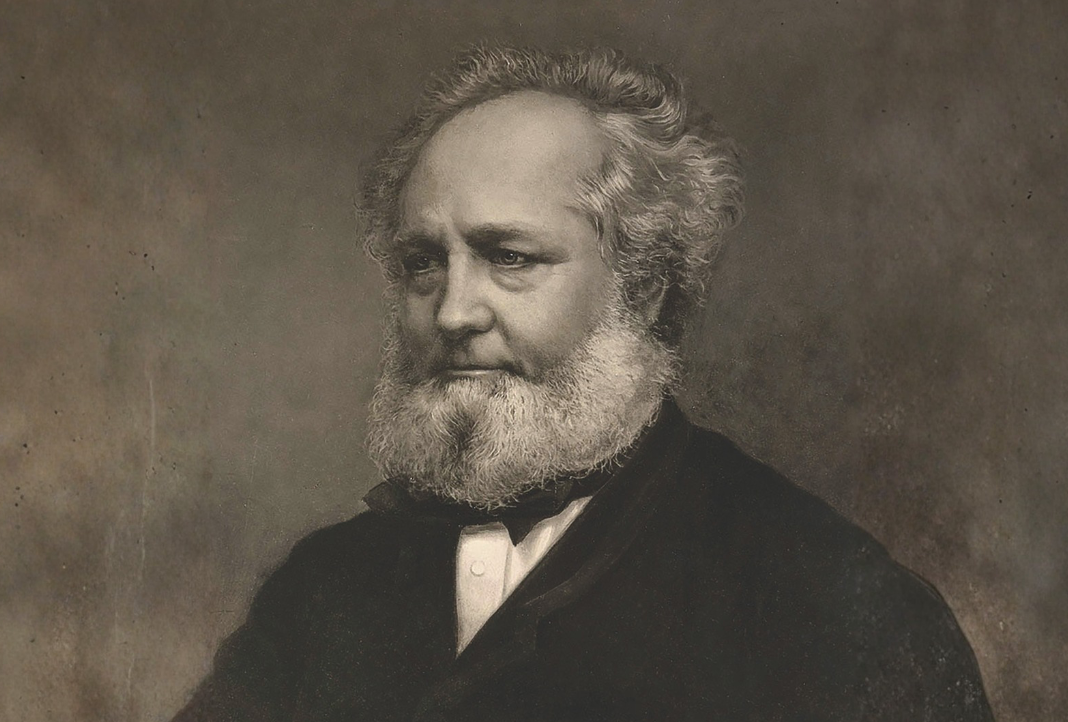
John Fairfax Lessons
My great-great grandfather John Fairfax was a remarkable man. Stuart Johnson has just published a new biography of him, titled Busy For Both Worlds. Johnson’s book outlines some key themes of my ancestor’s life in greater detail than have been discussed before and paints an incredible portrait of the impact my great-great grandfather had.
John Fairfax was born in Warwickshire in England in 1805 and died in Sydney in 1877. He founded a media dynasty that at its height had three of the most important newspapers in Australia – The Sydney Morning Herald, The Age in Melbourne and the Australian Financial Review, a daily financial paper – as well as TV and radio stations and magazines. During his lifetime, The Sydney Morning Herald had a daily circulation 20% greater than all the other Sydney newspapers combined and was larger than any of the London dailies e except for two. John Fairfax was known as “the father of the Australian press.”
But his business success was just one part and not even the most important part of his legacy and his impact on those who knew him and on my family. It was his faith, his character, his unswerving integrity, his generosity and his kindness that resonated most deeply. He had a positive impact on seemingly all who knew him. He was never defined by his crucibles, of which there were many, and he would always be one to encourage others who were going through hard times.
So what are some of the key lessons we can learn from this remarkable man?
1. Crucibles are not the end of your story.
John Fairfax went through many crushing crucibles that were very painful but yet never defined him. He was challenged but not broken. His faith held firm.
John Fairfax grew up in the midst of a generational crucible. The Fairfaxes in Warwickshire in England had been wealthy landowners for generations, with one becoming the mayor of the town of Warwick. But one of John Fairfax’s ancestors was a heavy drinker and gambler who lost the family estates. John grew up hearing stories about him from his ancestor’s wife, his great aunt. J.F. Fairfax in the 1941 biography The Story Of John Fairfaxspeculates that stories of his ancestor who squandered the family fortune may have inspired John Fairfax to make a bigger mark than the generations did after the wealth was lost.
In 1835 an unscrupulous lawyer sued John Fairfax’s paper in Warwickshire, the Leamington Chronicle, for libel. John won the court case twice, as the lawyer appealed. But the court costs bankrupted him. Still, John Fairfax would not let this loss, this setback, define him. He decided to emigrate to Australia with his young family to a land of more opportunities.
The four-month voyage to Australia was not easy, being in cramped cabins with straw mattresses, cooking your own meals in sometimes howling storms. John’s wife, Sarah, was pregnant on the voyage and gave birth to a son, Richard, during the journey. Their son died six months after he was born.
Australia went through a depression from 1841 to 1843. John Fairfax had to tell his employees that he would have to reduce their wages in order for the paper to remain solvent. He told them that they and he would draw their wages pro rata after the receipts were offset by expenditures. His employees agreed, enabling them to keep their jobs when many others lost theirs.
On December 26, 1863, John Fairfax’s eldest son, Charles, was thrown from a horse and killed. He left behind his wife, Anne, and three surviving children, youngest having died in infancy. In October 1871, on their way back from a wedding, the coachman, drunk, lost the reins and fell from the carriage. In an effort to regather the reins, John fell out of the carriage and was badly injured. His daughter Emily, in trying to help her father, also fell out and was seriously injured and died. Emily had a husband, Grafton Ross,and three children. Tragically a little more than two years later, one of Emily’s daughters died at 18.
Sarah Fairfax was in fragile health from her late forties. She was to die in 1875 at 67.
2. Faith is the anchor that helps you go on after you suffer crucibles.
Faith, in John Fairfax’s case, was his strong faith in Christ which was the bedrock of his life that enabled him to go on. His faith was strong, but certainly he felt the pain of his crucibles, especially the loss of two of his children, Charles and Emily. John’s son James, my great grandfather, said after the loss of Charles that “My Father suffered very severely from the shock of this calamity, indeed… I am not sure that he ever recovered anything like the buoyancy of his former self…” Losing Emily was a second hammer blow. J.F. Fairfax said of John Fairfax after this, “as tears trickled down his cheeks, Fairfax once said, ‘God has given me all that heart could wish in relation to this world, but He takes away my children. I do not murmur, but I cannot help but mourn.”
While still in his twenties while living in England, John Fairfax said this about his faith: “I do humbly hope that there is one spark of divine grace and love even in my poor cold and hard heart, and it is my earnest prayer that that spark may be fanned into a pure flame of unquenchable love to the great and ever blessed Redeemer.”
John never lost his faith. On his 50th birthday John Fairfax’s children presented him with a beautiful epergne, a silver centerpiece, expressing their deep admiration and devotion, in their words and through the gift. John was deeply appreciative of the gift and in particular their words of love and devotion to him. But John, ever wanting to ensure that his children would focus on their faith, said this, “We are all travelling on. Time is ever on the wing. Some of you have decided for Christ, and are fellow-pilgrims to Zion. All of you are hopeful. But I beseech you, suffer nothing to stand in the way of an early surrender of the spring-time of your existence to Him, who is both able and willing to save.”
The pastor of Pitt Street Congregational Church James Jefferis said this of John Fairfax: “In blighting prospects, in the despondency of exile, in the bitterness of bereavement, in the sadness of dying, he never let go his trust in God … he said to me upon his death-bed, ‘All things are working together for good. He doeth all things well. I am looking up. I am going home.”
3. Character is how you show your faith is real.
John Fairfax was certainly a man who lived his Christian faith in how he treated his family, his employees and how involved he was in actively participating and supporting financially many other businesses and charitable organizations.
John did not just make life easy for the two sons, Charles and James, whowent to work for the family business. He required full apprenticeships of his sons in The Sydney Morning Herald. James said his father was a believer in the principle that the man who would command must first learn to serve, and in order that he should be thoroughly conversant with the business which he was later to control. It was said his sons “went through the mill” in learning the practical work of each department of the paper. Because he loved his sons and wanted to do what was right, he wanted them to be prepared to take an active role in the family business.
In 1852, John Fairfax returned to Warwickshire in England, now a wealthy man. John then did the unthinkable. He paid back his former creditors, including allowance for interest accrued, despite not being legally required to do so because of his bankruptcy. John even reimbursed the son of the unscrupulous lawyer (who had since died) for the costs of his father’s vindictive legal actions against him fifteen years earlier. Who does this, pays back his creditors after bankruptcy and even the legal fees of the unscrupulous lawyer? That is forgiveness taken to another level, radical forgiveness, if you will.
Clearly John Fairfax did not hold grudges. For a time The Sydney Morning Herald had a rival in Henry Parkes’ The Empire. That paper did not last, and Parkes had to file for bankruptcy, then pursued a successful career in politics. John Fairfax expressed his sympathy after Parkes’ bankruptcy, published some of Parkes’ letters and articles, and supported some of his policies when Parkes was in government.
4. Fellow travelers help you get through crucibles and help bring your vision to reality.
John Fairfax’s ultimate fellow traveler was his wife, a woman of very strong faith. Upon approaching Sydney Harbour, John had a momentary feeling of despondency as he saw the rugged coastline and high cliffs. He wondered why he had brought his wife and family from England to a land so strange and seemingly of so little promise. John’s wife, Sarah, my great-great grandmother, sensed John was not doing well. She joined John on deck and said, “I knew, John, that despair was in your heart … and I know that you were worrying about me and ours and your ability to fend for us … Do not worry about me or the children. I will be brave and helpful, and whatever God may send or may take away, my love for you is the strongest thing I have in life and it will have no death. I do not worry about you; I know what you can do, and it is much… You are well armed, John, for any fray, and you will win and I will win, not only success, but content and great happiness.”
When John Fairfax bought The Sydney Morning Herald in 1841, he had a business partner in Charles Kemp. He and Kemp were a perfect combination. John handled the business, production and management side. Charles Kemp handled the literary and journalistic side. Together they would determine the editorial position of the paper. John Fairfax and Charles Kemp worked side by side until Charles Kemp retired in 1853.
5. Life is more than success in your business and career.
John Fairfax’s life mission was to be “busy for both worlds.” That is working in the world and in the church, as well as working out his faith in many other ministries and worthwhile charitable organizations and businesses that would help people. He was a deacon in his church, the Pitt Street Congregational Church, for almost 40 years. John Fairfax played a leading role in the planting of other Congregational churches in the state of New South Wales, the state Sydney is the capital of, encouraging and mentoring several church pastors.
John Fairfax was heavily involved in the YMCA in Sydney, being at the time a Protestant organization formed to offer young men life skills, education and encouragement in the Christian faith. John gave the following memorable speech to encourage young men to be diligent, “How strange it sounds, and yet we sometimes hear it: ‘That is a good young man, but somehow he doesn’t get on… He is amiable, but has no ambition. He believes in God’s providence, but doesn’t seem to like work; is early at church, but late at business’ … how he belies the Christian profession he makes. If all young men were like him, what a miserable colony this would become.”
John Fairfax believed that with wealth should come a deep sense of stewardship. He once said to a friend, “God has given me what some consider wealth; this wealth I hold from Him as a sacred trust: I am His steward and am responsible for the use of it, and it must be used in His service in helping those around me.”
John Fairfax was one of the founding directors of the Australian Mutual Provident Society (AMP), which was formed to be a not-for-profit mutual self-help society to provide policies to fund retirement by way of deferred annuities (pensions); and came to offer other policies to set aside funds for a child’s future needs and also life insurance.
He also was one of the early board members of the Sydney Fire Insurance, which provided insurance against destruction by fire. It is important to note that the services offered by the AMP and the Sydney Fire Insurance did not exist at the time, until these companies were started.
John Fairfax was also a faithful supporter and organizer of the Sydney Ragged Schools, which helped neglected children of the then “working class.” John was a foundation director of the Prince Alfred Hospital.
John Fairfax also endowed two prizes to be offered to women at the University of Sydney in 1873, supporting the admission of female students to the university. John employed a woman as the Herald’s Paris correspondent and published Louisa Atkinson’s series on the natural environment; at a time when there were few women journalists or writers who were published in a major Australian newspaper.
6. Live your legacy today.
When we look back at our lives, what do we want our legacy to be? John Fairfax was a successful businessman, a loving father and husband, a beloved employer involved in a great number of philanthropic causes and businesses that helped people. After his death, the Herald said this about John Fairfax: “He achieved success and earned a reputation by the exercise of a strong will, of shrewd sense, of a large capacity for work, of courage in meeting difficulties, and of unswerving honesty of purpose … He had more than an ordinary measure of the insight which understands men, and of the tact which manages them … His mindfulness of the needs of his employés was one of the features of his character that will, perhaps, be longest and most gratefully remembered … those who entered his service generally remained long in it, and the dismissals were very few.”
Another paper said, “As a public man he stood out as model of integrity and firmness; as a private gentleman and a Christian, his life was irreproachable; and, as an employer, he had no equal for generosity, justice, and kindness.”
The employees of the Herald said, “We feel that in his departure we have lost a kind employer and a valued friend.”
Pitt Street Congregational Church pastor James Jefferis said this of John Fairfax: “Of Fairfax’s ‘unswerving integrity,’ Jefferis offered, ‘It was doing the right thing just because it was right. He was the sworn enemy of all kinds of shuffling and evasion, and of the putting on of appearances’. Applauding Fairfax’s ‘intensity of will’, Jefferis said, ‘Our departed friend learnt to rule himself before he learnt to rule others … He did not, as most of us do, allow his circumstances to master him.”
Jefferis went on to say of John Fairfax, “He was always thinking of others… His desire and his aim was to make all about him happy, even to the visitor privileged to tarry for a while in his house, and to the servants who were discharging domestic duties… Our departed friend had the rare power found but in few of us, of entering, and entering heartily, into the personal concerns of all who sought his help or his advice, so much so that they felt at once that they were his friends, – not only that he was a friend to them, but that they were friends to him.”
7. Your crucibles didn’t happen to you, they happened for you.
This was certainly the case with John Fairfax. When bankrupted in Warwickshire in England, John did not let that misfortune define him, and he used that crucible as inspiration to buy The Sydney Morning Herald and ultimately found a great media business. John Fairfax suffered great loss; the loss of his infant son Richard, and then two of his children, Charles and Emily, and then his wife, Sarah.
James Jefferis spoke about John Fairfax’s ability to encourage, enthuse and generate endurance among those around him, “With a beaming face – what power there is in a face like his – with a beaming face and a resolute will, and with a confidence in God that nothing could daunt, he encouraged others to overcome difficulties which too often paralyzed their energy. By the impulse there was in him, by his cheerful tone, by the encouragement he gave, as well as by the help he rendered, he enabled them again and again to tide over difficulties that seemed insurmountable… All who came within the reach of his influence caught the generous enthusiasm, and worked more energetically than ever.”
But perhaps the most remarkable claim among the many expressions of appreciation for John Fairfax were the many references to his ‘kindness’. This was the single most repeated claim regarding him upon his death and appears to have been an exceptional feature of his character. This was summed up by the writer for the Dubbo Despatch, who simply stated, ‘I could tell many stories of John Fairfax’s kindness’.
Crucibles are not easy. They are often exceptionally painful and may feel life-defining. But crucibles do not have to be the end of your story. They were not the end of John Fairfax’s story. He could have been bitter about the loss of the family position and wealth by his ancestor. He wasn’t. The bankruptcy in England could have destroyed him. It didn’t. John lost his infant son, Richard, soon after he arrived in Australia, and then lost two of his children Charles and Emily, and then later his wife, Sarah. John went through excruciating pain and suffering at these losses, but it did not stop him carrying on with life and it did not destroy his faith.
John Fairfax spent his life caring for others both in his family, in his business, in his church and in the many charitable organizations and companies he was involved in. John spent his life in service of others. Life was never about him. It was always about serving his God through his faith and serving others. A life grounded in deeply held beliefs and values in service of others is not a bad role model.
Reflection
- How have you been affected by your crucibles? Do you think of them as happening to you or for you?
- How are you living out your beliefs and values? Are you a person of character whose life exemplifies your beliefs and values?
- What will be your legacy? Is it all about money and success and about you? Or is it about serving others and leaving a legacy of kindness and charity?
To explore Beyond the Crucible resources, including our free Trials-to-Triumphs Self-Assessment, visit beyondthecrucible.com.
Enjoy the show? Leave a review on your favorite podcast app and leave a comment at our YouTube channel and be sure subscribe and tell your friends and family about us.
Have a question or comment? Drop us a line at info@beyondthecrucible.com
—

Don’t forget to subscribe for more leadership and personal growth insights: https://www.youtube.com/@beyondthecrucible
Follow Beyond the Crucible on Facebook: https://www.facebook.com/beyondthecrucible
Follow Warwick on LinkedIn: https://www.linkedin.com/in/warwickfairfax/
Follow Beyond the Crucible on Instagram: https://www.instagram.com/beyondthecrucible
Take the free Trials-to-Triumphs Self-Assessment to discover where you are on your journey of moving beyond your crucible and how to chart your personal course to a life of significance: https://beyondthecrucible.com/assessment/


