
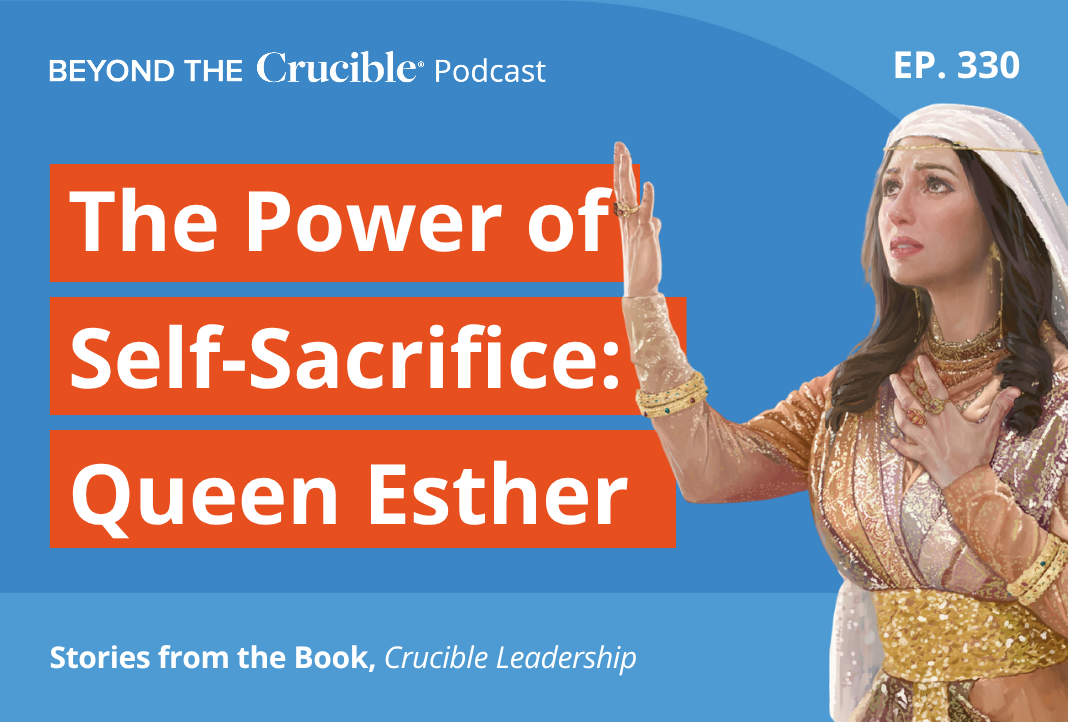
The Power of Self-Sacrifice
What does it look like to give up everything — including your life — for the greater good?
In this episode, we explore one of the most powerful examples of self-sacrifice in all of Scripture as part of our ongoing series, More Stories from the Book Crucible Leadership. Queen Esther’s story is a masterclass in what it means to lead not for personal gain, position, or safety — but for a purpose so much larger than yourself that you’re willing to risk everything to serve it. Self-sacrifice, as the Oxford English Dictionary defines it, means giving up your own interests to help others or advance a cause. Esther didn’t just define it. She lived it. And her example stands as one of the highest forms of leadership the world has ever seen.
Have a question or comment? Drop us a line at info@beyondthecrucible.com
—
👉 Don’t forget to subscribe for more leadership and personal growth insights: https://www.youtube.com/@beyondthecrucible
👉 Follow Beyond the Crucible on Facebook: https://www.facebook.com/beyondthecrucible
👉 Follow Warwick on LinkedIn: https://www.linkedin.com/in/warwickfairfax/
👉 Follow Beyond the Crucible on Instagram: https://www.instagram.com/beyondthecrucible
👉 Take the free Trials-to-Triumphs Self-Assessment to discover where you are on your journey of moving beyond your crucible and how to chart your personal course to a life of significance: https://beyondthecrucible.com/assessment/



Transcript
Warwick Fairfax:
Welcome to Beyond the Crucible. I'm Warwick Fairfax, the founder of Beyond the Crucible. She was willing to risk it all by going before the king and pleading a case. She was willing to risk her position, her lifestyle, and even her own life for her people. She was not focused on her life. She was focused on the lives of others, on her fellow people. She wasn't trying to be a hero. She was just trying to do whatever she could to save the lives of others.

Gary Schneeberger:
Self-sacrifice we discuss in this week's episode of our series within the show, More Stories from the Book Crucible Leadership means, as the Oxford English Dictionary puts it, being willing to give up your own interests in order to help others or advance a cause. The focus of our conversation, the Bible's Queen Esther, and how she exemplifies the truth that there are few higher forms of leadership than a willingness to sacrifice everything for the greater good. Welcome friends to this episode of Beyond the Crucible. You have joined us in one of the episodes that we call the series within the show. And this year, the series within the show is again about Warwick's book, Crucible Leadership, and this is More Stories from the Book Crucible Leadership.
Last year we did Stories from the Book Crucible Leadership. This year we pulled together a real top flight team of folks that, what should we call this one? And we came up with More Stories from the Book Crucible Leadership. No, it just made sense, right? Stories last year, more stories this year. And just to level set everybody, that book Crucible Leadership is the blueprint for what Beyond the Crucible has become. In fact, if there was no Crucible Leadership, Wall Street Journal bestseller, it's safe to say there would not be a Beyond the Crucible because that's where Warwick really leaned into telling his story and the lessons that he learned from his story. And that's what this podcast is all about, stories and what we can learn from those stories.
So today's story, speaking of stories, is Queen Esther, Queen Esther of the Bible. Her example in Warwick's book appears in the final manuscript section on self-sacrifice. So that's what we're going to focus on here today is how Esther can teach us many things about self-sacrifice. And we'll talk about that and about what self-sacrifice looks like. So Warwick, after that preamble, let me ask you this question. Why Esther? What makes her story a leadership story for this series?

Warwick Fairfax:
It's a good question because not everybody has heard of Esther, Queen Esther, but she is a great example of self-sacrifice. So let's just provide some context. Esther's story is in a chapter in my book, Crucible Leadership called Faith that Guides Leadership. And I speak of faith more generally as a key ingredient to life and leadership in the sense that it guides that direction. You might have different religious faith, spiritual faith, values and principles, and whatever that may mean to you, it acts as an anchor for our soul. And in a sense, it stands as something immovable in your life as you deal with your decisions in career, family, neighborhood, amongst your people. And the reason that faith in this context, again, we're describing it as an anchor for your soul is the reason it's so important. So when you're hit by the storms of life, and it's really more when than if-

Gary Schneeberger:
Indeed.

Warwick Fairfax:
... you need a solid set of values and principles that can help you make difficult decisions amidst challenging circumstances. One of the things that we found in the research that we've done on crucibles is that the vast majority of people have gone through crucibles, which we define as something so traumatic that it fundamentally changes your life. And our research experts said those who said that they didn't have a crucible were basically lying because if you looked at the underlying data, it said they really did have challenges. Sometimes you think, well, my life isn't that difficult and it hasn't been that bad compared to others. But the reality is everybody's going to go through storms in life. And the question is when they hit, how will you navigate your way through?
And one of the keys is having a solid set of values and principles that can help you make those key decisions that are true to who you are and what you believe to your core at your soul. And so in the chapter that I wrote, Faith that Guides Leadership, I talk about key principles of leadership and indeed they're really key principles of life that should help you put faith into action. Faith is important, but ultimately faith has to be active. It has to correspond with how you lead your life. It can't be just bumper stickers on a wall somewhere. And so some of the principles I talk about in this chapter include humility, integrity, servant leadership, and self-sacrifice. So these principles that we're talking about in this chapter, Faith that Guide Leadership, the one that we're going to be focusing on is self-sacrifice.
So let's talk about what self-sacrifice means. Self-sacrifice means being willing to give your all, even your own life for cause or principle you believe in. The Oxford English Dictionary defines self-sacrifice as being willing to give up your own interests in order to help others or advance a cause. So it may mean being willing to give up your position, your reputation, or even your career for something that you believe in. There are a few high forms of leadership or indeed life than a willingness to sacrifice everything for the good of others. And Esther, as we'll see, is a great example of self-sacrifice. She was willing to risk her life to save the lives of others, to save the lives of her people.

Gary Schneeberger:
And that's a good tease to my next question, which is what was the crucible that was facing Esther and her people? Because this is a podcast called Beyond the Crucible. So crucibles figure prominently in what we discuss. And Esther and her people were looking at a crucible when this story kind of picks up steam here, right?

Warwick Fairfax:
Absolutely. So let's talk a bit about who Esther was. Esther was a Jew who lived at a time when the Jewish people had been conquered and taken to Babylon as captives. Now, Babylon was the capital of the Persian Empire. King Xerxes asked for a search to be made of his kingdom for beautiful young women. And his officials rounded up many from throughout the kingdom. And one of these young women that King Xerxes had rounded up was Esther. And she was brought with other women to the palace. Now over time, she became one of the king's favorites and eventually she won his favor and approval and was made queen. Now the king did not know of her background that she was Jewish and that she was one of the captive people who had been brought to Babylon, but it's really remarkable here.
You have Esther as being just a normal person living somewhere in the Persian Empire and she gets rounded up as one of the beautiful women. And one of the things we'll find is, I don't know that we know this specifically, but what attracted Xerxes to Esther, I think was more than just her beauty. There was something, and again, this is me speculating, something within her soul, something about her that he truly admired and respected. I have the feeling, again, I'm just speculating, but I think it was more than just physical beauty that made him select her out of all of the women that he had in his palace to be his queen.

Gary Schneeberger:
So now that we've set the stage for that, what was the crucible? Again, Beyond the Crucible, what was the crucible facing Esther and her people at the time of this story taking place?

Warwick Fairfax:
So Esther's cousin Mordecai would not kneel or pay honor to one of King Xerxes' high official Haman. This set in motion a series of events that would threaten the very lives of Esther's people, the Jewish people. So Haman being an arrogant, proud official, saw that Mordecai would not kneel and he was enraged. And when Haman learned of Mordecai's background that Mordecai was Jewish, and obviously one of the captives that had been brought to Babylon, and he was just so angry, not only did he want to kill Mordecai, he wanted to kill all of Mordecai's people. I mean, that is just staggering to contemplate. I mean, people can be angry, but it's just staggering that Haman would want to kill not just Mordecai, but Mordecai's people, the Jewish people.
So Haman went to King Xerxes and he's basically said that there are people in your kingdom who did not want to obey your laws. And so he asked Xerxes for a decree, which was granted, to kill all of those people, all the Jewish people. And obviously Xerxes didn't understand the background that this was a personal thing between Haman and Mordecai. He was just told they're not willing to obey your laws. And the King's like, "Well, that's a problem." And back then there are dire consequences for not obeying the king's laws.

Gary Schneeberger:
And this is where in this story, where Esther begins to really play a prominent role. And it started with Mordecai challenged Esther with the words, "For such a time as this." And folks, if you've heard that phrase before, it's one of many, many, many. I actually wrote Warwick an op-ed for the Wall Street Journal for Mark Burnett and Roma Downey about this very issue about the Bible should be taught in schools, not as holy literature, but it should be taught as history because so many words and phrases come from the Bible. Here's one of them, "For such a time as this." So how did that challenge, if you will, how did those words change what Esther's position required of her?

Warwick Fairfax:
Well, when Mordecai uncovered Haman's plot to have all of the Jewish people killed, he sent a message to his cousin, Esther, pleading for her to save her people. Now Esther, she was initially reluctant and Esther told Mordecai that for any man or woman who approaches the king without being summoned, then that basically means death unless the king decides to spare their lives. So if you go before the king unsummoned, you're going to assume it's death unless by some miracle he says, "Well, actually in this case, I'll spare your life." But the default assumption is you're going to die if you go before the king unsummoned. So Mordecai replied to Esther that she should not think that just because she's in the king's house, that she alone of all the Jewish people will be spared.
He said that if she remains silent, you and your father's family will perish. And this is where Mordecai told Esther, and these are famous words that we might have heard, may not know the source, but these are words that are pretty familiar to many. And this is what Mordecai told Esther. "And who knows, but you have come to your royal position for such a time as this. And Mordecai had given Esther a huge challenge for Esther to try to save her people while risking her own life. That's a big challenge and a big ask to risk going before the king with the default assumption is you got to die to try to save her people.

Gary Schneeberger:
Right. And it's interesting in the context of Beyond the Crucible that you said when you were leading into him giving her that challenge, that she was initially reluctant. How many times, I mean, that is the way that we all tend to feel or that many of us tend to feel when we're facing something that can be a crucible, that asks us to have courage, asks us to step into some place we may not be comfortable. That's pretty common. Take us out of biblical times, take us into today's times. That's a pretty common reaction to being initially reluctant, isn't it?

Warwick Fairfax:
It is. We might be thinking that we want to do something, speak to somebody at work, your boss, have a conversation with family members or people in your community to take an action that's going to be risky to your career, position, status. You don't typically think, "Sure, let's go."

Gary Schneeberger:
Right.

Warwick Fairfax:
You got to be thinking, "I don't know that I really want to do this. Can't somebody else step up? Why does it have to be me? Why always me? Come on." Can somebody else just charge ahead while I'm on the sidelines and cheer them and say, "Hey, way to go. Off you go. Yeah. This is awesome. We'll cheer you." We can often think that, that we want to cheer from the sidelines, but we really don't want to take the big risk. But ultimately, we need to take that risk, but it's a rare person when challenged from other people or challenged from within that they're going to say instantly, "Sure, I'll go. I'll risk my career, position or even my own life."
It's like, "Well, let me count the cost. Do I really want to do this? Does it really have to be me?" So most mortals, most humans, they don't instantly charge in. They're thinking, "Gosh, I don't want to do this. It's risky. It's going to be painful. Surely, can't somebody else?" Most people will at least have some of those thoughts before charging in.

Gary Schneeberger:
Right. And in the case of Esther, what did she do and why do you call what she did self-sacrifice? And you've already hinted at it in what we've been talking about so far.

Warwick Fairfax:
Well, so Esther told Mordecai that she would indeed go to the king and she said, "And if I perish, I perish." So what that meant was she knew that if she went before the king unsummoned, she could be killed instantly even before she had a chance to say why she was there, which would've accomplished nothing other than her own death and obviously the death of all of her people, the Jewish people. So she knew that she risked her own life, but her words are just so heroic. And if I perish, I perish. So Esther put on her royal robes and went to the king. And the king asked, "What is it Queen Esther? What is your request? Even up to half the kingdom, it will be given you."

Gary Schneeberger:
Right.

Warwick Fairfax:
I think that really shows something that even before she opened her mouth with her request, clearly the king deeply respects Queen Esther. He knows that she's coming before him unsummoned. He knows the Persian laws. He knows the royal decrees. If you come before the king unsummoned, you're risking death. So he realizes this has to be important. She would not come in this way unless it's serious. And because he deeply respects Queen Esther, his default is to say, "What is your request? Even up to half the kingdom it will be given you. Pretty much whatever you ask, I will grant it even before I even know what you're going to ask." That shows deep respect and admiration for Esther.
And so Esther then asks the king to spare her people and her people were indeed spared. So this story of Esther shows remarkable courage, really tremendous courage. She was a Jew whose people had been captured by the Persians. She was willing to go before the king unsummoned to try and save the people, knowing that this could mean certain death, but she was willing to go anyway. So to risk your life to save other people is the highest form of self-sacrifice. It's putting others' interests before your own. There are a few more noble qualities than this.

Gary Schneeberger:
Yeah. And it's interesting. And again, in our experience at Beyond the Crucible, we hear these kinds of things all the time. We've gone through them all the time. And that phrase, "If I perish, I perish." Okay, that talks about if I die, I die. But there's a lot of... I mean, every crucible that you face, you can have a statement like that. If I fail, I fail, but I'm still going to go, right? If I have to start over, I'll start over, if you try something new. If I upset some people, I upset some people if you're taking a bold stand for something that maybe your family's not going to be thrilled about. If I hit a roadblock, I hit a roadblock.
That perspective, if this happens, then this happens, that's okay because that's what it's going to take for me to find my life of significance beyond my crucible, right? I mean, if I perish, I perish is the ultimate stakes, but we have a lot of stakes like that when we're going through crucibles that we have to answer that question in a positive way. If this happens, this happens, so be it. I've still got to go, right?

Warwick Fairfax:
Right. Having the attitude that irrespective of the outcome, I have to try. That might cost me my life, my career, my status within the community. If you're in politics, standing up for what you believe in your community or your state or beyond, that may not necessarily make you friends within your party, the other party. Typically, the way to get ahead is to go along to get along, basically. That's typically what happens.

Gary Schneeberger:
So the idea of if I lose the election, I lose the election. Talk about that takes a lot of courage and maybe not as much courage as Esther displayed, but that takes courage too.

Warwick Fairfax:
It really does. When thinking of politicians who are willing to make great sacrifices, it reminds me of a story from the book that we've spoken earlier about William Wilberforce who campaigned to abolish the slave trade in the late 1700s, early 1800s in Britain. And he was a member of the conservative party, a good friend of the prime minister, and he was this person who was young, charismatic. Everybody liked him. As I said, he was good friends with the then Prime Minister William Pitt, but he came to a deep faith in Christ and he believed that the slave trade was morally wrong.
And so he campaigned for that. It took a lot of years for parliament to pass a bill abolishing the slave trade, and he appealed to people's higher moral principles, even though the slave trade brought in massive amounts of money to the British Empire. Now, by doing this, he knowingly sacrificed his political career. The chances of him becoming-

Gary Schneeberger:
Right. That was self-sacrifice, for sure.

Warwick Fairfax:
Yeah. Chances of him becoming prime minister was zero after that. Some people may have respected him, but he was sort of making enemies in the process. He may have won the day, but his chances of being prime minister were gone. So he knew that going in, but his life, his career was not important. Slavery was a scourge on the British Empire, was morally wrong, and he was going to do whatever it took to have it abolished. There are very few people in business and politics who are willing to make a William Wilberforce kind of stand. It tends to be career ending and threatening, which is why people don't tend to do it. So Esther is a great example of being willing to make that stand, even though it might, in this case, mean her death.

Gary Schneeberger:
Right. You write that the key to self-sacrifice is motivation, and you hinted at it a little bit, right? Well, not hinted at it. I mean, your story of Wilberforce, his self-sacrifice, what was his motivation? He wanted to see the slave trade abolished. That was his motivation. What does Esther show us about this idea of the key to self-sacrifice is motivation? What lessons can we learn there?

Warwick Fairfax:
Yeah. Esther's motivation was to save her people. She was King Xerxes' queen and was the most favored and honored woman of all the women in King Xerxes' palace. She had a very comfortable, perhaps opulent and lavish life. Now, she may have thought that even though she was Jewish, that the king respected and liked her so much that there's no way that despite the decree that all the Jewish people should be killed, she might have thought, and she may have been right in thinking this, that she'd be spared, the king liked her and respected her, so she'd be fine. And that could be a fair calculation in this case, but she was willing to risk it all by going before the king and pleading her case.
She was willing to risk her position, her lifestyle, and even her own life for her people. She was not focused on her life. She was focused on the lives of others, on the fellow people. Now, she wasn't trying to be a hero. She was just trying to do whatever she could to save the lives of others. And it's such a wonderful example of self-sacrifice. She wasn't thinking, "Man, I'm going to be written up in the Bible or I'm going to be written up in annals of the great men and women who've sacrificed everything." She was just thinking, "I don't really care about all that. I just want to save my people." It was that simple. That was the motivation, not glory, grandeur, applause. It was all about doing whatever it took to help others, to save the people.

Gary Schneeberger:
Right. And this idea, you said it in answering the question, Esther was willing to risk it all. And for her, all could have, as you said, meant her lifestyle could have meant her life. It seems to me it's pretty true in bouncing back from a crucible and achieving a life of significance, we have to be ready, willing to risk it all to whatever all is, right? And you talked about it earlier, sometimes it's your reputation. Sometimes it's a political career. Sometimes it's... I mean, there's a lot of stuff that you have... This idea of being willing to risk it all seems to me at the center of what it takes to bounce back from a crucible and bounce toward a life of significance, right?

Warwick Fairfax:
It really is. More broadly, when you go through a crucible, you've got to take risks to bounce back.

Gary Schneeberger:
Right.

Warwick Fairfax:
There are different level of risk, whether maybe you're in the midst of substance abuse, you're hanging around with certain people, maybe you're growing up in a neighborhood where people are drug dealers. There's all sorts of levels of risk. We have to be willing to say, "Okay, I'm going to chart a different course. It's not good for me to hang around people that will reinforce habits and behaviors that is going to damage, if not kill me. I need to find different friends that will live lifestyles that help me." Well, people won't understand, "Why don't you want to hang around us? What's your problem?"

Gary Schneeberger:
Right.

Warwick Fairfax:
I mean, that's going to cause problems when you make waves in your party, in your company. People will say, "Well, look, it's go along to get along. What are you doing?" You might lose friends. You might lose your chance of being promoted. You might feel like you're very lonely. You're in a group of one because everybody else thinks you're crazy. Maybe your family thinks you're crazy. Maybe your husband, wife or partner says, "Look, if you make this choice, your career is over and the people at your company are sufficiently powerful that they'll blackball you from getting a job with any other company in that industry in your area." Sometimes people have the power to really might make life very difficult for you.

Gary Schneeberger:
Right.

Warwick Fairfax:
And you might have a spouse or partner saying, "We're enjoying the lifestyle we have. You take that risk, we could lose everything. We might have to sell our opulent house and move somewhere else." And so that could risk alienating your family, spouse, coworkers. So that can be willing to make a sacrifice to do whatever it takes, it's not easy, but you might feel like not only is it important for me, but it's important for me to stand up for what's right because I'm trying to defend the rights of others. But it's doing the right thing often entails big personal risks for yourself, your lifestyle, your friendships. It's not easy to do and it's risky and it's why many people won't do that. They don't want to risk their lifestyle, their friendships, their career. I mean, that's a big ask to risk all of that.

Gary Schneeberger:
Yeah. Right. I'm sorry to keep drilling on this point, but as you were talking about it, it made me think about your own story and this idea, right? You so wanted the family media business to be established again in the principles of the founder, your great-great-grandfather. You wanted it to continue to do good. You wanted a lot of things and you were willing, right? Your takeover, you had to be willing to risk it all, and there was a lot to risk in that takeover. Do you see this connecting in any way to your story?

Warwick Fairfax:
Well, that's an interesting question. I hadn't really thought about that before, but yeah, as listeners and viewers would know, I grew up in a very large family media business in Australia. It was founded by a person of faith, person of great principle in 1841. And by the time I grew up, it was very large with newspapers, TV, radio stations, magazines that had the Australian equivalent to the Wall Street Journal, New York Times, and Washington Post. And after coming back from Harvard Business School in 1987, my dad had died earlier that year. There was a sense when my father was alive and my parents that the company wasn't being run well.
It wasn't being run along the ideas of the founder. So I launched this $2.25 billion takeover, which was certainly risky to bring it back to the ideas of the founder and have it be well managed. Obviously, for those who've heard my story and read my book, Crucible Leadership, I made a lot of mistakes and false assumptions. Was my motives noble? I think in most cases, yes. Yes. My father had been thrown out as chairman 11 years before in 1976 by the family members that subconsciously that may have played a part. But yeah, I didn't really think about it as self-sacrifice. I mean, I was trying to do what was right. Was it really necessary? One could debate that.
But certainly, I don't know that I want to call myself an example of self-sacrifice, but I was trying to do the right thing and one could argue whether that was the right thing or not. It certainly caused friction within the family. And three years later after the takeover, Australia got in a recession and after a number of family members sold out, we had to file for bankruptcy and my wife's American. So we ended up starting a new life in the U.S. Where I'm not as well known and we could raise a family without all the pressures of being a Fairfax in Sydney, which is sort of like being a Bush or a Kennedy or a Vanderbilt or something.

Gary Schneeberger:
Right.

Warwick Fairfax:
So I don't know that I think of it quite as self-sacrifice, but my motivation was to try to do the right thing and it certainly had consequences. And some of them were because of my own mistakes and false assumptions. But yes, more generally, when you try to do the right thing, people aren't always going to see it as the right thing. They might have a different perspective.

Gary Schneeberger:
Right.

Warwick Fairfax:
And they certainly won't necessarily applaud it.

Gary Schneeberger:
Yeah, for sure. All right. We'll get off of your story because I can tell I'm making you a little uncomfortable here. Sorry. It just struck me as something I never thought of before and I think it's true. I'll call you this, you were someone who was willing to risk it all for the vision that you had for the family media business. And that is not dissimilar to what we were talking about here with Esther. So as we begin to wrap up here, Warwick, what can listeners and viewers take from the story of Esther doing the right thing that may cost them something? In other words, what can they learn about this very thing, being willing to risk it all and being able to say, "If it fails, it fails. If some negative outcome, that's okay, I'll survive." What do we want people to walk away with from this conversation?

Warwick Fairfax:
When there are challenges in life, be it at work or at home, amongst your people, it's easy to think that the smart play is to keep your head down, be quiet and do nothing. It's easy to say to yourself like, "I'm just one person. What difference can I make? I mean, look, it won't work. I'll sacrifice myself, my career, my job, my status within the community for nothing. What is the point?" So I'm reminded of, there's a great quote by Edmund Burke who was an Irishman and actually in the British Parliament sometime in the 1700s. He said something like basically bad things happen when good men, good people do nothing.

Gary Schneeberger:
Right.

Warwick Fairfax:
Something in that vein. And it's very true. Bad things happen when good people who should know better, they do nothing because they think, "Look, what is the point? Why even try?" But the issue is not so much success, but being willing to try to do the right thing irrespective of the outcome. It means being willing to talk to your boss at work when you feel a coworker is being mistreated, even though that might mean that you'll be fired and your career will be damaged. As I said before, sometimes people have enough power within the community to label you as a troublemaker, somebody that really wouldn't want to employ, somebody will just upset the apple cart. When you're making the decision to try to do the right thing, the noble thing, you typically, you won't know the outcome.
You won't know if you're going to succeed or not. You won't know if your sacrifice is worth it, so to speak. I mean, will your sacrifice succeed? But that's really not the point. You don't know the outcome. You don't know whether it will succeed. But the point is it's all about your motivation and your willingness to sacrifice your self-interest for the interest of others, irrespective of whether what you're doing is successful. And that's exactly what Esther did. She went to King Xerxes to plead her case for her people not knowing whether she would succeed. In fact, she might have walked into that room in the palace towards his throne and she might have been killed on the spot without even being able to plead her case.

Gary Schneeberger:
Right.

Warwick Fairfax:
I mean, that was a possibility. So that's like, not only may I not succeed, I might even get a chance to present my case. That was a real possibility. But she knew that she had to try to talk to the king to save her people. And success and indeed her own safety was certainly not assured. So that's what self-sacrifice is. Ultimately, it's being willing to sacrifice your reputation, your career, and even your own life for the good of others. It's interesting, when you think of self-sacrifice, you often think of brave men and women who've given their lives in defense of their country.

Gary Schneeberger:
Right.

Warwick Fairfax:
And especially when their cause is to preserve the freedom of their country or countries. You can think of World War II and the U.S. And Britain and other allies trying to defeat the scourge of Nazi Germany and free Europe. And you can think of soldiers receiving the Victoria Cross, which is sort of the ultimate medal that you can receive in Australia and the British Empire. In the U.S., you can think of soldiers who received the Congressional Medal of Honor. And such soldiers receive these medals in many cases by sacrificing their lives to save their comrades in arms. And soldiers in these circumstances are not thinking of being heroes. That is the furthest thing from their minds. They want to save their comrades, their brothers and sisters in arms. And that's true self-sacrifice.
And I'm just reminded of the theme of the Congressional Medal of Honor Society. And this sums it up so well. And this is what it says. It says ordinary people doing the extraordinary. And to me, that's what self-sacrifice is. It's not so much or not necessarily people who are famous and well known. Yes, it could be political leaders or business leaders, but often it's just ordinary people running into harm's way. Maybe there's somebody caught in a fire in your apartment building, a child or a neighbor and you go in to save them. You're not thinking maybe the fire department's on their way, but you're thinking, "Gosh, I need to do something before I dash out." And people aren't thinking of heroism at that point.
They're thinking of just, as the Congressional Medal of Honor Society says, ordinary people doing extraordinary. You're thinking somebody needs to do something. I need to step in. You're not even often thinking about the ramifications. It's like, "I need to charge into the fray. I need to do something." And that's what, in the case of the Victoria Cross or the Congressional Medal of Honor, that's what these soldiers are thinking. They're thinking, "I need to save the men and women that are in here with me amidst battle. I might lose my own life, but I've got to do what I can to save others." And it's often a split second thought. They just charge in and when they're asked later, and many unfortunately don't survive, but those who do, when they're given the Congressional Medal of Honor, for instance, or the Victoria Cross, then when people ask them, "Well, you're a hero."
They're thinking, "I'm not a hero. I just tried to do the right thing. I just tried to save my brothers and sisters in arms." And they just completely dismiss the notion that they're a hero. They won't accept that. I just tried to do what I could to... And they sometimes say, "Well, I just did what anybody would do. I would try to save the people around me." And obviously not everybody does, but they're thinking, "Well, surely anybody would do this." So that's really self-sacrifice, that's true heroism. And that's what Queen Esther did is she wanted to save her people and she did that, but she didn't know that. She just charged in. If somebody said to her, "Well, you're a hero." She said, "I'm not a hero." And from her faith perspective, she might think, "Well, God put me in a place where I'm the queen of this king and I'm part of the Jewish people."

Gary Schneeberger:
For such a time as this.

Warwick Fairfax:
Right. God put me in this place, so therefore I have to charge in and save my people or try even though I might risk my own life. So she's not thinking she's a hero. She just happens to be in a position where maybe she'll succeed. And she did. I don't think she was probably aware of the degree to which the king respected her. She might have had a notion, but not to the degree when he said, "Queen Esther, tell me what you ask and I'll give you up to half the kingdom."

Gary Schneeberger:
Right.

Warwick Fairfax:
She might think, "I think he likes and respects me, but not that much. Not half the kingdom, that's a lot of respect." But yet she was willing to go in and that's really self-sacrifice, being willing to go in when you don't know the outcome, but you know it's the right thing and you want to save the people around you, irrespective of the damage to your life, career, political career, whatever it is, that's self-sacrifice. So that's why Esther is such a great example.

Gary Schneeberger:
I would ruin a good ending. And as an old journalist, I was taught every story deserves a good ending and don't wreck it. I'm not going to wreck this ending by adding a bunch of stuff. I will simply say this as we wrap up, folks. This is our eighth episode of the series within the show on More Stories from the Book Crucible Leadership. We'll turn the page again in November to another story to help you turn the page and move beyond your crucible to a life of significance. We will see you then.
Welcome to a journey of transformation with the Beyond the Crucible Assessment. Unlike any other, this tool is designed to guide you from adversity to achievement. As you answer a few insightful questions, you won't just find a label like the helper or the individualist. Instead, you'll uncover your unique position in the journey of resilience. This assessment reveals where you stand today, the direction you should aim for, and crucially the steps to get there. It's more than an assessment. It's a roadmap to a life of significance. Ready? Visit beyondthecrucible.com. Take the free assessment and start charting your course to a life of significance today.