
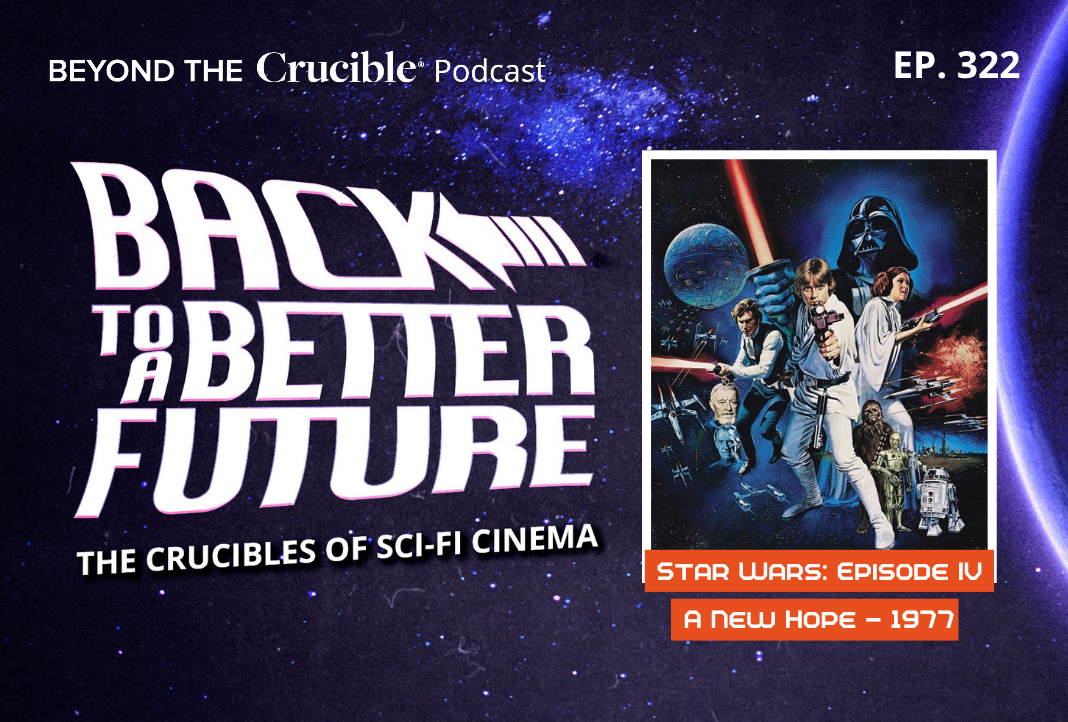
Back to a Better Future: The Crucibles of Sci-Fi Cinema VI Star Wars Episode 4: A New Hope
A farm boy, a princess, a smuggler, a druid, and a robot walk into a crucible. What happens next changed cinema forever.
In this episode, we dive into Star Wars Episode IV: A New Hope as part of the sixth and final installment of our special summer series, Back to a Better Future: The Crucibles of Sci-Fi Cinema. We unpack the crucibles faced by some of the most iconic characters in film history — Luke Skywalker, C-3PO, Obi-Wan Kenobi, Princess Leia, and Han Solo — and examine the tragedies unleashed by Darth Vader. Each character’s journey offers a distinct and powerful lesson about what it takes to turn setbacks into significance, and what happens when we choose the dark side instead.
Want to explore our three prior summer series about the lessons we can learn about overcoming crucibles from film?
Check out these playlists featuring every episode of each one:
LIGHTS, CAMERA, CRUCIBLES (2022): • Beyond the Crucible: Lights, Camera, Cruci…
CLASSIC FILMS, CLASSIC CRUCIBLE LESSONS (2024): • Classic Films, Classic Crucible Lessons: A…
BIG SCREEN, BIG CRUCIBLES (2025): • Back To A Better Future 2026
Have a question or comment? Drop us a line at info@beyondthecrucible.com
—
👉 Don’t forget to subscribe for more leadership and personal growth insights: https://www.youtube.com/@beyondthecrucible
👉 Follow Beyond the Crucible on Facebook: https://www.facebook.com/beyondthecrucible
👉 Follow Warwick on LinkedIn: https://www.linkedin.com/in/warwickfairfax/
👉 Follow Beyond the Crucible on Instagram: https://www.instagram.com/beyondthecrucible
👉 Take the free Trials-to-Triumphs Self-Assessment to discover where you are on your journey of moving beyond your crucible and how to chart your personal course to a life of significance: https://beyondthecrucible.com/assessment/



Transcript
Warwick Fairfax:
Welcome to Beyond the Crucible. I'm Warwick Fairfax, the founder of Beyond the Crucible. We also see Luke and he's grumbling a lot about his life. He just doesn't want to be on this planet. He wants to get off this rock. So we don't know much about Luke other than he's also not a happy camper and somehow just feels like, I don't know where my life is headed, but I sure don't want to be in this desolate, desert-ridden place.

Gary Schneeberger:
Those names, C-3PO and Luke, are familiar to anyone who's watched the Star Wars films, but maybe not from the vantage point we discussed them here. This week in the sixth episode of our special summer series, Back to a Better Future: The Crucibles of Sci-Fi Cinema, we unpack the crucibles not only these two characters face in the film that kicked off the saga, Star Wars: Episode IV - A New Hope. We also look at the trials Obi-Wan Kenobi, Princess Leia and Han Solo must move beyond and the tragedies Darth Vader dishes out. How can understanding the lessons of the crucibles they overcome or caused help you turn your setbacks into significance? Stay tuned.
Welcome, friends, to this episode of Beyond the Crucible. You have joined us in the midst of our summer series, which we do every summer. And if you have not heard or seen the first several episodes, this is the sixth episode, if you haven't seen the first five, we encourage you to go to beyondthecrucible.com and look them up because there's some pretty robust conversations here. That is because we're once again focusing on the world of film. We had so much fun for the three years that we've done films. We're doing it for a fourth time this year. And after doing movies spotlighting heroes, that's sports heroes, that's historical heroes, military heroes, then we did movies that made the American Film Institute's top 100 films, so really classic films. And then last year we did just a roundup of films that really had a lot of crucibles in them.
And in each one of those series, we've just had a great time and we've brought, I hope, I pray, I think that we brought some great insights on how to manage your crucibles and move beyond them. So that's why we're doing it again this year. And this year we've decided, we've landed on something that's near and dear to the heart of our host, Warwick Fairfax, and that is science fiction films. Here's what our series is about this year. It's called Back to a Better Future: The Crucibles of Sci-Fi Cinema. So, Warwick, before we get going, I'm going to ask you what I ask you every episode of this series. Why are we back in the theater talking about movies again? This is the fourth time, as I said, we've done this. And what are you hoping our listeners and viewers will take away from our discussions in this series?

Warwick Fairfax:
Well, Gary, we both love movies and we really enjoy looking at movies from a Beyond the Crucible perspective. Watching a movie for fun is different than when you're watching it from Beyond the Crucible.

Gary Schneeberger:
Indeed.

Warwick Fairfax:
So you're looking at what are the challenges and typically a movie portraying a protagonist that's facing significant challenges that they seek to overcome. And as you've mentioned, we've done superheroes, sports heroes, historical heroes. And as you say, we've done American Film Institute's top 100 movies last year, focus on films with significant crucibles. But yeah, it's just something that's a lot of fun to look at a movie and deconstruct it, if you will, saying, "What are the key learnings that we can have? How do the protagonist either grow in their wisdom and courage?" Or sometimes it happens, the reverse is true rather than not being defined by their worst day. They are defined by their worst day and they get an erosion of their soul and character. So movies are a lot of fun in that sense and are very helpful to us as we all learn to try to figure out how do we overcome our crucibles and live lives of significance.

Gary Schneeberger:
And you are particularly excited about the genre of film that we're talking about in this series because you are a big science fiction film fan. Science fiction everything fan, I think is fair to say. So why do you love science fiction so much? And what about science fiction films in particular make them ripe for us discussing crucibles and how we move beyond them?

Warwick Fairfax:
Yeah. I've loved science fiction since I was very young, both in movies and TV shows. And I think of that iconic movie, 2001: The Space Odyssey. It came out in 1968 and you saw future technology such as iPad-like things on the back of seats that are in front of you, which obviously didn't exist in 1968. You had talking computers that were sentient and actually caused a lot of crucibles for the folks in 2001: The Space Odyssey. You even had video conferencing.
And what 2001: Space Odyssey did so well is they put brands on them. So if you were making a video call from the Space Station back to Earth, it was a Bell Telephone, which was the former AT&T. I was also a fan of pretty much every science fiction show, including the original Star Trek, the day from 1966 to '69. And truth be told, I think I've watched pretty much every Star Trek series since. My favorite one, which we might talk about one of these days or something related to it is Star Trek: Next Generation. But I also was a big fan of great science fiction novels written by some of the classic authors, Arthur C. Clarke and Isaac Asimov.
And what I love about science fiction and still do, it's not just about the future technology, which is amazing, but at its best, it explores deep societal issues that affect the human race. How will humans interact with other forms of life and technology? And it's very relevant as looking at technology as we look at AI. And a lot of folks are thinking about is AI safe? What role does that have in the future of humans? And that's something definitely is explored in science fiction. So in science fiction, we see that very significant crucibles are portrayed. Can the human race survive? Will the expansion of the human race across the galaxy be beneficial or not? And will technology get to the point where it will actually control humans? A lot of very deep issues.

Gary Schneeberger:
And here, folks, in episode six, we're looking at the 1977 film that when Warwick and I first saw it was simply called Star Wars. That was before there were several sequels and prequels made. And now it is called Star Wars: Episode IV - A New Hope. And what's interesting about this movie, it was not only the top grossing film in 1977, the year it came out. And let's put a pin in that for a second and say the last four movies that we've talked about in this series were all the number one films in their year. Right?
This one, and we back up, it was Jurassic Park. Then we back up one more. It was Terminator 2: Judgment... It was, sorry, Back to the Future and then Terminator 2: Judgment Day. So the last four movies that we've talked about were the number one film of the year that they were released. But here's another fact about Star Wars that's really, really interesting. And that is, it is the number two motion picture in terms of total box office adjusted for inflation in movie history. Two.
I'm going to read the number so I get it right. It is made, adjusted for inflation, 1 billion, 629 million. I'm not used to these big numbers. $496,559. That's how much the first Star Wars, just the first one has made adjusted for inflation. And I told you this earlier when we were preparing, Warwick, but there's only one movie ahead of it, folks. I'm going to ask you to figure what movie could be ahead of Star Wars, all time box office adjusted for inflation. Think about that for five, four, three, two, one. It was Gone With the Wind is number one at something more than 1 billion, 600 million dollars. So pretty fascinating trivia here.
Here's another bit of fascinating. This is my second favorite part of the series. My first favorite part might be Warwick getting to say protagonist, which is just that sweet, catchy Australian accent that he has just a touch-up still, but it's the log line of the film. Here's the summary. The film industry calls this the log line. It's a short, compact version of what the film is about. And this is a good one.
A young farm boy joins forces with rebels, a mercenary and a wizard to rescue a princess and destroy an evil Empire's planet-killing space station, unlocking his destiny as a Jedi Knight. That's tight. That is a very tight summary of Star Wars. But the even more famous summary of Star Wars, Warwick, really is the first thing audiences see as the iconic opening text scrolls across the screen. The openings really become a character almost itself in the Star Wars cinematic universe. What does it say as those words scroll across and up the screen? And how does it frame the action and intrigue that we're in store for?

Warwick Fairfax:
Yeah. I think back to when we saw this movie at the theaters in 1977, and the first thing you see is space with stars and these giant letters kind of roll towards you as the iconic John Williams score plays. I mean, it was quite an epic beginning to the movie. And as we hear this music, these are the lines, the words that we see scrolling towards us. It says, "A long time ago in a galaxy far, far away." And then it continues with the story of how that there's a civil war between the Rebel Alliance and the evil Galactic Empire.
Rebel spies have stolen the secret plans of the empire's ultimate weapon, the Death Star, which sounds pretty ominous. And that Death Star has enough power to destroy an entire planet. Princess Leia races home with the stolen plans that can save their people and restore freedom to the galaxy while pursued by the Empire's sinister agents. Now what's interesting here is George Lucas that created Star Wars, the whole Star Wars motif harkens back to the serials that were movie theaters in the early '30s and '40s.
You go to the Saturday movie and before the main feature would play, you'd have this half hour serial. So it could be Flash Gordon, Batman, Superman. I mean, there's all sorts of heroic adventures. And it would take maybe several weeks to see the full story. Come back next week's at the part two and Flash Gordon. Will he escape from the evil Emperor Ming? I think that's who he was from what I can remember. So it definitely starts off with that kind of mindset.
And from the beginning of the movie, we are confronted with the central crucible challenge that we'll see play out. Will the Rebel Alliance be able to stop the Death Star, which threatens to destroy the Rebel Alliance and any prospect of freedom in the galaxy? Or will the evil Empire prevail? Who will win, the forces of good or the forces of evil?

Gary Schneeberger:
Yeah. It's interesting when you mentioned that opening crawl, right? A galaxy far, far away. Here's some inside trivia that you don't know, folks, about the title of this series, which is Back to a Better Future: The Crucibles of Sci-Fi Cinema. One of the ideas we kicked around in the beginning was a crucible far, far away. And it just didn't quite measure up to Back to a Better Future. But that was one of the things in considerations.

Warwick Fairfax:
So what's interesting is two of the movies that we're covering in the summer series, one is Star Wars, the original 1977 version, and a movie that we have already covered is Back to the Future. So in that sense, Back to the Future won out over Star Wars.

Gary Schneeberger:
And hopefully, you listen to that episode on Back to the Future, because it was indeed an interesting conversation. All right. So after the crawl happens on the screen, the film does quick introductions. Lucas does a great job as director and producer and writer of this film. It does quick introductions of some of the main characters to get us going on our journey. Who do we meet in these first few scenes and how does their introduction set up the plot for Star Wars?

Warwick Fairfax:
So after the opening words that we see, we see that Princess Leia's ship is captured by this large Empire ship. And for those of us who saw that movie for the first time, when you see this massive ship that looks like some huge battleship flying through space, the technology at the time was like, "Wow." I mean, you were just floored. It's like when we were looking at Jurassic Park and for the first time you saw these dinosaurs roaming around. Also, to John Williams' music, it was that kind of a moment.
And so Princess Leia Ship, it's captured by this large Empire ship. Leia gives a droid, in other words, a robot, R2-D2, the secret plans for the Death Star. And then we meet Darth Vader of the Empire soon after. Leia is captured and Darth Vader wants the stolen plans from her. And he knows that she's part of the Rebel Alliance. So meanwhile, R2-D2, who now has the secret plans and another droid, C-3PO, they flee in an escape pod to a planet below. And so we see the unfolding of a central theme in the movie. Leia wants to get the stolen plans for the Death Star back to the Rebel Alliance.
Meanwhile, Darth Vader and the Empire will stop at nothing to get those stolen plans back. You'll see that through most of the movie. They really don't think it's going to play that much difference if the Rebel Alliance gets hold of these plans because they feel that the Death Star is impregnable. But that being said, they don't want to leave anything to chance. So they're desperate to get these stolen plans back.

Gary Schneeberger:
Yeah. And then next we see R2-D2 and C-3PO. Pin in that for a second, folks. I'm confessing to you here on the podcast that when I was 12 years old when this movie first came out, and I talked about it with my friends in school, I referred to C-3PO as C-3 Po. And people, all my classmates made fun of me. And I might have a little bit of that still stuck to me, but we see R2-D2 and C-3PO. I got it right now, old former classmates. I got it right now.
They've landed on a desolate desert planet, Tatooine. And as they make their way to where they really don't know where they're going, they're just making their way around the planet, C-3PO says something that sums up not just what the droids are going through, but how it feels for all of us when we're living under the weight of a crucible. This is one of those moments that Warwick talked about at the start where you watch it for fun, you watch it in the theater, you're just having a good time, not for Beyond the Crucible purposes, you don't notice this kind of stuff, but what C-3PO says in this scene really sums up what it feels like to be hit by a crucible, doesn't it, Warwick? And what does he say?

Warwick Fairfax:
Yeah, it does indeed. So we've got this escape pod with R2-D2 and C-3PO, and it hurdles towards this desert planet. And when it lands on this planet, I mean, it's just desert sand dunes for miles and miles. And so here's C-3PO and R2-D2 trudging through the desert. And there's an interesting interplay that will play out throughout much of the movie. C-3PO, it constantly grumbles. He's like, "Why are we here?" And he's just really a wet blanket. And while we can hear what he says with R2-D2, it just really communicates through electronic swaths. So we don't know what he's saying.

Gary Schneeberger:
Right.

Warwick Fairfax:
But what happens is throughout the movies, C-3PO is, amongst other things, a translation droid, explains to us what he's saying. R2-D2 is on a mission to get the stolen battle plans back to the Rebel Alliance. And he will stop at nothing to accomplish his mission. On the other hand, C-3PO seems to blame everything that goes wrong on R2-D2. And at one point he's so disgusted with R2-D2, he blames him for everything that possibly could go wrong in life. He just goes in a separate direction. And so then C-3PO says these immortal words, "We seem to be made to suffer. It's our lot at life. What a desolate place this is."
So imagine that you have a fellow traveler and they act like C-3PO. It just gets to be annoying like sand on the gears. It's like anything you could possibly whine or complain about, C-3PO will. The glass is always half empty. The world's going to end. It's a gloomy day, even if there's not a cloud in the sky, and he's always going to complain. But despite the fact that R2-D2 certainly does not have an ideal fellow traveler, R2-D2 is loyal to the mission and he will not give up.

Gary Schneeberger:
Yeah. And it's the glass that was half full is going to become less full because next, the pair are captured by the Jawa hunters. We aren't sure immediately what these creatures are going to be doing with the droids. But once again, C-3PO is not feeling that this crucible, as we say, is happening for him, not to him. He is really still living in the fact that it's happening to him. What does he say? And how is it something that's all too familiar again to us earthlings when we go through crucibles?

Warwick Fairfax:
Yeah. For C-3PO, everything in life is happening to them. Every event that occurs around you is always for ill, is always going to harm you. That's just the way he looks at life. It's a pretty gloomy droid. And so yeah, here we have these small creatures, the Jawa hunters, and they've captured R2-D2 and C-3PO and they're inside this large transport with a whole bunch of other droids and what looks like a junkyard setting. And so C-3PO in classic fashion says, "Will this never end? There is no sign for hope. There is no sign for optimism. In the world of C-3PO, you're always defined by your worst day. And tomorrow can always be worse than today." That's just his negative view of life.

Gary Schneeberger:
So folks, think about it right now. B and R2-D2, not a C-3PO as you go through life and you encounter crucibles. That is learning number one, I think, from our discussion of Star Wars. The scene then shifts, Warwick. We meet the hero of the piece, the young man certainly with the greatest story arc in the film. And that's Luke Skywalker, whose uncle buys the droids to help him around the farm. He buys them from the Jawa hunters. Turns out they were just trying to make some money off the droids. Luke seems to be suffering from something else we talk about at Beyond the Crucible quite a bit. And that is this, is this all there is feeling about his life? How does that show up, Warwick, in what he says and does as we get to know him in the scenes that follow?

Warwick Fairfax:
So at first, Luke's uncle, he wants to buy C-3PO and some other droid that you see sparks going on and just starts failing. And so only then does C-3PO mention R2-D2. And of course, C-3PO grumbles about having to help R2-D2. Now notice when C-3PO is bought by Luke's uncle, he doesn't say, "Well, wait, hang on. You want an R2 unit? You absolutely need R2-D2." He only mentions that after this first R2 fails. So it's not like C-3PO is fine this moment. He's happy, at least, in the first instance, to abandon his comrade until, "Okay, fine, I guess maybe I need to help him since this other R2 unit's not working."

Gary Schneeberger:
Right.

Warwick Fairfax:
Now we also see Luke, and he's grumbling a lot about his life. And he just doesn't want to be on this planet. He wants to get off this rock. So we don't know much about Luke other than he's also not a happy camper and somehow just feels like, I don't know where my life is headed, but I sure don't want to be in this desolate, desert-ridden place. Not a whole lot of reason for hope. "What kind of life am I going to have in this rock?" As he puts it.

Gary Schneeberger:
Right. While doing some cleanup though on R2-D2, Luke finds something that will lead him to the adventuresome life he craves. What does he find and what happens next?

Warwick Fairfax:
So while cleaning R2-D2, Luke triggers a video message from Leia. And Leia says this, "Help me, Obi-Wan Kenobi. You are my only hope." And the message just plays back again and again. And so at first, Luke's not really quite sure what this is. And then R2-D2, always through C-3PO as his interpreter, says that he, R2-D2, is the private property of Obi-Wan. And that this message, the full message is a private message for him. Now Luke thinks, "I wonder if he's referring to old Ben Kenobi."
So Luke is having dinner with his aunt and uncle, and Luke asks about Obi-Wan. And his uncle says that Obi-Wan died at the same time as Luke's father, as if a long time ago. And his uncle wants Luke to focus on preparing new droids for tomorrow and to focus on working at the farm. Now, Luke says he wants to transmit his application for the academy this year and not work another year for his uncle with the harvest and the farm. And his uncle says, "Look, Luke, I need you for one more season. So forget the academy. I need you here."
Luke is disappointed and he leaves. And after he leaves, his aunt says to his uncle that Luke is not a farmer and that he's too much of his father in him. And then his uncle says these very interesting words, he says, "Well, that's what he's afraid of, that Luke is too much of his father." The scene ends as we see Luke staring out in the night sky as he reflects and looks out on the twin sons of this planet.
And clearly Luke is frustrated. He doesn't want to be there on that rock. His uncle just wants him to stay and walk on the farm. His aunt says, "Look, Luke's not a farmer, but it just feels like Luke is trapped in this life." It does seem, as we've said, a bit of a life of quiet desperation, but maybe his uncle will let him out in a year's time. Maybe next year will never come. Who knows? But it seems like for the time being, Luke's going nowhere and he's stuck in a life that he really doesn't want to live, but what alternative is there?

Gary Schneeberger:
Right. So you mentioned he was looking out at the twin sons. He falls asleep. Ah, but when he wakes up, Luke discovers the first beats of his destiny. As we call it at Beyond the Crucible, the first beats of his life of significance. So what does he discover? What happens after Luke wakes up the next morning?

Warwick Fairfax:
When Luke wakes up, he discovers that R2-D2 is gone. R2-D2 was never one to flag in pursuit of his mission. And so here's this little R2 unit and he's wandering in the desert looking for Obi-Wan. So Luke and C-3PO, they head out in the desert in some kind of hovercraft vehicle that hovers over the desert. It's kind of pretty cool and-

Gary Schneeberger:
Especially in 1977, it was pretty cool.

Warwick Fairfax:
Oh, absolutely. And so they're wandering in the desert, Luke and C-3PO looking for R2-D2. Now they realize that R2-D2 must be looking for Obi-Wan because that's what is said. So what then happens is R2-D2, C-3PO and Luke, they're captured by these sand people, like little creatures. And fortunately, Obi-Wan comes on the scene. He sees what's happening and rescues him and brings him back to his place. Luke says that R2-D2 was looking for his former owner, Obi-Wan Kenobi. Now Obi-Wan says he's not heard that name in many years. And Obi-Wan says that that is his name, even though Luke knows him by Ben Kenobi and that he's not dead yet, because remember his uncle said, "Obi-Wan's no longer with us. He's dead."
But he's not gone by that name in a long, long time, Obi-Wan Kenobi. So Luke's encounter with Obi-Wan would indeed change the direction of Luke's life. That's amazing how sometimes you meet one person and it can change the whole direction of your life. You're not maybe going to realize it at the time, but that absolutely happens when Luke meets Obi-Wan.

Gary Schneeberger:
Good, good point. Obi-Wan then gives him a special gift that cements the non-farming life that Luke is going to have and also explains the parameters of the battle of good versus evil that play out in the rest of, not just this film, but all of the films that follow in the Star Wars saga. Let's take a look and a listen of a clip that unpacks that moment really nicely.

Video:
Luke Skywalker: No, my father didn't fight in the wars. He was a navigator on a spice freighter.
Obi-Wan Kenobi: That's what your uncle told you. He didn't hold with your father's ideals, thought he should have stayed here and not gotten involved.
Luke Skywalker: You fought in the Clone Wars?
Obi-Wan Kenobi: Yes. I was once a Jedi Knight, the same as your father.
Luke Skywalker: I wish I'd known him.
Obi-Wan Kenobi: He was the best star pilot in the galaxy and a cunning warrior. I understand you've become quite a good pilot yourself. And he was a good friend. Which reminds me, I have something here for you. Your father wanted you to have this when you were old enough, but your uncle wouldn't allow it. He feared you might follow old Obi-Wan on some damn full idealistic crusade like your father did.
C-3PO: Sir, if you'll not be needing me, I'll close down for a while.
Luke Skywalker: Sure, go ahead. What is it?
Obi-Wan Kenobi: Your father's lightsaber. This is the weapon of a Jedi Knight. Not as clumsy or random as a blaster. An elegant weapon for the more civilized age. For over a thousand generations, the Jedi Knights were the guardians of peace and justice in the Old Republic before the dark times, before the Empire.
Luke Skywalker: How did my father die?
Obi-Wan Kenobi: A young Jedi named Darth Vader, who was a pupil of mine until he turned to evil, helped the Empire hunt down and destroy the Jedi Knights. He betrayed and murdered your father. Now the Jedi are all but extinct. Vader was seduced by the dark side of the force.
Luke Skywalker: The force?
Obi-Wan Kenobi: Now the force is what gives the Jedi his power. It's an energy field created by all living things. It surrounds us and penetrates us. It binds the galaxy together.

Gary Schneeberger:
So, Warwick, talk about that that scene and its importance to what's to come for the rest of Star Wars.

Warwick Fairfax:
So this scene is a powerful scene. It gives you a bit of background to what's happened and it's the beginning of a call to action, a call to purpose for Luke. So it's an incredible scene. So here we see that Obi-Wan, he's fought in the Clone Wars as Luke's uncle did. Obi-Wan says that he once was a Jedi Knight, Obi-Wan just like Luke's father. And he says that Luke's father was the best fighter pilot in the galaxy, a cunning warrior. And Obi-Wan says Luke's father was a good friend of his.
So as we can see in this clip, Obi-Wan gives Luke a lightsaber, which Luke's father wanted Luke to have when he was old enough, but of course his uncle did not want him to have. And then Obi-Wan says these really interesting words. He says, "The lightsaber is the weapon of the Jedi Knight, an elegant weapon for a more civilized age." Really interesting phrases. And Obi-Wan goes on to say that for over a thousand generations, the Jedi Knights were the guardians of peace and justice of the Old Republic. That was before the dark times, before the Empire. The Empire really signaled the illumination of peace and justice and now has called forth the dark times.
So Luke asked how his father died. Obi-Wan looks sad and reflects on how a young Jedi, Darth Vader, who was a pupil of Obi-Wan until he turned to evil. And Darth Vader, as we've heard, he helped the Empire hunt down and destroy all the Jedi Knights or seemingly all. And Darth Vader betrayed and murdered Luke's father, so now the Jedi, all but extinct. So Darth Vader, he was seduced by the dark side of the force. And this is where we begin to learn what the force is. And Obi-Wan says, "The force is what gives the Jedi his power. It's an energy field created by all living things." So Obi-Wan says, "It surrounds us and penetrates us and binds the galaxy together."
So now Luke has learned about his history, about his father and how Darth Vader murdered his father and all but eliminated the Jedi Knights. This conversation with Obi-Wan is the beginning of the change of direction of Luke's life. This is a powerful struggle that is going on between the forces of good and the forces of evil. One of the interesting sidelines here that George Lucas does, and this might be familiar to students of ancient history, is the whole Star Wars struggle is modeled after ancient Roman history.
So in ancient Rome, there was a Republic and a Senate, like there was an Old Republic and a Senate in Star Wars, and there was a quasi-democracy before Julius and Augustus Caesar took over and created the empire in some ways as the empires created in Star Wars. And just like with the Empire, the Empire in Roman times was essentially a dictatorship. So it's just fascinating how George Lucas borrows these terms of the Republic and the Empire, really echoing forth the struggle between democracy and dictatorship that happened back in ancient Rome.

Gary Schneeberger:
Folks, I would be remiss in my duties as co-host, but I didn't point out to you what just occurred here for the first time I think in Beyond the Crucible history. You got to hear our host, the creator of Beyond the Crucible, share his love of two things that just fit together like hand in glove. Science fiction and history. He brought them both together in the same way that George Lucas did. And that's truly no jokes at all. That's a special moment in the history of the podcast right there.
In the next scene, very well placed by George Lucas, we get our first look at the power and the malevolence of Darth Vader. Up until now, he's been talked about as this kind of evil influence, but we haven't seen it play out. It happens when the Empire leaders are discussing their efforts to crush the rebel resistance. And one of them criticizes the force as not a real source of power. Certainly not as strong as the Death Star. What happens next, Warwick?

Warwick Fairfax:
So this is our first seat of Darth Vader. And here's this grim foreboding figure with this black helmet and you can't see his face and this black cloak. I mean, he's a scary figure. And so we're at a council meeting on an Empire ship where they're saying that they're vulnerable until the Death Star is completed. So we see the commander of the Death Star saying that the emperor has dissolved the Imperial Senate and the last remnants of the Old Republic and then swept away.
Fear will keep people in line, fear of the Death Star. Some say that this Death Star is the ultimate technological weapon. Now, Darth Vader then joins a conversation and says that he should not be too proud of this weapon as the ability to destroy a planet is insignificant next to the power of the force. Now, some of these folks at this council meeting are thinking, "Okay, this whole force thing that's more powerful than the ability to destroy a planet?" I mean, that makes no sense.
So one person there marks Darth Vader's sad devotion to an ancient religion, as he puts it. And that person says the force, it can't give Darth Vader clairvoyance to find the stolen plans or the rebel's hidden base. Well, Darth Vader does not take highly to being challenged. You challenge Darth Vader at your peril. And he does not like being marked or confronted. And so he uses the power of the force to basically lift this guy off the floor and he's getting choked to death.
Now this is by the force. So Darth Vader does not have his hands physically around him. He's just using the force to choke him. And he might have continued until the commander tells him to stop. So for those knowledgeable about religion, the force has familiar overturns. Some view religion as myth and legend and irrelevant in today's society. And in most religions, there are absolutely forces of good and evil that battle it out. So it echoes through the age in which we live in and some people think religion, any religion is irrelevant. Others find great solace and strength in it.

Gary Schneeberger:
Then next, R2-D2 plays Leia's full message in which she begs Obi-Wan to take the Death Star plans to the planet, Alderaan, and give them to her father, a fellow veteran for analysis. What is Luke's reaction, Warwick, to hearing the full message from Leia and the conversation he then has with Obi-Wan?

Warwick Fairfax:
It's a very interesting conversation. So after hearing the message, Obi-Wan says that Luke must learn the ways of the force if he's to accompany Obi-Wan to Alderaan. I mean, Obi-Wan doesn't ask. He just assumes, "Of course you're going to come, right? I mean, it's battle of good versus evil. What's there to think about?" But Luke says he has to go home. And Obi-Wan says that he needs Luke's help because he's getting old and that Leia also needs Luke's help.
Again, Luke says, "Can't get involved." He's got work to do. He said that he hates the empire, but he can't get involved and there's just nothing he can do. And Obi-Wan says, "That's your uncle talking." Obi-Wan urges him to learn the ways of the force. Obi-Wan says that Luke must do what he feels right, of course. It's really an interesting thing that Obi-Wan says, "Well, you must do what you think is right." It's a telling question because I'm not sure that Luke is thinking about what is right. He's just thinking about, well, what is obvious, what he needs to do, not what's right.
It's an interesting question. I don't think Luke really fully understands what Obi-Wan is saying. So at this point, Obi-Wan has laid down the challenge and the call for Luke to fight for the forces of good against evil. And at this point, Luke says, "Okay, I hear what you're saying, but no. I decline to meet the challenge. I'm just going to stay on with my life. This whole battling good and evil, that can go on, but I can't do anything. Who am I? I'm just one person, so I need to stay here." So it's not really Luke's finest moment and certainly at this point, he doesn't seem like the heroic hero in this movie.

Gary Schneeberger:
So let's break, put a pin in this just for a second out of the movie and just talk to our listeners and viewers, because what you just described is something that we all have dealt with. Right? There's advice from someone like Luke's uncle who says, "You don't want to go into that. Stay away from that calling." And then there's advice from someone like Obi-Wan who says, "No, this is your destiny. Step into it." And if we're being honest, these are things that can happen to us pretty much every day. One voice says, "Go for it." One voice says, "Stay away from it." How do we walk our way through that satisfactorily?

Warwick Fairfax:
Yeah, it's a really interesting question. I think for all of us, there'll be the cries for fear and caution maybe from within. It may be from family members, friends. You can't do it. The fight is too big. It's not your fight. You don't have it. Who are you? Be cautious. Stay here. Don't follow your own destiny, your own path. I know what your destiny is. It's to be a farmer. Stay here.
Well, not everybody that grows up on a farm wants to be a farmer. Many do. Some are like, "Do I want to be a farmer?" Or it could be any profession. You don't always want to do what your father and grandfather or grandmother do. You sometimes want to follow your own path. And so you have some people that are calling for fear and caution and safety. Others are saying, "You have a destiny. You have a higher purpose. There's a battle for good against evil."
And so we have a choice to make every day and throughout our lives, are we going to listen to the voices of fear and caution? Or are we going to listen to the voices and hopefully some within ourselves that call us to courage and adventure to a higher purpose? Which voices are we going to listen to? The voices we listen to are fear and caution versus courage and destiny and purpose. It determines the course of our life and our legacy. So every day we get to make a choice. We're going to go with fear and caution or courage, destiny, and purpose. It's a choice we have to make.

Gary Schneeberger:
And Luke has to make that choice and does indeed make that choice in the next scene. He quickly changes his mind after Imperial Stormtroopers murder his family and destroy his home while searching for the droids. Warwick, how does that all develop? What happens next?

Warwick Fairfax:
So the death of Luke's aunt and uncle, it changes everything. Obi-Wan really tries to console Luke by saying that Luke couldn't have done anything to save his aunt and uncle. If he tried, if he'd been there, he would've been killed too. So Luke says he wants to come to Alderaan. He wants to become a Jedi like his father. There's nothing for him now. So this crucible has become the catalyst for a complete change in the direction of Luke's life.
We talk a lot about it didn't happen to you, it happened for you. Well, Luke maybe unknowingly is embracing that way of looking at life. Now that his aunt and uncle have been killed, he realizes, well, there's nothing for him now. And he does feel called to a higher purpose to fight for the forces of good against evil. He's not saying, who am I? Do I have the capability? It's really not relevant at the moment. It's like, what do I need to do? Who do I need to become? What's the next step? And so Luke really changes from, there's nothing I can do, to I have to become a Jedi like my father and fight for freedom and justice.

Gary Schneeberger:
Right. But there are other people who will come up in the very next scene who don't have the same perspective that Luke develops. The party, the group ends up in a bar populated by, it's a very popular scene in the Star Wars universe, by several interesting creatures this bar is populated by, and one human who will prove important to Luke in Leia's mission. Warwick, talk about what happens in that bar and who they meet there.

Warwick Fairfax:
So in this bar, we see here's Luke, Obi-Wan, the two droids, R2-D2 and C-3PO, and they need a ship to get to the planet of Alderaan because they want to get the secret plans of the Death Star back to the Rebel Alliance, which is at Alderaan. And so they come across Han Solo, and he is the captain of the Millennium Falcon, and Han Solo's first mate, Chewbacca. And Chewbacca is an enormous furry creature that doesn't really talk. It just groans. But a bit like C-3PO interprets for R2-D2, Han Solo seems to be able to interpret for Chewbacca.
So as we see Han Solo in the opening scenes of his presence in the movie, it seems that he's only about himself and money. That's all he cares about. So when the group led by Obi-Wan says that they need a ship to get them to Alderaan rather than, "Gee, how can I help?" His first thought is, "Well, it's all about the money." So he negotiates to get 2,000 or whatever currency they have now, and then 15,000 when they get to Alderaan.
If Obi-Wan hadn't offered a good deal, Han Solo would be like, "Forget it." If Obi-Wan had said, "But this is all about fighting the evil empire and helping the Rebel Alliance," Han Solo's attitude would've been, "So? What does that have to do with me?" We'll find out he's a smuggler. He's in it for the money. It's like the patriotic speeches of country and sacrifice. It's like, why? So yeah, he's not a particularly endearing character at this point in the movie. It's all about himself and money. That's the Han Solo that we meet.

Gary Schneeberger:
Right. But he's also, like pretty much everybody else in the movie, at least on the not bad guy side of things. He's someone who's facing a crucible of his own. And this crucible that he's facing at this moment has really nothing to do with the Empire's plans to snuff out the resistance. What is that trial that Han Solo is facing as we meet him?

Warwick Fairfax:
So we find out, surprise, surprise, that Han Solo owes a lot of money to Jabba. He's a smuggler. And so he's always trying to pay people. And sometimes his adventures don't work out. And we learned that on a previous smuggling operation, I think he lost some cargo, didn't get through. And so Jabba wants to be paid. And Han Solo manages to convince Jabba to hold off and he'll give him an extra 15% based on the proceeds of his current mission with Obi-Wan and Leia and just kind of leave me alone for a moment. I promise you, I'll give you what I owe you plus 15%.
So this seems to be the life of Han Solo. It's all about the money and keeping bad guys like Jabba or these smugglers at bay, keeping the creditors at bay. It's all about one more mission, get the money and somehow hold off people like Jabba from getting on his back. And it's just a miserable existence. One mission to the next, dealing with people like Jabba. So that's the life of Han Solo at this point in the movie.

Gary Schneeberger:
But you do, as the audience get the idea that maybe what's going on with Han Solo is his character has never developed because his character's never been tested. So let's just wait for a full determination on his character until the movie plays itself out. Then, Warwick, they all go and get on the Millennial Falcon to head to Alderaan. But the Empire has obliterated the planet after Leia told them it was the home base for the resistance, even though it was not. But the journey to Alderaan does serve perhaps a better purpose for Luke and his tutelage under Obi-Wan. What starts happening between mentor and mentee on that journey?

Warwick Fairfax:
Yeah. This is a really interesting moment in the movie. We see in a scene with Leia and Darth Vader on the Empire ship that they're asking, "Where is the rebel base? And if you tell us, we won't destroy Alderaan." Well, she tells them. Of course she doesn't tell them the truth, but they don't quite know that at the moment. And they just destroy Alderaan anyway. It has millions of people, if not more, on this planet. I mean, she is just shocked about the elimination of life.
In fact, when that happens, Obi-Wan senses something happening in the force, a disturbance in the force, and he feels like there are a million voices crying out as they're being obliterated by the Death Star. So meanwhile, on the Millennium Falcon, we see Obi-Wan is beginning to train Luke with the lightsaber. And he says that a Jedi can feel the force flowing through them.
Now, Han Solo, ever the sort of snarky pessimist, says that hooky religions are no match for a blast by your side, exactly what he expect Han Solo to say. He says he doesn't believe there is one powerful mystical force controlling everything. He says there is no mystical field that controls his destiny. It's a lot of simple tricks and nonsense. So then Obi-Wan steps up the training of Luke by putting a helmet on him where he can't see anything. It blocks his whole vision. And he tells Luke to let go of your consciousness and act on instinct. Let go of your conscious self. He says that your eyes can deceive you and not to trust them.
He tells Luke to stretch out his feelings and Luke actually does better in his training. So Luke, unlike Han Solo, he's embracing the ways of the force and his legacy. And he's training his mind, body, and spirit for the battle ahead, the battle between good and evil. That's one of the things we'll see in this movie, is not all just about Luke receiving training about how to be a fighter and use technology and all that. Nothing against that. But the focus of Obi-Wan's training of Luke is really more on the internal of the soul and the spirit and self-control, self-consciousness. That is the focus of Obi-Wan's training. As we'll find, that training will be absolutely vital in Luke's mission as the movie unfolds.

Gary Schneeberger:
You might say Obi-Wan makes sure he does the soul work. I've heard that somewhere else. Where have I heard that?

Warwick Fairfax:
Absolutely. It's so true. And so for most of us, the really bigger battle is the battle within the soul, the soul work. Are we going to lead a life for good or for evil? Is it all going to be about us and money and power? Is it going to be about helping our friends and neighbors, serving a higher purpose, whether it's in our company, a business or a nonprofit? The battle for most of us is really a battle of within. Are we going to go on a path of money and power and fame? Are we going to follow a path that leads to serving others and some higher purpose? And that's really the battle of the soul that ultimately determines the direction of our lives and our legacy. And that's what's going on here, is Obi-Wan is training Luke, really doing a lot of soul work.

Gary Schneeberger:
They're still not out of the woods yet, or out of the space travel problem yet because the ride is anything but smooth for them. The Death Star's tractor beam captures the Millennium Falcon, but Luke and his companions managed to avoid detection and infiltrate the station. But Darth Vader is on the Death Star too. We're starting to get good versus evil converging in each other's presence. And he senses Obi-Wan's presence and begins searching for him.
As Obi-Wan deactivates the tractor beam that's pulling the Millennium Falcon in, Luke persuades Han Solo and Chewbacca to help him rescue Leia, who is scheduled for execution after refusing to reveal the true location of the rebel base. And, Warwick, Luke doesn't appeal to the better angels of Han Solo's nature here, does he? Because he's just not sure that Hans got them yet.

Warwick Fairfax:
Now that is so true. I mean, altruism seems like it's not going to work with Han Solo. So with R2-D2's help, they managed to find where Leia's being held captive on the Empire ship. So of course, Han Solo, ever the non-hero says he doesn't want to help or get involved. I mean, meanwhile, the Empire Stormtroopers are looking for them on the ships. It's not like he doesn't have any role to play or not like he just sit back and do nothing, but somehow he feels like he doesn't want to get involved. Well, a bit too late for that.
But anyway, so Luke tells Han Solo that Leia is rich and powerful and that Han Solo will get a reward. That's about the only thing that's going to motivate Han Solo. So now, Han Solo is suitably motivated and is willing to help and will do what he can to free Leia. So it's like, "You want my help? What are you going to pay me?" It's like altruism doesn't seem to exist at the moment in Han Solo. It's all about the money and what's in it for him. Give him a good enough deal. Okay, I'll help you. It'll cost you something. Cost you a lot, but sure will help you in those circumstances. So it doesn't really paint a particularly rosy picture of Han Solo's character.

Gary Schneeberger:
No. He continues taking a half a step forward and 15 steps back. But hang in there, folks. It'll turn. Obi-Wan then disables the tractor beam and faces Darth Vader in battle. This is one of the most rousing scenes in the film. It's something we see and hear a lot at Beyond the Crucible two. Our past can keep pursuing us if we don't confront it. And that's what Obi-Wan does here. How does that play out, Warwick?

Warwick Fairfax:
So while Leo, Hans Solo, Luke, R2-D2, C-3PO, they're heading to the Millennium Falcon to try to get away, Obi-Wan faces Darth Vader. Now, both of them realize this is a destiny to have this epic battle. And Darth Vader, as he's in the middle of fighting, Obi-Wan said the circle is now complete. "When I left you, I was but the learner, but now I am the master," says Darth Vader. Obi-Wan says, "Only a master of evil, Darth."
As they fight, Darth Vader taunts Obi-Wan, "Your powers are weak, old man." Obi-Wan says these immortal words, "You can't win, Darth. If you strike me down, I shall become more powerful than you possibly could imagine." Now, Obi-Wan almost seemed to let Darth Vader kill him after these words. He just seems to put down his lightsaber. And so this is all happening while the rest of the group is getting on the Millennium Falcon.

Gary Schneeberger:
Right. They're scadabling.

Warwick Fairfax:
Absolutely. And so Obi-Wan sacrifices his life, both for Luke and for the cause of helping good prevail over evil. Somehow Obi-Wan realizes by sacrificing his life, he's actually going to help the cause of the Rebel Alliance, help the cause of good, and help the cause of the force, if you will. So as Luke flees to the Millennium Falcon, for the first time we hear Obi-Wan voice in his ear. Obi-Wan has been killed, but yet we still hear his voice, you assume through the power of the force, and Obi-Wan says to Luke, "Run, Luke. Run." And this voice in Luke's ear from his mental will continue as the movie unfolds in an extremely helpful and empowering fashion for Luke.

Gary Schneeberger:
Next up, those Death Star schematics that have been all about people chasing each other across the universe, they're examined and they reveal a weakness in a small exhaust port leading directly to the station's reactor. It's only two meters wide, two meters wide, a little hole. And a plan is hatched to drop a torpedo into it to destroy the Death Star. Warwick, this is a poetic moment in the movie from a beyond the crucible perspective. It shows that you don't always need a big effort to begin moving beyond your crucible in a big way. How does that play out in the rest of the film?

Warwick Fairfax:
So the group are now on the Millennium Falcon. Fortunately, Obi-Wan deactivated the tractor beam and they're able to escape from this empire ship. And they have the plans for the Death Star, which R2-D2 has. And at this point, you hear Han Solo say that he's in it for the money and not for revolution. And later, Leia says to Luke about Han Solo, "I wonder if he cares about anything or anybody." At this point, the answer I think would be, "Well, no."
So once they arrive at the rebel base, Luke gets equipped to be one of the fighter pilots. We hear early in the movie that he's an experienced pilot and he just has natural ability. So as Luke is about to take off, he wonders what Han Solo will do. And Han Solo says this, "You don't think that I would be fool enough to stick around here, do you?" And Han Solo actually asked Luke to come with him. He figures Luke could be helpful to him in his smuggling operation because he's a pretty handy person. So Luke says that they need a good pilot like Han Solo, and he's turning his back on them. And Han Solo says, "What good is a reward if you're not around to use it? Besides, attacking the battle station is not my idea of courage. It is more like suicide."
So Han Solo is like, "Forget it. It's not my fight. It's suicide. I'm out of here." But there is a sign of hope because as Luke walks off, Han Solo says, "May the force be with you." Now remember, this is somebody who thinks this is some kooky, ancient religion. It's irrelevant. So whether he believes in the force or not, I think at least it shows a sign of respect for Luke and for what he believes in. So Luke is understandably disappointed that Han Solo won't be fighting with them. And Leia says these words, "He, Han Solo, has to follow his own path. No one can choose it for him."
And those are very wise words. And that's true for all of us. We have to choose our own path. Nobody can choose it for us. The consequences are also, in one sense, our choice because each path we follow does have consequences. If you follow the path of, it's all about me and money and greed, that will have consequences. And they typically won't be good. You can actually make your own crucibles worse and then manufacture more of them. Or the path that leads to good and life of significance, there still might be crucibles, but there'll be a whole lot more fulfillment and satisfaction on that path.
So Luke and the other fighter pilots, they head towards the Death Star. They fly low over the Death Star to try and make the shot down that small exhaust port. It's an almost impossible shot. It's not going to be easy as the Empire's fighters are all over them, including one which is piloted by Darth Vader. Earlier on, we learned that Darth Vader is an excellent pilot, and that definitely is true. And one by one, Darth Vader shoots down the rebel fighters. If Darth Vader's on your tail, you're in trouble.
And so Luke is about to take his shot, but at this point, Darth Vader is on his tail. The chances of Darth Vader missing at this point, no matter how good Luke is as a pilot, is slim. It's one of the things you see in the movie, is there are these channels in the outside of the Death Star and a bit like going in a plane and a fighter plane down a canyon. There's no room for maneuver. You can't juke your way out of range of people pursuing you. So you're in a very tough situation.
And then out of nowhere, here comes Han Solo in the Millennium Falcon. He distracts the Empire fighters, including Darth Vader, kind of spins out of control, and Luke actually has a clear shot. So Luke has his targeting computer all set. But now we hear the voice of Obi-Wan telling Luke this, he says, "Use the force, Luke. Let go. Luke, trust me." And then Luke turns off his targeting computer. Now remember, this shot is an incredibly difficult shot. And what does he do? He turns off his targeting computer. It makes no sense. But Luke sends his torpedoes into the shaft. And while all this is happening, one of the things that George Lucas does, which is so brilliant, we constantly see the movie shift from the Death Star to the rebel fighters.
And what we understand is that this Death Star is on the other side of the orbit of a planet, and it has to get around the orbit of that planet to be in range at the rebel base, which is on a moon on the far side of this planet. So we see during this part of the movie, a countdown of when the rebel base will be in range. So at first, it's 30 minutes, then 15 minutes, then 5, and then 30 seconds. And just as Luke is about to fire these torpedoes down that narrow shaft on the Death Star, we see that the Death Star is in range at the rebel base.
They're powering up their weapon just in the process of firing. We're talking seconds away. And so Luke's torpedoes, they go down that shaft, it's a clean shot, and the Death Star explodes just before it can fire, mere seconds before it can fire. It's an incredible shot, an incredible end to this part of the movie and the Death Star.

Gary Schneeberger:
Yeah. And what follows then is a bit of a coda to the film. That is, it ends in a triumphant ceremony in which Leia awards Luke and Han Solo medals for their heroism. At the start of this movie, if you would've said Han Solo's going to get a medal for his heroism, no one would've believed you. But that's indeed what happens. And, Warwick, Luke and Han Solo really have started living lives of significance at the end of Star Wars, haven't they?

Warwick Fairfax:
It's so true. And you're very right, Gary. At the beginning of this movie, Han Solo certainly won't get any medals other than maybe cowardice, greed, self-centeredness, an anti-medal, anti-hero.

Gary Schneeberger:
Or when he bought himself.

Warwick Fairfax:
Exactly right. Exactly, because nobody else would give him one. But Luke, on the other hand, he's not a bad guy, but he certainly doesn't seem this heroic figure. It's like, look, I'm living my life a quiet desperation on this planet. I'm in Tatooine. I don't know that I want to be here. Maybe I'll escape one day. But really does not seem like the hero that would save the galaxy and the Rebel Alliance from the Empire. He's not a bad guy. You just wouldn't really think about him in that context.
So we see this transition from Luke as a young man working on a farm, wants to go to the academy, but he's locked into this desolate planet with his aunt and uncle. Doesn't feel he can make any difference between the Rebel Alliance and the Empire. And just like so many of us, we feel like we can't make a difference. We can't lead much of any life of significance. What does that even mean? It's meaningless for us. We're locked into a humdrum life the way he sees it.
By the end of the movie, Luke has saved the day with what Han Solo says, "It's a million to one shot with his torpedoes destroying the Death Star." Even with his targeting computer, the odds of that shot making it are a million to one. Without the targeting commuter, it probably goes up to a trillion to one. But Luke trusts the force, trusts his mentor, and makes this impossible shot. So Luke indeed learns to trust himself, trust the training of his mentor, Obi-Wan, trust in a higher power, and not just to rely on his own strength. Luke has grown tremendously in his courage, trust, and wisdom. Luke's journey shows that the key battle is the battle within. It's not just about what we do on the outside. The battle within has been won by his own courage, by the advice of his mentor Obi-Wan, and by relying on a higher power. All of those have empowered him to do the impossible.
Han Solo truly does make an amazing transformation. At the beginning of the movie, he's all about himself and money. It's all about helping number one, not about other people. He doesn't want to get involved in causes or battles. Hey, the fight pitting the Rebel Alliance and the Empire, it's not my fight. Nothing to do with me. But by the end of the movie, Han Solo is a key part of saving the day. So as Luke lines up that impossible shot to send the torpedoes down that shaft, if Han Solo hadn't been around, it's questionable as to whether Luke would've made it.
Darth Vader would've stood a very good chance of shooting Luke down. He had him right on his scope. There was nobody around to stop that shot. So Han Solo really did make the saving of Luke and the destruction of the Death Star possible. That would not have been possible without Luke. It certainly would not have been possible without Han Solo coming to help Luke save the day.
So it's really incredible. It shows you the evolution of Han Solo's character. It also shows that we should never give up on those around us, family and friends. Maybe we feel like they're going down a path of self-destruction. It could be drugs, alcohol. It could be poor choices in life. It could be just making choices of a life of quiet desperation. We know they have so much talent and ability, but they don't believe in themselves. They won't take chances. They won't take risks. And so they just take the safe route, the route that really leads to a life in which so many people would say about them what could have been. And only if they trusted themselves, trusted in a higher power, looked to others and not themselves.

Gary Schneeberger:
This whole episode, it's interesting, I said at the start, we kicked around ideas for the title of the series, and one of them was A Crucible Far, Far Away. And our discussion on this movie makes me think, we should have selected that one maybe. But it is indeed called Back to a Better Future: The Crucibles of Sci-Fi Cinema, and we're sticking with that. Warwick, how do the crucibles of the characters in Star Wars offer us insight into how to move beyond our own crucibles?

Warwick Fairfax:
It's easy to think that we can't make a difference with just some insignificant person who doesn't have the skills or the training or the pedigree to accomplish much. Maybe nobody from our family went to college. Maybe none of them left the town that we grew up in. Maybe we feel like our path on life was mapped out for us at birth. And we might feel like the battle around us is so big. How can we possibly make a difference? It's just me. I don't have the training, the skills, the courage, anything. But you look at the lives of Luke, Han Solo, Obi-Wan, Leia, R2-D2, and even C-3PO, we can see how they were willing to fight for a cause beyond themselves, to fight for good against evil. And each of them played a part and each of them were part of how good did indeed triumph over evil.
So we need to choose how we want to live our lives. Do we want to live lives of quiet desperation? Which is where we see Luke at the beginning of the movie. I can't really do much. Who am I? It's all too difficult. Do we want to live lives where it's all about money and about ourselves? Which is what we see Han Solo live his life of much of the movie. Hey, everybody's greedy. Everybody's in it for themselves. Why shouldn't I be? Why shouldn't I get a piece of the action? Nobody's going to help me. Why should I help them? That cynical, defeatist, it's all about me attitude, that could be us. Or we can make a different choice. We can decide to live lives of significance, a life on purpose dedicated to serving others.
We truly seek to make a difference in the world. Now, maybe we won't save the galaxy like Luke and Han Solo did. Maybe it's just our town, our community, our home. Maybe it's fighting for a friend of ours at school or a brother or sister. One path leads to a somewhat despondent, gloomy life, while the other leads to a life of fulfillment and purpose. So each day we get to make that choice for our lives and our legacy. Is it all going to be about me, money and greed? Is it all too difficult? Am I going to live a life of quiet desperation? Or am I going to live a life on purpose dedicated to serving others, a life of significance?

Gary Schneeberger:
Did you see that folks? Look, the house lights have come up, which indicates we have reached the end of this episode of Beyond the Crucible in our series, Back to a Better Future: The Crucibles of Sci-Fi Cinema. Next week, we will take another look at another film. And this time, Scott, give it to me, give me the drum roll, next time we're going to talk about, this is probably Warwick's favorite on the list that we have so far, and that is Star Trek: First Contact. So don't miss that. We'll be here next week. And as always, we'll save you an aisle seat.
Welcome to a journey of transformation with the Beyond the Crucible Assessment. Unlike any other, this tool is designed to guide you from adversity to achievement. As you answer a few insightful questions, you won't just find a label like the helper or the individualist. Instead, you'll uncover your unique position in the journey of resilience. This assessment reveals where you stand today, the direction you should aim for, and crucially the steps to get there. It's more than an assessment. It's a roadmap to a life of significance. Ready? Visit beyondthecrucible.com. Take the free assessment and start charting your course to a life of significance today.