
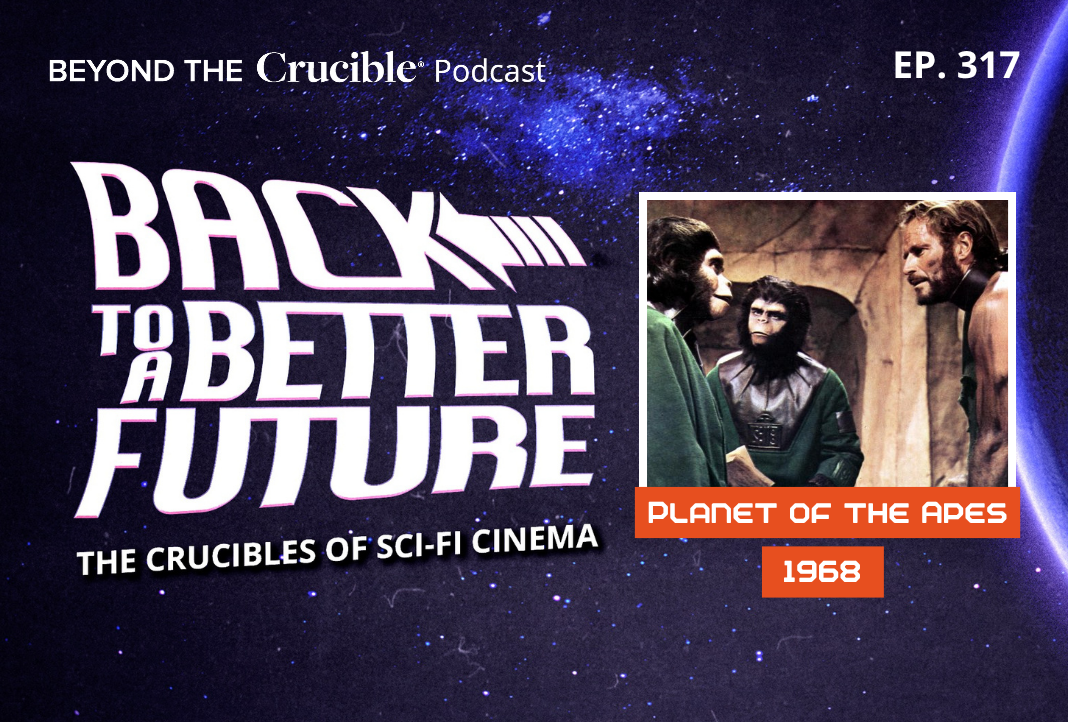
Back to a Better Future: The Crucibles of Sci-Fi Cinema I Planet of the Apes
What happens to your sense of self when everything you’ve known is suddenly turned upside down? In this episode, we dive into Planet of the Apes, the classic sci-fi film that used a stranded astronaut’s nightmare scenario to hold a mirror up to the chaos and disillusionment of late 1960s America. This is the first episode of our special summer series, Back to a Better Future: The Crucibles of Sci-Fi Cinema. We examine the film’s central crucibles, chief among them, how you muster the resilience to keep moving forward when your entire world has been inverted. What do Taylor’s struggles on screen reveal about your own capacity to survive disorientation, loss of identity, and a world that no longer makes sense? These are the questions we’re digging into this season.
Want to explore our three prior summer series about the lessons we can learn about overcoming crucibles from film?
Check out these playlists featuring every episode of each one:
LIGHTS, CAMERA, CRUCIBLES (2022): • Beyond the Crucible: Lights, Camera, Cruci…
CLASSIC FILMS, CLASSIC CRUCIBLE LESSONS (2024): • Classic Films, Classic Crucible Lessons: A…
BIG SCREEN, BIG CRUCIBLES (2025): • Back To A Better Future 2026
Have a question or comment? Drop us a line at info@beyondthecrucible.com
—
👉 Don’t forget to subscribe for more leadership and personal growth insights: https://www.youtube.com/@beyondthecrucible
👉 Follow Beyond the Crucible on Facebook: https://www.facebook.com/beyondthecrucible
👉 Follow Warwick on LinkedIn: https://www.linkedin.com/in/warwickfairfax/
👉 Follow Beyond the Crucible on Instagram: https://www.instagram.com/beyondthecrucible
👉 Take the free Trials-to-Triumphs Self-Assessment to discover where you are on your journey of moving beyond your crucible and how to chart your personal course to a life of significance: https://beyondthecrucible.com/assessment/



Transcript
Warwick Fairfax:
Welcome to Beyond the Crucible. I'm Warwick Fairfax, the founder of Beyond the Crucible. And Taylor was finally captured. He's holed up in a net. And Taylor for the first time speaks in front of the ape, his neck must have healed enough. And as he saw and heard, he says, "Take your stinking paws off me, you damn dirty ape." Now the apes, they are stunned. You cannot deny Taylor's intelligence. This is no mere mimicry. This is intelligence.

Gary Schneeberger:
In this pivotal moment from the movie Planet of the Apes, a stranded astronaut reveals he's not the animal the ruling class of apes believes him to be. This week in the first episode of our special summer series, Back to a Better Future, The Crucibles of Sci-Fi Cinema, we examine the film's central crucibles, including how you muster the resilience to keep moving forward when everything you've known is turned upside down. How can understanding these crucibles help you overcome your own? Stay tuned.
Well, friends, welcome to another episode of Beyond the Crucible. And I want you to do one thing before we start, find a calendar and look at it, because if it's summer, guess what we're doing? Beyond the Crucible is starting its special summer series. And we had so much fun the last three years where we have done this on films. We focused our summer series on the crucibles, the things you can learn about overcoming crucibles from movies. We did another one before the last, this is the fourth time we've done films as the basis for diagnosing how you get beyond your crucible, and we're doing it again this year.
Now, after doing movies the first year that spotlighted heroes, then we spotlighted classic movies that were celebrated by the American Film Institute, AFI. And then last year we did movies that had just a whole, you've heard of Chock Full o'Nuts coffee. This was Chock full of Crucibles, films that were full of crucibles that we could then unpack to help you get through your crucibles. And now we're moving to the fourth year of our summer series in films. You know what, Warwick? I'm going to call for a drum roll since we're going to... Scott, give me a drum roll before I tell folks what the name of the series is this year. One, two, three, go. There it is. We are calling it this year, folks, Back to a Better Future: The Crucibles of Sci-Fi Cinema.
And Warwick, before I say anything else and before we do anything else and dive into the film that we're discussing this week, why movies again? I asked you this question last time for the summer series, why movies again? This is the fourth time I said that we've done cinema for our summer series. What are you hoping listeners and viewers get out of our discussions this year?

Warwick Fairfax:
Both you and I, Gary, we love movies. We love looking at movies from a Beyond the Crucible perspective. It's funny, when you watch a movie just for fun, it's very different than when you're watching it from a Beyond the Crucible perspective, because we're looking to see, as is the case in really all of the movies we review is, we're looking at a protagonist that's facing significant crucibles and significant challenges that they have to overcome. And it's really a test of character. In some of the movies, many of them, they ride to the occasion and become better versions of themselves, their heroism, their self-sacrifice is evident. And in a few movies, actually the reverse happens and somehow they are found wanting, so to speak, when they face a crucible. But either way, we can learn a lot.
So we've covered, as you mentioned, movie superheroes, sports heroes, historical heroes. We've looked at movies from the American Film Institute's top 100 movies. And last year, as you say, we focused on films with significant crucibles. But it's really a proving ground, if you will, movies where you can just see faced with monumental challenges that seems almost like outsized compared to most of us. But still, it's a proving ground of how will they survive, not just physically, but mentally, emotionally, will they rise to the occasion or will they be defined by their worst day? As they say in Star Wars, so to speak, will they go to the dark side, so to speak, as opposed to the forces of light, if you will.

Gary Schneeberger:
And it's funny that you mentioned that it's different to watch movies for this than it is just to pop into a theater on a Saturday and watch a movie for purely entertainment, because this has changed the way I watch movies. Now when I'm just watching a movie for entertainment, I'm like, "Oh, that would be a good crucible." I mean, I'm seeing crucibles pop up in just films I watch every day in my life. So you're correct, there's a different lens through which we look at these films. And in particular, I want to ask you, Warwick, why are you so excited about us doing science fiction films this time around? Because you love science fiction films so much. So explain about why you love them so much and why they're particularly resonant for discussing crucible experiences and how we overcome them.

Warwick Fairfax:
I've loved science fiction my whole life, basically both in books, movies, TV shows. I think one of the most influential science fiction films ever made was 2001: A Space Odyssey, it came out in 1968. Remember that date, 1968, folks, it might come up later. So in this movie, you saw future technology with space shuttles. You had screens on the back of seats, which we have now in planes, but didn't exist back then. You had talking, intelligent computers, video conferencing. So it was just amazing, the technology that you saw. And one of the other shows that I was a big fan of was the original Star Trek that aired from 1966 to '69. I also read widely in science fiction, including great sci-fi novels by Arthur C. Clarke and Isaac Asimov. Arthur C. Clarke actually wrote the screenplay for 2001 of Space Odyssey.
And so what I really loved about science fiction, and still do, is not only does it explore future technology, but at its best, it explores deep societal issues about the future of the human race and how it'll interact with other forms of life and technology. What is humanity? Are we going to move forward in a way that is benevolent? Are we going to be a force that's not for good? How do we treat each other? How do we treat people that look different than us? All of these things are explored in science fiction.
In science fiction, we see very significant crucibles portrayed. Can the human race survive? Will the expansion of humans across the galaxy be beneficial or not? Will technology get to the point where it will control humans? So you've got these mega overall crucibles as well as the crucibles of the main characters in the stories. So it's one of the reasons why I love science fiction. It explores these deep societal issues. And in some cases, like Star Trek, for the most part, it portrays a benevolent future where humanity actually cares about other people. So yeah, it's some of the reasons I love science fiction.

Gary Schneeberger:
Well, folks, if you caught Warwick's little hint about 1968 and you know a lot about science fiction, you may have an idea of what we're going to talk about this week, because we're kicking off our summer series with the original Planet of the Apes, which came out in 1968. Now, since then, it has spawned a whole bunch of sequels back in the '60s and '70s, and then a bunch of reboots in more recent times. But the summary of the movie, if you remember from last year, I read the summary of the film in the log line, Hollywood terminology for what a movie's about. Here's the log line for Planet of the Apes, "An astronaut crew crashes on a distant planet in the future where highly intelligent apes are a dominant species, and humans are mute, enslaved creatures, forcing the sole survivor to fight for his survival and expose the truth."
Now that sounds pretty exciting, doesn't it? And there's a bunch of crucibles that we're going to talk about in the midst of that, which can help you get past your crucibles. But the movie, Warwick, opens with the lead astronaut whose name is Taylor. And they just call him Taylor throughout the whole movie. But later on we learned in the credits, I think it says, his name is George Taylor. So it's George Taylor. And he's recording in this first scene of the film, a video diary of the mission his crew is on. He explains that they're in deep space, that's the phrase he used. And even though they have been gone only six months in their time, by their body clocks, 700 earth years have passed since they blasted off. The scene, just Taylor talking into his microphone while his three other crew members are asleep in their pods where they sleep, reveals him to be both cynical and a little full of himself. How does this initial scene, Warwick, shape what we're about to see later in this film as it goes on and the crucible that Taylor finds himself in?

Warwick Fairfax:
Yeah. So as the movie opens, here's Taylor in the spaceship, his three crewmates are in cryogenic pods, which as science fiction writers of long theorized, that if you want to survive in deep space over massive periods of time, obviously you need that kind of technology. So it's just him at that point, he's the only person who's awake. And this log that he's dictating, it shows Taylor to be reflective, but a cynical man. He says he leaves the 20th century with no regrets. He continues and says, "Space squashes a man's ego. He feels lonely. Is man a marvel of the universe? Does he still make war against his brother and keep his children starving?" So clearly Taylor has a dim view of the human race. He's almost happy to be away from it. So he's reflective, but he's just wondering, "What is the point of man? What is the point of humans? Are they a beneficial force in the universe or not?" So he's asking these existential questions at the very beginning of the movie.

Gary Schneeberger:
When Taylor wakes up from his own slumber scene or two later, the film's biggest crucible has been set into motion. Their ship has crashed in a desolate area, the men's female colleague has not only died in her sleep because her pod cracked, but she seems to have been dead for more than a year because she's all wrinkled up on her face. Planet of the Apes is a no hurry. This is one of the beautiful things about this movie to me, it's a no hurry to get to this overarching crucible as the men set out on foot to find a more inhabitable place, to find higher ground.
They believe that they're on a distant planet. Taylor says it's more than 300 light years from earth and that they have been away from earth for more than 2,000 years. And it's funny, because Warwick and I, as we were preparing for this, did a lot of sci-fi math, and that all sinks up. And even though I'm bad at earth math, we did sci-fi math together and that sinks up. But as they walk, we see how deeply jaded Taylor is about the America that they left behind. So talk a little bit, Warwick, about what we come to understand about Taylor in these scenes where he's trying to make sense of where they've landed after his journey in space.

Warwick Fairfax:
Yeah. So here we see, here's Taylor and his crew, they've landed in a lake in this incredibly desert place with rocky deserts and high cliffs, and there's not vegetation to be seen anywhere. And so they clamber out of the spaceship and they've got their packs with food and some technology stuff that they need, and they start walking through this stony desert. And it's so isolated. There's thunder and lightning but no rain. There doesn't seem to be a moon. And Taylor, as they're walking with his two crewmates, he rides them hard. He just really gets on their back. And one guy in particular who is called Landon, he just is really merciless. Taylor says really to them all, "We're here. We have to accept reality." And he's sarcastic about the human spirit. And then he says about Landon that basically, "You're on a journey, you're an ego trip. I bet there's probably some decaying, rotting statue of you, Landon, on earth." Basically he said-

Gary Schneeberger:
Great leadership.

Warwick Fairfax:
... "Yeah, you just want to be hero with a legacy. It's all about the ego. That's why you wanted to be on this trip, you just wanted to be this big hero." And Landon admits to Taylor that he has him pegged. Taylor may be merciless, but Landon is basically saying, "You got me." And then he says, Landon about Taylor, that he thinks Taylor believes that life is meaningless. And Taylor says, "Well, he's a seeker." And he says, "There must be something in the universe that is better than man." So clearly Taylor, as we're beginning to see, has a very dim view of mankind. And so he was hoping there's something better out there. And Taylor's view of man is just shown in a very graphical, harsh way when Landon, he plants this small little U.S. flag on the ground, which small is maybe a couple of inches. I mean, it's small. It's not feet.

Gary Schneeberger:
Yeah. It's like what kids wave at parades, right?

Warwick Fairfax:
Yeah. And he sticks it in this rocky ground as if, "Gere we are, we're claiming this ground for the United States," or something. And so what's Taylor's reaction? He laughs this sarcastic belly laugh as if, "Oh, come on, really, what's the point? You've got to be kidding me." It's just this savage, sarcastic laugh at landed. It's just merciless. And again, this really shows Taylor's view of the human race, "What's the point? The U.S., the earth, there is no point." Clearly his view of mankind is not good.

Gary Schneeberger:
Yeah. And he's going to get some company in his view of mankind not being good in the next scenes that come up in Planet of the Apes. So talk a little bit about the next scenes and the crucible that the astronauts find themself in, because this movie is called Planet of the Apes. So I'm guessing something's about to turn here in the film.

Warwick Fairfax:
Very true. So Taylor and the crew begin to see vegetation a little bit at a time, and they're thinking, "Huh?" Because they're not going to survive too much longer if they have to walk through the desert with their elementary provisions. And so they come across more vegetation. And then finally they see this large waterfall that descends into a pond. And they're thinking, "Hallelujah." There's a pond, there's a waterfall, there's clean drinking water. So they take their clothes off and just dive in and go for a swim. And so at this point they're feeling pretty good about life. Well, meanwhile, we see the outlines of other humans. We don't really see their faces too much. We see arms pulling things. And so these humans, they take away their clothes and their packs, and basically rip their clothes apart. They rip their packs apart and distributes things everywhere. So whatever provisions or technology they had in those packs are now useless, they're just destroyed.
And so the crew begin to see this, and they dash out of the water to try and get their clothes and their packs. And so finally they come across a clearing with a whole bunch of humans who were in skins. I mean, these look like very mute and unkempt, very primitive people. And so just as Taylor and his crew are trying to figure out what's going on here, we hear the sound of apes. And suddenly into the scene we see these gorillas on horsebacks with guns. And the humans are terrified by these gorillas and they flee. And the gorillas, they begin to fire their guns at the humans and try to capture them with nets. And in the frenzy, one of the crew, Dodge, is killed. Taylor is shot in the neck. And Landon and the other crew member is also captured.
And the apes are talking. This is a very different world. I mean, at this point it's clear that these talking apes are in control and the humans are the primitive people that are enslaved, and that the world has been turned upside down. And one of the things that we'll find is, these humans, not only do they not seem very intelligent, they're mute, they don't talk. So the whole world is turned upside down. The apes are in control and the humans are animals basically, who are just being rounded up in nets and shot and captured.

Gary Schneeberger:
Yeah. And I love that it takes a bit of time to get to that reveal. We're seeing them, the astronauts are trying to find their way and people are stealing their clothes. And it just seems like it's a normal sci-fi action movie. And then all of a sudden, boom, there's gorillas shooting at them. And the gorillas aren't just shooting at them, they're doing things that human hunters do to their prey. I mean, talk about that a little bit, because you see things that clearly shows the gorillas are the quote unquote "people," as we would say, and the people are the quote unquote "animals."

Warwick Fairfax:
Yeah. So these apes are talking, they're taking photographs of each other on the hunt, because this is a hunt. And you'll even see humans tied upside down by their ankles much the way that people might after hunting deer or elk or some kind of game, they might capture it and hang it up saying, "Hey, look what I've got with my prey. I did pretty well in the hunt." So humans are no more than deer or elk. They're just another type of game to be captured and killed.

Gary Schneeberger:
Yeah. I mean, it really shows how the tables have been turned in the Planet of the Apes, in the planet and in the film. The action then shifts a little bit, Warwick, to Taylor in captivity. It's there that he meets an animal scientist, the chimpanzee Dr. Zira, who is fascinated by what she sees in him as an intelligent... That's greater than most humans that she's encountered. She's intuitive and she sees that in him. She's trying to prove that man can be domesticated in her work. And her fiance, another scientist named Cornelius, is conducting research to discover a "missing link," quote unquote. You've heard that phrase before, right, folks? Cornelius wants to find a missing link among the humans that shows how apes came from something, what's the thing that apes came from? He's doing research into that.
Meanwhile, the orangutan, Dr. Zaius, head of the planet's religious and scientific endeavors, is dubious about what the couple is trying to do. "Man is a nuisance," he says. Taylor's unable to speak to Zira and Cornelius because of his neck wound. Remember, he got shot in the beginning when the gorillas were taking control of everything, but he does begin writing them notes that prove his intelligence. Warwick, in these scenes, it's Zira and Cornelius who face some pretty intense crucibles themselves. What trials do they find themselves up against as they study Taylor and try to stay at the same time in the good graces of Dr. Zaius?

Warwick Fairfax:
So Zira is an animal psychologist who wants to understand more about humans. So remember in this world, humans are considered animals. So therefore she's an animal psychologist. And she believes that humans have the capacity for some intelligence. And she also says that there is no biological reason why they cannot speak, because the all the humans are mute on this world. And Dr. Zaius, on the other hand, who's really over Zira, has no time for humans and believes that humans can only do simple mimicry. He says, "Only brain surgery makes sense. Humans are useless. They should be exterminated." And he says, "Simeon, survival." In other words, apes is what is important. So he believes not only are humans are useless, but in an ideal world, there would be no humans. They should be exterminated. That's his view of humans. And Zira's fiance Cornelius, he on the other hand, he's conducting archeological research about apes descending from man. So he's an archeologist and he believes that there's an evolutionary connect between apes and man.
Now these lines of research, whether it's Zira on humans having some capacity for intelligence, and Cornelius looking at the link between apes evolving for men, they're going to get both of them into serious trouble with Dr. Zaius and those in charge. So Zira and Cornelius in a sense, they're trying to advance science, be it through biology or archeology, and they want to understand humans and archeological history, but this is a world where the studies that Zira and Cornelius are conducting are considered criminal activity. They're certainly considered heresy. These are banned lines of inquiry.
Zira sees that Taylor is writing notes because as we mentioned, he can't talk because of the neck wounds he has, but he's writing notes. And as she watches his notes, it's very clear he's intelligent and he's not just some dumb human, that's undeniable, but she knows she will face massive pushback in this area of research from Dr. Zaius. But she's a scientist, she wants to push forward scientific understanding, in this case, biological understanding of humans. So she knows what she wants to do from a scientific perspective, but yet what are going to be the repercussions for her and her career if the powers that be object to her line of heretical inquiry. So she's in a bind.

Gary Schneeberger:
As you're talking about all of that, I just thought of one of those things where watching the movie in the Beyond the Crucible context is different than watching it just to enjoy it. I've always thought it interesting in this movie that the kinds of apes have different jobs. The chimpanzees are scientists, the gorillas are the enforcers, and the orangutans are the leaders. But it's interesting now that I think about it in the context of what you were describing earlier with George Taylor thinking that mankind is backward, has it wrong, still kills their brother, there's a stratification to this society that I have to believe is a little bit of a commentary of what in 1968 was the way that America operated, I would think, right?

Warwick Fairfax:
Yeah. I mean, as we'll see, you can say a lot about human society and its ills and things it's done, and a lot of that is fair commentary, but it's not like this world of apes is some socially evolved-

Gary Schneeberger:
Right, exactly.

Warwick Fairfax:
... community of enlightened folks. It seems that apes are trying to suppress knowledge because of heresy and fear and other unenlightened ways of thinking. And yes, it does seem there is stratification. You've got the chimpanzees, which you say are the scientists. And then in some sense above them, or at least it feels that way, the gorillas are the ones who are the soldiers, the enforcers, the police. And then you've got the orangutans who are the heads of council and leaders. And you don't see a chimpanzee being either an enforcer or the head of the councils, that doesn't happen. So it doesn't seem like an enlightened society. And even if humans are these dumb, mute, unintelligent beings, shouldn't they be treated with care and love? I mean, most enlightened people today believe that animals should be treated fairly and humanely. They shouldn't be just rounded up and killed for sport so to speak. You make a good point, Gary, that it's not like this ape society is so enlightened. It has issues-

Gary Schneeberger:
Right, it's not Nirvana.

Warwick Fairfax:
No, it is certainly not.

Gary Schneeberger:
Yeah. So Taylor's crucible gets turned up several notches in the scene that follows what we've just been talking about. He is chased by gorillas. Remember, they're the enforcers. He is chased by gorillas who serve as soldiers through the apes' museum, which features exhibits of humans, includes Dodge, one of Taylor's other crewmates from his spaceflight who has been taxidermied. The scene ends with one of the most notable moments in Planet of the Apes. Let's watch and listen to a clip of that moment.

Dr. Zira:
Taylor, why did you run away?

Speaker 4:
Security, police.

Dr. Zira:
I'm in charge of this man.

Gary Schneeberger:
No longer, madam. He is now in the custody of the Ministry of Science.

George Taylor:
Take your stinking paws off me, you damn dirty ape.

Gary Schneeberger:
So Warwick, why is this scene and the scenes that led up to it so pivotal to the direction that Planet of the Apes takes?

Warwick Fairfax:
Before Taylor escapes, there are conversations between Zira, Cornelius, and Dr. Zaius. So Zira and Cornelius are trying to tell Dr. Zaius that Taylor is intelligent and there is evidence of an earlier culture prior to ape-recorded history, into the work that Cornelius had been looking into. It is clear that Dr. Zaius is very hostile to this way of thinking. So we then see Taylor in a cage with gorillas coming to take Taylor to get a lobotomy based on orders from Dr. Zaius. That tells you everything you need to know about Dr. Zaius. He's afraid of Taylor, he wants to squash anything and everything that he's about.
And so as they're about to take Taylor away, Taylor flees for his life and he's running all over the place, as you mentioned, through this museum with these humans that are there, in one case, the stuffed human that used to be his crewmate Dodge. And Taylor was finally captured and he's holed up in a net. And Taylor for the first time, as we saw in this clip, speaks in front of the apes, his neck must have healed enough. And as you saw and heard, he says, "Take your stinking paws off me, you damn dirty ape."
And Now the apes, they are stunned. You cannot deny Taylor's intelligence. This is no mere mimicry. This is intelligence. Well, intelligence with attitude, but intelligence nonetheless. And Taylor is now a very real threat to Dr. Zaius and the others in charge. So Taylor by his presence calls into question everything that ape society believes in, everything it was founded on, everything they believe about ape evolution and man's role in society. And so Taylor's now back in a cage with the gorillas yelling at him. And Taylor says in another memorable scene, "It's a madhouse." Clearly Taylor is not in, as you put it, Nirvana, he's not in this magical place. It's like, "What upside down crazy world am I in?" This is not the society he was looking to be a part of when he thought it would be great to escape from the human race. This doesn't seem like a great landing place for Taylor. This isn't this happy place free of human control, far from it.

Gary Schneeberger:
Yeah. And when I see that, "Get your stinking paws off me, you damn dirty apes," scene, it makes me nostalgic for the days of movie theaters, because that scene is a lot more fun, I bet, in 1968 when you're watching in a crammed theater full of people and that happens and the crowd goes nuts and applauds as opposed to you're watching on your big screen at home. I think we've lost a little something. It has nothing to do with crucibles, but we've lost a little something where those moments can't be shared together in a communal setting.

Warwick Fairfax:
[inaudible 00:31:55].

Gary Schneeberger:
So both Taylor and the scientists are then put on trial, he, Taylor, because Dr. Zaius wants to ensure that he can never procreate, they, the scientists, for scientific heresy. In the debate that follows, there are many points of contention that address the issues in our culture about evolution and other issues like that. If you watch this movie and you see this court scene, you can see a lot of things that point to 1968 America, and in some senses to America today. Those themes get expounded on even more after Zira and Cornelius bust Taylor out to save his life. And the action shifts to the archeological site that Cornelius has been studying. Dr. Zaius turns up and dismisses the evidence, good bureaucrat. Human or ape, there are bureaucrats. He dismisses the evidence and destroys the site after Taylor escapes into the forbidden zone where his spaceship crash-landed.
Warwick, what stands out to you from these scenes? And why does it serve as cultural commentary on life in the 1960s America?

Warwick Fairfax:
So in this courtroom, it's not just Taylor that's on trial, but so are Zira and Cornelius. So this courtroom wants to pretend that Taylor must have been operate on to be able to speak. Humans can't naturally speak, it's a circus trick, that they must have done something to him. And Zira and Cornelius have been accused of scientific heresy. And obviously nobody believes that he's from another planet, which is what Taylor claims. And when they go out to find his other crew members, because he said, "Hey, I'm not alone. I had some other crew members with me," because he knows that Dodge was killed, but he doesn't know what happened to Landon. And so Taylor goes and he sees Landon, but he sees the side of Landon's head has been shaved and there's surgery. He sees that he's been lobotomized. So now Landon is just some mute, sadly, unintelligent being like other humans. And Taylor just yells at them and says, "You bloody baboons." It's like, "What have you done to my crewmate?" He's just horrified by what he sees. And Dr. Zaius, interestingly enough, rather than just admit it, for some reason he says that Landon suffered brain injury, maybe he had a head trauma and there was an operation that was needed.
And so at that point with all this going on, after this courtroom, we see Cornelius and Zira break Taylor out of prison and flee. Now Dr. Zaius says Zira and Cornelius will be indicted for heresy and that Taylor will have experimental surgery done to him so that he will be a living death. I mean, there's a scene in which Dr. Zaius talks to Taylor and basically says, "We're going to do experimental surgery onto you. And that will be like a living death." And Taylor knows what that means, he's seen Landon. And so it's just a horrific scene. And so Zaius says that Taylor is a menace, a walking pestilence. So we see Cornelius and Zira, as we've mentioned, break Taylor out of prison. And they go through the desert and eventually they end up in a cave that lies beside the sea. Now, this is a cave where Cornelius has been doing his archeological research. And so Cornelius says that there are tools and bones at this site from 1,300 years ago.
What's interesting, as we've mentioned, is that Dr. Zaius turns up and he has his henchman of gorillas, because he suspects, "Where's Cornelius going to go to?" He's going to go to the forbidden zone, to this cave where his research is. And so in the scene, not only do we have Zira and Cornelius and Taylor, but we also have Dr. Zaius there in this cave. Now one of the other things to mention is that when Taylor was in this prison, there was a human woman there who he calls Nova. She, like other humans, is mute, limited intelligence, but they form a bond, and he takes her with them as he's escaping from prison. And so again, here we are in the cave, Zira, Cornelius, Taylor, Dr. Zaius and this woman, Nova, and they're looking at these tools and bones from 1,300 years ago, but then they see there are artifacts from 700 years before that, which show an ancient culture that was more advanced.
And what's interesting is they find a human doll beside the bones of a man, not an ape. Remember, humans are meant to be these unintelligent people. You don't see animals with dolls, not unless a human has given it to them.

Gary Schneeberger:
Right. Dogs have toys. They don't have little babies.

Warwick Fairfax:
Yeah. And they don't get it themselves, you know?

Gary Schneeberger:
Right. Yeah.

Warwick Fairfax:
People provide it to them. Anyway, so we see this human doll beside the bones of a man. And then Taylor sees a man who wore false teeth, eyeglasses, and some kind of a heart valve. Those are all evidence of a bygone culture of some sophistication. So here we have this human woman, Nova, and Nova squeezes the doll, and that doll says, "Momma," much like dolls today would say. But here's the thing, Taylor asked Dr. Zaius this question. He says, "Why would an ape make a human doll that talks?" Because remember, humans are mute, they have no intelligence. So why would you do that? It makes no sense. There is no answer to that question. And Dr. Zaius, as we'll find, is not surprised for what they're finding, because I think he's been there before. But then Dr. Zaius fires this back. He says, "If man is so superior, why didn't he survive? Where are these intelligent humans today if they even existed?" No real good answer to that question either.
So then we hear gunfire outside and everybody rushes out. We see that the gorillas are there and they're armed. Taylor captures Dr. Zaius and he makes the gorillas retreat. And he says to Dr. Zaius, "Look, I want a horse, I want a gun and provisions for myself and for Nova," the woman that's been with him on this trip. And they want to just get away. Dr. Zaius lets them go. He wants to get rid of them. But before they leave, we see that Dr. Zaius has the cave entrance dynamited, because he wants to erase all evidence of what was found. And this harkens comes back to something earlier when we had Taylor in an outside cage. And before they knew he could speak, when his throat was still damaged, he writes some letters on the ground that Nova erases. And he gets angry at Nova. Well, then there are other letters that haven't been erased. Well, Dr. Zaius sees those letters and erases them. There's no hint of surprise at all on his face. So Dr. Zeus knows that there was human intelligent life at one point on that planet.
So none of this is a surprise. He wants to, as one of the religious leaders, erase all evidence of intelligent human life. And so he wants this cave dynamited, which he does. So then as Zaius is lying tied up, he says this to Taylor, he quotes from the 29th scroll of the ancient ape laws. And what he's about to say, it is haunting. This is what the ape scrolls say. It says this, "Beware the beast man, alone among primates, he kills for sport or lust or greed. Yay, he will murder his brother to possess his brother's land. Let him not breed in great numbers, for he will make a desert of his home and yours. Shun him, drive him back into his jungle layer for he is the harbinger of death."
So that's what Dr. Zaius thinks of humankind. And then he goes on to say that all his life he was afraid of someone like Taylor, somebody that would be like those intelligent humans that he's discovered on this archeological dig, I'm guessing years ago. And Dr. Zaius says this, "Man's wisdom must go hand in hand with his idiocy. Emotions must rule his brain, a war-like creature who will hurt everything around him." And then Dr. Zaius says, "The forbidden zone was once a paradise. And then man made a desert of it."
So in these scenes, we see why Dr. Zaius is so afraid of Taylor and the work that Zira and Cornelius are doing, Zira showing that mankind has the capacity for intelligence, and Cornelius that there was indeed intelligent human life at one point on this planet, extremely threatening to ape culture and everything that Dr. Zaius believes in. So he believes, Dr. Zaius, that humans are a menace and only bring destruction. They should be in cages, if not ideally be exterminated. There should be no trace whatsoever of humans' prior civilization or their technology.
So in the late 1960s, as we think of the time when this movie came out in 1968, you had both civil rights movement, you had the Vietnam War, you had the assassinations of Dr. Martin Luther King and President John F. Kennedy and Robert Kennedy. So there probably would've been many at the time who wondered, "What is the value of the human race?" Look at the assassinations. Look at the bigotry that necessitated the civil rights movement. Look at what's happening to what was perceived at the time as the quagmire of the Vietnam War going after years costing enormous amounts of lives.

Gary Schneeberger:
Yeah. And before I get to the big reveal of the movie, I'm going to do a little reveal since we have time to do this. And actually, Warwick, in 1988, I interviewed Charlton Heston who played Taylor, and I asked him about Planet of the Apes. I just asked him, because I was going through all of his movies, "And so tell me about Planet of the Apes." This is what he said to me, "Actually, that was the first of the space operas. And the thing that perhaps was unusual about it was that as a space opera, the humans had the best parts," Charlton Heston said in 1988. "Since then, they still make them in their marvelous movies, but the robots and the curious creatures have the best parts." And then he said this to me, which I just thought was hilarious, "They approached me the other day about doing a sequel, which confuses me because they've already made a sequel or about four of them. I can't figure out what the hell they would make me do." I said this back to him, "Maybe they'll put you in eight makeup." And Charlton Heston said back to me, "No, then I wouldn't do." He did it. He actually did it about 15, 20 years ago when they did the first reboot of Planet of the Apes with Mark Wahlberg. But there's a little trip back to my interviewing days in 1988.
All right, back to our programming here. The biggest reveal, Warwick, comes in the scene that follows what you were just talking about, the scene that ends it. Taylor rides farther in the forbidden zone to discover something that shows the truth of how the planet of the apes, the planet itself, not the film, the truth of how the planet of the apes came to exist in the way that it exists. And I'm going to let you explain what exactly we see in that final scene.

Warwick Fairfax:
So after this fascinating talk between Taylor and Dr. Zaius about humanity and all its ills, we see Taylor and Nova ride off along the shorelines of the sea. And as they do that, there's a conversation where Cornelius asked Dr. Zaius what Taylor will find out there. And Zaius says, "His destiny." This is truer than even Dr. Zaius knows. So in this last scene of the movie, and this is one of the all time classic movie scenes.

Gary Schneeberger:
Oh, yeah.

Warwick Fairfax:
It's got to be in the top 10 or top five. It's incredible. So we see Taylor, he's riding along the shoreline of the sea, and we see him looking up at a statue, but at first the camera is situated high and above this statue. We don't quite know what it is, but it's enormous. And Taylor is looking up at it. And he mentions these immortal lines. He says, "Oh my God, I'm back. I'm home. All the time, we finally really did it. You maniacs, you blew it up. Damn. God-damn you all to hell." I mean, he's just screaming at the top of his lungs. So he's on the sand, on his knees, looking up at the statue. And then we see Nova looking up at this half buried statue. It's the Statue of Liberty.

Gary Schneeberger:
That still gives me chills just to hear that.

Warwick Fairfax:
Oh, absolutely. It's half buried in the sand. And this really is Taylor's worst nightmare, because they're not on some other planet, they're on earth. And it's because of man's idiocy, not some other human race of some other planet, but humankind on the planet earth. It's because of man's idiocy, as Dr. Zaius calls it, that the human race as Taylor knew it no longer exists. They're a shadow of their former selves. They're enslaved, they're mute, they have limited intelligence, they're running around in skins, they have no agency or authority. They're just treated like animals. So it seemed that sadly that Taylor's cynicism about the human race was warranted. I'm reminded of that phrase we sometimes say, that we don't want to be right. I wonder if Taylor was thinking of that, that, "I knew I had a dim view of the human race and where it was headed, but I was right. And how could I be right? I do not want to be right." At that moment he wasn't so much cynical, he was horrified, he was distraught. He wasn't saying, "Well, you got what you deserved." Ge was angry at humankind, of which he was a human.
And interestingly, yes, he says, "You maniacs, you blew it up," but he also says, "We finally really did it." He doesn't say, "They did it," "You did it." He says, "We." He's taking some responsibility for the destruction of the human race. It's a powerful scene.

Gary Schneeberger:
Yeah. I mean, Taylor in the beginning, both cynical and full of himself. At the end of the movie, he's emptied of himself and he doesn't have any place for cynicism. It's now replaced by just horror and deep despair, as you pointed out. It's a brilliant end to the movie, but it's not an end, Warwick, to the lessons that we can learn from the planet of the Apes. So let me ask you this. How do the crucibles the characters in the Planet of the Apes face offer us insight into how to move beyond our own crucibles, especially in the face of challenging circumstances where we might not have agency, as you pointed out, we might feel like we're trapped, what are some lessons that we can pull from Planet of the Apes to apply to our own crucibles?

Warwick Fairfax:
So in Planet of the Apes, throughout the movie, Taylor is in this incredible mind-bending crucible. The human race is now mute with little intelligence, and it is enslaved by apes. Human civilization has seemingly destroyed itself. All of Taylor's worst fears about humanity have been realized. At the beginning of the movie, Taylor's clearly cynical about the human race as well as his crew members. Taylor does not have many redeeming qualities. At the beginning, he'd be hard-pressed to think of anything, but as the movie progresses, we see that Taylor shows resilience. He does not give up fighting for his own survival or fighting for the truth. He wants to escape, he wants to figure out what has happened, what is going on. And he is determined to show the apes that he is intelligent. It's not like, "Look, I'm done for. What's the point? They're probably going to kill me." He doesn't give up. He never gives up.
So he's fighting for his own survival and fighting for the truth that he is intelligent. But more than just fighting for his own life and fighting for the truth that he is an intelligent human, he shows compassion. Early in the movie, Taylor shows zero compassion for people. And it's clear that he cares about the welfare of Zira and Cornelius. He's concerned about them being indicted for heresy for thinking that humans can be intelligent or that there was some ancient civilization before apes, as in potentially human civilization before apes. And Taylor also cares about Nova. Now Nova was in the same cage as he was at various times when he was captured. And she can't speak, again, like all of the humans of limited intelligence, but he has compassion on her. And when they escape, he wants to take her with him.
So this isn't some companion who we can have an intelligent conversation with, but yet he shows compassion and wants her to come. And so as we look at all this, sometimes we're faced with crucibles that are terrifying and beyond our control. They could be economic depressions, worldwide pandemics, earthquakes, other disasters, and they might seem way beyond our control, and they're a test of our character. Will we give up, as we often say, will we hide under the covers and say, "This is it. This is awful. I'm giving up"? Or we say, "Yes, it's awful, but how can I get out of the pit of despair? How can I take one more step even when I think..." We may think that, "One more step to where?" You know?

Gary Schneeberger:
Right.

Warwick Fairfax:
It's a worldwide pandemic, it's an economic depression, there is no hope. Imagine trying to take one more step in the Great Depression, which was in the U.S. and many other countries from 1929 into the '30s, endless bread lines, "One more step, what is the point?" But people of courage will say, "I'm going to take one more step." And not only do we have the opportunity to show resilience, but amidst these horrific crucibles, we have the opportunity to show compassion. Do we care about just ourselves or about others? Again, think about the Great Depression. Maybe you scarcely have enough food to feed your family, or maybe there's a friend across the road, an old lady that's a widow, maybe you can part with a little bit of your food and provisions for her. You don't have much for your own family, but when disaster strikes and horrific crucibles strike, it's a test of character. Will we show resilience? Are we going to be all about ourselves? Or will we show compassion? Will we have the capacity to care for others?
So crucibles are a tremendous test of character. And really this whole movie, Planet of the Apes, it's a test of Taylor's character. He goes from some cynical person that could care less about anybody else that thinks that humanity is doomed a destruction, and he goes from that to being somebody that shows resilience, that never gives up. And while indeed humanity has in this movie caused its destruction, at least as humanity and intelligent life was known back then, he shows compassion on Nova and Zira and Cornelius. And so this movie shows that despite the devastating crucibles that you can face, it is possible to get through them with character, with resilience, and compassion, and some level of human dignity.

Gary Schneeberger:
Folks, I've been in the communications business long enough to know when the last word's been spoken on a subject. And our sci-fi-loving host, Warwick Fairfax, just spoke it with authority. And that will end this first episode of our summer series, Back to a Better Future: The Crucibles of Sci-Fi Cinema. Next week we will be back. And we're not going to tell you what it is, we want you to come and be excited to find out, to discover the film crucibles that we're going to walk you through in the next episode of this summer series. We'll see you next week.
Welcome to a journey of transformation with the Beyond the Crucible Assessment. Unlike any other, this tool is designed to guide you from adversity to achievement. As you answer a few insightful questions, you won't just find a label like the helper or the individualist. Instead, you'll uncover your unique position in the journey of resilience. This assessment reveals where you stand today, the direction you should aim for, and crucially the steps to get there. It's more than an assessment. It's a roadmap to a life of significance. Ready? Visit beyondthecrucible.com, take the free assessment and start charting your course to a life of significance today.