
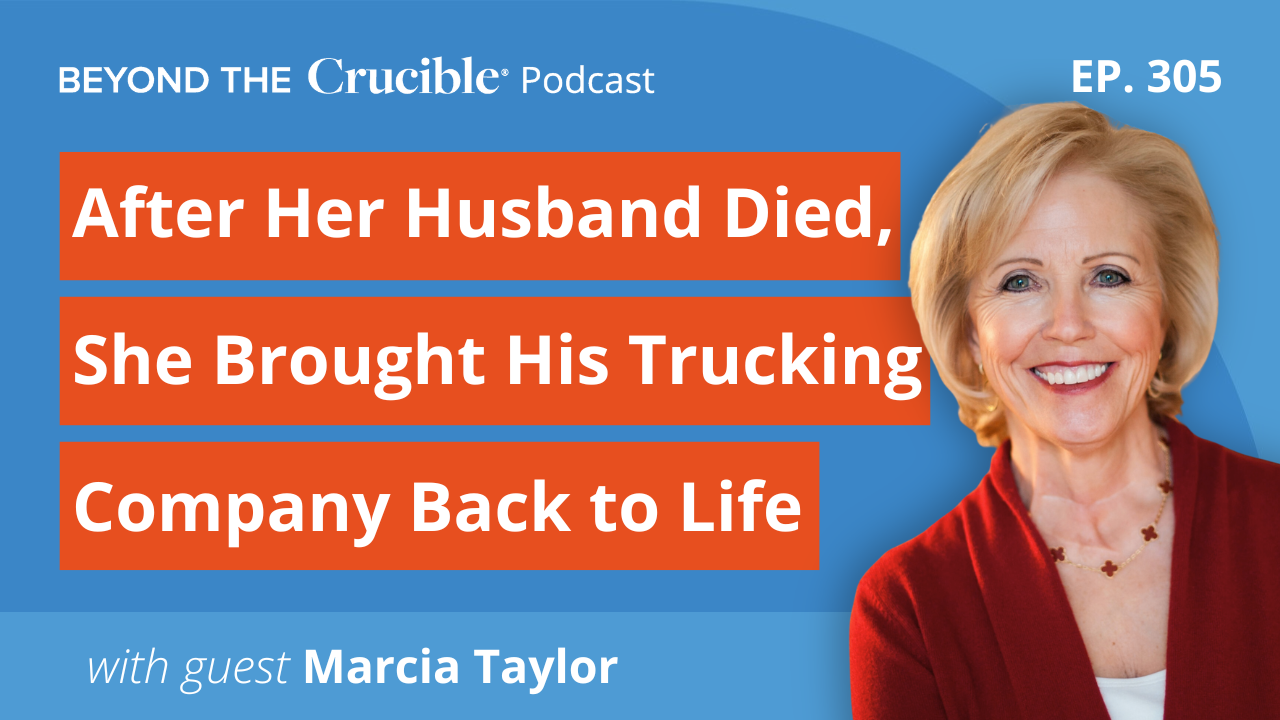
After Her Husband Died, She Brought His Trucking Company to Life: Marcia Taylor
Not wanting to let down those who are counting on you is a feeling we all can relate. That’s how Marcia Taylor felt after her husband died in a medical mishap, and she found herself in charge of the small trucking company he owned. Despite her early concerns about the challenges she was facing as a woman in a male-dominated business, she has built that company into a multifaceted industry leader worth nearly a billion dollars. She’s done it, she says, by being guided by her faith and values and learning that if she tried something and failed, it would be OK, because she could bounce back and try again. To learn more about Marcia Taylor and her trucking company, visit www.bennettig.com
Enjoy the show? Leave a review on your favorite podcast app and leave a comment at our YouTube channel. And be sure subscribe and tell your friends and family about us.
Have a question or comment? Drop us a line at info@beyondthecrucible.com
—
👉 Don’t forget to subscribe for more leadership and personal growth insights: https://www.youtube.com/@beyondthecrucible
👉 Follow Beyond the Crucible on Facebook: https://www.facebook.com/beyondthecrucible
👉 Follow Warwick on LinkedIn: https://www.linkedin.com/in/warwickfairfax/
👉 Follow Beyond the Crucible on Instagram: https://www.instagram.com/beyondthecrucible
👉 Take the free Trials-to-Triumphs Self-Assessment to discover where you are on your journey of moving beyond your crucible and how to chart your personal course to a life of significance: https://beyondthecrucible.com/assessment/



Transcript
Warwick Fairfax:
Welcome to Beyond the Crucible. I'm Warwick Fairfax, the founder of Beyond the Crucible.

Marcia Taylor:
I wasn't sure if the bank would agree for me to stay on and run the company or how our customers was going to feel. And so in the midst of losing JD, I was very worried because we had employees, we had wonderful employees, and we had drivers out there, and I just didn't want to let any of them down either.

Gary Schneeberger:
Not wanting to let down those who were counting on you, we all can relate to that feeling. And the stakes for our guests this week, Marcy Taylor, were unnervingly high. When her husband passed away after a medical mishap, she had to wrestle not only with her grief, but also with being the new head of the small trucking company he had run. Despite her early concerns about the challenges she was facing, she built that company into a multifaceted industry leader worth nearly a billion dollars. She's done it, she tells us, by being guided by her faith and values, and learning that if she tried something and failed, it would be okay because she could bounce back and try again.

Warwick Fairfax:
Well, Marcy, it's so wonderful to have you here on our podcast. Very excited for you to tell us your story, which it's an incredible story. You've lived an amazing life. And just want to read a little bit of your bio so that listeners and viewers know a bit about you.
Marcy, formerly Marcia Taylor, is chief executive officer of the Bennett Family of Companies. She and her late husband, JD Garrison, acquired the company in 1974 when it was a small contract carrier with five trucks and 30 trailers. For 50 years, Taylor has overseen the company's strategic growth into an international transportation management and supply chains solution leader with nine primary business lines. Through its affiliated companies, Bennett provides commercial vehicle transport, manufactured housing transport, heavy haul and specialized freight transportation, logistics, warehousing and distribution services, international freight forwarding, crane and specialized lifting services. The company and its entities employ more than 1,000 employees, 4,025 independent contractors, and include about 600 agent offices globally.
Additionally, Taylor is also the CEO of the Taylor Family Foundation. Through the foundation, a percentage of benefits' quarterly profits are donated to nonprofit organizations who missions align with the values of the family. Taylor is married to Michael K. Taylor. She has three grown children, David Larry, Denny Lowry, and Lynette Mathers, who all work for the company. Nine grandchildren and 11 great-grandchildren. That's a big family. I'm sure-

Marcia Taylor:
It is.

Warwick Fairfax:
... come Thanksgiving and Christmas, you need a big table for all of those. Marcy, I'd just love to hear a bit about your backstory and what life was like for you growing up. Which I believe I read somewhere you grew up in Illinois on a farm. What was life like for a young Marcy and hopes, dreams? And yeah.

Marcia Taylor:
Well, first, I'd like to thank you for asking me to be on this podcast. It's a great honor for me to be here and to tell a little bit about my story and about our Bennett Family Companies. Yes, I grew up on a small farm in Southern Illinois. It was a wonderful way to grow up. My grandparents lived on both sides of our farm. And we were two farmers. The only thing that we purchased at the grocery store was flour and sugar and things like that; we grew everything else.
Unfortunately, when I was 14 years old, my father passed away. And life changed for us when that happened. I had a younger brother who was seven years younger than me. And my mother at that time did not drive. She had always worked on the farm. And we ended up having to sell everything that we had on the farm, and so life became a little different at that time.
In fact, I think that my life, I went a little bit off track when that happened. And I was really mad at God for taking my dad. And he and I had a lot of talks during that time. And I ended up getting married very young. I was 16, going on 17 and had a baby. Ended up having three babies by the time I was 20 years old, so I was a very young mother. Really didn't have a way to make a good living. Ended up working two jobs. I worked in a pharmacy during the day, and I actually tended bar at night. And so ended up in a marriage that was... We were both just way too young to have gotten married and have that kind of responsibility.
I was looking for a change. I knew that I needed to make a change. And I had this opportunity to move to Georgia. A friend had called me and said, "We're starting a little trucking company in Georgia, and would you be interested in coming and going to work for us?" Now, I had no idea anything about trucking, didn't know the first thing, but I thought it would be a great opportunity for maybe a new start for myself and for David, Danny, and Lynette.
We packed up everything that we owned. And it all fit in the back of a... I think it might have took up about 10 feet in the back of a 45-foot trailer. And moved to Georgia, moved into a manufactured home. And I started to work for this little trucking company. And actually, I started to work for JD Garrison. Some folks in the little town that we lived in had asked him would he come and start this company?
And what I didn't know when I was 12, 13 years old, my grandparents lived right down the street from JD. And I had this tremendous crush on this boy, and I would walk down the street just to see if I could see him. He was a good bit older than I was, but I just had this big crush on this guy. And when I got to Georgia, I realized that the man that I was going to go to work for was the guy that I'd had... or the young boy that I'd had a crush on way back when I was in Wayne City.
We ended up getting married. I went to work. And we were in this little mobile home behind a truck stop. And there was only three of us. There was JD, and he took care of all of the sales and the equipment. And then there was a gentleman that did safety. And then I had to learn everything else. I had to learn everything from fuel tax to billing to settlement, but it was great because later, as the company started to grow, it was good that I knew how to do those things.

Warwick Fairfax:
Yes. Obviously the first huge crucible was losing your dad. And you've mentioned another, well, somewhat crucible, you had a challenging relationship with your first husband. But then, as you mentioned, you married JD Garrison, and then there was another crucible that changed the course of your life, one of the biggest crucibles. Now talk about what happened with JD and how that just completely upended your whole life. And you had three young kids. And talk about that whole experience.

Marcia Taylor:
Certainly. Well, when we first came here, we came to work for a little company called Specialized Truck Service. That was in 1971. And then in 1974, JD and I had the opportunity to buy a little small trucking company. We actually bought it on credit. I think a gentleman by the name of George Bennett had this company. His health wasn't good, and he wanted to sell it. They had 15 trucks, 30 trailers, and two small contracts, one Sunshine Biscuit and Ford Motor Company. We bought it on credit, and we had $500 the day that we opened in the bank. You couldn't do that now.
It was a tough way to start, but we had such good customers that we would bill out all of our freight during the week. We would go take our bill to Sunshine, and they would write us a check on Thursdays so we could make payroll on Friday. And we never, ever missed a payroll. But it was a tough way to start. We had a lot of really tough years at the very beginning.
And we had just began to get more trucks, get more business, and we finally got a bank that would loan us money, and so things were beginning to turn the corner for us. And JD, he was a heavy smoker, and he had to quit. They had told him that for his health reasons, he had to quit. He and I had gone to Houston to look at... We were doing a lot of work with the railroad, and we had gone to look at the location. And we saw a sign for a stop smoking, a stop smoking clinic. And so JD said, "You know I'll try anything once." And so we made an appointment while we were there and went to this clinic. They gave him some injections. They injected him in his ears and his nose and his throat.
We came back to Georgia, and a few days later he was not feeling well. And he never, never not worked, but he said, "I've got to go home. I'm just not feeling well," so he went home. And when I got home that evening, I could tell he was really, really not doing well, so I called a friend of mine at work and we took him to Atlanta to the hospital, thinking we were just going to be there for a few hours. And they looked at him and they told me, they said, "Look, I think we're going to take him up to ICU." And so they did.
And we were in the waiting room, and they came out in a little bit and they told me, they said, "You need to prepare yourself. I don't think he's going to make it." And I'm like, "How? What? How could that be?" But the doctors had injected a gram... We found out later, we did not know at the time, they had injected a gram-negative bacteria into his body. And his face and his neck started swelling from the infection. And he couldn't breathe. They had to put in a breathing tube. And so for about three days, he was on this breathing tube, and it was just touch and go. And we were all just praying. It was really a very difficult time. And on the third day, they told me, they said, "We're going to go try to do surgery, see if we can get rid of the infection." And he basically passed away on the operating table. It was a very, very difficult time.

Warwick Fairfax:
Your kids were pretty small back then, I'm assuming?

Marcia Taylor:
They were in high school.

Warwick Fairfax:
Okay. Okay.

Marcia Taylor:
Yeah. My oldest son, David, had stayed in Illinois and Danny was a senior and Lynette was a junior.

Warwick Fairfax:
Got it. Got it. Yeah, it's one thing when your husband or wife gets sick, but when you just go to a place to have help from smoking and they just inject you with something, and obviously it was infected with, as you say, this gram-negative bacteria, it wasn't like a heart issue, it's just this unthinkable, how in the world could this happen? You must have been filled with shock because obviously a week before, you weren't even thinking about it other than, "Hey, we need to get his smoking under control." But you weren't thinking about some imminent end of life situation. Obviously there was sadness. I'm sure there was anger. In the days we live in now, people would probably have sued the hospital for medical malpractice. What were your thoughts that were going through your head? It was probably anger at the hospital, maybe anger at God. It's like, again, another loss. How can this be? What was some of the thoughts flooding through your mind at the time?

Marcia Taylor:
Well, certainly there was a lot of grief at the loss. I just wasn't sure what I was going to do because we had this company that we had just began to get on its feet. And we had contracts, we had some good customers. This was in 1981. There just wasn't any women in trucking and there certainly wasn't any women that were managing or running a trucking company, so I wasn't sure if the bank would agree for me to stay on and run the company or how our customers was going to feel. And so in the midst of losing JD, I was very worried because we had employees, we had wonderful employees, and we had drivers out there. And I just didn't want to let any of them down either.
I'm a faith-based person, and when things like this happen, I just have to put my faith in God, turn it over to Him. And that's basically what I did. I just had to say to Him, "Look, God, I'm here. I've got to turn this over to you. And whatever happens, that's what's going to happen."

Warwick Fairfax:
It is remarkable that you, rather than reject your faith, it's like, "Okay, this is awful, but Lord, I need your help. I've got drivers, employees. There are people depending on me, my family. I've got to move forward." You didn't just sit there in anger or grief; I'm sure that was there. But it's like, "Okay, I got to find a way to move forward." You were in a very challenging position, as you say, very rare back then for a woman to be the owner of a trucking business. Talk about that, because not everybody makes that decision. You made a decision, "I got to move forward. People are depending on me." How did you make that decision? Because not everybody makes the choice you made.

Marcia Taylor:
Well, we had some wonderful people that worked with us, and we just all sat down and we talked about it and we said, "Look, this is..." We didn't have any money. We still didn't have any money. And really, what else was I going to do? And as I said, I still have a family, and so we said, "We're going to do the best we can, and we're just going to move forward."
And so it was a really dark, difficult time, but I think God just come beside me. And the days that I felt I didn't know what to do, I just leaned on Him. And He just got me through for probably the first year. I don't even really remember that first year after JD died. I actually think work was what I needed. I came to work and I did what I needed to do.

Warwick Fairfax:
Did you have any friends and family just... I'm sure employees, coworkers come alongside you and... I think maybe there's a time when Moses was in the desert. It was Aaron or a couple of people held his arms up, a proverbial thing. Were there people that were, in a sense, holding your arms up? Obviously you're a very strong person, but we all need people to come alongside us. Did you have those people in those early challenging days?

Marcia Taylor:
Oh my goodness, yes. Drivers, we had... In fact, one of the ladies that I was working with us is still working today. We've been together 52 years now. And so yeah, wonderful people. We just all worked together and leaned on each other, and it was great. And God brought some amazing people that helped us find additional customers. And yeah, it was amazing.

Gary Schneeberger:
There was an article that I read about you from one of the myriad awards that you won that didn't have time to talk about at the start of the show because there's so many of them. But you said this, Mercy, about just how you learned. You didn't know anything about trucking, so this was your guiding principle as you learned your business. And it says this: "The most important thing that Taylor has learned from her years in business is to rely on her core set of values, integrity, honesty, and faith, and to be resilient and take risks." And then this is a quote from you: "I had to learn to be fearless," she says. "I came to understand that if I tried something and failed, it would be okay because I could bounce back and try again."
You probably would not know this, but those words could have come from Beyond the Crucible because that's what Warwick teaches all the time, what Warwick talks about all the time. Yes, people came up and helped you, but how did you lean in with the trepidation, the fear, and press into all those things that you talked about? Because that's what turned things around for you, so how did you manifest that, make that happen?

Marcia Taylor:
Well, I've always said that Bennett is a can-do company, and we would just... And I'll give you an example. In our business, just a lot of different great opportunities have came about, but if we had a customer that had a need, whatever that need was, we would just say, "We can do that." And we would just go out there and figure out how to do it and find the right people to help us do that. And you had to just be fearless. You had to not be afraid to step out. I always think that when God opens the door, you got to have enough courage to step through it.
And so over the years, we're actually made up of 14 different companies that do 14 different types of transportation. And we're almost a billion dollar company. Hopefully this year we'll cross that threshold. And it's just from, over the years, having really wonderful, great people and not being afraid to say, "Yes, we can do that." And then you just figure it out.

Warwick Fairfax:
That's remarkable. You grew this from a small business when you took control, as you say, almost a billion dollars. Talk about some of that journey of growth. What were some of the key milestones in that journey to Bennett being amazing company it is today?

Marcia Taylor:
Well, I think you had talked about our core values. One of the things that we did very early on is we established a list of core values and of integrity, the fact that we're a faith-based company, financially responsive. Safety is priority one. No matter what we did, we tried to live by those values.
And so over the years, as I said, we have a customer that had a need, and we would find a way to fill that. What that did then is lead us into another type of business. We got into the drive away business. We're probably one of the largest non-unionized carriers out there that does drive away. And what that basically means is that we put drivers in any vehicle that is too large to be hauled. That led us over into manufactured housing. We're the largest carrier that delivers manufactured housing and modular buildings in the US.
We didn't start out to be the largest company, but because we just worked hard and figured out how to do it, and as I said, we had some incredible people come along, we've grown organically. And we've also had the opportunity to purchase other small trucking companies that were family-based. We're in our third generation now. And other companies that have been family-based have joined us. We do international business, 3PL, logistics. We have a crane company. We move heavy, high, wide. We touch most areas of transportation.

Warwick Fairfax:
It's really a remarkable story because here you were as you didn't have obviously the opportunity to have the education that others had. You almost didn't really have the opportunity to work your way up because it was just thrust upon you at a relatively young age. And here I am, obviously you have this can-do attitude, and somehow you've used your resilience and your faith to grow this large business. There aren't many that have done what you've done. It's a remarkable story.

Marcia Taylor:
Now my children work in the business, and they've been a huge part of our growth. And over the years, each one of them have taken a different part of the business. And they certainly are responsible for a lot of our growth. And now I have grandchildren in the business and grandson-in-laws in the business. Yeah.

Warwick Fairfax:
It's not always easy to maintain that legacy and a sense of responsibility. I know in my case, my great-great-grandfather, John Fairfax, who came out from England to Australia, he was the stronger business person for Christ as I've ever really come across. He was like an elder at his church. Pretty much every nonprofit in Sydney he either founded, was on the board of, even helped mentor church planters. How he had the time to do that and run a business... When he died, his employees said, "We've lost a kind and valued friend."
There were no unions or worker rights laws in the 1800s, but over time, at least in our family... Our family was fine, upstanding people, but the faith became a little less central, certainly not quite as evangelical, and more money. It tends to change people's values. It's hard to withstand the temptations of a lot of money, frankly. Because you obviously have, I'm sure, friends that own other family businesses and you have colleagues and network and all, have you found a way to maintain the faith in your company, in your kids? Without letting the growth and, frankly, the money distort their faith and values? Because that's not easy to do.

Marcia Taylor:
Well, frankly, we put most everything that we have back into this company to help it to grow. And several years ago, I had some really good friends that were... They were wonderful at how they gave back. And they were just someone that I really looked up to. And we decided to start a family foundation, which we... As a family, we all agreed to do this. And we give 10%. We put 10% of our earnings into the foundation, and then we give 10% out each year. And gen two, my children and I, make the bigger decisions. But then I wanted my grandchildren to be... I wanted them to understand about giving back, and so they manage the foundation, they decide who we will give money to. And we have a set of values that we will give to, a set of things that we agree to give to. And it's up to them to manage it because I want them to understand about giving back.

Warwick Fairfax:
That's very wise and probably unusual. Typically, a founder controls all that, but to set up a family foundation and have your kids and grandkids have responsibility, to have your kids and grandkids operate in different parts of the business. And you must have really modeled a way of service and giving back so that everybody's contributing and there aren't... Which is common, like family infighting or jockeying for position. Which sibling will take over one day, or grandchildren? It's like a Shakespearean play. You've obviously modeled a set of values and faith that Bennett and your family doesn't need to be another family business statistic like so many. Is there a way that you lived your life that really influenced how your kids live their lives? Because it just sounds like your family is very unusual amongst family businesses, from what I'm hearing.

Marcia Taylor:
I believe in having a strong work ethic. And this company, we have a huge responsibility because we have a lot of people that work here. And my children believe that as well. Although they're ready to retire and I'm not ready to retire, so I'm not quite sure how we're going to deal with that. But they've always just worked in the business. And as I said, we've put everything back into the business to help it grow. And my grandchildren are the same. I think everybody feels that they have a responsibility.
And then it's not easy having a family business. I always say it's okay for us to go into a room and have a disagreement. We can certainly discuss things, we can have a disagreement, but when we walk out of that room, we better walk out of there standing back to back. And we've tried to always do that. And then we brought someone in, Bill High, who's wonderful. He works with a lot of different family companies. And he has really helped us to manage through the different generations, manage through different personalities and different abilities. Everybody has strong points and weaker points. And so I really give him a lot of credit for helping us get to where we are today in our family company.

Warwick Fairfax:
That's so wise. When I was involved in my family business in the '80s, I'm not sure that really existed back then. You had lawyers and accountants and investment managers, and they'll all give you advice, and that's often helpful, but family business consultants and counselors, which I'm somewhat familiar with now, that's just remarkable that you've done it. It just seems so sensible just to figure out what are those unseen conversations? And get them sorted out before it gets serious, or what have you. That's amazing.
You mentioned earlier that obviously yours was one of the few women-run businesses. In those early days, how did you get respect from truck drivers and others that... Yeah, because you had to make your way in a world which it's not easy today, but was far harder. How did you manage that, to get their respect and so that they would work with you not saying, "What's this woman doing here?" Or some attitude they might've had.

Marcia Taylor:
I really never had an issue with drivers, I think, if you showed them respect. A lot of them call me mom. And as far as my drivers, I never had an issue about that. I always had some great folks that worked here and some folks that I would travel with. I had a couple of salespeople, and we would go and make a sales call. And if we went in to make a sales call and I could tell that the person that we called on was not comfortable talking to me, they were comfortable talking to the salesman that was with me, then he just handled it. And it didn't matter to me. I didn't care as long as we got the business. I didn't care who got it. But sometimes we'd go and somebody would be more comfortable talking to me. It never really mattered to me who got the business.

Warwick Fairfax:
I think one of the things I'm hearing you say is it's not about ego. A can-do attitude means getting the job done. And it doesn't really matter who gets the credit, are we going to get the job done? If we do, we're going to serve our customers, and all of them.
As you look back, there are probably some keys to your success, and yes, I'm sure having a good strategy and all that. But it sounds like there are some ways of thinking like not letting ego get in the way, getting good people, working hard. As you think back, are there some other keys to your success and Bennett's success?

Marcia Taylor:
Well, I think you have to treat people right. That's why those core values are important. And I always say we're going to live our core values. They may not always be popular, but it'll always be the right decision. And now, we haven't always done everything right. My goodness, we've certainly had hiccups along the way. We've tried things that didn't work, and that's okay. We tried it. We are an entrepreneur company. The one thing that we've always tried to do is find people who had an entrepreneurial spirit and then go with it. If it was a good idea, we would try it. And it certainly has worked for us over the years.

Warwick Fairfax:
And one of the keys to an entrepreneurial environment is it's okay to fail. And obviously there's level of failure. Small failures are better than gigantic ones, obviously, because they have bigger consequences. But you're a smart person, you give people, like you do when your kids are small, enough room that if you fail, the world's not going to end. You know? It's-

Marcia Taylor:
Right.

Warwick Fairfax:
As they get better, you give them a bit more room. And Yeah, I'm reminded of somebody we had on our podcast, Lisa Blair, who was a woman that sailed around Antarctica. Was, I think, the first woman to do that. And just remarkable journey with 50-foot seas. She had this incredible attitude. She said, "Failure is not trying. If you try and it doesn't work out, that's not failure." She has an Olympic level of resilience because of her attitude towards failure. She's fearless because of her definition.
And you obviously have the same, I think, definition, that so long as you've tried and given it your all, that's not failure. And so in many companies, you make the smallest mistake and you're gone. It's normal in companies for people to have a fear of failure, fear of speaking truth to power, fear of giving you information you don't want, but you've obviously built a company where it's okay to fail, obviously within reason. But you can't be entrepreneurial if you don't give people the ability to fail. And doesn't mean they're fired instantly for every little failure. Does that make sense?

Marcia Taylor:
Now, as I say, we tried a lot of things, and not all of them worked, but sometimes, since something will come from that, that does work. And I think you have to be willing to step out there and try different things. We're a family, so we've worked really hard over the years to build a family culture within our company. We have a lot of employees that work here that are family and have family that work here. We have second and third generation family that work for us, and we like that. We like that a lot.

Warwick Fairfax:
Yeah, and you obviously treat people well. Looked at some of the videos on your website, and just it's clear that you've had a lot of employees that have done it for decades and love being there, feel treated well who feel respected and heard. It's not easy to find a company where you've got to work hard and perform but that you're respected. That's not normal in our day and age. And it obviously gets modeled from the top. And obviously you're not somebody that's driven by ego. And I'm guessing if you make mistakes, which because we're human, I'm sure you have, you'll say, "Yep, that's on me. I thought that was going to work; it didn't. Okay." Whereas your average leader says, "I never make mistakes. It's you guys that make mistakes because I'm perfect. If there's anything goes wrong, it's your fault, it's never mine." That's normal, but clearly you have a different way of leading, right?

Marcia Taylor:
I'm laughing because we had a symposium this weekend, which we do every year. And so a lot of our folks out in the field, a lot of our home office folks are there. And it's a weekend of celebration. Celebration, their achievements and awards. And so we have this big awards banquet that we had on Saturday night. And I got this idea how we should have these little cowbells that... They were Bevin Bells that celebrate the 250th anniversary of America, and it would be fun to have that, so we had one of those at every table. And I said, "Well, instead of clapping, we'll just ring that cowbell." Oh my gosh, what a mistake that was. It was so loud in there. Our ears were ringing and we were ruining the sound. And so I said, "Well, it was a good idea at the time, it just didn't work out." That's just one of many.

Gary Schneeberger:
You've talked a lot about legacies in this discussion. We're recording a podcast right now, and one of the things that you see as fueling your legacy moving forward is a podcast that you have, which is I'm jealous that you came up with the title as creative as Driven by Faith. But talk a little bit about that, how the podcast both serves folks who hear it, but also how it serves your legacy. What are you hoping to achieve through the show?

Marcia Taylor:
Well, it's not so much my legacy. What I'm hoping to achieve is... And actually, I can't take credit for Driven By Faith; that was our marketing team and Lee Gentry, who has been with me for 39 years and just retired, he's came back to help run the podcast, he and my granddaughter, Caitlin. But we have a lot of drivers out on the road, and it's not easy for them. That's a tough, hard life. And they're away from their families. It's tough.
Back during COVID, we were doing a Bible study here. Well, when COVID happened, we could no longer do that so we looked at a way that maybe we could reach our drivers. And we started doing a call-out. We have a chaplain who works for Bennett that actually went to school with my kids. And so John Dewberry is our chaplain, and he and Lee started doing a devotional every Wednesday. It's 15 minutes long, and with a call-out to all of our drivers out on the road. And we'll have 300, 400 drivers a week on this devotional.
And then John gets a lot of calls afterwards from drivers who maybe have a problem or just need somebody to talk to, and so it had always bothered me that if we were doing that for our drivers, how could we reach other drivers on the road? Because they need that. They need that help. When we started talking about doing a podcast, we wanted it to be... We call it Transportation Nation. We want it to be a positive podcast about what is happening in the trucking industry. Where can you come and learn about our industry and what's happening right now?
And so off of that, we said, "Okay, let's start doing a Driven by Faith. I want to do a spiritual podcast that we can put out there that would hopefully reach other drivers that's in the industry." And so that's what we started to do. They're usually about 12 minutes long. We're trying to bring people from different parts of the trucking industry in to help give a good message to our drivers. And if we can encourage one driver out there on the road, then we've served our purpose with it.
But we're just trying to figure it out. It's new, and we're getting our feet under us, and we're trying to figure it out. We are now able to post the devotionals that Lee and John do on Wednesday out on YouTube so that if drivers can't listen on the call-out, they can go find them on YouTube.

Warwick Fairfax:
Marcy, as you look back on your life and what you've done at Bennett, what do you feel like God has taught you over the years? Because I have a feeling God has taught you a lot.

Marcia Taylor:
Oh, He certainly has. I think He mostly has taught me to just lean on Him, because if I have a decision that I have to make about something, I will always try to sleep on it. And I just have to learn that I have to wait. Probably that's the hardest thing, because I'm impatient, is waiting, waiting for the answer to come. And it always comes.

Warwick Fairfax:
Yeah. Scripture talks about that still small voice of God and just waiting for that. At least for me, I often feel like it doesn't so much matter whether I have peace, do I feel like I have this peace about what the Lord is telling me? If that makes some degree of sense. For me, sometimes it's like, gee, that wouldn't have been my choice, but I feel like that's God's choice. At least, I don't know, everybody's different, but does that make any sense?

Marcia Taylor:
Yes. Well, it's just like these podcasts. God laid it on my heart. It was like He laid it on my heart that you got to do these podcasts, and you need to do this. And there was no choice but to do it. And thankfully, I've had some wonderful people come along beside and try to help with it, so I know that the answers will come about what it is that He wants us to do. We have this great opportunity to use it for His good. We have yet to quite figure it all out, but we will.

Warwick Fairfax:
So Marcy, as you look back, not just on your life, but as you move forward, legacy is something we all think about. What would you like your legacy and the legacy of the Bennett Group of Companies to be?

Marcia Taylor:
Well, as far as my legacy, I want my legacy to be for my grandchildren. I want them to be able to think about their grandmother and think about what she stood for, and what did I teach them? That's what I want my legacy to be for my grandchildren.

Gary Schneeberger:
Folks, that sound you heard, if you've listened to the podcast, it's usually the captain turning on the fasten seatbelt sign to say we're about to land the plane in this conversation, but come on, we're talking about the trucking industry, so that sound you heard was actually a truck's horn indicating that it's time for us to hit the brakes on this conversation. I would be remiss as we do that, though, Marcy, if I did not give you the opportunity to let listeners and viewers know how they can find out more about all that you do at Bennett. Is there a good place on the worldwide web that they can go to find out more of what you're doing?

Marcia Taylor:
Sure. They can look for Bennett Family of Companies. They can also look for Transportation Nation on YouTube, and they'll find us there. And thank you very much for allowing me to be on your podcast. I've certainly enjoyed talking with you today.

Gary Schneeberger:
Well, that's awesome. And you're going to get a chance to talk to Warwick one more time because I always throw it back to Warwick for a final question. Warwick, take it away.

Warwick Fairfax:
Marcy, there might be somebody listening and watching today. Maybe they've lost a loved one, a father, a spouse, maybe they've lost a business, and they might be feeling angry at themselves, angry at God, angry at other people. They might feel there's no hope. What would a word of hope be for somebody that maybe today might feel like their worst day?

Marcia Taylor:
For me, it's faith. I have to just go to God in faith. And that will help see you through.

Gary Schneeberger:
Folks, I've been in the communications business long enough to know when the last word's been spoken on a subject. And our guest, Marcy, has indeed spoken that word. In fact, she spoke it so quickly, I didn't know I was going to have to do an outro. But Bravo. Well done, Marcy.
Warwick, we just talked to Marcy Taylor. A fascinating, fascinating story. I'm going to make it hard on you. What's the one takeaway that you have of what Marcy talked about in her crucible journey?

Warwick Fairfax:
I would say the words that come to mind are resilience and humility. She is not an ego-driven person. It's just remarkable. She's gone through some challenges losing her dad when she was 14, and then she had a challenging relationship with her first husband. She got married at 17 and had three kids by the time she was 20. Then she moves to Georgia to work for this guy, JD Garrison, who she'd actually somehow, through her grandparents, knew a little bit many years before. And so here she is in Georgia, she's working for this guy, and just after that challenging first marriage, he ends up getting married to JD Garrison.
And so it seems like things are going well in the sense it's a small business. It's not like it's large at the time. He went to Houston in 1981, and he was injected with some things that apparently were trying to help his smoking, and there was some bacterial infection on that needle and it ended up killing him. It's just a crazy, crazy circumstance. Here she was at a relatively young age, she now had this trucking business that was still relatively small that she had to start in an age when, in the early '80s, there were a few, if any, trucking businesses controlled by women.
And she grows this small trucking business in the early '80s to now to a business that's almost a billion dollars. She has her three kids involved and her grandkids. And you ask her about how it succeeded, and she just says, "Well, we care about our customers. This can-do attitude." She doesn't go on about all the milestones and all the successes she's had and the challenges and the times it was on the knife edge. And she could have painted a very colorful story, and I'm sure that's true, but she has just such humility and such strong faith that she doesn't talk about herself much, if at all. She talks about her kids, her team, her employees having a can-do attitude, but she's this humble person who's clearly driven and resilient.
And certainly one of the keys to her success is, as she says, if a customer asks for something, they find a way to say yes. They have this can-do attitude and they've got these very strong values that... Obviously she is a person of very strong faith. She has a remarkable story that all the crucibles she's had in her life, she didn't let her worst days, because she's had more than one, define her. Not once did she say, "God, why did you let this happen?" was she frustrated at times? Absolutely. But yet she didn't linger on anger, she found a way to persevere and overcome and say, "Okay, this was awful losing my dad, losing my husband. This was awful, but what do we do now? I've got a family," that she had when her husband died. "I got to find a way to move forward. I've got employees depending on me. What's the next step? Let's go. Let's have this can-do attitude." She is not a person that is bitter or is angry, she just has this strong faith of, "Okay, what do we do next?"
And we could all learn a lot from Marcy Taylor of not getting angry at God, at yourself or others, but saying, "Okay." I didn't hear her talk about, "Yep, I was really contemplating a lawsuit against that medical clinic that used a injection that was contaminated with bacteria." It just doesn't sound like that was her focus. It was, "Okay, what do I do now? I've got kids who depend on me. I've got employees." I didn't hear her talk about lawsuits or, "I can't believe I'm in this situation." She just had this, "Okay, what do we do now? We'll figure out a way to move forward, lean on God, lean on my faith." And that kind of can-do faith attitude, not dwelling on anger. I didn't even really have to ask her, "How did you forgive God? How'd you forgive the clinic?" It just seemed like there wasn't the question to be asked because she wasn't dwelling on it.
It's remarkable her attitude of faith, resilience, optimism, can-do attitude. It sounds simple, but it's not easy to do. I guess it's fueled by her faith. But hers is a remarkable story, and I didn't sense even a grain of ego in there. It's all about serving her customers, her employees, her family. It's just a remarkable story.

Gary Schneeberger:
Until the next time we're together, folks, please remember, we know your crucible experiences are difficult. Warwick has described his many times on the show, Marcy described hers today, but guess what; as you heard here, they're not the end of your story. They weren't the end of Marcy's story. They're not the end of Warwick story. They weren't the end of my story. They can be the start of a new story if you learn the lessons from them and move forward following those lessons. And where they can lead you to is the greatest destination you could ever want, and that is a life of significance.
Welcome to a journey of transformation with the Beyond the Crucible Assessment. Unlike any other, this tool is designed to guide you from adversity to achievement. As you answer a few insightful questions, you won't just find a label like the helper or the individualist. Instead, you'll uncover your unique position in the journey of resilience. This assessment reveals where you stand today, the direction you should aim for, and crucially, the steps to get there. It's more than an assessment, it's a roadmap to a life of significance. Ready? Visit beyondthecrucible.com. Take the free assessment and start charting your course to a life of significance today.