
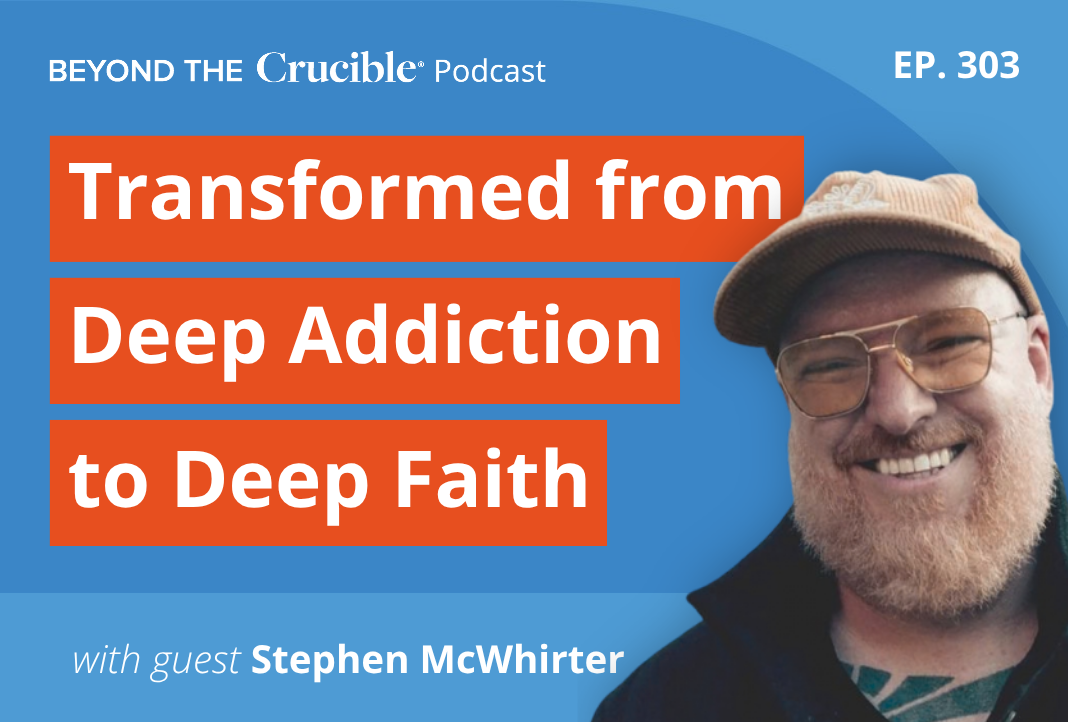
Transformed from Deep Addiction to Deep Faith: Stephen McWhirter
After living in the desperate darkness of drug addiction, Stephen McWhirter ‘s life got turned around in ways no one — least of all him — saw coming. Today, he’s an award-winning Christian music artist whose best-known song has been seen and heard by millions of people. How did the miraculous change happen? God grabbed him out of his addiction and healed him of it, turning him into someone who truly knows and loves Jesus, leads people in worship all over the world and has a happy, healthy family. And if God could do it for him, he says, he can do a similarly radical work in your life, too.
Enjoy the show? Leave a review on your favorite podcast app and leave a comment at our YouTube channel. And be sure subscribe and tell your friends and family about us.
Have a question or comment? Drop us a line at info@beyondthecrucible.com
—
👉 Don’t forget to subscribe for more leadership and personal growth insights: https://www.youtube.com/@beyondthecrucible
👉 Follow Beyond the Crucible on Facebook: https://www.facebook.com/beyondthecrucible
👉 Follow Warwick on LinkedIn: https://www.linkedin.com/in/warwickfairfax/
👉 Follow Beyond the Crucible on Instagram: https://www.instagram.com/beyondthecrucible
👉 Take the free Trials-to-Triumphs Self-Assessment to discover where you are on your journey of moving beyond your crucible and how to chart your personal course to a life of significance: https://beyondthecrucible.com/assessment/



Transcript
Warwick Fairfax:
Welcome to Beyond the Crucible. I'm Warwick Fairfax, the founder of Beyond the Crucible.

Stephen McWhirter:
I remember being up for four days straight during this time and just having the thought of, "Well, you're going to die young because you're not going to quit. And it is what it is." And just kind of residing to that, it doesn't get much darker, darker than that.

Gary Schneeberger:
But the life of our guests this week, Stephen McWhirter, did get brighter. So much brighter, he's become an award-winning Christian music artist whose best known song has been seen and heard by millions. How did the miraculous change happen? God grabbed him out of his addiction and healed him of it, turning him into someone who truly knows and loves Jesus, leads people in worship all over the world, and has a happy, healthy family. And if God could do that for him, he says, He can do a similar radical work in your life too.

Warwick Fairfax:
Well, Stephen, welcome. It's so exciting to have you. And just what you do with your ministry and your music is such a powerful ministry that have just impacted literally millions of people, which we'll get to, which is pretty mind-blowing, I'm sure. So just a little bit about Stephen. Stephen McWhirter. Over 20 years ago, Stephen was a meth addict and wounded preacher's kid who had a radical encounter with Jesus. Today, he travels the world leading worship, sharing his testimony, and seeing many people come to Christ. His song, Come Jesus Come, which has amassed over 100 million views and streams across platforms. It's been performed by CeCe Winans on American Idol and recorded by Winans with gospel legend Shirley Caesar, by country music artist Cody Johnson and in Spanish by Christine D'Clario. With the momentum from Come Jesus Come, Stephen started going live on social media and traveling all over the world, worshiping Jesus and sharing his testimony.
Today, Stephen is an artist and writer with Capitol Christian Music Group and Re:think Music. Stephen is married to Tara and has three growing red-headed boys. They live in Louisville, Kentucky and are swervingly committed to worshiping Jesus and leading others to Him. And in addition to, as I mentioned, his song, Come Jesus Come, having more than a hundred million views, he won the 2025 GMA Dove Award for Gospel Song of the Year. So it's just amazing the impact that you've had. And I want to get into a bit of the backstory, but one of the things I really enjoyed-

Stephen McWhirter:
You literally read my bio.

Warwick Fairfax:
I did. And I love reading your book. In fact, let me-

Stephen McWhirter:
After that, I've got nothing to share.

Warwick Fairfax:
There you go. Let me just mention your book that is actually, it looks on here, came out maybe a couple days ago? So this is very current. And his book is Radically Restored: How Knowing Jesus Heals Our Brokenness. And one of the things I love reading in your book is that you're a fan of Star Trek. And believe it or not, I'm also-

Stephen McWhirter:
I'm checking out now, guys.

Warwick Fairfax:
I'm a fan of Star Trek. I've watched every series, every episode, including Star Trek Discovery. A lot of people like the original. I love the original. I watched that growing up, but I also like Star Trek Next Generation with Patrick Stewart-

Stephen McWhirter:
That's my favorite.

Warwick Fairfax:
... Jean-Luc Picard, because it kind of reminds me of my dad, he's a bit of a philosopher, but they're all good. And so in this podcast, we will endeavor not to violate the prime directive because that will be a problem. So we won't do that. Anyway.

Stephen McWhirter:
No, I get it. I get it. My kids bought me that big ... They got me for Christmas that big Lego that's like the Next Generation, the enterprise from Next Generation.

Warwick Fairfax:
Yeah.

Stephen McWhirter:
Yeah.

Warwick Fairfax:
Very, very thoughtful.

Gary Schneeberger:
Have you put it together, yet?

Stephen McWhirter:
I have. It took us a while. It was a lot. It was a lot.

Warwick Fairfax:
That is incredible. So I want to hear a bit about the backstory. One of the things we say is, what was the backstory pre-crucible? But there really wasn't a backstory pre-crucible. And just early on in your book, you've got really a heart-wrenching scene. You're 10 years old and your mother's bed over you and she's taking you out of the house and you were just waking up and it says, "I had one thought--freedom." And talk about why that was your thought and kind of what happened as your mom was taking you out of the house. Talk about your dad and because you grew up in this conundrum of somebody that had a powerful impact for the gospel, but yet had a dark side. It was just one of these stranger stories and incredibly sad. So just talk about that scene and your growing up.

Stephen McWhirter:
Well, I'll say it's only sad if you don't know the whole story. I genuinely don't think of it as a sad story, only because I know how it ends and how it keeps going. But yeah, we were raised, my dad was an evangelist and we would travel from church camp to church camp and we would watch him preach about Jesus, but behind closed doors, we would watch him be physically abusive and violently so with my mom. And so a lot of trauma, a lot of really dark moments as a child watching that throughout my younger years. And what happened was I just said, "You know what? If God's real, He's not good. I don't want anything to do with this Jesus guy." So I've been getting down this path of just wild rebellion, man. 11 years old, I was smoking, drinking, marijuana, that kind of stuff. By the time I was 15, it was cocaine pills. I'm selling drugs.
By the time I was 17, I was a full out crystal meth addict and I was using every day for many, many years to come. And I was the guy who hated Jesus, hated Christians, would have cussed you out if you mentioned His name around me. Yeah, there was just a lot of darkness through those years on up into my early 20s. And if I think about the thought pattern through all that, it was really, I guess, I was kind of giving my dad the middle finger subconsciously. The other part of it was just whatever made me feel good and kind of made me check out from reality is what I went after. And of course, throughout all those years, I was in metal bands and stuff, screaming my head off, people beating each other up in front of me. But yeah, God was after me. There were people really, really praying for me, really praying. And it works. It actually works.

Warwick Fairfax:
Just in these early pages, you talk about that scene in which your mother was rescuing you and your family. And really the sad thing is that you mentioned your dad was, you grew up in Indiana, I think Southern Indiana, and your dad was this traveling evangelists, went to Christian camps, and they sang incredible songs. And he brought many people to Jesus through his sermons, but yet he was physically abusive to your mom, and I mean, not I guess physically to you and your siblings, but physically abusive and just created this atmosphere of fear. So you left, but yet at some point, soon after your mom, when he just said, "I'm so sorry as people who are abusive sometimes too." And you came back. And I love what you write about your mother, that she was just this wonderful person, but this elegant woman. You write about her kind of mowing the lawn in a formal dress, high heels, and pearls. I mean, that's style. I got to look my best.

Stephen McWhirter:
That's right.

Warwick Fairfax:
I mean, it's just a crazy, crazy story. And you write about how, I think, your dad always had these dark tendencies, but he suffered back pain caused by obesity and then he had painkillers.

Stephen McWhirter:
You've just gone through my book. You read it.

Warwick Fairfax:
Oh, I did. The doctor prescribing painkillers for relief and then uppers so he could preach and so that didn't help.

Stephen McWhirter:
Probably not.

Warwick Fairfax:
He was somebody that you said was a narcissist and mentally unstable, I mean, these sort of medical malpractice, those painkillers and uppers just really messed him up. But you write about even after that incident when you briefly escaped and came back, okay, he didn't hurt your mother, but yet that sense of darkness was still there. And it was clear that it's like, you must have thought to yourself, I think you just said this, "If this is Jesus, who needs Him? What kind of an earthly father does this?" I mean, he was kind of what we all hoped not to see, somebody that preaches Jesus but doesn't live it. And that has turned many people away from the gospel. I mean, that's the bit that to me is gut wrenchingly sad. You had a different path, but some may not have. Do you know what I mean?

Stephen McWhirter:
I'll speak to some of that. First off, that's a lot. You said a lot and there's a lot you could go off and go different directions on.

Warwick Fairfax:
Sure.

Stephen McWhirter:
Let me just say this. First, if your faith is in a person, like the only thing you know about Jesus is through someone, you know about Jesus through someone. Maybe it's a celebrity pastor, maybe it's someone's books or whatever it is, my music. I don't know. And that person fails or something happens, they fall, suddenly you go, "Oh, my faith is rocked and I'm leaving, blah, blah, blah." I don't know how effective that ministry was if they didn't introduce you to Jesus and get out of the way because there's this part of teaching, yes and leading, yes and discipling, yes. But then the real discipleship comes when somebody actually knows Jesus in a way that when someone falls, they go, "Well, that's a person, but Jesus, He never fails."
And that sounds like a nice idea, but the best part about it is it's true. It's 100% true. And I think that's part of what we see today with a lot of people and celebrity pastors or people that fall, you see all this stuff, right? People act it's the end of the world if your world was built around that person. And so yeah, with my dad, all I knew of Jesus was that, but I wasn't saved yet. That didn't help. But it also, the good news is it didn't stop it either because as I go on, and hopefully will go on, I ended up giving my life to Jesus. And the fact that I did with all of that, I think is proof to just how good and how powerful God really is beyond how well we carry ourselves and how perfect we act. We're so afraid of people finding out that we have problems like it's going to give God a black eye. I don't think we're giving God enough credit.

Warwick Fairfax:
It's so well said that as people of faith ourselves, you can't put faith in a person because all of us, maybe we don't do with our kids kind of what your dad did, but we're all going to fall short and make mistakes, raise our voices, let our wives, husbands, kids down. Each of us are going to have those moments.

Stephen McWhirter:
Well, I think the key to some of that is not to be perfect. It's to be honest.

Warwick Fairfax:
Amen.

Stephen McWhirter:
To be authentic, to be repentant without fear of what'll be taken from you, what you'll lose.

Warwick Fairfax:
Right. Amen.

Stephen McWhirter:
My kids, they know a dad who says, "That was dumb." Sorry.

Warwick Fairfax:
Yeah.

Stephen McWhirter:
Yeah.

Warwick Fairfax:
That's well said. And just on this, at least I find it's hard enough to apologize to your wife. Apologizing to your kids seems harder. Now, fortunately, I haven't done anything horrific, but still, how can you expect your kids to learn how to say I'm sorry if you've never modeled it for them? You've got to sort of walk the talk. And so yeah, it's important. But before we get to kind of the miraculous turnaround, I think one of the things that helps make your turnaround so powerful that people understand how challenging it was. So I want people to hear your story because I want them to think if Stephen can do this, then maybe God can do this in my life. So that's why I don't want to sugarcoat it, not to dwell on it, but just to show people how, frankly, how miraculous a God that we have if God can turn your life around.

Stephen McWhirter:
Yeah. My heart with the book was not to be all dark, just to have a story that makes people go, "Ooh, that's terrible." Right? The idea was half really the story, the hard stuff. The other half is helping people walk through theirs and it's the good news.

Warwick Fairfax:
Amen.

Stephen McWhirter:
The gospel is good news. And if you're not hearing good news, you're not hearing the gospel. So yeah, people were praying for me during those years of massive rebellion and anger towards Jesus. I was an enemy of the cross for sure and people were praying for me. Like I said, my mom being one of them and my grandma, people were really praying. And somebody came and gave me this book during this time called The Case for Christ by Lee Strobel. If you don't know of it, Lee wrote a book that's basically a case for the evidence of the resurrection of Jesus, right? And the fact that I accepted this book without causing a scene and kicking somebody out of the house is probably the most miraculous part of the story because I was just like, "Cool, whatever." Because I told you how much I hated Jesus.
It was miraculous, for sure. So I accepted the book. Fast-forward, it's three o'clock in the morning. I'm in a room with drugs on the side table next to me. Nobody's playing music in the corner or anything like that. It seems like the most impossible place, most improbable place for someone to come to Jesus. For many, it's probably offensive, the idea that I got saved in a place like this, but that's exactly what happened. I was in this room, I knew God was in the room. I was reading this book. I think it was at a passage in the book where I'd read several chapters in a row with drugs on the side table and everything, but each page I think I went, "Man, really? Huh? Okay. Next page. Man, really? What? Okay." And then I get to this one where there's somebody, it's hard to remember. Hopefully Lee doesn't hear me say that, but I haven't read it in a while, but anyways, but I get to this part where there's a man in the desert crying out to Jesus.
And I was in that moment. I just went, "God, I believe this, I think. And I want to give You my life. I want to quit all this addiction, all this darkness, all this anger and depression and ugh that I've known for so long. God, I want to, but I cannot do it." Again, at this part of my story had been over 11 years of addiction. I remember being up for like four days straight during this time and just having the thought of, "Well, you're going to die young because you're not going to quit. And it is what it is." And just kind of residing to that, it doesn't get much darker, darker than that. And so that's where I was. So when I say, "God, I want to, but I can't." I meant it and He knew it. And then I had a thought that I'm certain to this day is from the Lord and it's this, "Stephen, you won't do it. I'll do it."
Now, at the time, I didn't know this, but this is Ephesians 2:8, "You're saved by grace. This isn't something you could boast about. It's a work of God. God does it." But there is something you and I get to do and it's what Jesus says in John 6:29. He says," The only work the Father asks of you is to believe." And that is what I did in that room. I agreed with God. I believed Him like I believe I'm breathing air right now and I fell to my knees and I gave my life to Jesus and I literally quit everything overnight, which is insane. I'll say more about that in a second, but I quit everything overnight. Don't worry, there was plenty of other screwed up things that need to deal with for years to come, but for whatever reason, that's the way that went.
And I always tell people, because I speak a lot in addiction, recovery situations, ministries, and I always say, "Don't be discouraged by that because in the gospels, Jesus never healed anyone the same way twice. Every story has a purpose. If it takes 5 times, if it takes 10 times, and you fall at the feet of Jesus and you mean it, He is going to use your life to draw people, your story, to draw people to Him."

Warwick Fairfax:
I mean, that's an incredible story. And I want listeners and viewers to understand just how incredible Stephen's story is and just how miraculous God's intervention in Stephen's life is. Because as you write in the book, you were so angry at your dad for what you, I think, rightly saw his hypocrisy, giving incredible sermons, but just being abusive to your mom. And so it was like, okay, I'm going to, as you said, show the middle finger to my dad and just abandon God. That's your way of rebellion. You were arrested six times, three for possession of narcotics and underage drinking. At one point, I think you did crystal meth. I mean, it was a very challenging-

Stephen McWhirter:
Not at one point, that was about six years.

Warwick Fairfax:
Sorry, I got to pile on too much, but-

Stephen McWhirter:
Tried a little something for six years, yeah.

Warwick Fairfax:
And then I love one of the chapters that says, "If it's broke, keep breaking it." I mean, that just shows you your then philosophy of life. It was just this self-destructive life. And what is fascinating, you write in the book in terms of who that someone is with Lee Strobel, it was your sister, Suzanne, who had her own encounter with Christ, which was kind of incredible. And she gives you this book, she takes you, I guess summer 2001 to a Billy Graham crusade. And at that point, I guess you must have felt so far that you just couldn't hear the gospel. It was almost like a spiritual warfare.

Stephen McWhirter:
I was literally had spoke to meth before I went to that Billy Graham thing and sat there and heard the gospel. I think third day was ... I think that's what I say in the book. Third day was singing like God of Wonders or something. And I just felt anger, seething anger like I was about to jump out of my skin and I just left cussing. I was like, "Nope." Yeah, I was pretty far off the deep end. I didn't even know how I ended up at that thing. I think it was more of a get them off my back kind of thing. I'll go to this set and then they'll leave me alone.

Warwick Fairfax:
And yet you mentioned, just as you were saying earlier, just with your wife, Tara, who I guess you knew as like teenagers in school, that here you were in the basement of this place with people taking drugs all over the place. And just when you write that, what you just said, that you felt like the Lord telling you, "Stephen, I'm real. I am good. I have a plan for your life. I want to give you my life. I want to let go of all this addiction, darkness and anger I've lived for so long. I want to give you my life, but I can't." And then as you just said, these are the most, maybe arguably the most powerful words in the book when you felt the Holy Spirit was telling you, "Stephen, you won't do it. I will do it." I mean, that is incredible.
And to give you an idea of how real this was, you write that your now wife, Tara, was so moved after watching my life change so drastically, she soon gave her life to Jesus as well. That doesn't happen unless they see the real living Jesus Christ living in your life. I mean, this wasn't just mouthing some words, this was a radical change. You see, you stopped doing all of these drugs, which not everybody can do, but that was clearly a gift from God. That was a miracle, a real miracle.

Stephen McWhirter:
Yeah. The thing about my wife that's so interesting is, well, she's amazing. There's more than that. She's incredible. But we'll be together 30 years next year, so a lot of life together. She was watching to see if I meant it because I really was going around to people like, "Oh my God, it's real. It's all real." And I feel like I'm still doing that today. And she was waiting to see and she saw that I did mean it. It's funny, we go back to my dad, not funny, but what's important, what's important for me to highlight. If you read this book, my wife plays a big part in this.
If you read this book, I think there's a couple of overarching themes, but one big one, the reason we called it Radically Restored is because of just all that God can restore and redeem is kind of amazing because when I got saved, I was like, "Man, this is great. If I could just be sober and be okay and not have to not be burning my life down around me, that'd be great, Lord." But when we give our life to Jesus, I'm going to get a little sensei on you here. Give my life to Jesus, when we give our lives to Jesus, like a pebble in the ocean that begins to ripple out into this tsunami of grace and restoration and redemption that starts hitting all these parts of our lives that we never even saw coming.
So I remember after giving my life to Jesus, one of the first things I felt led to do and encouraged by my wife, if I remember correctly, was to forgive my dad. Now, at this point in my story, my dad hadn't been abusive with my mom for, gosh, many years, 11 so years at that point. I don't know. The story where she wakes us up, gets us to the car, we drive off, we weren't gone 24 hours till he was like, "Come back home, please." My mom went back. And to be honest with you, there was a part of me that resented my mom for not leaving him throughout all that as well. And you can say what you want about all that, but she did stay with him. And so from that point on, he had not done anything, though he was emotionally still abusive, I felt, in many ways.
But here we are. I've given my life to Jesus. I knew the first thing the Lord wanted me to do was that, to forgive my dad, and it seemed like the most unimaginable, most unacceptable thing I could ever do. Like, this man does not deserve this, but I don't deserve it. I don't deserve. And this sounds like this is the part of the Christianity that's so offensive, that sounds so trite. We say it this stuff a million times and we go, "That's beautiful. Yes, I was saved and Jesus forgave me," but it's real. There's not one sin on this side of eternity ... Well, that's not necessarily the truth. There is the blasphemy of the Holy Spirit, but there is the ... Anyone is redeemable, is restorable, is capable of forgiveness from Jesus if they're willing. The only thing they could do is reject it, the forgiveness, right? And so this was shocking to me and offensive to me, but I knew I was supposed to do it.
So I go to my dad and he's in that quintessential father's lazy boy and I'm like, "Hey, I need to talk to you." This is a very, by the way, this is a very ... You would never put this moment in a movie, okay? But here I am, my dad's in the chair. I said, "Hey, I need to talk to you." He stands up. And I say, "Okay, I just want to say I forgive you for all the stuff you did, blah, blah, blah as a kid." He looks at me like a deer in headlights and goes, "Oh, okay." And then I'm like, "Okay, dad, well, that's it. Okay, bye." And I get in my car and I drive off. It's like there was no bird landing on my shoulder or beam of light shooting in the room or ... It was just super awkward.
But I knew that the Lord had done something in that moment beyond what I could see. So fast-forward a little bit, my wife saved at this point. We are engaged and she says, "Hey, I want your father to baptize us." I'm like, "This is the worst idea ever. Whatever. Fine." So on our way to get baptized, my wife and I get in the worst screaming and cussing match you could ever imagine on your way to get baptized, right? We knew that the Lord was up to something and that the enemy was trying to keep us from going to do this thing. Well, we go, we get baptized. It's beautiful. My mom tells me later that my dad weeped and cried all night over the idea that God might be restoring what he had broken. And fast-forward a little bit more. We're about to get married. My wife says, "I want your father to perform our wedding ceremony." At this point, I'm thinking, "This marriage is not going to work out."
So I'm like, "Okay, fine." He does perform the wedding ceremony. It's beautiful. Great. Now, as of today in this interview with you guys, my father has passed from cancer over 12 years or something. And when you get people that you know that have gone through cancer, there's the moment where they go into hospice and they're in the hospital. It's a very difficult time for people and the person is in a coma. They're unresponsive, but the doctors and the nurses and the hospice team will tell you they can subconsciously, they can hear you and you need to tell them, because they'll hang on for a very long time like that. You need to tell them it's okay. They can let go. It's okay to go. And normally they do during that time, right? Well, we'd been doing this with my father for a few weeks and I remember sitting in the room by myself with my dad at one point, watching him struggle to breathe.
And I thought about where Peter goes to Jesus, "Hey, how many times should I forgive my enemies?" And Jesus says, "Seven times." Or Peter says seven times to Jesus, is that enough? And Jesus says, "No, 7 times 77 times, just don't even try counting. Just keep doing it."

Warwick Fairfax:
Exactly.

Stephen McWhirter:
"Do it. Just do it completely and ongoing." And so I remember, I'm in there alone with my dad and I lean in with tears in my eyes, man. And I just say, "Dad, I love you and I really do forgive you." And in that moment, my father took his last breath and his soul left his body. And I knew that the Lord was teaching me something, which is a big part of this book. The most Jesus-like thing that we can do on this side of eternity, guys, is this, to forgive. Forgiveness is one of the most Jesus-like things we can do on this side of eternity.
And it's also one of the hardest things for us to do, but I've learned this about it, that there's something really powerful that God wants to do in our lives on the other side of it, but also forgiveness is about a legitimate debt, like a debt someone owes you or you owe someone, but someone owes you, you have the ability to tear that debt up. That does not condone what they did. It doesn't go, "Oh, you can now have that job again at that church and be the pastor again, or you can now come back over and do this and that." No, no, no. This is not what this is. This is forgiveness. Love doesn't necessarily mean you're going to be in that relationship with the people or you're going to give them access, but you are going to forgive. There's something powerful about that.
Now, here's the wild part. I'll just say this, Jesus is reconciled to us. We are reconciled to Jesus, though what we've done is terrible, as bad as anything else ever done in the history of the world to him, all sin, right? Yet we are forgiven and reconciled to Jesus. And that should cause us all to pause and recognize how important people are and how important forgiveness is. There's a reason why, even in the Lord's prayer, he says, you know, "Forgive us our sins as we forgive those who trespass against us," right?

Warwick Fairfax:
Stephen, we talk a lot about forgiveness on this podcast and it's eerie that some of the words you use that we actually use too. Like you said, "For the longest time, I couldn't see that my anger had become a prison of my own making." We use that metaphor. Sometimes we say lack of forgiveness is like drinking poison. It destroys you. It destroys your soul. It eats you up. The other thing we often say, and you know this to be true, I'm sure, from people you know, that anger and bitterness leaks. I can't understand it, but it's so often people who have been abused abuse their own kids. That's incomprehensible to me, but the statistics say that that's true. And often when you think about anger leaking, it leaks on the people you love the most. The people you least want to hurt, you end up doing it because that's just the power of the sin of anger or bitterness.
Now, you just talk about from your perspective why forgiveness is important in part for the person who's the victim, who's been wrong. Why is forgiveness important and why is lack of forgiveness like from your perspective, in your words, like being in prison?

Stephen McWhirter:
To follow Jesus is to do what He does. That's the rabbi way. That's what it meant. You follow what they do. You follow their lead and Jesus forgave and He calls me to forgive because I'm forgiven. That's part of it. The other part is you're only hurting yourself by not forgiving somebody. You think you're punishing them, but you're not. You're just punishing yourself. So forgiveness is for you and the forgiver. Now, that's huge. But what if you're the person that needs forgiveness or wants forgiveness or seeks forgiveness? I think it starts with repentance. We hear the word repentance. And in the church today, I believe it's become very taboo, the word repentance. We hear it and we go, "Oh, that doesn't sound good. If I repent, everybody's going to know the terrible, awful thing I did and no one's going to talk to me anymore. I'm going to lose my job. I'm going to lose everything. I'm going to be canceled."
That's where we go. So what do we do? And what do we see in most of the church culture? We see it get hidden, buried, covered up. Just try to ignore it. Maybe it'll go away. Maybe no one will ever know. We can see how that's gone. That never goes well. So all that is hidden will be made known, the Lord says. So what do we do? In the Bible, repentance always equals blessing. What I mean by that is in the Old Testament, Deuteronomy, for example, "If my people are called, my people will turn from their wicked ways, then I will hear their prayer and I will heal their land." That sounds pretty good.
Because repentance is to turn from something to something, right? So turn from death to life. In Acts 3:19 and 20, Peter says, "Repent so that the time of refreshment will come from the Lord." There's a healing that happens in repentance. There's a righting of the wrong in repentance. Now, are there consequences potentially to the thing that you've done? Absolutely. But there's still forgiveness. Could you end up in prison? Yes, but you will be forgiven in prison. You will be a son covered by the righteousness or a daughter covered by the righteousness of Jesus in prison.
But you know what? There will be healing. There will be real freedom. And that's the hard thing for us to understand. We're worried about what we're going to lose. We don't have to repent; we get to. And that doesn't mean you go on Facebook and tell everybody. It means you go to people you trust and you love. I'm not saying get it right, no, that's not what I mean. You go to people you trust, people you love. You tell them and you confess and you repent and you let the Lord heal in His way and His time.

Gary Schneeberger:
I have been uncharacteristically silent in this episode for folks who've listened and watched the podcast before. And that's because, Stephen, so much of your story has ... My story has flavors of your story. I grew up, my father-

Stephen McWhirter:
Congrats, and I'm sorry.

Gary Schneeberger:
Yeah. Right? My father physically abused my mother. They both have passed. But there was a moment that I saw him do exactly what you're talking about, about forgiveness and repentance. And it was at her funeral. She died in 1993. And the family was all there in the visitation. And I watched my dad, all of the kids. I have four siblings I had at the time. All of us would walk up to the casket and say some things and back up. And my dad was just kind of awkward around it. And he waited until the kids were clear. And I saw him and he kneeled in front of the casket and just did his business quietly with his ex-wife, with my mother. And I believe I never asked him about it because it wasn't my business. That was his asking forgiveness, I believe, of the mother of his children.
And to me, that was just a very beautiful moment because of what it represented. Get down on your knees and repent. And I carried that with me. I wasn't a Christian at the time. In fact, my story of getting saved, of people praying for me, I gave eulogies for my mother, one of my brothers, and my stepfather over the course of five years. And I had a cousin who would pray for me because I was drunk one of the times I did it. And I was clearly just roiling in agony about the way I was living. And I had a cousin who prayed for me every time, but I didn't know that until the last eulogy I gave where I gave a gospel presentation in the eulogy. And she came up to me afterwards because nobody knew. And she came up to me afterwards and with tears in her eyes and said, "I've prayed for you every single time. I've been in one of these family funerals and you've eulogized a loved one and now it's taken."
And she was just so thrilled. That perspective and I imagine this happened to you too, when people met you who knew you when you were an addict, and 28 years sober, I will be in, I'm sorry, 29 years sober in April of this year. I know what that's like where people see you later and they're like, "What happened to you?" And so much so that I got a job, if you've ever heard of the Christian ministry Focus on the Family, I was the head of public relations there and my hometown newspaper did a story-

Stephen McWhirter:
I know Jim and ... Yeah.

Gary Schneeberger:
Yeah. Good friend of mine and my boss, because I'm back there again. But they give a story-

Stephen McWhirter:
Tell him to [inaudible 00:37:33].

Gary Schneeberger:
I will. They did a story in my hometown newspaper about my work at Focus on the Family. And a buddy of mine, a running buddy of mine when I was growing up, saw the story in the paper, hadn't talked to him in two decades. And he said, he looked at the story and said, "So Schneeberger finally burned down a church." That's what he said when he saw me in the paper. So I imagine that there are people who, when they saw you after your conversion, were shocked and thrilled. And I mean, I can't imagine that news landed lightly with some of your friends.

Stephen McWhirter:
Yeah. Some have come to the Lord. Most have died, OD'd, or are in prison. That's the truth. But that being said, the Lord has used my life in many ways. If you read the book, you'll see one of my friends when I was younger, the guy I stole the car with when I was younger, is now the sheriff at the town we grew up in and he loves the Lord. And we were actually at his prison not too long ago, at the jail not too long ago, outside of the jail that I spent nights in in the yard and we baptized a bunch of inmates and got to share the gospel and it was really cool. So yeah, God has done some really wild stuff, super just amazing. But there's a lot of heartache too for people that didn't make it.

Warwick Fairfax:
I want to get to the story that led up to you writing that song, Come Jesus Come, which is to understand your backstory as you listen to those words, it gives an extra layer of power. But it's just amazing how God used the path. You write how somehow there was an ad in the paper for a worship leader at United Methodist Church in Indiana. And somehow you write, you got the job, like a former meth addict getting a job as worship leader. I mean, he's like, "How can this be?" And what I find-

Stephen McWhirter:
You never underestimate how bad a pastor needs a worship leader.

Warwick Fairfax:
What I find incredible is on the set list that you were given. One of them was, Mercy Me's, I Can Only Imagine, which as you would know better than me, parallels your journey in one sense of an abusive father. I mean, I don't know how much you knew about that song when you were singing it that first time, but it's just incredible. But talk about that journey because there was another crucible, like you had this idea, you wanted to go from church to church to bigger churches. And you write in not so many words about almost like the idol of success as a worship leader. So you forgave your dad and that's one thing, but the enemy, if you will, is smart. It's not like it gives up.

Stephen McWhirter:
No, no, he'll find way.

Warwick Fairfax:
Okay, that didn't work. Let's try a different angle. Let's try the whole idol of success as a worship leader. So just talk about that because that's probably not as well known part of your story, but yet understanding that it's critical to understanding your song. Yeah.

Stephen McWhirter:
It's interesting. Over 10 years ago, I entered into the world of songwriter, I guess, in the industry. But six years ago, my wife and I sat in our basement and we were worshiping Jesus. We had our Bible open to Revelation 22:20 that says, Jesus says, "Behold, I'm coming soon." And right after that it says, "Come, Lord Jesus." And as we were reading the scripture and just worshiping and weeping, the first verses of the song, Come Jesus Come, started to come out. And we were learning, honestly, for the first time, I feel like what it means to long for Jesus to return, to love people better here and now towards that day, to build things that matter more here and now towards that day. So that's what was going on in our hearts. So we knew it was special. We brought it to some friends of ours, Hank Bentley and Bryan Fowler, very talented songwriters that loved Jesus.
It was great. So the Lord crafted the songs, we know it. And I paid money I didn't have at the time to record a version of it. And I took it to the record label I was with at the time that will not be mentioned. They passed on it. They were like, "Oh, we'll pass." And then they actually dropped me from my publishing deal, I don't know, a few weeks later. And I was like, "Okay, God, you're up to something. It's okay. He's good. He knows what he's doing." So for four years, I even took it to radio people, crickets, but for four years I was just like, "Okay, I guess it's just I'm going to sing this song to you, Jesus." And I remember it was on TikTok or Instagram or something. It went viral, me just with the acoustic guitar singing and got millions and millions of views. And it was really kind of one of those things where I was like, "Well, I guess ..." People weren't like, "Oh, what a great singer." It was a real longing for Jesus to return. That was the primary comments, primary reaction to it.
And so as time went on, this is four to five years now. I pay money again out of my own pocket to make a radio version of me that gets picked up by a lot of stations and does really well. Then CeCe Winan does a version, obviously. And just what was it? A couple weeks ago, she won a Grammy for Come Jesus Come. And Brooklyn Tabernacle won best album with me saying, Come Jesus Come on it for Gospel Roots album. But I don't win a Grammy for any of that.
My name's on stuff here and there, but technically the Grammy only goes to CeCe and only goes to Brooklyn Tab. And I always tell people, I'm like, a lot of things have to line up for you to win a Grammy in this world. It's a secular ... It's kind of a world thing anyways. There's a lot of politics in it, right? I'm not poo-pooing it. I'm just saying we know that. And so that's hard to do. But for your song, projects with your song to win twice and you not to get one, that's astronomical. That is the Lord and He's up to something.
And throughout my life, I've said in many, many scenarios, I want Jesus more than I want an award. Even when it won the Dove Award, I wasn't at the Dove Awards. I'm not against going to them. I just wasn't there. But this is kind of a gift. And I'm not just trying to say this sounds spiritual, don't get me wrong. I was bummed, right? But at the same time, I was like, not many people get the gift to actually show that they mean it when they say, "I want you Jesus more than an award." And that kind of a way.
And I was like, okay, I either can act very mature about this or I can actually trust that you're in it and go, okay, I want you more. And thank you for what you're doing with this song that you wrote Jesus that you want that's more than about a song. It's more than about me or anybody. It's about a longing for the thing that the spirit of God and all of heaven is crying for, which is the return of Jesus seated as King of Kings, the Lord of Lords, over all creation, bringing into restoration, bringing into fulfillment, the finality of all of history and time. It is wild. And when you think about that, everything on this side of eternity gets pretty small.

Warwick Fairfax:
That's so well said. I want people to understand, at least as I read the book, I felt like God had to do a work in you before you were ready to write Come Jesus Come.

Stephen McWhirter:
Sure.

Warwick Fairfax:
Without that work in you, and I may be misreading it, the song wouldn't have been written, certainly wouldn't have had the power of impact. So talk about that because you have to be the right person in the right place in a sense for God to ... I don't know if this is biblical and in one sense, God to use you. So talk about the heart change when you're on sort of the corporate worship leader ladder and you hit a point probably on your knees saying, "Lord, I need to change my thinking." So talk about that change because that's the key part of the backstory, I think, that Come Jesus Come [inaudible 00:46:20].

Stephen McWhirter:
Yeah. I'm not anti the church. I'm not anti-being on staff at a church. That is not ... I love it. I love what God's doing. I just don't want to be on staff at a church, personally. I could never do a meeting ever again and I'll be quite happy. Thank you very much.

Gary Schneeberger:
Amen.

Stephen McWhirter:
But that's just me. That's just me. That's just me. The people that stick it out and do that, I actually greatly admire. I think it's beautiful, but I just didn't feel called to it. So I was like, "Lord, you're going to have to open a door for me." And I did probably 12 years, but yeah, the Lord kind of opened the door and started preparing my character for my destiny. I always say that the Lord loves you too much. If you really want what Jesus wants, then what I mean by that is you want what He wants. It's just you don't know yet that it's not what you want, right? It might not be what you want.

Warwick Fairfax:
When you're writing about going from church to church and just focus on the next big church. And again, I agree with you. It's not wrong to be a worship leader. I mean, I'm an elder in a non-denominational, evangelical church in Maryland. So I love the local church, otherwise I wouldn't be an elder. But for you, there was a temptation. And I love how the step of faith somewhere here, I forget exactly where it talks about God uses people, like sometimes you've got to go on a limb. And when you said to your wife, Tara, "I want to stop being a worship leader," nothing wrong with it, "but I feel called to writing songs," and you're the primary provider and you don't know how it all work. And Tara said, "Sure, let's do it." That's faith. That is epic faith.

Stephen McWhirter:
Or she's insane. No. No.

Warwick Fairfax:
Let's assume it's epic faith.

Stephen McWhirter:
Yeah, she's great. It's faith. I will say, when we stepped into all that, again, a lot of this didn't happen in my 20s. I'm in my 40s now. And I believe that's because when you really do want what Jesus wants for your life, He won't let you step into your destiny until your character's ready. He loves you too much because you'll just make yourself miserable and everybody around you, right? That does not mean that you can't do it in your 20s. Your characters can't be ready in your 20s. That just means I had a lot of character problems up until I was ready to go in my 40s, I guess, to [inaudible 00:48:51]. And I will have other things that I'm not ready for yet that'll take this time until I get to it. And that's fine. That's the way it is. So yeah, the Lord was preparing my heart for it and he's probably preparing your heart, whoever's watching us, for it. Don't despise where you are right now. Ask for the Lord to give you the perspective to see how He's preparing you for what's coming.

Warwick Fairfax:
Well said. I mean, yeah, basically as you're implying that you wouldn't have been ready to write Come Jesus Come when you were 25. It needed a few more decades. And I love what you say here in a chapter called You have a Kingdom Destiny. You say, "God has a divine purpose for your life, a kingdom calling that He whispered into your soul before time began." Those are incredible words. Talk about what you mean by that, that divine purpose. And I love that phrase, the kingdom calling. What does that mean?

Stephen McWhirter:
Yeah. I believe the real you is the you that Jesus saw before the corruption of sin, like the you that He knew you would become. The you free from addiction, the you free from despair, the you free from hopelessness, the you fully alive. Jesus says in John 10:10, "I've come that you might have life and have it to the full." That's the real you. And He saw, He knows who you're really meant to be. And a lot of us walk around going, "You're not going to trick me. I know who I am. I've figured me out." I'm telling you for what it's worth, you can't know the real you because the real you is the you in Jesus. That you is the you fully alive.

Warwick Fairfax:
Well, as we kind of come to the last part here, many will have heard your song, but I just want to read the words to the chorus that is just worth to meditate on, pray about, and just do some soul work with Jesus on. You write these words. "Come, Jesus, come. We've been waiting so long for the day you return to heal every hurt and right every wrong. We need you right now. Come and turn this around. Deep down, I know this world isn't home. Come, Jesus, come." I mean, that's a Holy Spirit inspired. I'm sure you would agree when you write that. That's not human words.

Stephen McWhirter:
Yeah. And again, crafted prayerfully with my friends, Hank Bentley and Brian Fowler and my wife, Tara. I want to give credit where credit is due and honor them because God used them also together to prayerfully finish off those ideas that really the Lord birthed me and my wife. And I'll say this world isn't home yet because it will be home when Jesus redeems it, when He restores it. It says in Revelation 21, it says, "There'll be no more mourning, no more crying, no more death for the old order of things that's passed." That's when Jesus returns. There's just things in this world, guys. We look around. I don't care who you are or what political party you are. It's just broken. It is broken. And we can see that there's no person or party that can fix it, really. It's not that we don't try, but it's Jesus and He's the one that does it.

Warwick Fairfax:
One kind of last thing I want to mention. You write in the book that you did live streams of your music.

Stephen McWhirter:
Yeah. When the song went viral, when Come Jesus Come went viral, the Lord opened a door for us and I started going, "You know what? I'm going to go live on TikTok and Instagram and all this stuff and I'm just going to worship Jesus and share the gospel." I never was like, "Check out my music. Come follow me." So all we did was worship. And then in between songs, we would stop and we'd ask people if they want to give their life to Jesus. And then as ever many people said they did, we would then pray with them and we would have, we had like a few people across the country connecting with these people and praying with them and helping them get to a church or whatever. We had like a simple follow up way. But in about a year or so, we had 40,000 people come to Jesus. And so yeah, looking forward to doing that again soon to get that going again soon because I just want to ... This thing is short, guys. People matter.

Gary Schneeberger:
That sounds you just heard, folks, the captain has turned on the fasten seatbelt sign indicating we've begun our dissent, landing the plane on this conversation. We're not there yet. And I would be remiss if I didn't do two things, actually, Stephen. The first thing is the singer Jewel is upset with you, or she should be upset with you because up until I heard your version of O Holy Night, hers was my favorite. So I heard your version-

Stephen McWhirter:
You're talking about the, (singing), "These hands are small, I know." That girl? Jewel?

Gary Schneeberger:
Yeah, that Jewel. Yeah, it's that Jewel. She does a great version of O Holy Night. You knocked her out of the park.

Stephen McWhirter:
Oh, cool. I'll check it out.

Warwick Fairfax:
That's awesome.

Gary Schneeberger:
And the other thing is, how can listeners and viewers find you online to learn more about your book, about your music, all of that stuff?

Stephen McWhirter:
Sure. Yeah. Radicallyrestoredbook.com is the book website, radicallyrestoredbook.com. My name is hard to spell, so that also runs to my website and everything, but the website is worshipjesus.life, not dotcom, dot L-I-F-E, worshipjesus.life.

Gary Schneeberger:
Warwick, as always, the last question or questions are yours.

Warwick Fairfax:
So Stephen, there might be somebody today and maybe today feels like the worst day. Maybe they've been abused. Maybe they were the one doing the abusing. Maybe they feel like my life is irredeemable. Nobody could love me. Nobody could forgive me. What would a word of hope be to that person who today might be their worst day?

Stephen McWhirter:
We all have this door that we keep lock shut and behind it is every horrible thing, deplorable, disgusting, gross thing we've ever done or has been done to us. And we think if anybody ever looked behind this door, they would never talk to me again. They would never want anything to do with me. There's no way I would save that person or even want to be near them. But Jesus kicks that door down and he says, "I want her. I want him." He wants you. You can't imagine. But I love where Ephesians says He does immeasurably more than we can hope or imagine. So good news and hope and imagine and watch Him blow your mind because God is so good. And there's absolutely nothing and no one that He cannot restore. I know because I have no business breathing air right now. I have no business being on air talking to you about Him.
It's just because of this one thing. Jesus is real. Jesus is real. He is Lord. And when you call in His name, when you repent, when you call on His name, you believe that He's Lord, that He's savior, that He died for your sins, that He rose from the grave. When you believe and give Him your life, buckle up indeed because you're about to see Him use you and bring you into the fullness of life. Don't take my word for it. Take His word for it. John 10:10 says, "I've come that you might have life and have it to the full."

Gary Schneeberger:
Friends, I've been in the communications business long enough to know when the last word on a subject has been spoken and our guest, Stephen McWhirter, just spoke that last word. Warwick, we've just had a very inspiring and educational and I think equipping conversation with our guest, Stephen McWhirter. What's the big takeaway you would like our listeners and viewers to have from this conversation?

Warwick Fairfax:
I would say the power of Jesus and the power of forgiveness. Stephen's story is just, it's incredible to read. He grew up as the son of a pastor who was a very charismatic pastor, brought many people to faith in Christ, but he had this dark side. He had this anger, this darkness. He was physically abusive to Stephen's mother for years. It created a place where people would say to him, "Gosh, your dad is amazing. He helped bring me to Jesus." And Stephen would be thinking, "This is a man that abused my mother and who made our home a dark place." So he spent years as a teenager and in his 20s, just rebelling, taking drugs, getting convicted of various crimes. It's almost like, to use his words, he was putting the middle finger up towards God saying, "If this is God represented by my preacher dad, who needs it?" He was so angry towards God.
His sister gave him a copy of Lee Strobel's book, The Case for Christ. And eventually, at 3:00 AM in the morning, he starts reading it with his girlfriend, future wife, Tara, by his side and in this sort of home with drug addicts and everybody high on something. And he commits his life to Jesus. He feels like the Holy Spirit telling him, "I know you might think it's impossible, but for the Holy Spirit, for Jesus, everything is possible." He gave up all those drugs and found his way back. And it's just a remarkable story of redemption. And the way that he forgave his father is you have to read it to believe it, but to forgive a man who's made your home a dark place to go and forgive him, then to say, "Dad, can you baptize me?" And then say, "Dad, can you marry Tara and I?"
I mean, that is just something that's not humanly possible. It wasn't like he did it easily. It was like, "Are you kidding me, God? I'm not doing that." He was encouraged by his wife, but still wrestling with God is one thing, but saying yes and forgiving and being with his dad on his dad's deathbed and his dad saying to Stephen, "Can you forgive me? "He said, "Yep, I've already forgiven you." And the song he wrote Come Jesus Come that has come to prominence in the last couple years, when you know his backstory, that song is worth listening to, just the power of forgiveness and it just goes to show you that forgiveness is not easy. It is one of almost the Mount Olympus level of challenges we have in life, but if Stephen McWhirter can forgive his dad the way he did, I think it's possible for all of us.
So we say this all the time, Stephen said not forgiving is like being in prison. We say that often. We talk about not forgiving is like drinking poison. It corrodes your soul. If you had to bounce back from your worst day from a crucible, you have to forgive both yourself depending on the situation and other people. You're not moving forward without forgiveness. Lack of forgiveness is like chains that binds you. They stop you from going anywhere. It's just a horrendous place to be. So you've got to find the place within your soul to forgive. And as Stephen said, and we say often, forgiveness does not mean condoning. It does not mean having a relationship with a person who's abuser, for instance. It is likely not safe. So it does not mean condoning. It doesn't mean you have to be around them, but it does mean forgiving so that you can move on.
So I have one takeaway from this podcast is the power of forgiveness. And the converse of that is lack of forgiveness will be like chains bind you to your worst day. Who wants to live their worst day for the rest of their life? None of us do. So you want to get out of the pit and you want to get beyond your worst day, you've got to forgive both yourself and others depending on the situation.

Gary Schneeberger:
So until the next time we are together, please remember that your crucible experiences are not the end of your story. Stephen's story proves it and we will see you next week.
Welcome to a journey of transformation with the Beyond the Crucible Assessment. Unlike any other, this tool is designed to guide you from adversity to achievement. As you answer a few insightful questions, you won't just find a label like the helper or the individualist. Instead, you'll uncover your unique position in the journey of resilience. This assessment reveals where you stand today, the direction you should aim for, and crucially, the steps to get there. It's more than an assessment. It's a roadmap to a life of significance. Ready? Visit beyondthecrucible.com. Take the free assessment and start charting your course to a life of significance today.