
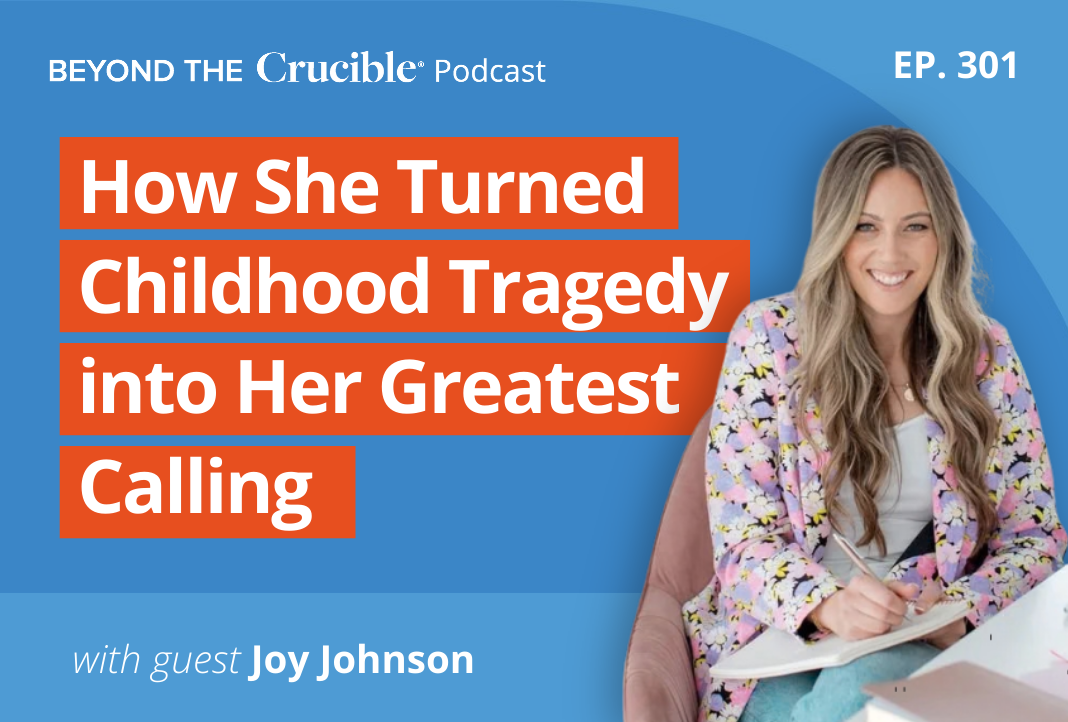
How She Turned Childhood Tragedy into Her Greatest Calling: Joy Johnson
Our guest this week, Joy Johnson, describes her first steps as a girl into the life of significance she would pursue after the death of her mother, who took her own life on Christmas night when Joy was 6 years old. Losing her mom was just the first devastating crucible she’d face. She has moved past her crucibles by leaning into her faith and dedicating herself to building a community of women she helps step out of constant self-sabotage, gain control of their lives and give themselves permission to live out the vision God has for them.
To learn more about Joy Johnson, visit www.thejoyfulfitlife.com
Enjoy the show? Leave a review on your favorite podcast app and leave a comment at our YouTube channel. And be sure subscribe and tell your friends and family about us.
Have a question or comment? Drop us a line at info@beyondthecrucible.com
—
👉 Don’t forget to subscribe for more leadership and personal growth insights: https://www.youtube.com/@beyondthecrucible
👉 Follow Beyond the Crucible on Facebook: https://www.facebook.com/beyondthecrucible
👉 Follow Warwick on LinkedIn: https://www.linkedin.com/in/warwickfairfax/
👉 Follow Beyond the Crucible on Instagram: https://www.instagram.com/beyondthecrucible
👉 Take the free Trials-to-Triumphs Self-Assessment to discover where you are on your journey of moving beyond your crucible and how to chart your personal course to a life of significance: https://beyondthecrucible.com/assessment/



Transcript
Warwick Fairfax:
Welcome to Beyond the Crucible. I'm Warwick Fairfax, the founder of Beyond The Crucible.

Joy Johnson:
What I felt was a freedom, a level of freedom, and being able to share the goodness of God coming out of my testimony. And that is when I began to really like my heart for others began to develop when I was in my junior high years. And so I would call, I would make a list of my friends and I would write down what they were going through and I would call.

Gary Schneeberger:
That's our guest this week, joy Johnson, describing her first steps toward the life of significance she would pursue decades after the death of her mother, who took her own life on Christmas night when Joy was only six years old. Losing her mom was just the first devastating crucible she'd face. She has moved past those trials and traumas by leaning into her faith and dedicating herself to building a community of women she helps step out of constant self-sabotage, gain control of their lives, and give themselves permission to live out the vision God has for their lives.

Warwick Fairfax:
Well, Joy, it's wonderful to have you here on our podcast, and a little bit of an introduction to Joy. Joy is Joy Johnson. She's a coach, speaker, and host of the Top 1.5% Globally Ranked Podcast, The Journey to Becoming. Love that title, which we'll talk a lot about, and the founder of The Joyful Fit Life community. She lives in California with her husband and two wonderful children. And she says today her life is better than she ever could imagine, but it wasn't always that way.
That's a great way to have a buyer because that's a perfect intro to really, as we begin the discussion, what we often talk about at Beyond the Crucible is tell us what life was like before the crucible. But you were so young when you had your first crucible. Can you even remember? I think you were six years old. Can you even remember what life was like pre-crucible for a very young joy?

Joy Johnson:
Yeah, I think it is, first, I just want to say thank you so much for having me. It's such an honor, and I think it is hard. It is hard when you've experienced such deep trauma at a young age and our mind or our subconscious can... Our body wants to keep us in... wants to protect us. And so I want to say that I remember, and at the same time it's like, "Is it my memory? Is it because I've seen pictures? Is it because I've been told?" So yes, the memories are a little fuzzy.

Warwick Fairfax:
I can imagine.

Joy Johnson:
Yeah, definitely.

Warwick Fairfax:
So just talk about that Christmas night when you were six years old, and you've had a few crucibles, but that was, I guess, one of the-

Joy Johnson:
Yeah.

Warwick Fairfax:
... most traumatic, horrendous that anybody could possibly imagine or go through. So tell us what happened that Christmas night.

Joy Johnson:
Yeah, yeah. So let's see, Christmas evening, Christmas is a time in a child's life where you just look forward. You're looking forward to the day, and it's like the presents. What else besides the presence? And yes, no, we're celebrating Jesus and Jesus' birthday. And we were at my grandmother's house on my Dad's side and we had gone to see our grandparents on my Mom's side prior. They both lived in the same city and she said, "We forgot our jackets." And she said, "Joy, do you want to come with me?" But this was also at the exact moment when we were about to open our Christmas presents. And so I was like, "No, I don't want to go. I'm so sorry Mom, I don't want to go." And so she did. She went by herself and we proceeded to open presents, and she had just had... She was four months postpartum with my youngest brother.
And looking back at pictures, she was dealing with depression. She was dealing with postpartum depression, and the pictures that we had of that day, you could just see, you could just see that something was wrong. And so she left. We opened presents. I'm in the restroom, and this is a vivid memory I have. My grandmother's house and there was... It was the bathroom was all peach. And I hear my Dad saying, "Joy, Joy," and I'm like, "Oh, man, we're probably leaving. We probably have to leave now." And I walk out into the living room, and there was just blanks stares. Like my whole family was in that living room, and my Dad told me in that moment, "Your mom is not coming back."
And I think it just like was fuzzy. I think that's the best way I could describe it. And I'm like, "Well, what do you mean she's not coming back?" And so it was at that time that when she left to go retrieve our jackets, that is also the period of time where she took her life. And, of course, as a six-year-old, you're trying to process these things, and the sudden thought in my mind, too, was like, "I should have gone with her. If I went with my Mom, then maybe she would still be here." And I remember sharing that with my Dad, and even my Dad, she was 32 when she took her life. And my Dad, too, immediately he's like, "Joy you cannot."
Thank you Jesus for my Dad, who just covered me in so much love, so much affirmation and really... not... yes, encouraging me, but reassuring me it was not my fault because it's so easy, and I think this is a sensitive topic to talk about, suicide, suicidal ideation, depression, mental illness, all of these things. And so as I was six years old, growing up, and as I learned about my Mom, it was always painted in the light that she was sick. And I did not harbor any anger. I'm so grateful for the way that it was presented to me because, yes, of course I'm so sad. I lost my Mom and it's the most traumatic thing for a child, and at the same time, I had such grace for her in knowing that it wasn't because she didn't love me.
There was something that was wrong. It was a chemical imbalance. That's how my Dad... Those are the words that I remember that echoed in my mind. She was not okay. And I came to learn also that it was not just her that had took her life, my grandmother. So it was a generational stronghold. If you're not familiar with that term or that phrase, a generational stronghold is something that has... it's in the name, a strong hold on your family. And it can be like, "Oh, this is the way at it's always been and it always has to be this way. And as believers, we know or we understand that with the power of Jesus that we can break. It is a decision. We can break these strongholds. And so that's a little picture into little Joy at six years old on Christmas night.

Warwick Fairfax:
How did you sort of manage that? Because I know your dad was reassuring, was it faith? Because there would've been many kids no matter what their dad had said, that would have said to themselves, "I know my Dad is being nice, but it was my fault. I know the whole chemical imbalance thing, although gee, at six, I don't really understand what that means. Sick." But yeah, even if she was sick, from a spiritual perspective, that's almost like the voices of the enemy, so to speak. You could have easily gone down the track of, "No matter what my dad says, it was my fault. If I'd been in that car, she wouldn't have." How did you avoid going down that dark trail, which you could have-

Joy Johnson:
Mm-hmm.

Warwick Fairfax:
... in spite of your dad?

Joy Johnson:
Yeah, I think there's so much of my faith attached to that. I'm not sure when in the year, so this happened Christmas night, and I know that when I was six years old, I did ask Jesus to come into my heart. I can't recall if it was before or after, but I did grow up in a Christian household. And when I came back to school, the whole school knew. The whole school knew what was taking place, and kids say some silly things when it comes to death, and especially when it comes to suicide. And I remember somebody told me, "You know what? If your dad dies, you're going to have to go to an orphanage and they have gross food there."

Warwick Fairfax:
Ugh.

Joy Johnson:
Like that is forever-

Warwick Fairfax:
[inaudible 00:09:22].

Joy Johnson:
... etched in my mind. But I know that I did go into counseling. My Dad did put me into counseling, and I can't say anything else, but it was the grace of God. And this is something that at a six-year-old, my brain was not fully formed and all of these things. There is a term and it's called transgenerational trauma, and I'm so grateful that I did not experience and have not experienced depression, suicidal ideation. I have not experienced those dark mental areas. But what had taken place, and this followed me into years and decades, and I had to do some deep healing, was the transgenerational trauma that took place in my life was more in terms of emotional health.
And so while I did not live in the shame and in the guilt of that, what did come up, and I really think that this is something that isn't talked about so openly or that we can receive healing from, like you mentioned, evening knowing about postpartum depression, all of it, this was 1991, so this was a long time ago. We have made strides in the mental health area, but emotional health is so different because it looks and disguises itself as people pleasing. IT disguises itself as creating false narratives. It disguises itself in lying and saying like, "Oh, I am okay." Like, "Maybe if I just do more."
So the way that it showed up in my life was like, "I have to be the best, I have to be perfect," because it was almost like works-based and striving, which is the opposite of what we know in the Bible. But that is something that really it contributed to my lack mentality, my poor or poverty thinking because I grew up and I felt like I am less than because I do not have. "I don't have my Mom and everybody knows it. I don't get to experience these things and everybody knows it." And there was a level of shame that was brought, and we'll probably get to this in a little bit, especially in my older years and the shame in what it was around, because again, in the '90s growing up, it's like, "Oh my gosh. What do you mean? That's how your mom died?"
So much shame and like, "There must be something wrong with my family. So let me cover it up by how I can perform. Let me cover it up by trying to be perfect." That's exhausting. Another thing that I felt as well growing up was I have had experienced such deep loss, yet my name is Joy. And at a young age I was like, "I don't like my name. I don't like it." Everyone's like, "Oh, happy, happy, joy, joy. You're so happy. You must be happy all the time." And yet, on the inside it's like, "But do you know what I lost? Do you know what I experienced?" And so I was also wrestling with that and having that shame even in what I was named, not knowing that it was prophetic, that it was who I get to be, but I did have to go through this healing in those emotionally unhealthy patterns.

Warwick Fairfax:
Now, one of the things you said here, which is incredible that you used this verse, you used this verse of Genesis 50:20, the story of Joseph. And as people know, Joseph was sold into slavery by his brothers. He was in Egypt, eventually became Pharaoh's right-hand man and ends up meeting his brothers later, which were a little anxious about. But this verse says, actually talking to his brothers, Joseph says, "You meant to harm me, but God turned it around for good for the saving of many lives." Talk about how that verse, what that meant for you. How could God use what you've been through with your mother and grandmother and later on, unfortunately, your younger brother. I mean, how in the world could God use any of that for good? Because a lot of listeners will be thinking, "That's not possible, is it?"

Joy Johnson:
Yeah, I think when it comes to that verse, a lot of the times we stop before it ends. "Okay, you meant to harm, but God turned it around for good." We know that we serve a good God. And if as believers understanding that we get to believe the Bible in its entirety, we cannot pick and choose. And so if we're going to believe that God will turn it around for good, and the last part of that verse is for the saving of many lives, I think that there has to be a confidence in knowing that it is out of our control. And I think a popular verse that many people like to cling on to, too, is Jeremiah 29:11, and it says, "For I know the plans I have for you." I remember hearing that verse growing up. "Plans for good, not for evil, to give you a future and a hope."
And in the midst of what I had experienced, it's like how in the world can... And I think a lot of people when they're going through their crucible moments, they're like, "How can a good God allow this to happen? If He's so good, then why would He allow my Mom to pass? Why would he allow this to continue?" And it's not so much that it's like He caused it, but yeah, it does happen. Why? Because we live in a sin-filled world. Well, this is our sin nature. When sin entered the world, this is how God redeems. And so going back to that, "And He will use it for the saving of many lives," I don't know the exact moment that I realized that my testimony was so much more for others than it was for me. I can't tell you that exact moment. I think it was more of a gradual realization over the years.
But I remember in junior high, I started to share. I remember we were in a chapel. I went to a private school up until about eighth grade, and I remember sharing about my Mom and looking in the audience and everybody was like... it was like crickets. People in junior high, they're like, "What's going on?" But what I felt was a freedom, a level of freedom and being able to share the goodness of God coming out of my testimony. And that is when I began to really... like my heart for others began to develop when I was in my junior high years. And so I would call, I make a list of my friends and I would write down what they were going through and I would call. And I wasn't as bold in my faith as I am now. I wouldn't necessarily be praying for them, but I would check up on them, and I became that friend that was on the phone encouraging people.
And it's like a gift. We have our natural abilities and then we have our spiritual gift. And the gift of encouragement is something that I know that I have, and that's when it began to bubble up. And I would be filled up by encouraging others. And so again, it's like a gradual revelation, if you will, in knowing what I had gone through was not just for myself. And then as I got older, too, it was like, "Oh, I'm feeling this way," or, "I lost my Mom," and people would be like, "You need to go talk to Joy. Let me connect you with her." "Oh, your son is going through this? I know somebody that has gone through it." And how did they know? Because I began to talk about. And so sometimes we can also have this false humility in the idea that, "Well, God, go use somebody else. Go use somebody more qualified. Go use somebody that's already doing this, that's already advocating, that's already been sharing their story."
Because, yes, there are so many people and we all have different stories, but nobody has the testimony that you have. And we can have this false humility and really what it can be disguised as is it can be disguised as selfishness. And the reason why I use that word, selfishness, is because it's a little bit like it would be more comfortable for me to stay in my little corner and not sharing what God is doing, but because I get to step out and because I have that boldness, there's the saving of many lives. There's the breakthrough, there's the freedom.

Gary Schneeberger:
And I would add, based on what we talked about at the outset, what you talked about at the outset, there's the joy, right? I mean, that's-

Joy Johnson:
Mm-hmm.

Gary Schneeberger:
... when you truly embraced and lived out and transferred the meaning of your name to those people to whom you're speaking, right?

Joy Johnson:
Yeah, and in the Bible, when God will rename people, although he didn't rename, He restored. He restored the joy. Joel 2:25 says, "I will restore to you the years. I will restore to you the years." Right? Job 42:12, "And God blessed Job in the second half of his life, greater in the second than in the first half."

Warwick Fairfax:
You talk about a number of steps of faith as you've bounced back. You've lost your brother. Before your wedding, you were thinking, "Gosh, am I going to have suicidal ideation? Am I going to have postpartum depression?" And those things didn't happen, but the fear was probably very real. So how did you get through those fears of, "I'm going to be another in the long line of people, suicidal ideation, I'm going to get postpartum depression? That's a given, but how am I going to deal with it?" How did you deal with that and not let it control you, all those fears?

Joy Johnson:
I think, honestly, having the right people around me, the right voices, when you are vulnerable, you have to have the right voices around you and you have to... The Bible says that we need to guard our heart because out of the heart flows the issues of life. And when my wedding day, three days before my wedding day as I was going to pick up my wedding dress, my Dad called me, and that just... Dealing with trauma from at the age of six and then almost like the same thing at 26, so 20 years later, and it was that felt like a horrific dream. I remember waking up the next day being like, "Please, God, let this not be real." And it was I wanted to hide. That was such a different type of shame and embarrassment because we're about to go have a wedding with all of our friends and our family and they know.
And a lot of... I had thoughts of like... I remember asking my Dad, "Should we even get married?" And this is my husband. So my husband and I were high school sweethearts. We had dated for 10 years. We met when we were 15. We had dated for 10 years. That's a long time. Engaged for a year and a half. This was a long time coming. This was a highly anticipated day. And I remember, "Should we even go through with this?" And my Dad was like, "Yes, absolutely." I did not cry one tear. I want to share this one story because this was like this is only God. So we got married in September. In the summer, I had picked a song that I was going to walk down the aisle to. I had a very eclectic playlist that I was very specific. I had a lot of time to think about this.
And so on my way to work, on my drive, I would be playing this song that I was walking down the aisle to, and every single time bawling my eyes out crying. I was practicing walking down the aisle with a smile, and I was just crying my eyes out in anticipation. And I believe this was God preparing me. I believe that God shows up in the smallest details. The fact that I got to walk down the aisle, not shedding one tear, my family probably thought I was crazy. They probably thought, "Does Joy not have a heart? She just lost her brother." Some family members, I could see the way that they were greeting me and looking at me.
Of course, they were heartbroken and so devastated. And here I am in a white dress ready to celebrate. That is something that only God can do. He reminds us that He brings us a peace that surpasses all understanding. And so I believe He shows up in those details, even in... And then two years later when I became pregnant, so I had lost my baby brother three days before the wedding. And when it came time, when my husband were like, "Okay, we want to start trying for kids," I told God, I'm like, 'You're going to give me a son."

Warwick Fairfax:
Ha-

Joy Johnson:
"You're going to give me a son."

Warwick Fairfax:
... you told him, yeah.

Joy Johnson:
"Remember what happened? Remember everything that I lost? I need a baby boy, okay?" So when we went to the ultrasound for my firstborn and they're like, "It's a girl," and I am, "Please check again." Because this is my restoration moment. God, remember? I need a boy. And I had my beautiful baby girl. She has brought so many layers of restoration. I've had the opportunity to everything that I wanted when I was a little girl, I've gotten to experience like the mommy in me and dressing up and doing the tea parties and her calling me her best friend. And she's just such a sweet girl, and God is in the details, in the details.
And then I got pregnant with my son two years later. And again, driving, the voice of the Holy Spirit. I remember I was getting off an exit and He said, "Do you know why you couldn't have a son first? Because if I would have given you a son first, you would have put your healing and attached your healing to him instead of Me." And that hit me so heavy because how many times do we say, "Oh, my children, they saved my life. If it wasn't for my child." And we thank you God for the gifts that you give us in children, and he is our one true healer. And so he had to heal me first before I could have my son.

Warwick Fairfax:
It's often easier to see God's plan in hindsight, you know?

Joy Johnson:
Of course.

Warwick Fairfax:
Like for me, I've lived in the U.S. in Maryland since the early '90s, and yeah, I just feel obviously blessed to have the wife I do and three adult kids now, like 30s to 20s. And they have strong faith, they work hard. They have good values. I mean, everything I could want and more. And I find that just deeply moving. I'm just so thankful to God for that. It's hard to put it into words and just to have kids that love you and a wife, if one of the kids calls and they're out of town and things are going on, she will listen to them an hour, two hours. No time is too much, and it's like, I mean, what kind of a mother is that? I mean, that's unbelievable.
So I just feel, I guess, when you go through things that are different, it makes you appreciate to a degree that's hard to describe what you have, a loving husband, loving children, and it's like they're going to grow up differently. And I'm not perfect, but I'm going to do my level best to be there and love them unconditionally and all that. So I want to shift a bit here because there's another bead to your story of which births what you do in which you help so many women. So talk about I think you mentioned back in 2019 you were doing a lot of leadership things in church. You had a wonderful husband and, I think, wonderful kids, but you felt like there was something missing. So talk about what that is because I'm sure that many people, certainly many women, can relate to what you were going through. So what was it? Because it wasn't like life was terrible, you know, but yet-

Joy Johnson:
Yeah. Mm-hmm.

Warwick Fairfax:
... there was something that was missing. What was that?

Joy Johnson:
Yeah, it was lack of vision, honestly. The Bible says that, "My people will perish for a lack of vision." And vision begins in the Heart of God, and as you are going about your life, and 2019, my children were younger and motherhood was mothering. And it's you can get lost in the identities. And I like to refer to them as hats, as hats you wear, I'm a mom. "What do you do?" "Oh, I'm a mom. Oh, I'm a wife. Oh, I'm a business owner. Oh, I do this. Oh, I do this." And we wear all these hats and we wear them all at the same time. There's a lot of burnout and overwhelm that can take place if we are not careful. And so I was feeling the repercussions of also these unhealthy emotional patterns and not being able to put myself first in a way to take care of those emotions.
And so instead of taking care of them and getting to the root of them I was putting band-aids on them. And how was I putting band-aids? "Oh, I'll do more. Oh yeah, I can do that." I was the people pleaser to the max. Why would I... I had to say yes because if I said no, that meant that I couldn't do it and I wasn't strong enough. And so in 2019, going into 2020, my husband began to talk a lot about vision. "Joy, where do you see your business? Where do you see this? Where do you see this?" And for somebody, if you do not have vision, and if you can't see forward, that question is triggering.

Warwick Fairfax:
Hmm.

Joy Johnson:
It is because you don't think about it. And it's like, "Can you stop? I don't want to talk about... I don't even know what I'm going to eat tomorrow. Why do I want to plan for the future? I don't want to see five years ahead." But we began, that we began to take some steps and say, "No, we are going to write the vision. Habakkuk 2:2 in the Bible also says, "Write the vision, make it plain." Write the vision and make it plain, so we began to write plans for our finances. We began to decide like, "Who do we want to be as parents? What do we want our marriage to look like?" And this happened so organically and it has really shifted into who I am today, but I had to get to the root of healing.
And one of the books that has changed my life, it is called The Emotionally Healthy Woman. I love a good resource, and you know what? Men should read it, too, honestly. It is by her name is Geri Scazzero, and her and her husband, they have a whole ministry, actually. Pete is her husband, and they've created an entire ministry on emotionally healthy discipleship, spirituality, relationships. And it comes from confronting all the hardest things that we don't want to confront ourselves. He says often, he says, "Jesus may be in your heart, but grandpa is in your bones." And so we have to go back, and it has to go just beyond us.
And that's where I began to... I discovered that term "transgenerational trauma" because I had to go back. Okay, although this stops here with me, the generational stronghold stops here. It will not continue into my family. If I want to be the one to break the cycle, then I have to go back. I have to go back and I have to heal so that I can have vision forward. And so even though I have outlived my Mom, I've outparented my Mom, she was 32, I just turned 40 this year. My kids are 10 and 12. I was six, so outparented all of these things. I choose that I will honor her and my brother by living with vision, and that is what I get to help women do now.
And so it's like maybe you've heard that phrase is like, "The best person you're qualified to help is the past version of you." And so I am on a mission to link arms with the women that God brings in my path through the community to say, "You're not going to stay here. With a heart full of grace, I may not understand what you're going through, but I do know that we cannot stay here, so we're going together. We're going to create a vision for your life with God at the center. We're going to get to the root issues. We're going to get outside of our comfort zone."

Warwick Fairfax:
That's so important because in order to move forward, we have to understand where we are and what's going on and why, and oh, I get that. I mean, I'm fortunately a very self-reflective person and I'm a certified executive coach, so I tend to want to know why. But so for you, what was the why behind the people pleasing? "Hey, I can do it all. It's all about my husband, about the kids. My needs don't matter because I'm here to help everybody else because they need me. I can't think of myself. That's selfish." I mean, so as you began to dig beneath the surface, what did you find? What was the origin story of some of those, in a sense, unhealthy manifestations?

Joy Johnson:
Mm-hmm. I think it honestly was years of just ignoring them. It was, it was years of suppressing them. And one of the things that I used to say was like, "I feel bad. I feel bad." And honestly, there was a period of time where I think advocating for myself, I advocate for mental health and advocate for so many things, but advocating for my own feelings and understanding that feelings are not the best leaders. And even though I felt this way, I did owe it to myself to express it and then to keep going. And even though it was like I'm not appeasing my feelings and I'm not making allowances for them and sitting in them, I don't want to continue to feel that way.
I was at the point where this was affecting my nervous system. I was at the point where this would wake me up in the middle of the night. I was at the point where it was affecting how I showed up, if that makes sense. And so I don't think it was an exact like one thing, but it was like, "Oh, am I going to admit that I am and that I have perfectionistic tendencies? Am I going to admit that I want to be a people pleaser?" So even like confessing those things, when you can expose it, when you can expose it, then you can begin to take steps and saying like,' Hey, I don't identify." I like to say it's like shedding past versions of ourselves when we know we cannot stay here. I'm going to be committed to my healing.
So yes, I know that's who I used to be, but that's no longer who I am. And that came with, again, we talked about surrounding ourself and who we surrounded ourself with. I had to change who I surrounded myself with and the way that I spoke. We have to like... As our identity shifts or as we come to that God-given identity, it's like, "I'm going to fully step into it. I'm not going to be scared." I think another thing that really paralyzed me was a fear of failure. If I fail, then everyone's going to think I'm a failure. Then, if I fail the first time, then what's going to happen? Well, yeah, Joy, what is going to happen? Are you going to be labeled by your failures? Or are you going to allow those to help you and find what maybe didn't work and keep going?

Gary Schneeberger:
One of the things that we say all the time, Joy, and I was looking through some things that you've written, your marriage felt like it was on autopilot. Every day, you were doing a lot, but not moving any further ahead. One of the things that we say a lot at Beyond the Crucible is that, and it sounds like it's sort of what you described, and we call them is-this-all-there-is moments. You're living your life and it's going okay, but we're made for something so much more than okay, and I think that's what you described here. So is that fair that both what you went through and some of the women that you're helping, they arrived at this place of, "Is this all there is? There's got to be more." And you helped show them that. Is that fair?

Joy Johnson:
Absolutely. Absolutely. We know that we were made for more. And I think, again, if we are used to staying comfortable and this is all there is, it's easier to think that. And it does take a moment or it does take somebody to be like, "Oh no, I see something in you. I see something in you." And for me, that's my husband. I'm so grateful for my husband. He's like... I remember a time even like during, so before getting into the coaching, I was in the health and fitness space for 15 years prior. And I remember during when I was making the switch to online, my insecurities were at an all-time high, and he was encouraging me like, "Hey, what do we need to do to get you mobile, to get you online?" And I was like, "Why do you hate me?" I say it so like... It sounds so nice right now.
I was like ugly crying, probably like snot dripping down my nose. I'm like, "You hate me." And he's probably like, "Who is this chick? Where's my wife? This is not her." But he said, "Joy, I do not hate you. I love you." And I am so grateful for my husband because he loves me enough to tell me the truth, that he does not... He sees the gifts inside of me and he pulls it, he pulls it and he pushes me forward. And because I have him, because I have that support, then I get to do it for other women as well.

Warwick Fairfax:
So talk about this community that you've built and you've got this incredible podcast, and I love the phrase "The Journey to Becoming" because we're all on a journey. One of the things, I'm sure you do, too, but I love about this podcast is I learned from people that we have on/ Early on we had this guy, David Charbonnet, who was a Navy SEAL in Southern California, and he was injured in a parachuting accident, became a paraplegic. And I remember saying to him, "Look what I went through losing this family business, it wasn't about the business, it was losing the heritage of this business that my father loved and my great-grandfather started. I believe it was more. I just lost the whole thing and I was embarrassed. So what I went through is nothing compared what you went through."
And he said, "You know, Warwick, your worst day is your worst day. It's not a competition." That was so gracious and such a gift. I've never forgotten that. It's like there's always somebody you can think of that's gone through worse than you have, and you feel embarrassed that you complained about your own tragedy, at least not that you should, but you feel that. So to me, that's part of the coming, and I'm sure you've probably learned a lot from your community, from the women that you advocate for. So talk about, to use the V word your husband used, your vision for Journey to Becoming Podcast, for you've got The Roadmap Method and Becoming a Woman of Value Challenge, and your community. So talk about what your vision is and what you love about what you do and the women that you're coming alongside to support.

Joy Johnson:
Yeah, this is my absolute passion. This gets me up in the morning, and I'm so grateful that this is what I get to do every single day. I'll start with the community. So the Joyful Fit Life Community is it is a vision-building community. It is discipleship and it's accountability. I think when I need this community as much as anybody else does, and it's because of how we get to influence each other. And this is showing up not in... We're not faking it. This is who we're becoming. So I loved this kind of tagline, which is held the podcast's birth after is like, "Hey, I'm a woman who is on her journey to becoming all that God has created her to be." So going back to Gary's like, "Gosh, you're saying we're created for so much more." There has to be something more. So I'm going to lean into not all the doing.
We will create to-do lists that will flood our mind, that overwhelm us, that burn us out, and we get stuck in striving, comparing, doing all these things. But the difference is in becoming, there's a level of surrender. You have to lean into the tension of where you are now and who you are going to be in the future. And you get to lean, you can oppose it and dig your heels in and stay stuck and say, "I'm not moving." Or you can release it. You can relax your jaw. You can lean into the tension. And seriously you can lean into the tension. Give your nervous system a little break because you're not stuck in survival mode anymore. And you can say, "I want to become this version."
And I like to speak to the Jeremiah 1:5 version. I say Jeremiah 1:5. It says that, "Before you were formed, before you were formed, I knew you. Before I put you in your mother's womb. I called you. I set you apart to be a prophet to the nations." So this is speaking to the deepest form of who we are, our identity. And when we can receive that and say, "I'm going to take these steps in who I am becoming," this is how the Roadmap was birthed, in focusing on. So I help women. We're planning in quarters. We plan in 90-day increments. So we create our vision, and I like to say the vision is our why and it anchors us, and then we create our goals.
Our goals are our what. We know, especially in the beginning of the year, goals are at an all-time high, and we can create audacious goals and all of these things, but we want to create realistic goals. So our goals are our what, and then it's like, "How? How did you do that?" And how becomes our systems. We don't rise. James Clear, for all those Atomic Habit fans, James Clear says, "We do not rise to the level of our goals, but we fall to the level of our systems." And so it's breaking these things down and how we can wake up with vision. We can wake up with clarity for our days, and we're doing it on the inside together. We have a private app. We are checking in daily for accountability. We have community calls and you can see all the stats about accountability and actually getting stuff done.
It jumps up to 90% when you have a set time with a set person. It's like I want to say 94% or something, I could be wrong, but it's in the 90s when you have a plan and then you have that accountability. So that's the accountability portion. And then The Journey to Becoming is the podcast is we're talking all things on our Roadmap, our faith, the four pillars, faith, relationships, our wellness, overall wellness, and then contribution. And then contribution is really all about becoming a Woman of Value. You can be a Woman of Value in your home, in the workplace, in how you serve, an entrepreneur. You can start the business, you can make an impact. You can make an impact in the home that you've been called to steward, in your finances, and really understanding I want to see myself as a Woman of Value.
And so I've also created a free five-day challenge. So it's a private podcast. It's separate from The Journey to Becoming, but this is where we speak to your identity. We're understanding and uncovering what do you truly value? That's something we got to be intentional and think about. What do you value? How are you going to become this person? What version do you have to shed in order to become her? And you got to love yourself enough today to become her tomorrow. Speaking of the ladies, I know I'm saying her, but you got to love yourself enough. You got to love yourself today, period. You cannot hate yourself into transformation. You can't. You have to love yourself enough today and say, "I'm going to love myself today to take that step forward into who I'm becoming."

Warwick Fairfax:
What I love about what you're talking about, Joy, is the whole notion of becoming, and you give them tools for how to have systems, come up with a vision, accountability. But I love the thing of identity because so often we think, "Well, my identity is wrapped up in what I do," and I've really tried to make sure in my case, that's not me. I remember when my book came out, I was literally on my knees saying, "Lord, whether it sells one, a thousand, 10,000, my identity is not going to be in a number." We have a great social media team. We track numbers on YouTube, Instagram or whatever. We're putting mechanisms in place, content to increase and everything that we should be doing. We've got good systems in that way, but yet my identity is not an anomaly.
It doesn't mean that we're not doing what we should be doing and being faithful stewards, but yet we get to live our own lives. We get to make choices. In my case, I spoke a fair amount when my book came out, but I don't really enjoy running around speaking. I feel like I've got to the point where I'm competent and it seems like they go over well. But I enjoy podcasts. Well, I get to choose. In my case, I don't have to run around speaking. I love what I do here, but I'm also an elder at my church, which I love. I want to do that. My kids all went to Taylor University, a great Christ-centered university, Indiana. I help out on a campaign committee.
There's a number of... a couple of nonprofits I'm not that involved in, but a little bit. I like all those rhythms. I feel called to all those things. So I said to my team one time, "I'm not going to speak. There are certain things I'm not going to do because I feel called to these other things like elder at my church and obviously my family and my kids." So we get to design our own life the way we feel God is calling us to. And it's great to have businesses, but your identity is not wrapped up in numbers. It's for people of faith it's wrapped up in being a child of God and nothing else really matters. I'm sure that's probably part of what you do with the women. Does that make any kind of sense?

Joy Johnson:
Absolutely, and I think what I hear you saying, too, is it's about obedience in a world, in a culture that is so obsessed with overnight success, virality, self-made man like, "I did this on my own," chasing numbers, striving as believers. I've heard this definition of success and it just is so good. He said, "Success is obedience at God's pace."

Warwick Fairfax:
Hmm. Wow.

Joy Johnson:
Isn't that so good? And it's like, doesn't that take all the pressure off? And I love that you use the word "rhythm" right now, Warwick, because it's like there's a Scripture, Matthew 11:28-30, and I believe it's The Message version. And it is a popular Scripture, and usually it says, "Are you weary? Come to me." Oh, it says, "Come to me all you who are weary and burdened, and I will give you rest." Right? That's what it says in maybe the NIV version, but in Matthew 11, I'm going pull it up because it's too good not to share. This is from The Message version, and it says, "Are you tired, worn out, burned out on religion? Come to me, get away with me, and you'll recover your life. Walk, or I'll show you how to take real rest, walk with me and work with me. Watch how I do it."
That's discipleship, right? "Learn the unforced rhythms of grace. I won't lay anything heavy or ill-fitting on you. Keep company with me and you'll learn to live freely and lightly." And that is so attached to our emotional health. Rhythms is something that you welcome. It it is not a list of rules that is all or nothing. Rhythms allow, the rhythms of grace. And so when we can obey God, when we can be attuned to His ear and we can find success in being obedient to Him, guess what? He brings the increase because He is the Source. He is the One who brings it all. And so the pressure to perform, it just is released in that moment when you can adopt that perspective.

Warwick Fairfax:
So well said.

Gary Schneeberger:
I'm sitting here and I'm realizing that I failed in my co-host duties because you just finished, Joy, talking about for eight minutes all the great things that you do through your community, and my job is to make sure that you get to tell our listeners and viewers how they can find it online, so please do so.

Joy Johnson:
Yes, yes. Everything is at thejoyfulfitlife.com. So you can head there and you can find the challenge. You can find the community. You can find the podcasts and listen, and yeah, everything is right there, thejoyfulfitlife.com.

Gary Schneeberger:
Awesome. Warwick, as always, the last question or question are yours. And I'll just say this as I set you up, clearly we have a guest whose name fits exactly how she talks about what she does. So...

Warwick Fairfax:
Well said. Yeah, you no longer need to think, "Gosh, I don't know that I'm very joyful."

Gary Schneeberger:
Yes.

Warwick Fairfax:
I think with God's help and inspiration, I think you are, so no need to be like, "Can I change my name?" Hopefully you don't really think about that anymore. But yeah, I mean, what you do is so inspiring. The women that you help is incredible. And there may be somebody, some woman today that maybe she feels like she's broken, damaged. Either things were done to her or she's made mistakes that she feels like, how could you love somebody like here given the mistake she's made or what was being done to her? It may feel like today's the worst day. For a woman like that, what would be a word of hope? Because she might be feeling pretty hopeless and, frankly, worthless, what would a word of hope be to a woman like that?

Joy Johnson:
Mm-hmm. I would say to that person that it's never too late. It's never too late. I think as women, we think, "I let too much time pass me by. I should have made that decision." We can go into shoulds and, "I should have, I would have," all these things. You're never too late. You are not too old. That's another one, especially for women. "Oh, my time has passed." Absolutely not. We serve a God that is outside of time and space and He can do anything. We serve the God of the impossible, and when it comes to our worth and feeling hopeless, I want to remind you that there is nothing that you can do to separate yourself from the love of God. There is absolutely nothing. It says in Romans 8:30, I believe 38 and 39, that, "There is nothing that cab be done to separate you."
So although you may feel that way, I want to remind you that your feelings are not the best leaders. And I say that with all the love in my heart, and I pray that this episode would encourage you and it would also awaken some dormant things that have been taking place in your life. And so I want to speak to those dormant things, those dreams that have been maybe, "Oh, it's too late." Mm-mm. We will call them back to life. In Ezekiel, it says, "Can these dry bones live?" They absolutely can, and so it's like thank you Jesus that you were in the business of restoring. You're restoring the years. You bring everything back to life. He literally resurrected. He came back to life, and so if He can do that, that is also what lives inside of as believers, His resurrection power. So there is nothing too great or too far gone that He cannot resurrect.
That's what He wants to do. He wants you to live with vision. And even if it's just the smallest step, sometimes we can overestimate all the things that we have to do, but the smallest step, these are seeds. The Kingdom of God is likened to a seed. There are so many parallels between seed time and harvest. And the day that you plant the seed is not the day that you eat the fruit. And guess what? Back to Genesis 50:20, the fruit isn't even for you. Do you ever see an apple tree consuming an apple? The fruit that gets to be produced from your life is always for the Glory of God. So take that small step. I pray that you're encouraged today to keep going.

Gary Schneeberger:
Friends, I have been in the communications business long enough to know when the last word has been spoken on a subject, and you just heard it from our guest, Joy Johnson. Warwick, we just finished our conversation with Joy Johnson, and it was a, this is a word that people don't use anymore, but it was a humdinger. It was an excellent episode. Of all the guests we've had, I think she epitomizes her name Joy in what she talked about and what she gives to the folks that she helps. So what is the top takeaway that you can think of all that we covered with Joy today?

Warwick Fairfax:
You know, Joy Johnson is a remarkable person. She has just incredible things she does. She is the host of The Journey to Becoming Podcast, which is a Top 1.5% Globally Ranked Podcast that focuses on helping women become, I think from her perspective, who God would have them be. She's the founder of The Joyful Fit Life Community. I mean, she's contributing a lot, but what's amazing is given that where she's coming from, it's just remarkable. She lost her mom on Christmas night to suicide when Joy was just six years old, and it would have been easy for her to blame herself because her mom wanted her to come with her to do an errand. And Joy was like, "No, I want to stay here," because she was six and it's Christmas. She wants to open presents. But her dad handled it very well and said, "Joy, it's not your fault." But still, she's had to deal with her grandmother took her life. Also, she had a brother that took his life just shortly before Joy's wedding day.
So she's been through a lot, but she's not let her crucibles define her. I mean, it has not been easy, but she has faced her fears. Like her mother had postpartum depression, so she's thinking, "Gee, when I become a mother, I'm going to have postpartum depression," or, "What will happen then?" She is naturally afraid of that, but yet, fortunately it didn't happen for her. So she had a number of fears, and almost shame is like when she would tell people, "Oh, my mother took her own life." It's like, "Oh, you're that family." That's the thought that she had, and people will think, "Oh, that's sort of this broken family." All these fears, which aren't always what people are thinking, but that's the fear.
She was able to face those fears and not be defined by them, which is the key to coming back from your worst day is reflect on them. And she's very good about really getting in touch. It took her a while to get in touch with what those fears are, what those hurts are, and talk about that because then she lived sort of another crucible, which was the sense of she is going through the motions as a wife and mother and a business owner. But yet life because a sort of a, "What's it all for? What does it all mean?" That we had a serious 2 Acts significance when people bounce forward from a place where they're feeling like life is just moving along. "I'm not depressed, but it's like not a vibrant life." It's sort of like a black-and-white life, not full color.
And so she was able to face that with the incredible help of her husband who just said, "You know, I think you could be a podcaster." And she says, "I don't know." Even bought her some equipment. I mean, he was really advocating for it because from what he knew that she wanted to do. And now she helps a whole bunch of other women and advocate for them to find their own vision, to be honest with what they're feeling, to have other women come alongside them, and have systems and accountability to help make these dreams and these visions become reality. So she's a person of very great faith. I think for all of us, no matter what your faith perspective, you've got to be honest with what you're feeling, with what you've been through. You've got to cling to some higher purpose, which is what Joy has done. For her, it's her faith in Christ.
Whatever that is for you, that was the key to pulling her away from negative thoughts to the light and having people that you can be, she used this word, not just safe with, but secure. Whether it's your husband, wife, parents, brother, sister, partner, friends, find people that know you that you can be vulnerable with. We talk about fellow travelers. I mean, this is fellow travelers to the nth degree. People who know you and will advocate for you, who will support you, who won't judge you. That is so helpful as you try to get beyond your worst day to live a vision that maybe it's come out of your worst day and it will lead a life of significance.
We can learn so much from Joy Johnson, her honesty, her compassion, and her courage in advocating for other women, to help them have visions. They're not just settling for. She's really just a remarkable person with a lot of courage, a huge amount of faith, and every day she tries to live in light of her beliefs and values. That's what we believe at Beyond the Crucible, whatever your beliefs and values are, cling to them. Nurture them. Have people that support you in them and live your life in light of them. Be honest and vulnerable. Yes, we all can feel a bit broken or a few scars. That's okay. It's remarkable when you find people who you can be safe and secure with, who will say, "We know who you are. We know that you have those scars, but we love and support you anyway." That gives you incredible freedom, so we can learn so much from Joy Johnson.

Gary Schneeberger:
So until the next time we're together, please remember this. We do know that your crucible experiences are hard. Goodness. You heard Joy talk about the crucible she went through, both as a young girl and then as a young woman. These were hard, difficult crucibles. Warwick talked here a lot about his crucibles as well. They're hard, but here's what we've learned. They're not the end of your story, your crucible isn't. In fact, if you learn the lessons from them, if you apply those lessons to your life moving forward, where that journey can lead you is to the best destination you could possibly visit, and that is a life of significance.
Welcome to a journey of transformation with Beyond the Crucible Assessment. Unlike any other, this tool is designed to guide you from adversity to achievement. As you answer a few insightful questions, you won't just find a label like The Helper or The Individualist. Instead, you'll uncover your unique position in the journey of resilience. This assessment reveals where you stand today, the direction you should aim for, and crucially the steps to get there. It's more than an assessment, it's a roadmap to a life of significance. Ready? Visit beyondthecrucible.com. Take the free assessment and start charting your course to a life of significance today.