
Don’t Be a Cotton-Headed Ninny-Muggins: Learn These 3 Crucible Lessons from Elf
What would you call a movie about a baby orphaned at birth, who the nuns at the convent where he lives feel sorry for because he doesn’t have a permanent home and family? A film about a baby who grows into a man who later gets adopted but looks so different from the others in his town, whose abilities are so different from theirs that he’s the least successful employee at this job? A picture about a man who is talked about as a failure behind his back by those who act in his presence like they care for and respect him?
Maybe you think that movie turns out to be a depressing drama about an unfortunate soul discarded by society who winds up living a self-destructive life. A tragedy about hope denied, a life lived in ever-crumbling shambles. Maybe even a character study of a protagonist who winds up having no character and, with nowhere else to turn, leans into a life of narcissism and crime.
Well, if those are the conclusions you’ve come to, you’re a cotton-headed ninny-muggins.
That’s because the movie whose opening beats were just described (and from which that ninny-muggins line came) is Elf, the holiday comedy classic released in 2003. But the story of Buddy the elf is not just a funny, heartwarming Yuletide charmer. It’s also a master class in what it takes to overcome the trials and traumas of life we call crucible experiences. So, here are three lessons from Elf to help us move beyond our tragedies and failures and cast a unique vision for a life of significance, a life lived on purpose, dedicated to serving others.
Your gifts and talents don’t have to match everybody else’s or anybody else’s (and probably shouldn’t) for you to discover your vision.
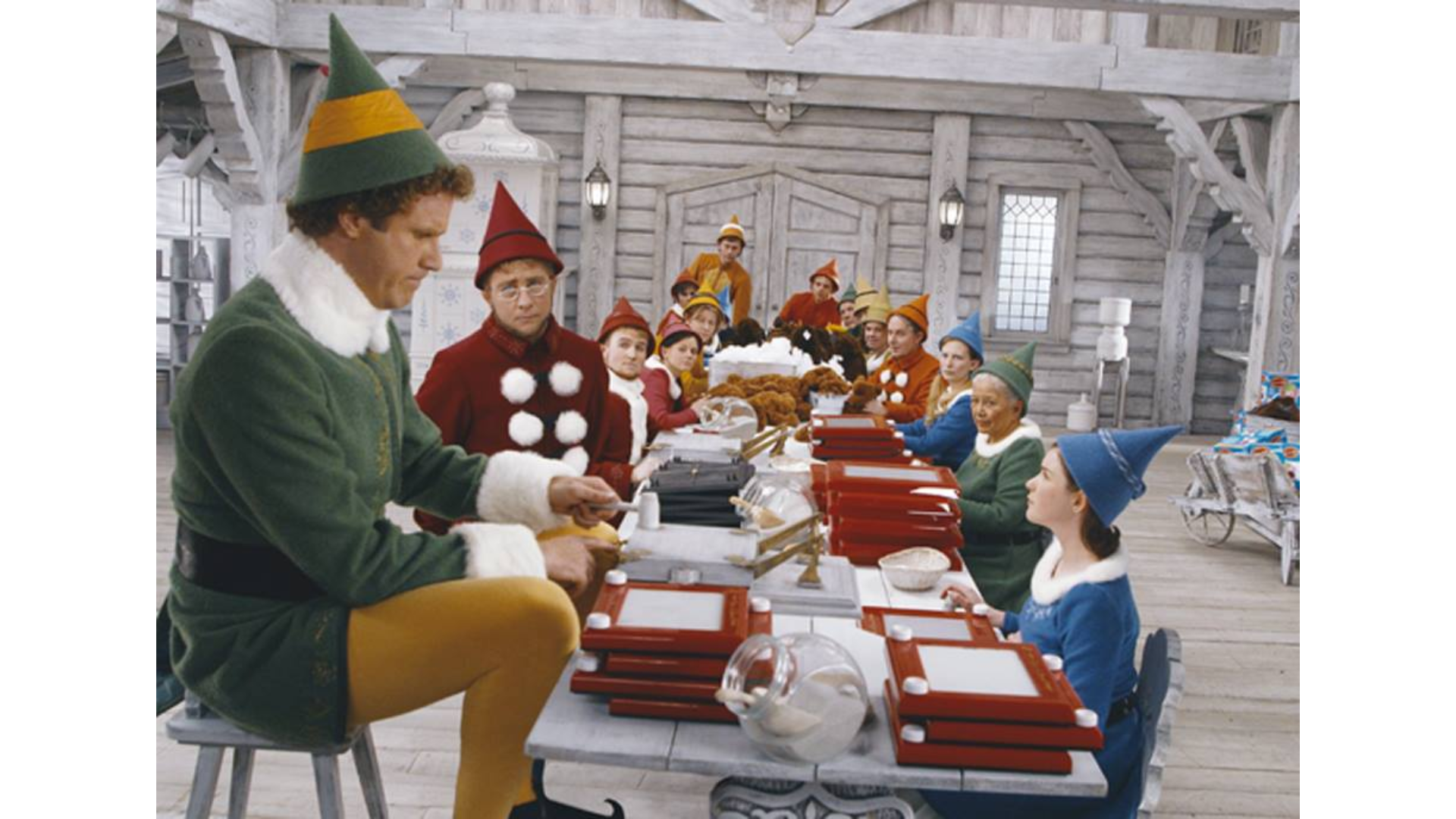
Buddy grows up to work as an elf at Santa’s workshop after being adopted by Papa Elf, one of the most respected of Santa’s inner circle. Buddy is given the opportunity to master the most desirable job for an elf, being a toymaker at the North Pole, referred to as “The Show” and “The Big Dance” by elves, a far superior vocation than the other two available– making shoes at night while the old cobbler sleeps and baking cookies in a tree. But because he’s a human, he only possesses two of the three skills that make elves great toy craftsmen – natural cheer and an active mind. He does not, alas, have nimble fingers.
So, when he can’t keep up with his colleagues making Etch-a-Sketches and gets reassigned to testing the quality of jack-in-the-boxes, he overhears two of his bosses deriding him for not realizing he’s a human, not an elf. Gobsmacked, he talks to Papa Elf, who tells him he was indeed put up for adoption by his human biological father, Walter Hobbs. Papa Elf encourages Buddy to go meet Walter in New York City, describing it as “a golden opportunity to find out who you really are.” Buddy then sets out on a journey to meet his father and perhaps discover what his gifts and talents may truly be.
In New York, Buddy’s plucky good nature comes immediately under attack. His dad rejects him as someone suffering from a mental disorder and has him forcibly removed from his office, where he works for a children’s book publisher. His younger half brother, Michael, thinks he’s weird. The boss of the Christmas department at Gimbels department store thinks he is a spacey employee who’s loafing when he’s really just a huge fan of Christmas and Santa who’s hanging around to help spruce up the place.
But Buddy lets all the ridicule, all the disapproval, roll right off him like his favorite food, syrup, rolls down his throat. For every insult hurled at him by others, every side-eyed glance questioning his behavior, Buddy doesn’t just stay joyous – he doubles down on that joy. It shows the most effective way to take the criticism of others when they think we’re off or odd when we’rebeing our true selves: stay happy with who we are, who we were both created and nurtured to be, whether others share that happiness or not. We’re the only ones, Buddy’s life proves, who are in charge of our personal disposition.
Serving others helps them overcome their crucibles … and helps you overcome yours, too.
Buddy begins to “fit in” better as his new friends and relatives get to know him better. Key to them getting to know him better is the help he offers them to get beyond their own crucibles. Consider Jovie, whose work at Gimbels requires her to wear an elf costume similar to the one Buddy has always sported, prompting him to compliment her for being a fellow traveler who “appreciates elf culture.” She begins to warm to him after he encourages her to not just sing in the shower – but to sing for others. “You have the most beautiful singing voice in the whole wide world,” he tells her, and challenges her with the North Pole truth that “The best way to spread Christmas cheer is singing loud for all to hear.”
He also rescues Michael from bullies who attack the two of them with snowballs while they’re walking home. Buddy’s prolific creation of snowy ammo and his sniper’s accuracy in hitting his human targets send the mean boys scurrying. Their shared victory makes the brothers fast friends. Michael even notices Buddy staring at Jovie at Gimbels and encourages his brother to ask her out on a date. He does, explaining to her that “I think you’re beautiful, and I feel really warm when I am around you and my tongue swells up.” Jovie is charmed by the comment she would have thought weird a few days earlier and says “yes.”
What Buddy does by helping Jovie and Michael helps him, too. That’s what happens when we help others along their journey to move beyond their crucibles. We get back as much relief and breakthrough as we give.
Perseverance is the jet fuel that propels you to a life of significance … even if that perseverance wavers and wanes at times.
When Walter gets hit hard by a crucible – his job is in jeopardy because of declining book sales – Buddy inadvertently makes it worse by insulting and then getting in a fistfight with a little person ghostwriter brought in to right the ship, because he assumes that the little person is an elf. Walter furiously tells Buddy to get out of his life – and Buddy dejectedly does just that. He sets out to walk back to the North Pole.
The outburst from his dad emotionally floors him – he could take his dad not saying he loved him, even after Buddy said he loved his father multiple times. But his perseverance is short-circuited when he feels angry antipathy, not just awkward indifference, from the man who gave him life.
But Buddy rediscovers that perseverance because his true purpose is needed again. It is needed by Santa, who’s piloting his sleigh – primarily powered by Christmas spirit – on his Christmas Eve run as he passes through New York. The sleigh is having a hard time staying in the air – Santa’s lost the booster rocket Papa Elf invented decades ago, and there’s a pronounced paucity of Christmas spirit in the atmosphere.
It’s up to Buddy to find the rocket (which he does) and help elevate the Christmas spirit all across the globe. Jovie and Walter are instrumental to the latter – she by breaking into “Santa Claus is Comin’ To Town” for the crowd gathered around the TV cameras covering the crisis; Walter by apologizing to Buddy and telling him he does indeed love him. Buddy’s dad helps with the propulsion of Santa’s sleigh by singing along with Jovie and the crowd witnessing the Christmas miracle.
That miracle would not have been possible had Buddy done what we caution those who have been through crucibles to never do: slip into bed and pull the covers over their heads. The Christmas crucible the world faces in Elf is overcome by Buddy refusing to let his perseverance get completely away from him.
And if anyone tries to tell you differently, they sit on a throne of lies.
Reflection
1. Have you ever found yourself discouraged that your gifts and talents aren’t like others’? What can you do to appreciate the uniqueness of who you are?
2. Think of a situation when helping someone through their crucible helped you through yours. Why do you think that happened?
3. When your perseverance starts to falter, what do you do to re-establish it?
Are you ready to move from trials to triumphs? Then join us on the journey today. Take our free Beyond the Crucible Trials-to-Triumphs Self-Assessment.
We share inspirational stories and transformational tools from leaders who have moved beyond life’s most difficult moments to create lives of significance.
Listen to our Beyond the Crucible Podcast here.