We have spoken of how inspiring a group of people with a shared vision is one of the hardest challenges in leadership. Growing your vision is not easy. Having your vision impact the world for generations is perhaps the ultimate goal for a visionary, but such a goal can feel like climbing Mount Everest. Impossible! However, Jesus did it. The key is to create a growing wave of ambassadors for your vision across continents and generations.
One of the greatest success stories in spreading a shared vision is through the approach and method Jesus used. We may think of Jesus as a good man or the Son of God, but a visionary leader?
The reach of the Christian faith grew dramatically from Jesus’ death to a few hundred years later. In 40 A.D., a few years after Jesus’ death, there were around 1,000 Christians. By 350 A.D., just over half of the 60 million people in the Roman Empire were Christians. That is a growth rate of the Christian population of 40% per decade. Sociologist Rodney Stark outlines this in his fascinating book, “The Rise of Christianity.”
The Jesus Approach
Jesus was truly authentic to the vision he shared. In the Sermon on the Mount, Jesus says the poor in spirit (i.e., the humble), the meek, and the merciful are blessed — Jesus was all these things. Aside from authentically living his vision, there were a number of factors that accounted for the dramatic growth in the shared vision of the Christian faith.
1) Jesus Consistently Shared His Vision
Jesus shared his vision with his team, his disciples, and with others. He embodied love and preached the good news of the forgiveness of sins and challenged the hypocrisy of the religious leaders of his day. He did not share his speech just once to a big crowd, but shared it often with small numbers of people, as well as with larger groups of people.
2) Jesus Entrusted His Message to a Faithful Few
The organizational model that Jesus used to spread his vision is worthy of study. There were three levels in his leadership model: The Three (Peter, James, and John), The Twelve (Jesus’ twelve disciples) and The Seventy-Two (a wider group of disciples). Jesus knew that his vision wouldn’t spread as well with just a big speech, but with faithful followers who would embody the vision and preach the vision. This is the theory of multiplication that is so critical for the exponential growth of any vision — the kind of exponential growth that the Christian faith had.
3) The Next Generations Lived and Spread the Vision
Two great epidemics illustrate the extent to which early Christians lived their vision and the power of people who live what they preach. The first epidemic occurred in 165 A.D. It lasted fifteen years and led to the death of approximately a quarter to a third of the population of the Roman Empire. The second epidemic was in 251 A.D. and was equally devastating. Caring for those with the disease was very risky, but the early Christians embodied the values of love and charity. Many Christians died caring for the sick. A contemporary observer stated that caring for the sick was very counter cultural at the time.
4) Early Christians Were Committed to the Vision
Early Christians were so committed to the vision that they were willing to die for it. While the number of Christians who were martyred for their faith was not great, their example had a powerful effect.
5) The Vision Was Different
In spreading a vision or a message, it helps if it stands out. The central message of Jesus’ vision was one of love, forgiveness, and mercy. In a time when the culture taught that humility and mercy were not rational, the early Christians’ message of forgiveness and mercy was striking.
Creating an Impactful Vision
While the growth of Jesus’ vision across continents and generations might seem daunting for us as leaders, there are some practical tips that Jesus’ approach can teach us about creating a vision that has impact.
Embody Your Vision: Let the way you live be as bold a message as the words you speak.
Consistently Share Your Vision: Sharing your vision does not happen in one big speech. Share it often in different places, with different people consistently and constantly.
Give Ownership of Your Vision to a Team:More than the big speech, having a core team that lives and preaches the vision is key. They will help spread the vision, ideally even after you.
The key to rapid exponential growth globally of your vision is multiplication. Spread the vision to a faithful few who will preach and embody the vision, who will in turn find others who will preach and embody the vision. Significant growth in your vision depends on this multiplication. Start small, with a faithful few, to grow big.
Reflection
How are you authentically living your vision?
Who are you giving ownership of your vision to that can carry the vision to future generations?
To explore Beyond the Crucible resources, including our free Trials-to-Triumphs Self-Assessment, visit beyondthecrucible.com.
Enjoy the show? Leave a review on your favorite podcast app and leave a comment at our YouTube channel and be sure subscribe and tell your friends and family about us.
Take the free Trials-to-Triumphs Self-Assessment to discover where you are on your journey of moving beyond your crucible and how to chart your personal course to a life of significance: https://beyondthecrucible.com/assessment/
One of the hardest areas of leadership is to inspire a group of people with a common vision, a shared vision. Why is this?
Typically, leaders are in love with their vision. They have a hard time letting anyone touch their vision. More often than not, their vision is years in the making and a culmination of all their hopes and dreams. It summarizes everything they are and everything they value. They would rather fail than have anyone desecrate a vision that they have come to believe in. At least, this is what a visionary often thinks.
The statue of David, by Michelangelo, comes to mind when I think of a leader’s attachment to their vision. They see their vision as perfection, a masterpiece. They almost worship it. How could you let anyone mess with such a wondrous vision? The problem with this way of thinking is that, while you may perceive your vision to be at the same level as the statue of David, it likely needs more work and polish from a team of people who can add value.
Empower Your Team with A Shared Vision
Great leaders have learned to give others on their team the hammer and chisel and let them contribute. They encourage their team to take this hammer and chisel and go chip away. They allow their team to have ownership.
“The price of success, of a vibrant, breathing vision, is partnership. The willingness to share your vision, to give the keys of the kingdom to your team, is one of the most powerful things you can do as a leader.”
It can be tough for a leader to ask for input from their team, but which is better: 100% buy-in from your team to 80% of your vision, or 0% buy-in to 100% of your vision? For most leaders, if the final vision is 80% of your vision, that’s a win. What’s the point of having 100% of your vision when your team does not buy into it? What’s the chance that your vision will succeed, that your vision will get implemented? The answer is it won’t.
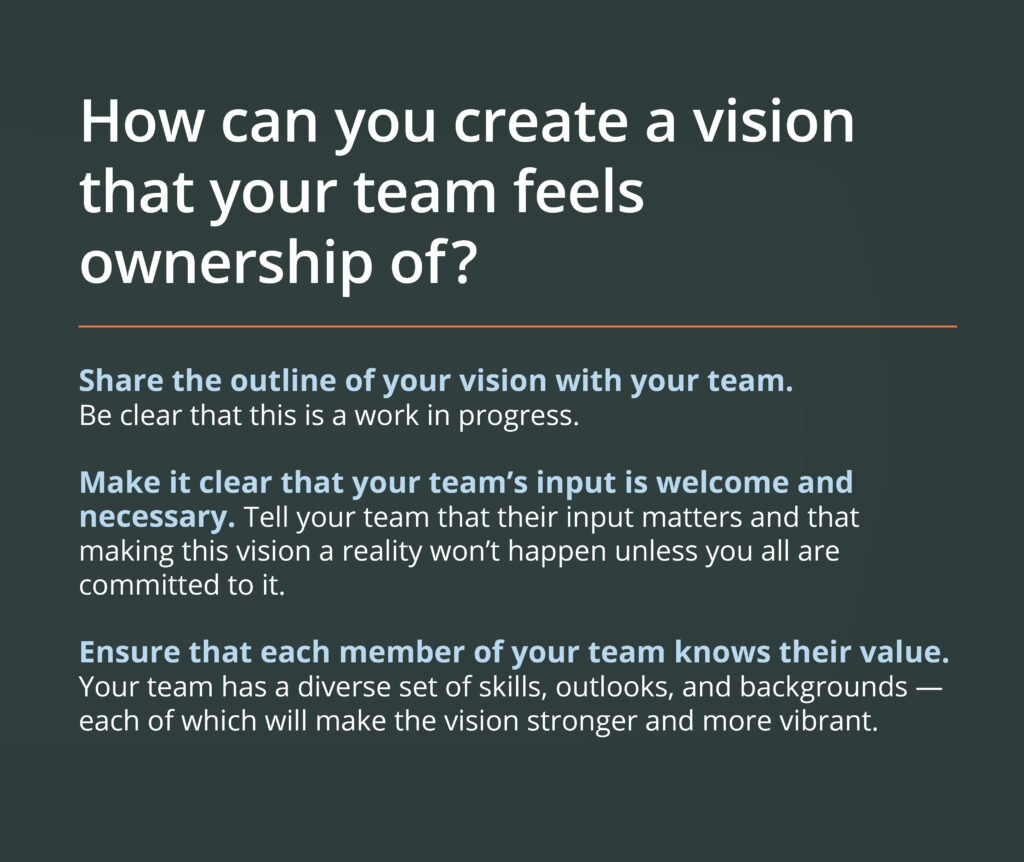
This is where it gets really hard, because you have to mean it. Your team needs to believe that you actually want their input. When they hesitantly offer some thoughts, it’s important to thank them, especially if this is a shift for you and how you do things. It won’t be easy, but giving a little ownership goes a long way in creating a team who is committed to your dream.
Those on your team who implement the vision must buy into it, it is that simple. Without the buy-in of your team, the vision will go nowhere. It is sheer pragmatism. Your team will get that.
Evolve Your Vision for Success
Armed with the philosophy of why it is important to get the input of the team, you now need to put it into practice.
1. Depending on the size of your team, share your vision and have a brainstorming session.
If your team is large, consider having several groups meet separately to gather feedback. Then have the team leaders of these groups gather with you to discuss the feedback they have received.
2. Go back and redraft your vision using the input you’ve received.
You might consider having someone else redraft the vision, but since it is your vision and you are the team leader, you might want to do the redrafting. Input is good, but you are still the team leader and you still have to buy into the vision.
3. Share the redrafted vision with your team. What is good about this new version of the vision? What could be improved?
Gather their input again and redraft the vision. After a few rounds of this, you need to declare victory and make the vision final — at least final for now.
By this point, you should have a group of people who have passionately bought into the vision. They are ready to take any hill or go through any obstacle. After all, it is not just your vision, but it is now also their vision. Isn’t that what you want, a group of people passionate about the vision, locking arms together to do whatever it takes to make the vision become reality?
Reflection
What ways can you be more proactive in sharing your vision with your team?
Have you gathered your team’s input and included them in the process of setting the vision?
How are you giving your team ownership of the vision?
To explore Beyond the Crucible resources, including our free Trials-to-Triumphs Self-Assessment, visit beyondthecrucible.com.
Enjoy the show? Leave a review on your favorite podcast app and leave a comment at our YouTube channel. And be sure subscribe and tell your friends and family about us.
👉 Take the free Trials-to-Triumphs Self-Assessment to discover where you are on your journey of moving beyond your crucible and how to chart your personal course to a life of significance: https://beyondthecrucible.com/assessment/
On Saturday, June 8, 23-year-old Ashleigh Barty won the French Open Tennis Championship. She is the first Australian to win the French Open in more than 45 years.
What is amazing about Barty is that she is only 5’5” in an era where many of the great women tennis players are closer to 5’10”. Despite the height disadvantage, she has one of the stronger serves on tour. She wins matches with a combination of her serve, her groundstrokes, her variety, and her never say die attitude. But it is also her character and the backstory that make her Championship win at the French Open so compelling.
Barty is of Aboriginal heritage, the first Aboriginal tennis player since the great Evonne Goolagong. Barty has said that it would be “amazing to get more kids enjoying tennis across Australia within indigenous communities.”
Barty was one of the top junior players when she took a break after winning junior Wimbledon in 2011. She was burnt out and had lost her passion for the game. She took a three-year break and when she came back to tennis, it was on her terms. As one writer put it, “The bravest decision Ash Barty ever took was to walk away from the thing she did the best.”
Ben Crowe, a professional mentor and leadership coach to sports stars and corporate leaders who has worked with Barty, says, “For me, her humility, her gratitude, her respect, and her acceptance are her greatest attributes. Her goal is to be a good person and, with that foundation, go after her dreams. That is 100% authentic. She will always have that humility and respect, rather than getting caught up in ego and pride.”
Not only is Barty authentic and grounded, she has no fear. Earlier this year, before her recent success, Barty told a press conference that she fears nobody in women’s professional tennis. When asked about this, she paused, and with an intensity in her eyes, she replied forcefully, slowly, and quietly, “Fear won’t get you anywhere, mate.”
Ash Barty embodies the ideal of the great Australian cricketer, Sir Donald Bradman – a person who is a decent individual and competitor. He said, “When considering the stature of an athlete or for that matter any person, I set great store in certain qualities which I believe to be essential in addition to skill. They are that the person conducts his or her life with dignity, with integrity, with courage, and perhaps most of all, modesty. These virtues are totally compatible with pride, ambition, and competitiveness.”
Lessons from Ashleigh Barty
Stay Courageous: When Barty says she fears nothing, it does not seem arrogant. The key is to have your identity in something more transcendent — something other than the pursuit of your goal or vision — while at the same time giving it your all.
Have Strong Character: Character is everything. Having a mixture of humility, gratitude, and respect is important, as is being authentic. As you are fearlessly pursuing your dreams, keep them in perspective — be grounded and know who you are.
Ash Barty is a great role model, not only for young aspiring tennis players, but for all of us. Pursue your dreams without fear, but know who you are and stay grounded. After all, it is this that has proved a winning combination for Ash Barty.
To explore Beyond the Crucible resources, including our free Trials-to-Triumphs Self-Assessment, visit beyondthecrucible.com.
Enjoy the show? Leave a review on your favorite podcast app and leave a comment at our YouTube channel. And be sure subscribe and tell your friends and family about us.
👉 Take the free Trials-to-Triumphs Self-Assessment to discover where you are on your journey of moving beyond your crucible and how to chart your personal course to a life of significance: https://beyondthecrucible.com/assessment/